Choose a stone, name what you want in the present tense as though it has happened, keep the stone where your hands will find it, and go back to the sentence. Whether that is the right practice at all depends on the tense.
Set the two standard instructions beside each other and they do not match. Manifestation practice tells you to speak of the thing as already done. I am earning this. Intention practice tells you to name what you are cultivating, which stays open-ended. I am becoming someone who does the difficult call first. One sentence is closed and the other is not, and that single grammatical difference runs deeper through the two practices than any of the stone lists suggest.
One sentence is fixed, the other is renewable
A manifestation sentence describes an end state, so it has exactly two futures. It arrives, or it does not. There is no version of it you can update in month four without the update feeling like a retreat, because any change to the sentence is a change to the thing you said you were getting.
An intention has a third option, which is renewal. Say it again next month and it is not a smaller version of itself, it is the same sentence said again. That is the whole reason intention practice has a restatement cycle built into it and manifestation practice does not.
Here is the position that follows. For anything that will run longer than a season, use the renewable sentence. Set the intention rather than the manifestation. Wanting the outcome is neither greedy nor naive; the difficulty is that a closed sentence has nowhere to go across eight months and an open one does. Practices that cannot be revised get quietly abandoned instead, and the abandoning takes the stone with it.
The other place the closed sentence struggles is when it names something another person decides. A hiring manager, a landlord, someone who has stopped calling. You can write that as an end state, and people do, but you are then holding a sentence whose one permitted update is somebody else’s answer. Aim at the part that is yours and the sentence becomes sayable again.
None of this asks more of you. Most of the apparatus around manifestation, the lunar timing and the numbered steps, can go, and a sentence and a stone you handle is what remains. The intention version, with the stones usually chosen for it and the grammar rules in full, is in how to set intentions with crystals.
Running the manifestation version properly
Plenty of outcomes are largely yours to move, and for those the closed sentence is the right tool. It is a short practice.
- Name one thing, in a sentence you would be willing to say out loud to somebody who knows you well. Say it out loud before you commit to it. Four seconds.
- Put it in the present tense and the first person, since that is the rule the whole practice runs on.
- Keep the stone where your hands already go. A coat pocket, or the shelf by the kettle. The prettiest spot in the room stops being visible in about a week.
- Choose one evening a week to reread the sentence. Pick one that is reliably quiet, and put a reminder on it.
Then do the work the thing requires.
Why these three stones and not others
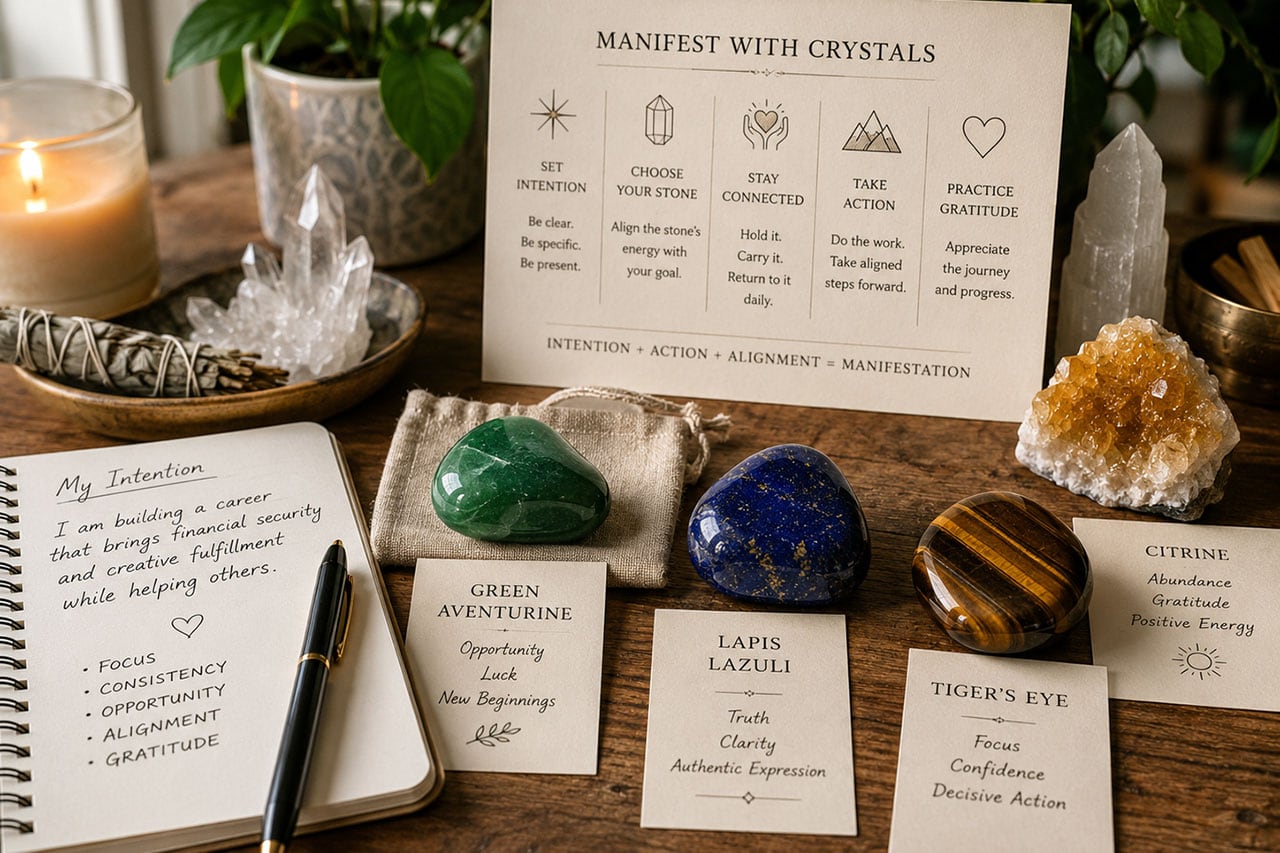
Green aventurine is quartz or quartzite holding flakes of fuchsite, a green chromium-rich mica. Those flakes give it both the colour and the faint internal glitter, an effect named aventurescence after the stone. Practice puts it with opportunity and good luck, the receptive end of the money associations rather than the pushy end.
Lapis lazuli is not a single mineral. It is a rock, coloured deep blue by lazurite, usually carrying small amounts of white calcite and brassy crystals of pyrite, and its most important source is Badakhshan in north-eastern Afghanistan. Practice hands it the intentions about being understood accurately, which is why it turns up attached to speaking and writing.
Tiger’s eye is a quartz shot through with parallel fibres. Light reflecting off those fibres in ranks produces the moving band across the surface, which gemmologists call chatoyancy. Practice gives it decisiveness and staying power, and files it with goals that need you to keep turning up rather than to have one good idea. Knowing what each of the three is turns out to help about as much as knowing what it is asked to do.
Read those three associations together and the sorting principle becomes visible. It is colour. Green and gold for money, blue for being heard, warm brown for holding your nerve. Saying so is not a knock on the lists, because it means you can extend the logic yourself when a list has nothing on it that fits. Gratitude gets sorted the same way, which is how citrine ended up carrying it, and the longer history behind citrine and money specifically is in does citrine attract money.
Each of those stones has its own entry in the Crystalance Mineral Library, covering the chemistry and the localities.
Write the sentence down somewhere you will come across it by accident, and set the weekly reminder before you do anything else. Both take under a minute.
Sources
- Aventurine as translucent quartz or quartzite with flake-shaped inclusions, most commonly fuchsite, a green chromium-rich mica, producing the sparkle known as aventurescence: Geology.com, Aventurine.
- Lapis lazuli as a rock rather than a mineral, coloured by lazurite with small amounts of white calcite and pyrite usually present, its most important source the mines of Badakhshan in north-eastern Afghanistan: Britannica, Lapis Lazuli.
- Tiger’s eye as quartz containing parallel fibrous inclusions that act as microscopic reflectors, producing a bright moving band: Geologyscience, Tiger’s Eye.