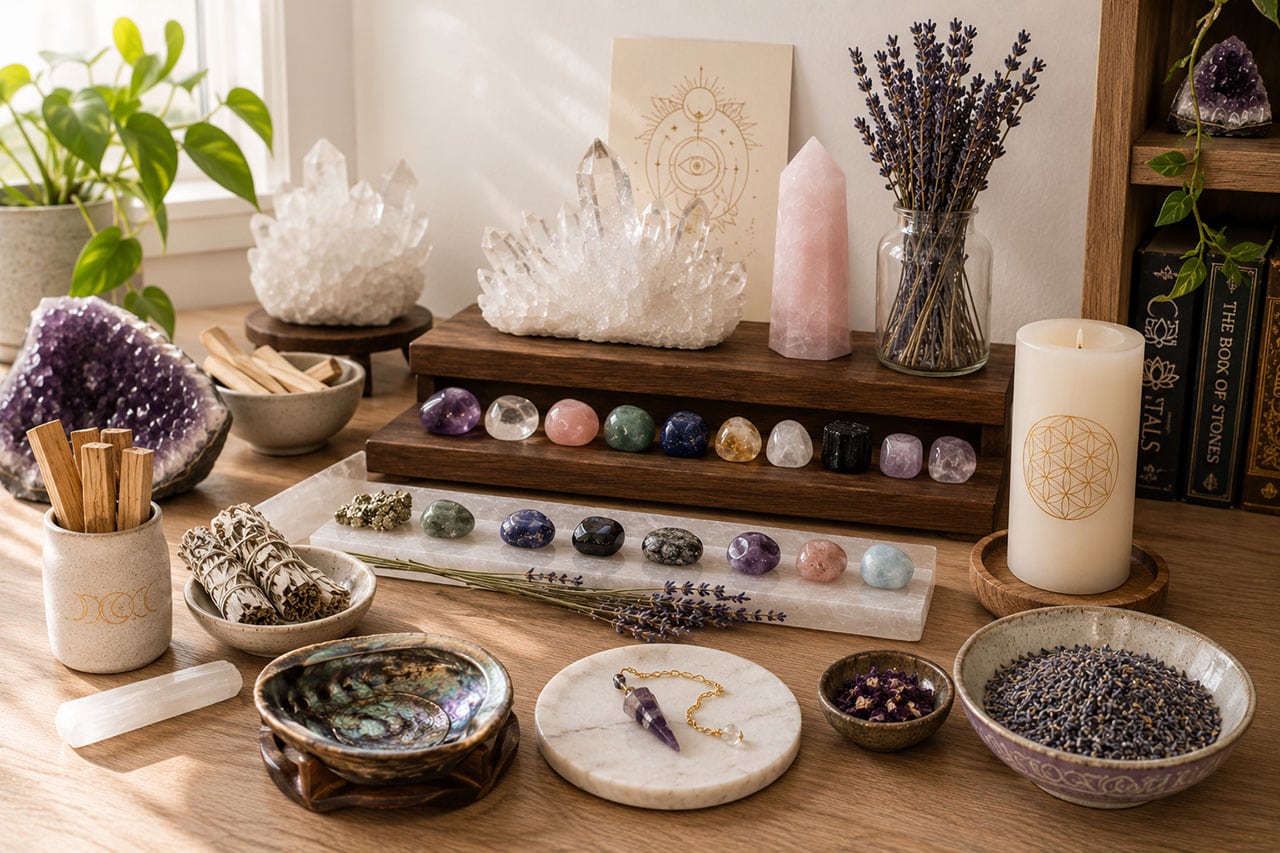
Pick a surface you already walk past, name what the altar is for, put one stone at the centre with a few around it, then add a light and something that will need replacing. After that, go back to it.
A Roman household kept a shrine to the Lares, the gods of the house, and a prayer was said to them every morning, with fuller offerings at family festivals. A Mexican ofrenda carries photographs of the dead, food, marigolds and candles. Neither of those is a crystal altar and neither one led to it.
They are the same object all the same. The shelf is much older than anything you would put on it, and people have had a very long time to work out what a household altar needs. The answers they settled on turn out to be the answers to nearly every question people ask about setting one up.
The shelf is older than the crystals
Set those two examples beside each other and four things line up.
There is a focal object that stays put and is not moved for convenience. There is a light, lit at the start and put out at the end, which marks the difference between passing the shelf and attending to it. There is something perishable, flowers or water, which has to be replaced and therefore forces a return. And there is a schedule, whether that is the Roman prayer every morning or the ofrenda built for particular days.
Nothing here says a crystal altar descends from either of them. It does not. The traditions are separate and the resemblance runs, at most, through the general shape of a domestic shrine rather than through any line of transmission. What two well-documented examples can tell you is what a household altar has tended to need, and on that evidence these four are worth having.
Set the four against the usual crystal altar and the gaps show up immediately. Most home altars people describe have the focal object and the supporting objects. Rather fewer have the light. Very few have anything perishable on them, and almost none have a schedule. Those last two are what separate a working altar from a nice arrangement of stones, and they are also the two that cost nothing to add.
What goes on it
A working starter altar has five things on it, and it fits on a surface the size of a book.
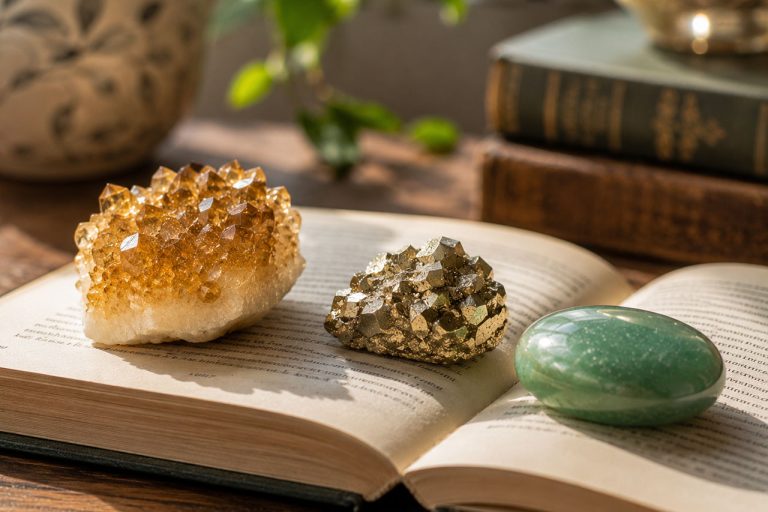
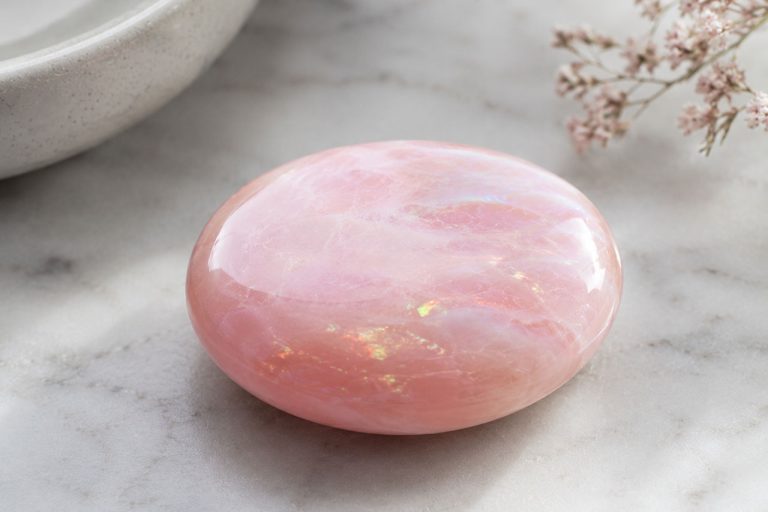
- One stone sits at the centre and carries the altar’s purpose. Clear quartz is the usual first choice because it has no strong colour association of its own, which is why practice hands it whatever intention you have. Amethyst, rose quartz, citrine and black tourmaline are the other common anchors, associated in practice with calm, self-compassion, abundance and protection respectively.
- Two to four supporting stones sit around it, chosen because they belong with the centre rather than because you own them. Beyond four the eye stops reading the arrangement as a whole. The question of which stones sit well together, and why some pairings fight, is worked through in can you wear multiple crystals at once.
- A candle gives you the light. Lighting it before you sit and putting it out afterwards is a small piece of theatre, and marking a moment off from the ordinary minutes on either side of it is what the theatre is for.
- Something perishable goes on next, a shallow bowl of water or a single flower. This element gets left off a lot, and it is the one that quietly runs the whole thing, because it will die if you ignore it and that is precisely the point.
- A written intention, folded small and tucked under the central stone, finishes it. Writing the sentence by hand is part of the practice rather than a decoration on it.
Photographs, inherited objects, religious items and things picked up on a walk all layer onto that structure without disturbing it.
Setting it up
Choose the surface first, and choose it for traffic rather than for beauty. A shelf in the hall you pass eleven times a day beats a lovely corner of a room you enter twice a week. It also has to be somewhere nothing gets knocked, which rules out most kitchen counters and every windowsill a cat uses. There is more on where stones do and do not sit well around a house in where should you place crystals in your home.
Wipe the surface down before anything goes on it. Then say what the altar is for, out loud, before you place the first stone. Be specific. An altar for holding your nerve through a particular six months is a workable thing. An altar for good energy is a sentence rather than a practice.
Place the central stone, then the supporting ones, then the ritual elements. Sit with the finished thing for a few minutes. That first sitting is the altar starting rather than a ceremony you have to get right.
Chakra altars, healing altars and grids
A chakra altar is built around what the practice calls the energy centres of the body. Either it focuses on one, with three to five stones associated with that centre, or it lays out stones for all of them in a vertical column, lowest at the bottom, and that fuller version works better as something you sit in front of than as something you glance at in passing.
A healing altar narrows to a specific emotional or recuperative intention, and tends to carry more of the perishable element than a general altar does. Rose quartz, rhodonite and smoky quartz are the stones most often on one.
A shrine is an altar with devotional or ancestral weight, where the stones serve the focus rather than being it. The boundary between the two is soft and nobody polices it.
A crystal grid is a geometric arrangement, a central stone with others radiating out in a pattern, either sitting on an altar or occupying its own surface. On the question people always ask, practitioners hold that a grid lasts as long as its intention is live and the pattern is undisturbed. Some are built for an afternoon and some stay up for a year. Nothing in the arrangement is held to run out on a timer. That is the short version, and the grid form needs a piece of its own rather than a paragraph at the end of this one.
Keeping it
Altar stones sit touching each other for months at a time, which is not something a drawer or a pouch asks of them. The soft ones take the damage. Selenite is gypsum and sits at 2 on the Mohs hardness scale, and a selenite wand leaning against a quartz tumble for a season comes away scuffed. Half a centimetre of space between pieces solves it entirely.
Dust settles on everything and it dulls a polished surface. A soft brush every few weeks is enough. Change the water and replace the flower as they need it, and take the whole thing apart three or four times a year to clean the shelf and rebuild it around whatever you are working on now, because an altar that has not changed in two years has stopped being looked at.
The mineral behind every stone on that shelf is what the Crystalance Mineral Library gives its space to.
Start with three stones, a candle and a glass of water on a shelf you already walk past. If the water is still clear in a fortnight, you have been visiting it.
Sources
- The Lares as Roman household deities, with a prayer said every morning and special offerings at family festivals: Britannica, Lar.
- The ofrenda as a Day of the Dead altar set up to welcome and honour the deceased, decorated with photographs, food, marigolds and candles: Britannica, Ofrenda.
- Gypsum as calcium sulfate dihydrate with a Mohs hardness of 2, and selenite as a variety of gypsum: Geology.com, Gypsum.