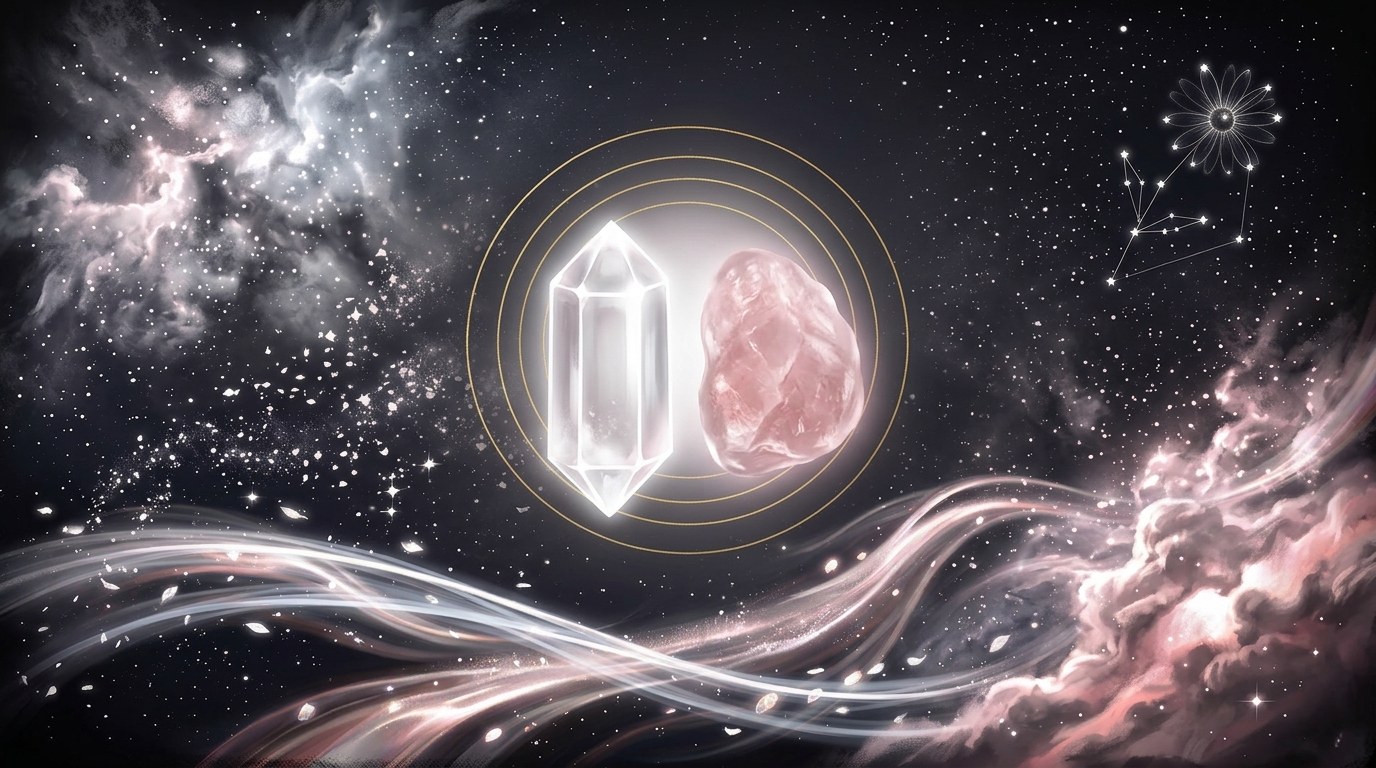
Clear quartz works beside almost any stone, but not because it is agreeable. The stone has no direction of its own. Crystal practice treats it as an amplifier, so pairing it turns up the volume on the other stone. Add it when you want more.
Pair clear quartz with rose quartz and the rose quartz gets louder. Pair it with black tourmaline and the tourmaline gets louder. That is the whole trick, and it pays to understand before you pick a single combination, because clear quartz behaves unlike any other stone in a pairing. Most stones bring a character. Clear quartz brings a multiplier.
In crystal practice it is called an amplifier, a stone held to strengthen whatever sits beside it without contributing a flavour of its own. The useful question, then, is never really what clear quartz goes with. It is what you already have that you would like more of.
What amplifying means here
When you set clear quartz next to another stone, practice holds that you are not blending two energies, you are raising the intensity of one. Rose quartz becomes more openly warm. Amethyst becomes more deeply calm. Black tourmaline becomes more firmly protective. The direction stays exactly where it was. Only the dial moves.
That cuts two ways, and both are useful. If a stone’s effect feels too faint or too slow to notice, clear quartz is the standard way to bring it forward. If there is a stone whose character you are sure of and simply want more of, the same move applies. The one time to leave it out is when a combination already feels like enough, because more is not always the thing you want.
There is a second job practice gives it, closely related. Clear quartz is one of the stones most often used to hold an intention, a conscious aim you set while holding the stone, which is why it turns up at the centre of so many crystal grids and laid-out arrangements. It does not push an agenda of its own into that intention. What it holds is the one you brought.
The pairings you will reach for
A handful of clear quartz pairings come up again and again, and each is the amplifier doing its one job on a different partner. With amethyst it makes a combination people set out for meditation and sleep, deepening the calm the amethyst already carries. With rose quartz it is gentler, a warmer pairing for self-kindness and emotional repair, and it is the easy fix for anyone who finds rose quartz on its own a little too faint to feel.
Protection is where it earns its keep for a lot of people. Black tourmaline is already the stone practice reaches for to guard a space, and clear quartz makes that guarding more pronounced, which is why the pair ends up near doorways and in rooms that see a lot of coming and going. If your aim is a bright, forward, get-things-done corner instead, clear quartz with citrine is the version of that, sharpening citrine’s warmth and optimism.
A partner to approach carefully
One combination rewards slowing down. Obsidian, a volcanic glass that practice treats as heavy and revealing, gets a good deal stronger with clear quartz behind it, and that is not always what a beginner bargained for. More surfacing of what is buried, more of obsidian’s confronting quality. For someone deliberately doing that kind of inner work it has a place. For everyday carrying it is more than most people need, and there is no failure in deciding the plain stone was enough.
Living with clear quartz
Clear quartz is one of the easier stones to own. It sits at seven on the Mohs scale of mineral hardness, so ordinary handling does not mark it, it takes water without trouble, and it does not fade in sunlight the way some coloured stones do. The one caution runs the other way. At hardness seven it can scratch softer stones stored against it, so a clear quartz point loose in a pouch with selenite or fluorite is a slow problem for the softer piece.
It also has a reputation, in practice, for keeping other stones fresh rather than needing much attention itself, which is why people rest other crystals on or beside a clear quartz cluster. Whether or not you hold with that, the underlying point is real enough: it is a low-maintenance stone. A rinse under the tap when it looks dull and the occasional few hours in daylight are all the upkeep it asks of you.
For the full range of quartz, including how to tell natural clear quartz from glass, the Crystalance Mineral Library has it in detail, and if the stone you keep confusing it with is selenite, clear quartz versus selenite sorts the two out.
Sources
- Mineralogical Society of America, Mohs Scale of Hardness: http://www.minsocam.org/msa/collectors_corner/article/mohs.htm