You can scratch selenite with a fingernail.
Clear quartz will scratch glass. That gap, 2 against 7 on the Mohs hardness scale, is about as wide as it gets between two stones that look this much alike, and it is not a trivia point. The standard advice to cleanse a crystal under running water is fine for quartz and quietly ruins selenite.
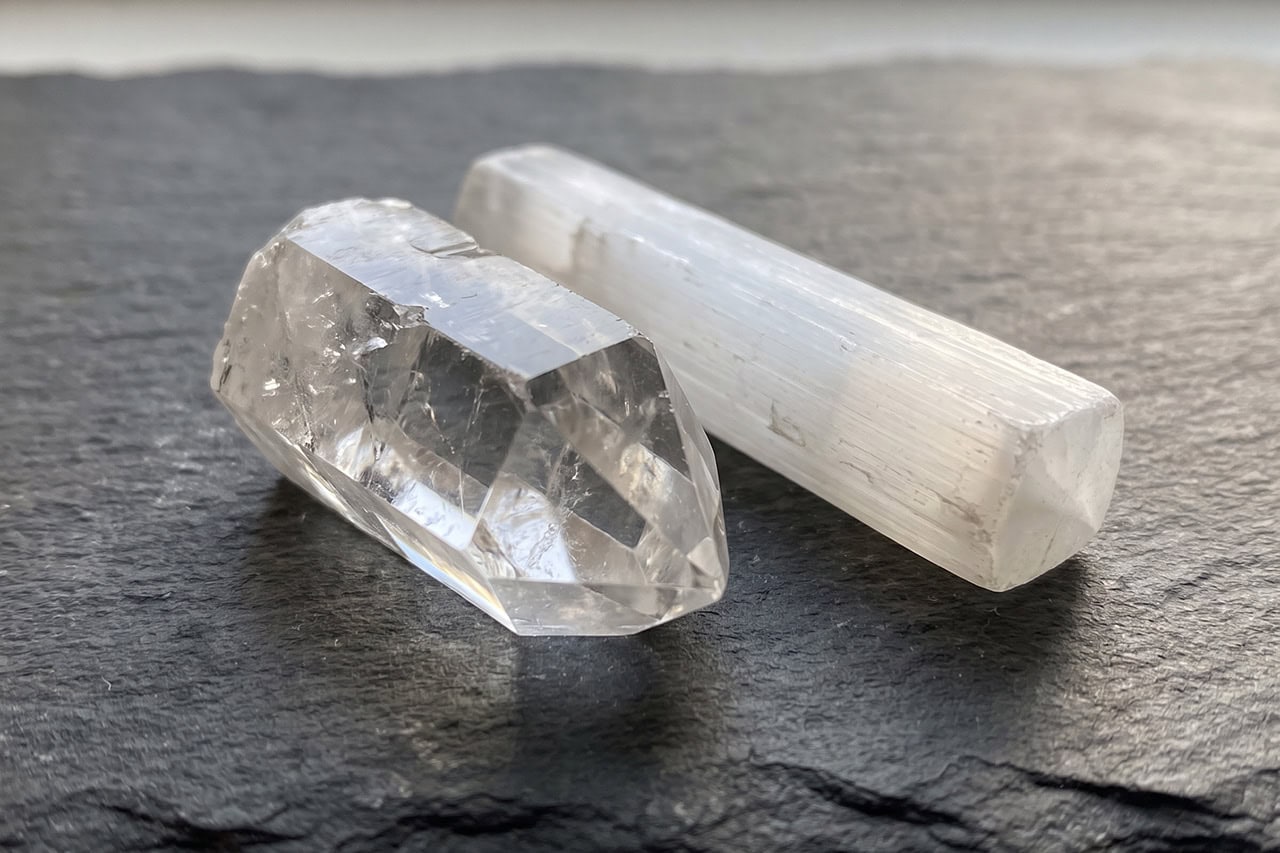
The two really do look close. Both are pale, translucent and glassy enough that beginners group them together. They are unrelated minerals with opposite practical properties.
The scratch test
Pick an inconspicuous spot and try to scratch the stone gently with a fingernail. If it marks, you have selenite, or something else very soft. If your nail does nothing, it is quartz or something in that hardness range.
Glass works as a second check. Quartz scratches glass and selenite does not come close. That is worth knowing for its own sake, because people do ask whether clear quartz is just glass. It is not. Quartz is a natural crystal with an ordered atomic structure and a hardness of 7, while glass is amorphous and softer, which is why the scratch only goes one way.
What each one actually is
Clear quartz is silicon dioxide, part of the quartz family and one of the hardest common minerals. It is glassy, often fully transparent, and it frequently grows sharp six-sided points.
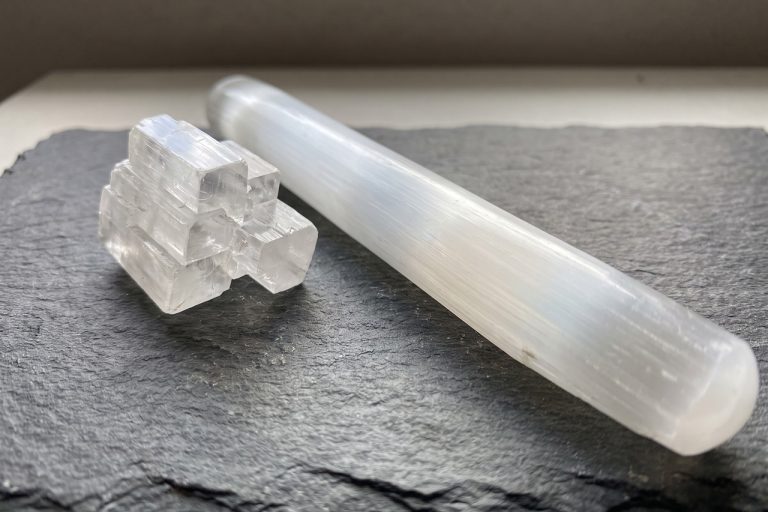
Selenite is a variety of gypsum, calcium sulphate, and one of the softest minerals you will ever handle. It looks pearly or satiny rather than glassy, and it forms tabular crystals or those fibrous, glowing wands you see everywhere. Those wands are usually satin spar, which is abundant and easy to shape into towers, and that is why selenite tends to be cheap while clear quartz prices swing with clarity and size. We cover the stone in detail in what selenite is good for, and the muddle between selenite and its own fibrous form in selenite vs satin spar.
The look is where the similarity ends. One of these sits near the top of the hardness range for common stones and the other near the bottom, and nothing about their appearance tells you that.
Other things to check
Beyond hardness, a few cues confirm what the fingernail told you:
- Quartz feels denser and cooler in the hand. Selenite comes up light for its size.
- Clear quartz is glassy and often genuinely transparent, while selenite reads pearly or milky, and the wands have a soft fibrous sheen rather than any real clarity.
- Shape gives it away. Quartz commonly grows as six-sided prisms ending in a point, and selenite never does that. It forms flat tabular blades or fibrous columns instead.
- Both show striations, but running in different directions. Selenite’s fine fibres run lengthwise, and quartz’s run horizontally across the faces.
Water and care
Quartz is tough and water-safe. Rinse it, soak it, handle it however you like.
Selenite is slightly water-soluble. Water clouds it, flakes it and eventually dissolves it, and because the stone is soft and scratches easily to begin with, it has no margin to spare. Keep it out of water, keep it out of humid rooms, and cleanse it dry. For the wider list of stones with the same problem, see which crystals should not be put in water.
Do they do the same thing?
Their reputations overlap, which is part of why they get muddled in the first place. Both are associated with clarity, cleansing and amplifying intention.
The emphasis differs. Clear quartz is the all-rounder, the “master” stone people reach for to amplify, program and pair with almost anything. Selenite leans specifically toward clearing and calm, and it has a reputation as a stone that cleanses and resets other stones, which is why it is sold as wands and charging plates. And yes, you can use it on quartz. Resting other stones on or beside a piece of selenite is one of its most popular uses, and hard quartz is entirely unbothered by soft selenite.
They are still not interchangeable. Quartz is the workhorse, and selenite fills a narrower niche, provided you keep it dry.
Which should you own?
For a first stone, clear quartz. It is hard, water-safe, versatile and difficult to damage, which is forgiving while you are still working out how you like to use crystals. Selenite is lovely and luminous, especially for cleansing and calming, but it asks more of you: keep it dry, keep it from knocking against harder stones, handle it gently.
Plenty of people end up with both, quartz as the do-anything piece and selenite as the dedicated cleanser on the shelf. If you own both, the rule to get right is water. For more on either, see the Crystalance Mineral Library.