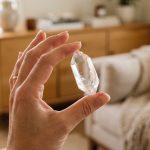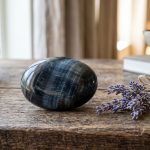
Yes, and celestite belongs in a bedroom. What it will not do is take part in the way sleep advice assumes you will use a stone. Keep the cluster where you can see it, and buy a small tumbled stone for anything involving your hands.
Read a list of sleep crystals and count how many of the instructions need your hands. Hold it while you slow your breathing. Put it under the pillow. Move it to the windowsill in the morning. Turn it over while you settle.
Celestite is on those lists, and it is the one stone there that cannot do a single one of them. Not because it is fragile, though it is. Because of the shape it arrives in.
What you have got on the nightstand
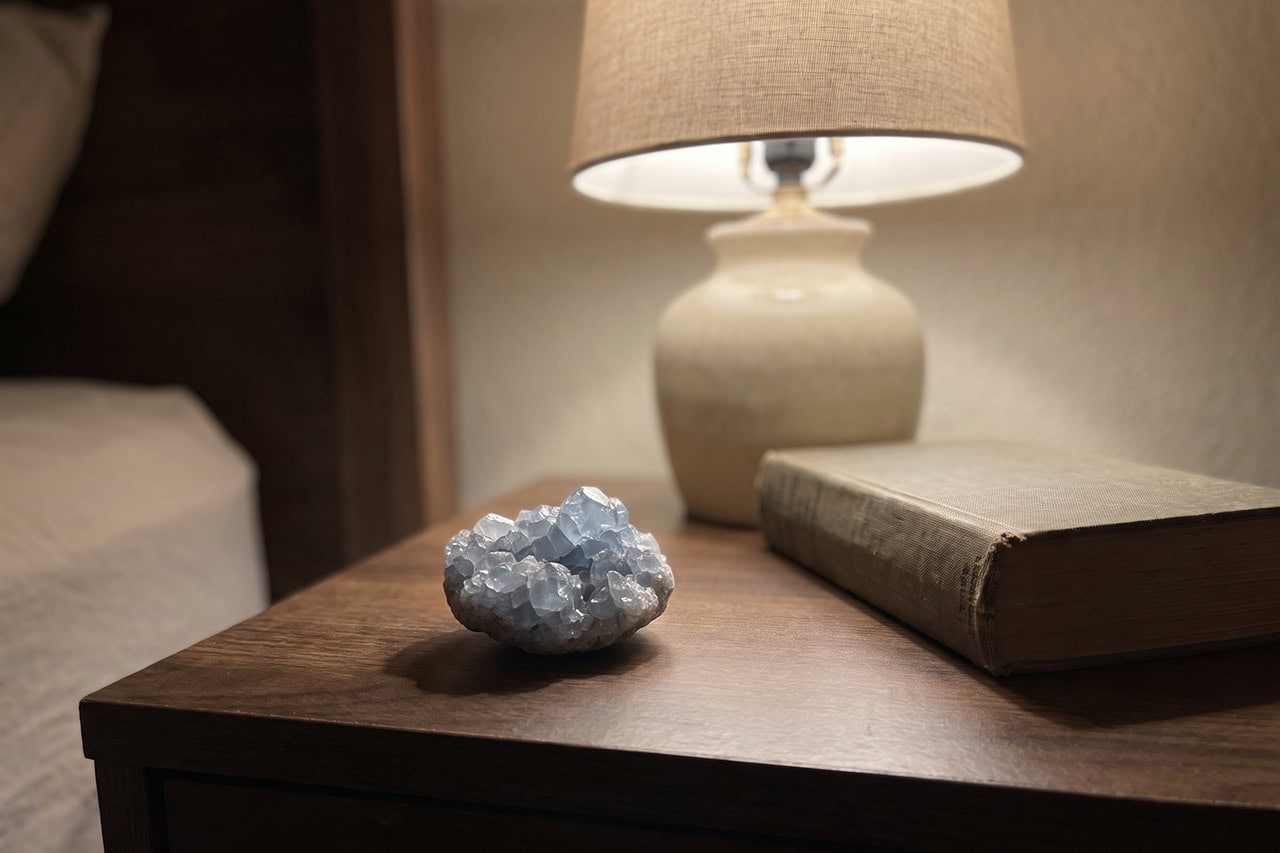
The celestite sold for bedrooms is a geode half or a broken-open cluster, pale blue crystals standing up out of a grey shell, usually somewhere between a fist and a dinner plate. That is simply what the mineral does. The Handbook of Mineralogy gives celestine, the mineral’s formal name, as strontium sulphate, orthorhombic, with well formed crystals that are typically thin to thick tabular, occurring as fissure and cavity fillings precipitated by migrating strontium-bearing groundwater. A cavity filling grows into open space. Open space is why you get a cluster instead of a pebble.
The hardness is 3 to 3.5 and there is one perfect cleavage direction, on the crystal’s flat face, which in ordinary terms means a set of keys in the same drawer will mark it and a bad knock splits a crystal along that face rather than chipping a corner off it. That is the fact most articles about celestite lead with, and it is the least useful thing you can know about the object.
Here is the useful thing. A cluster has a front. It sits one way up, it is meant to be looked into rather than gripped, and the blue that is the entire reason anyone chooses celestite over the other pale minerals only shows properly when light crosses the crystal faces at an angle. Close your hand around it and you have put away the part you paid for.
The sleep methods were written for tumbles
Think about what crystal practice asks of a sleep stone. It asks you to have it on you or near you at the moment you stop being busy, so that picking it up is the signal that the day is finished. The stone is doing the work of a cue. That is why the instructions are all small physical acts, and why they are all written for a smooth closed pebble that fits in a palm and survives being sat on.
A cluster fails every one of those. Under a pillow it is a hazard to itself and mildly to you. In a pocket it loses crystals. Held in the hand it does nothing a pebble would not do better, and the one time you drop it will be the last time it looks like it did in the shop.
None of that makes celestite the wrong purchase. It makes it a different purchase. A cluster on a nightstand is the last object in your eyeline before the lamp goes off and the first one there in the morning, and if you want an argument for why the placement matters at all, the reason objects go beside a sleeping person turns out to be older and stranger than the one usually given for it. Being looked at is a real job, and not one a pocket stone does well.
The one care rule, and why the bedroom already handles it
There is a genuine care question with blue celestite, and the bedroom answers it before you ask.
The National Park Service, in its conservation guidance for geological collections, names the minerals whose colour is at risk from light, and blue celestite is on the list: minerals such as maxixe beryl, blue celestite and some brown topaz can fade. Its recommendation for light-sensitive specimens is that they should not be exhibited and should be stored in closed cabinets. That is written for museum stores holding material for centuries, not for a stone you bought last spring, and the wording is “can” rather than “will”.
Still, it points somewhere useful. A bedroom is usually the dimmest room in a house. The curtains are shut while you are asleep and the lamp is low for a good part of the evening. The placement people worry about, tucked beside a bed rather than displayed on a bright shelf, is closer to conservation practice than a sunny windowsill would be. If your celestite is going to keep its colour anywhere in the house, it is going to keep it there.
The care instruction is short, then. Keep it off the windowsill, keep it out of the drawer with the keys, and otherwise leave it alone. There is nothing else to do.
That leaves the handling half of the practice unserved, and serving it costs almost nothing. Buy one tumbled stone. Amethyst is the obvious partner. Crystal practice puts it in the same lane, and it is quartz at 7 on the Mohs scale, which GIA calls appropriate for daily use in rings and other jewellery, adding that over time it may show wear and require repolishing. GIA’s caution is about light rather than handling, and it comes in one sentence that has to travel whole: though the colour is stable with normal use, this is not a stone to wear to the beach every day. A tumble the size of a walnut costs less than a coffee. Put the celestite where you look and put the tumble where your hand goes, and the practice you read about is suddenly available to you in full.
The Crystalance Mineral Library unpacks the chemistry of both.
Sources
- Handbook of Mineralogy, celestine: SrSO4, orthorhombic, hardness 3 to 3.5, perfect cleavage on {001}, typically thin to thick tabular crystals, occurring as fissure and cavity fillings.
- National Park Service, Conserve O Gram 11/2, Storage Concerns for Geological Collections, April 1998: blue celestite among minerals that can fade; light-sensitive specimens should be stored in closed cabinets.
- GIA, February birthstone: amethyst is 7 on the Mohs scale, “appropriate for daily use in rings and other jewelry, but over time it may show wear and require repolishing”; “some amethyst fades with prolonged exposure to strong light. Though the color is stable with normal use, this is not a birthstone to wear to the beach every day.”