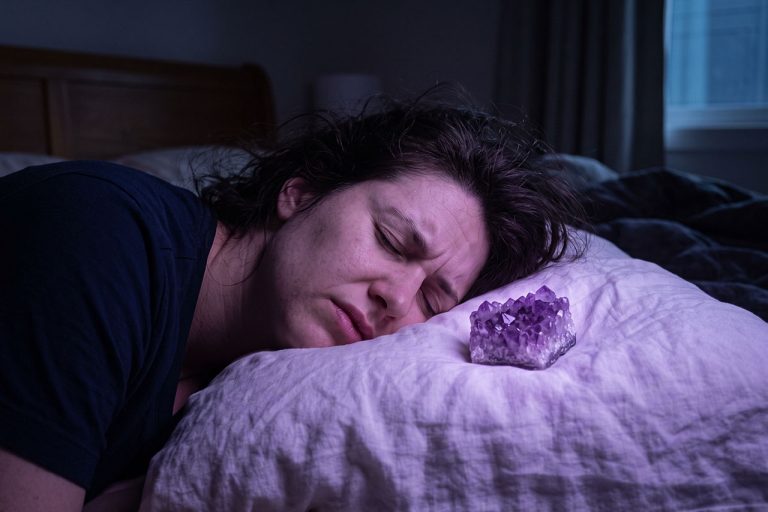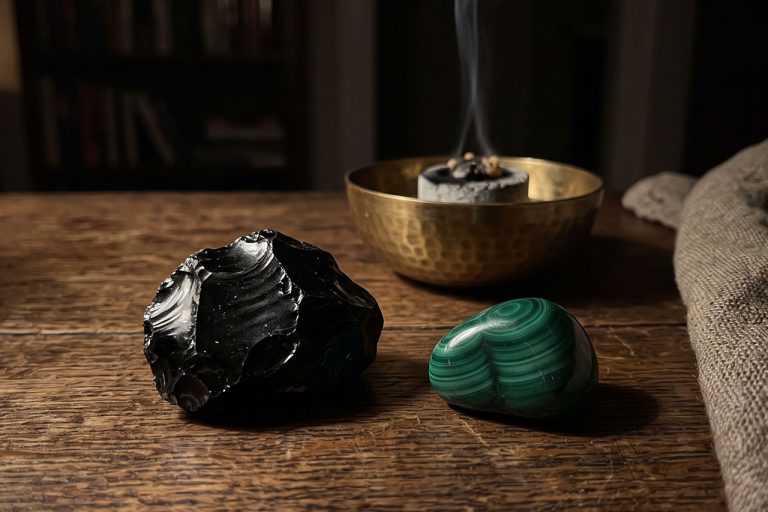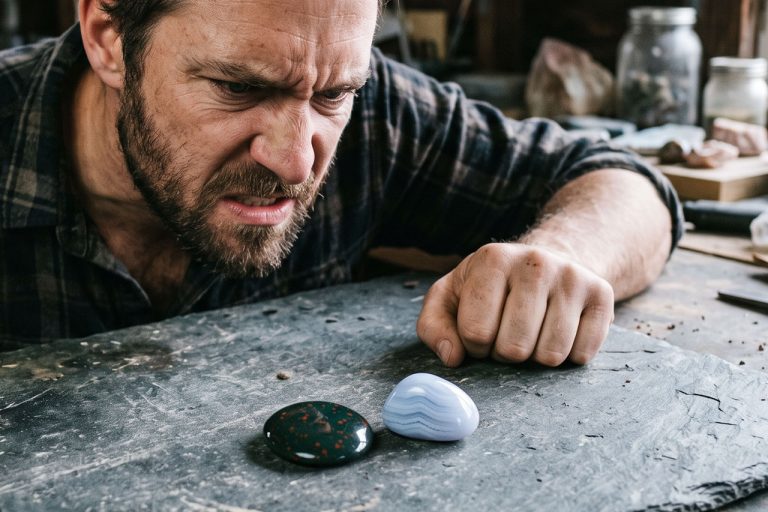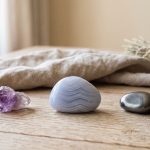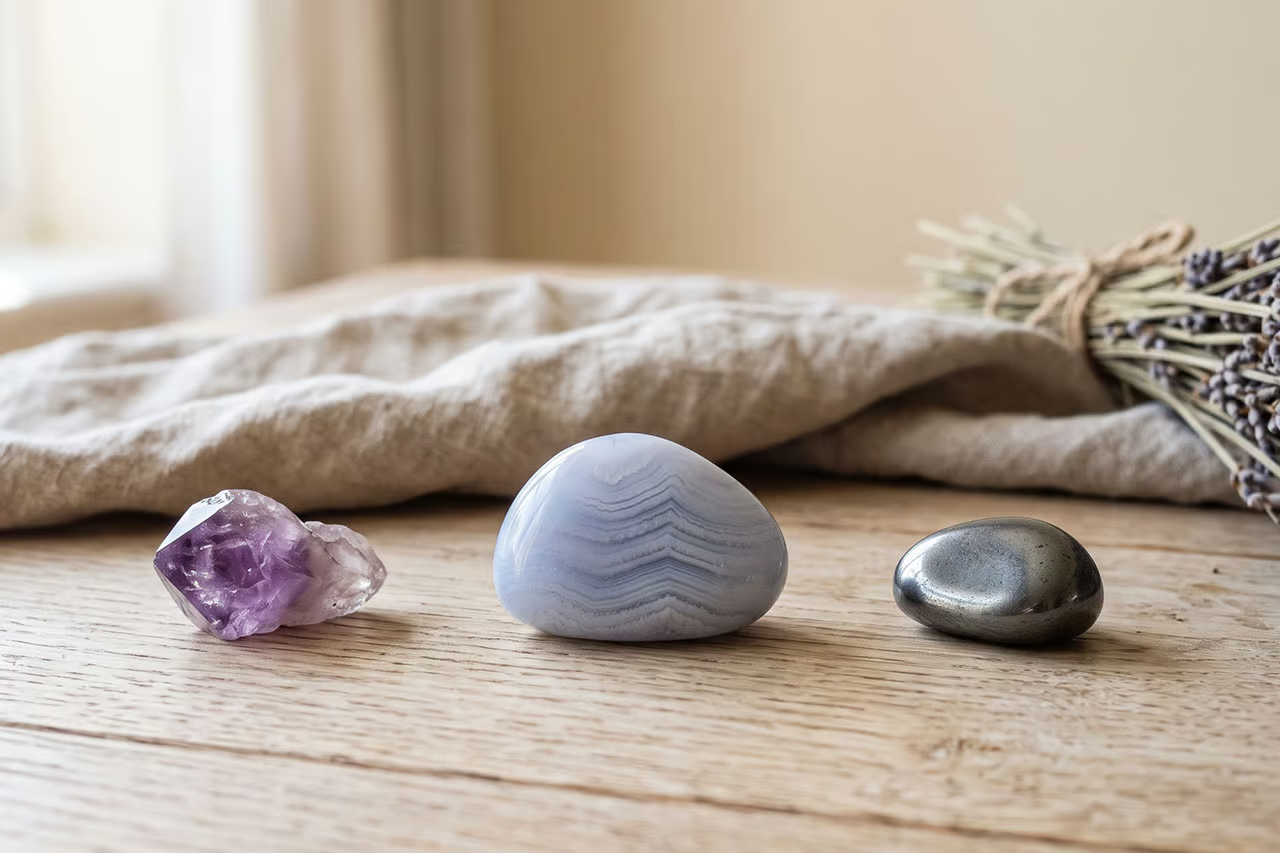
Amethyst, blue lace agate, howlite, lepidolite, aquamarine and selenite are the usual list. Crystal practice places most of them at different heights on the body, and the height tells you which version of peace of mind each was meant for.
Ask where the practice puts them rather than what it says about them and they spread out across the whole torso. Practice sets amethyst up at the brow and above it, puts blue lace agate and aquamarine at the throat, and sends hematite and smoky quartz, which turn up on the longer versions of this list, all the way down to the base of the spine.
Nothing does one job at four different heights. A list that scatters like that is not one answer to one question, it is an index to several, and the indexing was done by the tradition rather than by whoever typed the list.
Three different things people are asking for
Sit with the phrase for a minute and it comes apart into requests that have very little to do with each other.
The first is the loop. It is eleven at night and the same forty seconds of a conversation is going round again, and what you want is for the thinking to stop. The second is quieter and people rarely name it: there is something you have not said, to a colleague or a sister, and the not-saying is what is eating the evening. The third has no event in it at all. Nothing is wrong in particular and nothing will stay still either, and what you want is ground.
Those want different things from you, and the third one especially is not a smaller version of the first. Somebody with a loop needs the volume down. Somebody sitting on an unsaid thing needs to open their mouth, and no amount of quiet is going to substitute. The reason a peace-of-mind stone so often does nothing is that it was bought for the wrong one of the three.
The map the practice already uses to tell them apart
Britannica describes a chakra as one of a number of psychic-energy centres of the body, prominent in the occult physiological practices of certain forms of Hinduism and Tantric Buddhism. It reports a traditional figure of 88,000 of them, of which six located roughly along the spinal cord and one just above the crown are of principal importance, and it notes that Buddhism emphasises four rather than seven. The seven-part version that crystal shops print on wall charts is one tradition’s count, not the only one.
Crystal practice lays its stones onto that map, and this is where the sorting has already happened. You have already seen where they sit. What the map adds is why those positions are not interchangeable. Brow and crown are where the practice locates thought and perspective, which puts amethyst at the loop’s end of the scale. Move down to the throat, the centre it associates with saying the thing, and blue lace agate and aquamarine are pointed at the second request rather than the first. The base of the spine is as far from the loop as the map goes, and that is where hematite and smoky quartz sit. Howlite and lepidolite live next door to amethyst in the settling-the-head lane. Selenite the practice uses for rooms rather than for bodies, so it turns up on this list and then never gets a placement, and knowing that before you buy one saves you carrying it around waiting for something to happen.
Nothing here says what happens inside you when you hold one. The claim is about how the practice has organised its own material, and you can check that against any shop or any chart. What the wall charts get right, the shopping lists then flatten, which is a habit worth knowing about and which comes up again in what crystals help with anger.
Choosing without buying six stones
The position, then. A six-stone peace-of-mind set is a worse buy than one stone picked for the right request, and not because sets are a rip-off; they are usually fine value. Buying the set is what lets you skip the only question that decides anything.
Work out which of the three you are in, then buy for that one. Amethyst is the obvious first purchase for the loop, with howlite as the cheap equivalent in the same lane. The unsaid thing wants blue lace agate, and the point of it is not that the stone will make the conversation easier. It sits at your throat where you keep noticing it, and that makes the thing you have not said harder to go on not thinking about, which is a different sort of use from a calmer evening. Ground is the one where the instruction is plainest. Go low and go heavy, and a hematite tumble in a coat pocket is the whole of it.
One stone, one request. When it stops matching, and it will, because the three rotate, that is the moment to buy the second one. Coming to it that way you will end up with three or four stones over a couple of years, each bought for a reason you can still remember, which is a better collection than six bought in an afternoon. The broader question of what to reach for when the trouble is closer to anxiety than to any of these sits in what crystals help with anxiety and calm.
The sorting was already done, and in a lot of the shops selling the bag of six it is hanging on a chart behind the till. The Crystalance Mineral Library arranges the same stones the other way round, by mineral rather than by mood.