Crystal beauty is really two practices wearing one name. Face rollers and gua sha tools are massage, and they do the small, temporary things massage does. Gemstone essences, stone-soaked water you drink, are the half with a genuine safety rule, because several popular stones are not safe in water.
Put a jade roller and a little bottle of stone-soaked water side by side and they look like two parts of the same routine. They are not. One is a cool object you move across your skin, and the worst it can do on a bad day is nothing at all. The other is water you are about to drink, and depending on which stone sat in it, that is a different kind of question entirely. The beauty shelf files both under crystals for your skin. It helps to pull them apart before you start.
What face rollers and gua sha tools do
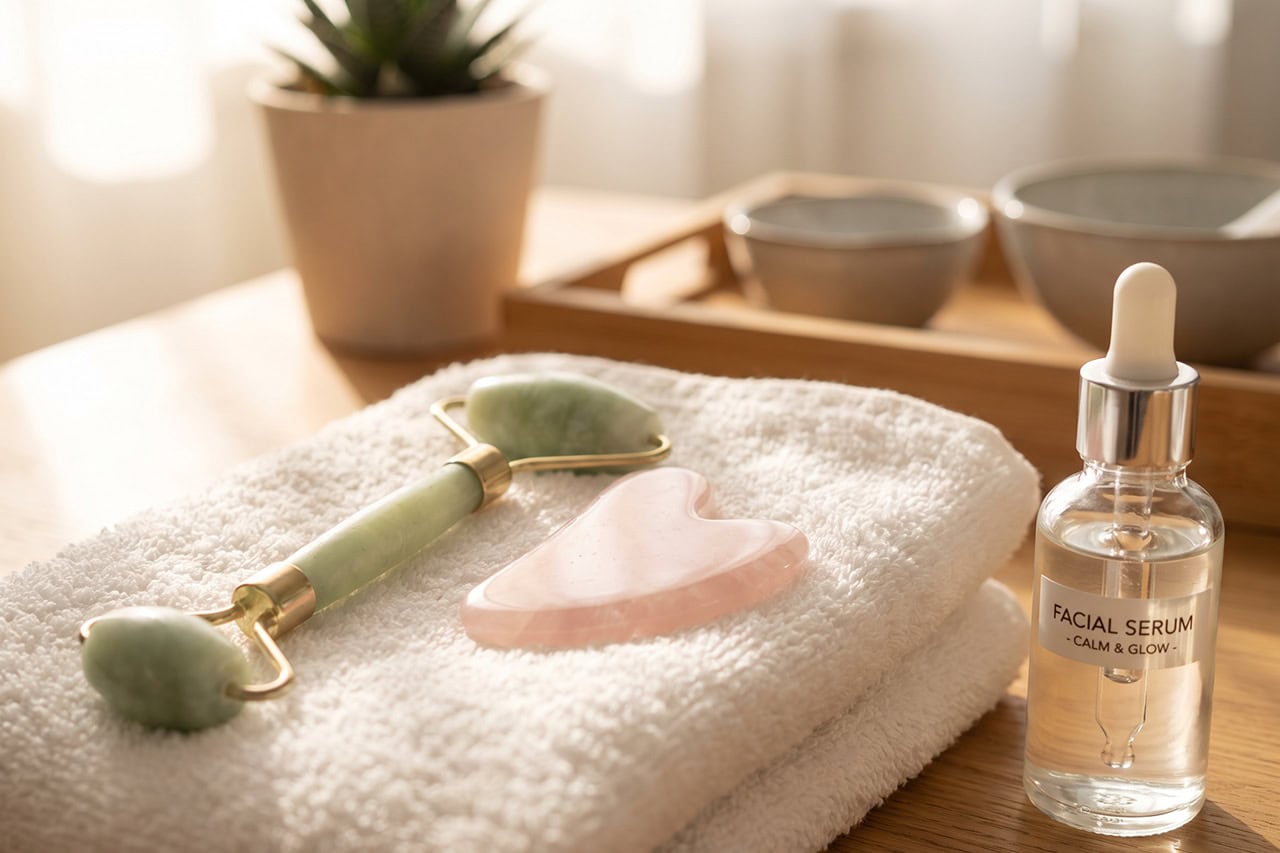
A face roller is a small carved stone on a handle, run across the face and neck. A gua sha tool is a flat stone, usually shaped to the jaw and cheekbone, drawn across the skin in slow strokes. Both are massage instruments, and they work about as well as massage does.
What that means in practice is modest and short-lived. A 2025 randomised trial found gua sha shifted facial surface distances by roughly two millimetres and eased muscle tension for a while, which is fluid moving and muscles loosening rather than anything rebuilt. Dermatologists describe the same mechanism: gentle directional pressure nudges the fluid sitting between the tissues toward the lymph nodes, so the puffiness under your eyes goes down for minutes, maybe a few hours. Cold helps too. A tool kept in the fridge feels tighter and brisker on the skin, which is part of why a chilled stone seems to do more than a room-temperature one.
What the research does not find is any lasting change. It does not build collagen, reshape a jawline, or erase a wrinkle. A 2023 review in the Journal of Cosmetic Dermatology looked at the whole category and called the evidence too thin to support anti-ageing claims. Use the tools for what they give you, a few minutes of de-puffing and a pleasant ritual that makes you more likely to tend to your skin. Roll outward from the centre of the face, keep the pressure light near the eyes, and wash the tool after each use, the porous stones especially.
Why jade and rose quartz, and why it barely matters
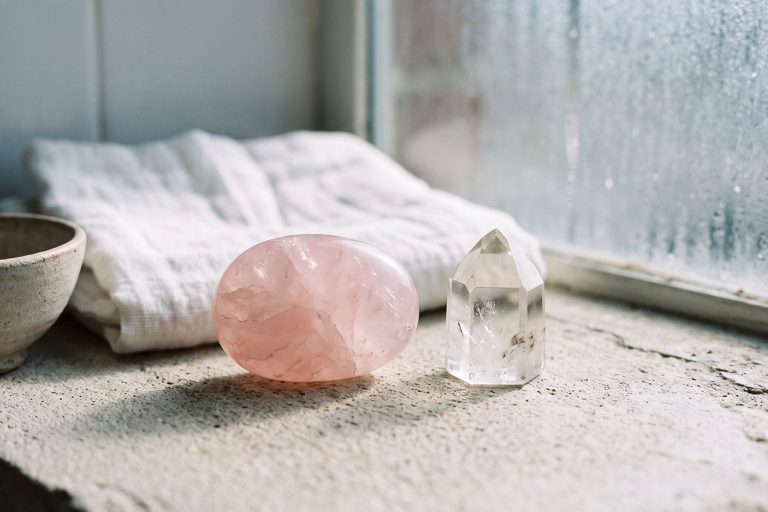
Jade and rose quartz dominate this shelf for two ordinary reasons. Both stay cool against warm skin for a good while, and both are dense enough to roll smoothly without flexing. The self-love and beauty associations printed on the box arrived afterward, layered onto stones that were already the practical pick. The dermatology on this is blunt. The benefit comes from the pressure and the temperature, not the mineral, and a smooth stone of almost any kind moved the same way would do the same job. If you love the rose quartz because it is pink and it makes two minutes feel like something you chose, that is a real reason to own it. Just know the stone is the nice part, not the working part.
Gemstone essences and the one rule that counts
A gemstone essence, sometimes called a crystal elixir, is water a stone has soaked in, then taken as a drink, in drops, or in a bath. The practice holds that the water carries the stone’s quality into you. Whether you find that convincing is your own call, and as crystal ideas go it is a gentle one. The safety part is not a matter of belief, and this is the one place in crystal beauty where getting it wrong can genuinely harm you.
Plenty of popular stones are not safe to soak in water you mean to drink. Malachite, the banded green stone, is a copper carbonate. Cinnabar, deep red, is mercury sulfide, the ore that mercury itself is refined from. Anything carrying copper, lead, mercury, arsenic or a sulfide has no business leaching into a glass you will swallow, and a fair number of the prettiest stones are exactly those. There is a vanadinite specimen in our collection, a cluster of small reddish-brown crystals, and it never goes near water for any reason, because vanadinite is a lead mineral. It stays a display piece and nothing more.
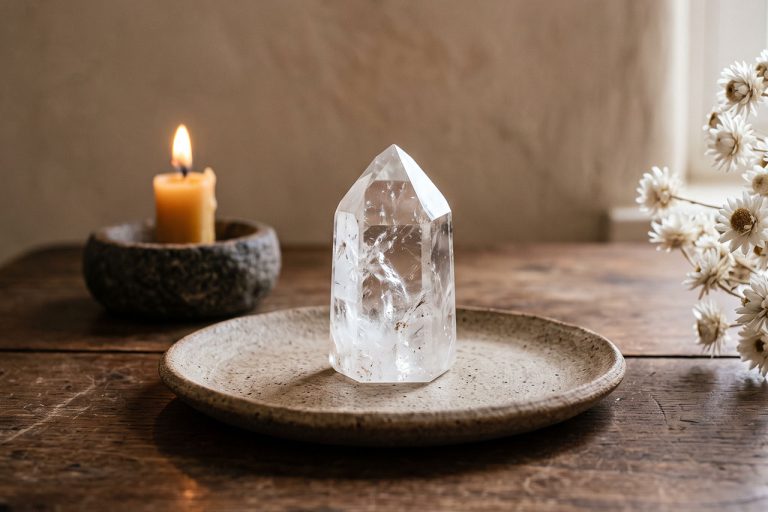
Two habits cover it. Use only well-known water-safe stones, which in practice means the quartz family: clear quartz, rose quartz, amethyst, citrine. Or use the indirect method, where the stone sits in a sealed glass inside the water and never touches it. That removes the leaching problem completely, though it also removes any direct contact the practice was counting on, so how you feel about it depends on which framing you hold. Wash the stone first either way, and do not treat any of this as a stand-in for plain water or real care. For the fuller picture of which stones tolerate water at all, that sits with the guide to what crystals are good for the bathroom and what is safe in water.
Holding the two apart
The clean way through crystal beauty is to keep asking which half you are in. If the answer involves rolling or scraping, you are in the physical half, where the effects are real but small and short-lived, and the stone is mostly there for the pleasure of it. If the answer involves drinking or bathing in stone-touched water, you are in the belief half, where the safety rule is not optional even when the rest is.
Held that way, a crystal beauty routine is a sound thing to keep. The roller does what a roller does, and the essence stays safe as long as you keep to quartz or the indirect method. For the individual stones behind any of this, the Crystalance Mineral Library gives each one its own entry. The tools are worth using and the essences are worth trying, as long as the stone in your drinking water is quartz and not something with a metal in it.
Sources
- Dermatology Times, Social Media Mythbusters: At-Home Facial Gua Sha (reporting a 2025 randomised trial and a 2023 Journal of Cosmetic Dermatology review)
- Encyclopaedia Britannica, malachite (basic copper carbonate, Cu2CO3(OH)2)
- Encyclopaedia Britannica, cinnabar (mercury sulfide, HgS, the chief ore of mercury)