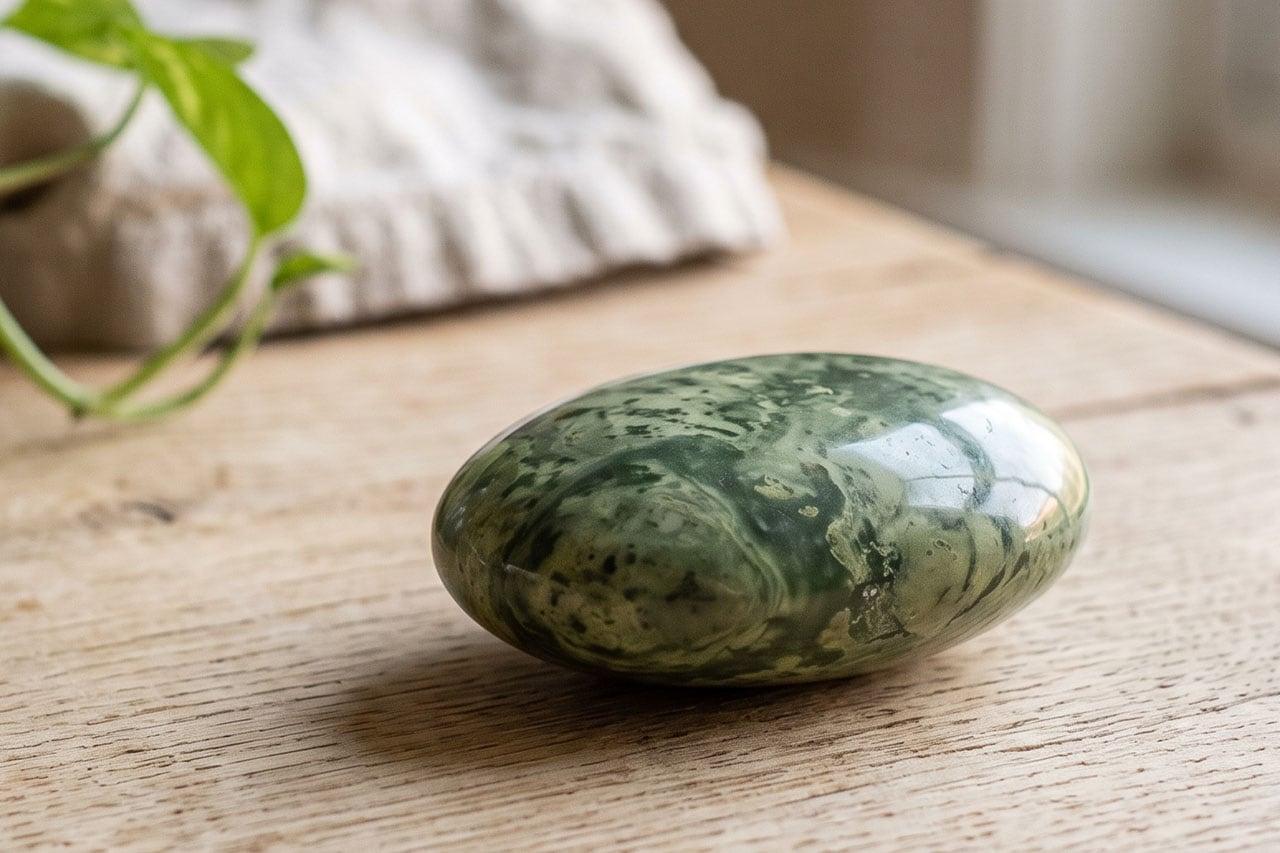
Green jasper is durable, opaque quartz. In practice it is used for grounding and a felt connection to nature. It is hard to mishandle, so carry it, wear it near the heart, or take it outdoors and use it hard.
Green jasper is the stone you can take out into the garden and forget about. Jasper often gets written up as if it were delicate, something to keep dry and away from knocks, and for green jasper that caution runs almost exactly backwards. It is opaque quartz, hard and dense, the same tough material as agate with more mixed through it. Where the rest of the jasper family sits under grounding and the root, the green ones drift toward the heart, mostly on the strength of being green. And what green jasper rewards is being used out in the world rather than parked on a shelf.
What green jasper is, and why it is tougher than it looks
Jasper is an opaque form of chalcedony, which is microcrystalline quartz, the same mineral as clear quartz but built from crystals too small to see and packed solid. What makes jasper jasper is everything mixed in with the quartz: iron oxides and other mineral impurities give it its colours and patterns, the reds and browns most people picture, and in the green varieties, the green. It runs 6.5 to 7 on the Mohs hardness scale, which is hard enough to scratch glass and most household surfaces, and being quartz it does not dissolve in water.
That combination is why the delicate reputation is misplaced for this stone. Running water will not hurt it. A day in the sun will not fade it the way it can lighten some softer, dyed or water-sensitive stones. Setting it down on the ground, which suits its earthy associations anyway, does it no harm at all. The one sensible caution is the ordinary one for any stone: keep it from knocking against harder pieces in a bag or a bowl, and it will not pick up scuffs. Beyond that, green jasper is about as low-maintenance as crystals get, and the practice built around it leans into exactly that.
How to use it
Because it is so hard-wearing, green jasper suits the uses that put a stone through its day rather than protecting it. Worn as a pendant or necklace, it sits near the heart, which practice reads as its natural position given the heart associations, and it holds up to daily wear without fuss. On the left wrist as a bracelet is the traditional placement in crystal work for drawing a stone’s quality inward, the left being taken as the receiving side. A pocket stone is the simplest version of all, there to be touched through the day when you want a moment of steadiness.
The use that green jasper is genuinely best suited to is outdoors. Take it on a walk, hold it while you sit outside, set it among plants or in a garden. People who spend most of their time indoors often reach for it precisely for that felt link to growing things, and the stone responds better to being used near the natural world than to indoor meditation, at least in the way practitioners describe working with it. For a quieter sit, hold it in both hands or rest it on the centre of the chest, breathe slowly for a few minutes, and let the exhale carry off some tension. For emotional balance it pairs conventionally with rose quartz, which adds warmth to green jasper’s steadier heart note; with moss agate the nature side deepens; with clear quartz the practice holds that its effect is amplified. As with any stone, treat these as conventions of the practice rather than promises, and use the pairings you are drawn to.
Cleansing green jasper is just as forgiving. Because it shrugs off water and light, every common method is open to it: a rinse under the tap, a few hours in sun or moonlight, sound, or a rest on a selenite plate all work. The one that suits it best is the earthiest, laying it on natural ground or briefly setting it in soil, which fits a stone whose whole character points back to the earth. If you use it daily, a quick cleanse every few weeks is plenty, since jasper does not hold onto energy the way the softer, more porous stones do and asks for less resetting than most.
In use it is an undramatic stone, which is much of its appeal. People reach for green jasper when they want something steadying in the background rather than a jolt, a low even note under a scattered day.
Green jasper asks very little and gives back most when it is treated as the outdoor, everyday stone it is. Take it outside, let it get rained on, and it will do its plain work for years. For green jasper alongside the wider family of jaspers and quartzes, the jasper page and the broader Crystalance Mineral Library run through green jasper and the rest of them.