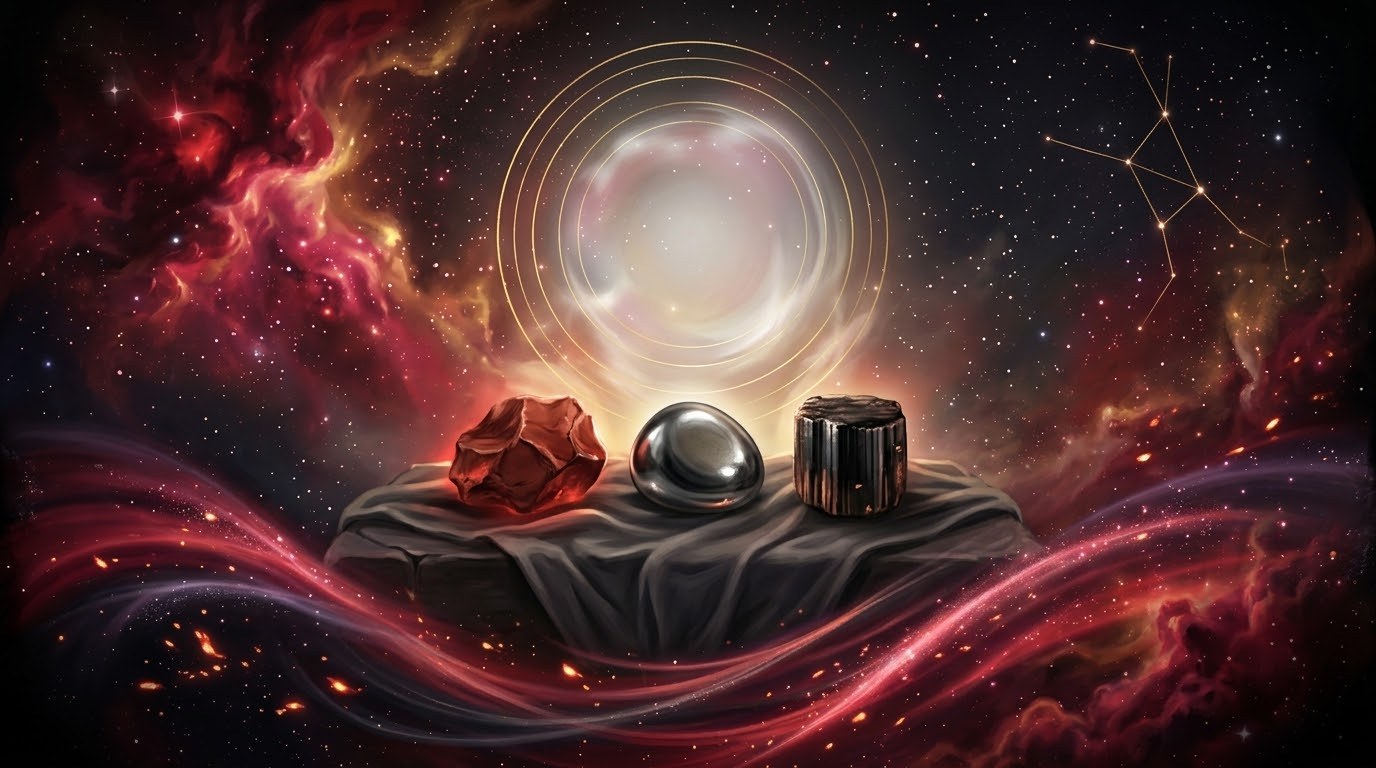
Lie down with red jasper or hematite at the base of your spine and a second stone just beyond your feet, then carry one low on the body through the day. Black tourmaline, smoky quartz and bloodstone are the other root stones.
Being slightly off the ground is how people who work with the chakras describe a root that needs attention, the feeling of living mostly in your head and never quite settling in the room you are in. Grounding is their word for what it needs.
Chakra practice places the root at the base of the spine, ties it to safety and to the earth you stand on, and uses the root stones to ground it.
The five root stones
Crystal writers give red jasper, brick-red and opaque, steadiness and staying power for the long haul. Hematite is their stone for attention that has scattered, to call it back down into the body. Black tourmaline is their choice when the grounding needs a protective edge, in an unfamiliar place or an unsettled stretch. Smoky quartz is a softer grounder in crystal writing, with a note of letting go. Bloodstone, dark green flecked with red, joins them where grounding meets a wish for more vitality.
Garnet and carnelian turn up at the edges of root lists too, though crystal writers also give carnelian to the sacral centre just above.
The chakras, Sanskrit for “wheels”, go back to yoga teachings that took shape in India between roughly the first and the sixteenth centuries CE. The rainbow order of colours and the stones are a later Western layer: Kurt Leland, tracing that history, finds the rainbow scheme and the list of qualities that begins with grounding at the root first printed together in 1977.
The classical picture of the root is older and more detailed than the 1977 chart. In the Shat-chakra-nirupana, which Arthur Avalon (Sir John Woodroffe) translated in The Serpent Power, the centre is the Muladhara, from mula (“root”) and adhara (“support”), and it is a lotus of four crimson petals beneath the other centres. It holds the yellow square of earth, the element of this centre, and its seed mantra, Lang, is pictured seated on the elephant Airavata.
Lying down with them
Choose some quiet minutes and, if you like a setting, lay a red cloth on the floor or light a red candle. Lie on your back. Put one stone just under the base of your spine, on a folded cloth if the floor is hard, or rest it on your hip if lying on it is uncomfortable. Put the second a hand’s width beyond your feet.
Then picture roots growing from the base of your spine, down through the floor and into the earth below, a little further with each slow minute, until you feel held from underneath. For the classical image, add the yellow square of earth at the base of your spine. Stay with that for five to fifteen minutes. What builds the practice is coming back to it, most days, over a few weeks.
Crystal practice counts a stone resting on clothing the same as one on skin, at the root or at any other centre, which makes this easy to do before bed. If you want to work the whole run of centres in one go rather than the root alone, what are the 7 chakra stones lays out the full set.
Between sittings
A hip or front trouser pocket keeps a root stone in the lower body, and the stone is a comfort to find with your fingers in the middle of an unsettled afternoon. A piece of red jasper or hematite on a low shelf, or on the floor of the room where you sit, is, in chakra practice, a way of keeping the root in that room too.
Now and then, in chakra practice, the root stones are cleared with a night buried in earth.
Obsidian below the feet
Some charts file obsidian with the root, and others with a centre below the body altogether, the Earth Star, beneath the feet. When you lie down, it can go at either place, the base of the spine or just beyond your feet, and when lying down is not practical it can simply be held in the hand.
The obsidian in the collection here is a raw, chunky mass of glossy black glass, and some of its edges are still sharp. Raw obsidian breaks to edges like that. A polished piece has had them ground away and can rest against the skin, so keep a raw one on a shelf and hold or pocket only a polished piece.
Anyone starting with a single stone can let it be the brick-red jasper, laid at the base of the spine most days and carried low on the days in between.
Sources
- Kurt Leland, “The Rainbow Body: How the Western Chakra System Came to Be”, Quest 105.2 (Spring 2017), Theosophical Society in America: chakras, Sanskrit for “wheels”, a schema that originated centuries ago in India, with its early evolution there from the first to the sixteenth century CE; the Indian chakras have colours but no rainbow; gemstones and minerals are among the Western correspondences; the rainbow colour scheme and the list of qualities came together in print in 1977.
- Arthur Avalon (Sir John Woodroffe), The Serpent Power, 2nd ed., Ganesh & Co., Madras, 1924, on archive.org: verse 4 of the Shat-chakra-nirupana, the Muladhara lotus “has four petals of crimson hue”; the name “derived from Mula (root) and Adhara (support)”, “at the root of the six Chakras”; “the centre of the yellow Prithivi, or “earth” Tattva, with its quadrangular Mandala, the Bija or Mantra of which Tattva is Lang”; the Bija “seated on the elephant Airavata”.
- Geology.com, Obsidian: natural volcanic glass with very sharp edges.