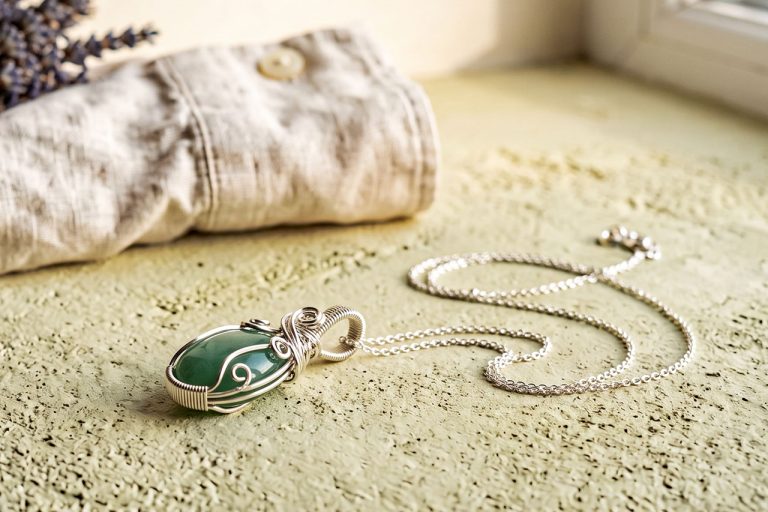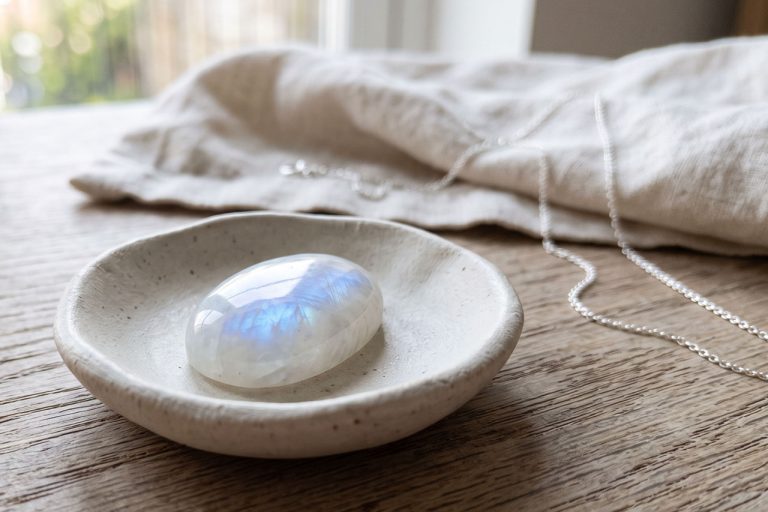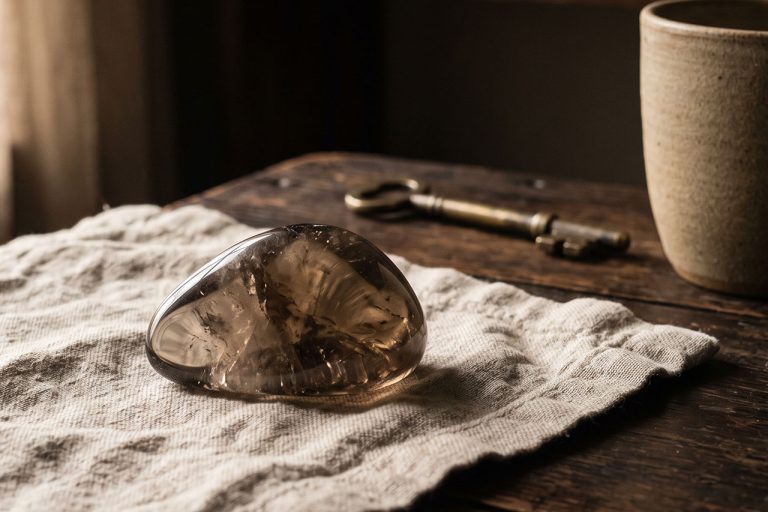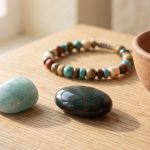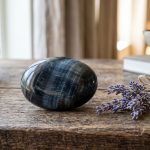
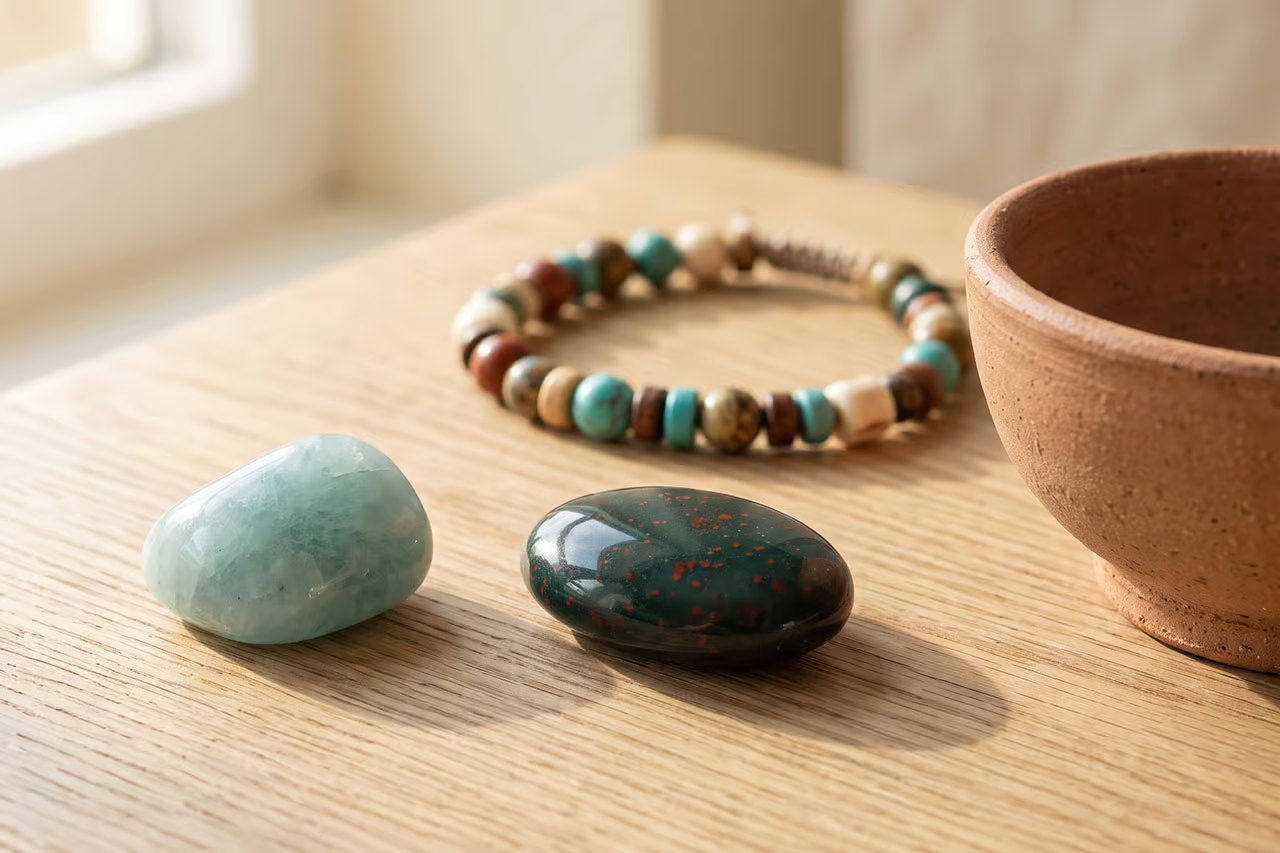
The inner wrist is the part of this that matters. Aquamarine, bloodstone and malachite are the stones crystal practice names for motion sickness, and whichever you pick, it wants to sit three fingers up from the wrist crease where your other hand can press it.
Crystal practice has an instruction for a bracelet worn against sickness, and the instruction is about the side rather than the stone. The beads go against the inner wrist, which the tradition reads as the receiving side of the body, rather than sitting on the back of it where a watch face goes.
The acupressure charts put something on that same patch of skin. Three finger breadths up the inner forearm from the wrist crease, between the two tendons you can feel when you bend your hand back, sits the point the Cochrane reviewers write as P6 and Miller and Muth write as P6 or Neiguan. It is what the plastic travel bands in the pharmacy are shaped to press.
Two systems with no shared history landed on the same square of skin, and that decides the object you want more than the choice of stone does. Something on a strap can be pressed into that point by the weight of your own hand. A tumble loose in a bag cannot.
Setting it up so it works as an object
Finding the point takes about five seconds. Turn your left hand palm up. Lay three fingers of the other hand across the wrist with the ring finger against the crease, and the spot sits under your index finger, in the dip between the two tendons running up the middle of the forearm. Press there and it feels different from the flesh either side of it.
A beaded bracelet turned so the stones face inward will rest on or near that dip on most wrists. When the queasiness starts, close the other hand over it and press, steady rather than hard, and let your breath out slowly while you do. Hold it for as long as the pressure is comfortable, then let go and repeat. A single tumbled stone works the same way with your thumb on the spot instead of a bead.
The whole thing has to be on you before you set off. A stone in a suitcase in the boot is a stone you own rather than a stone you are using, and the moment you need it is the moment you are least willing to go rummaging. A front pocket or the door bin next to your leg both do the job. The clasp of a bracelet is the argument for doing this in the driveway.
The three stones, and how to choose between them
Aquamarine is the one the tradition reaches for first, and the name explains why. GIA gives the name as coming from the Latin for seawater, and in its own account of the stone’s folklore records that ancient mariners claimed the gem would calm waves and keep sailors safe at sea. That is GIA reporting a claim rather than confirming a history, and it is the root of every modern link between aquamarine and settled water. It is a beryl at 7.5 to 8 on the Mohs scale of hardness, which GIA calls durable enough for everyday wear, so a bracelet of it survives being worn. For the placement crystal practice gives it on the body, what chakra is aquamarine takes that side of it.
Bloodstone is the steadying one in the practice, and its association is with the body holding itself together rather than with the sea. It is a variety of chalcedony, a dark green jasper carrying red inclusions of iron oxide, also sold as heliotrope. GIA gives it 6.5 to 7 and advises storing it in soft fabric so it does not pick up scratches. That is the practical difference between it and aquamarine.
Malachite is the traveller’s stone in crystal practice, carried for safe passage rather than for the stomach. Britannica gives it as a basic copper carbonate, and minerals.net puts it at 3.5 to 4, soft enough to mark against a metal buckle in a way the other two will not. Malachite is a copper mineral, so it is also one of the stones kept out of drinking water, which makes it a carry piece and nothing else.
If you want one, take the aquamarine. It is the hardest of the three and it is the one the practice puts closest to this exact problem.
What has been tested, and what has not
The point itself has a research record, and it is narrower than the shelf of travel bands implies. A Cochrane review of P6 stimulation pooled 40 trials and 4,858 participants and found nausea reduced against sham treatment, with a risk ratio of 0.71, and no evidence of a difference between P6 stimulation and antiemetic drugs. Seventeen of the 40 used simple acupressure rather than needles or electricity, which is to say pressure from a band or a thumb. The reviewers were open about the limits, since the trials varied a great deal and only four reported adequate allocation concealment.
All of that concerns nausea after surgery. Motion sickness is a different problem with a different cause, and the direct test came out the other way. Miller and Muth, publishing in Aviation, Space, and Environmental Medicine in 2004, put 77 people in front of a rotating optokinetic drum wearing an acupressure band, an electrical stimulation band or a placebo. Neither band nor placebo prevented motion sickness, and it made no difference whether people had been trained to position them correctly.
The point is well established and it has support for sickness after an operation. The one controlled trial aimed at motion in a moving vehicle found nothing. None of that research involved a stone at all. What the stone adds is something small and hard to press into at the moment your attention has nowhere good to go, and if your motion sickness is the kind that ends journeys, a doctor has tools none of this can match and asking costs nothing.
The mineral side of all three sits in the Crystalance Mineral Library, and if it is car journeys specifically that catch you out, what crystals are good for your car covers what people keep in there and where it goes.
Whether any of this gets used comes down to the driveway. A clasp is not an easy thing to manage on the third hairpin.
Sources
- GIA, March birthstones: aquamarine and bloodstone (aquamarine Mohs 7.5 to 8 and durable enough for everyday wear, name from the Latin for seawater, mariners’ folklore; bloodstone a chalcedony variety at 6.5 to 7 with red iron oxide inclusions, to be stored in soft fabric)
- University of Minnesota, Taking Charge of Your Health and Wellbeing, nausea acupoints (the point located three finger breadths from the wrist crease on the inner forearm, between the two tendons)
- Cochrane commentary, stimulation of acupuncture point P6 for postoperative nausea and vomiting (40 trials, 4,858 participants, nausea RR 0.71, 17 trials using acupressure, four reporting adequate allocation concealment, no evidence of difference against antiemetic drugs)
- Miller and Muth, Efficacy of acupressure and acustimulation bands for the prevention of motion sickness, Aviation, Space, and Environmental Medicine 2004;75(3):227-34
- Encyclopaedia Britannica, malachite (basic copper carbonate, Cu2CO3(OH)2)
- Minerals.net, malachite (Mohs 3.5 to 4)