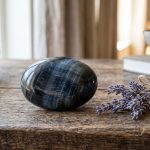
Rose quartz, smoky quartz, rhodonite, lepidolite and apache tears are the names grief lists hand you. What the lists leave out is that the tradition these lists come from did not originally ask you to be doing anything with a stone at all.
The last time the English-speaking world had a settled, widely observed grief object, it was jet. What jet was chosen for turns out to say more about grief than any of the five names above.
The stone the West mourned with
Jet is a strange thing to be famous. Britannica describes it as a dense, fine-grained, compact variety of subbituminous coal. Geology.com is more specific about how it happens: a single piece of woody material, a branch, washed into water, waterlogged, sunk, and buried under organic-rich sediment. Not a seam of coal. One piece of driftwood at a time.
Two dull physical facts about it are worth setting beside the nineteenth-century mourning industry that grew on it. It is soft: Britannica gives its hardness as 2+, Geology.com as 2.5 to 4, and either way it carves easily enough for large and obviously visible pieces. It is also remarkably light, and Geology.com’s own comparison puts a strand of jet beads or a large cabochon at roughly half the weight of the same thing in agate, jasper or quartz. Easy to carve big, light to wear all day. Whether or not those properties are why it was chosen, they are what let mourning jewellery be the size it was and be worn for as long as it was.
What the practice asked of a person
Queen Victoria adopted mourning dress, jet included, after Prince Albert died in 1861, and kept it for the rest of her life. The industry that followed is easy to underestimate. Whitby Museum records that at the height of it, between 1860 and 1880, there were over 200 jet factories in the town employing 1,500 people. The museum dates the material they were working to the Lower Jurassic, about 183 million years earlier; Geology.com gives the deposition as about 180 million years ago.
The part worth sitting with is not the scale but the rules. The Pitt Rivers Museum’s account of English mourning jewellery notes that a Victorian widow was expected to mourn for at least two years, and that jewellery was not permitted at all during the first of them.
Read that as a set of instructions and see what it does and does not require. It does not ask her to feel a particular way. Nothing in it requires her to work through anything, reach a stage, or arrive anywhere by a date. What she is given is a length of time, a thing to wear during part of it, and no further obligations. Whatever else you think of Victorian mourning, and there is plenty to think, its demands on the interior life of the bereaved were close to zero.
The rules were rigid and public and in many ways unkind, and the two-year expectation the Pitt Rivers account records is one placed on widows. That is a fair objection and it does not touch the point being made here. Rigid as they were, the rules were about conduct and clothing. They did not reach inside.
Modern grief lists, this site’s earlier version included, do the opposite. They file their stones under release and under working through, and the effect of that vocabulary is to hand a grieving person a job. If the stone is for processing and you are not processing, you now have two problems, and the second one arrived with the article rather than with the loss.
What the stones on the list carry
Crystal practice, read carefully, is gentler than the headings suggest.
Rose quartz is the comfort stone, and the tradition points it at self-directed kindness rather than at any kind of work. Smoky quartz is the grounding pick, and grounding in crystal practice means steadying somebody who feels scattered, which is a fair description of the first few weeks. Rhodonite is pink to red, MnSiO3, 5.5 to 6 on the Mohs scale, and Minerals.net notes that massive specimens often carry black manganese oxide veins; practice associates it with the tending of old hurt. Lepidolite is the calming entry, the one reached for when sleep goes. Apache tears are the fifth and they get their own section below, because the story attached to them is the reason they are on the list at all.
None of those associations, in their own terms, is a demand. They describe company rather than a procedure, and company is a much older idea about what an object does for a person in mourning than anything involving stages.
The demand came in later, with the language. It can go back out again, and nothing in the practice objects.
Apache tears, and the story in the name
Apache tears are the one entry with a story attached, and the story is gestured at more than it is told.
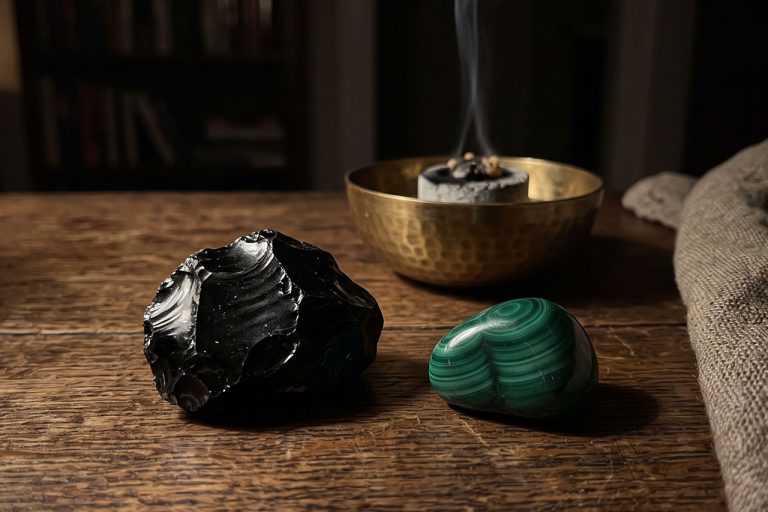
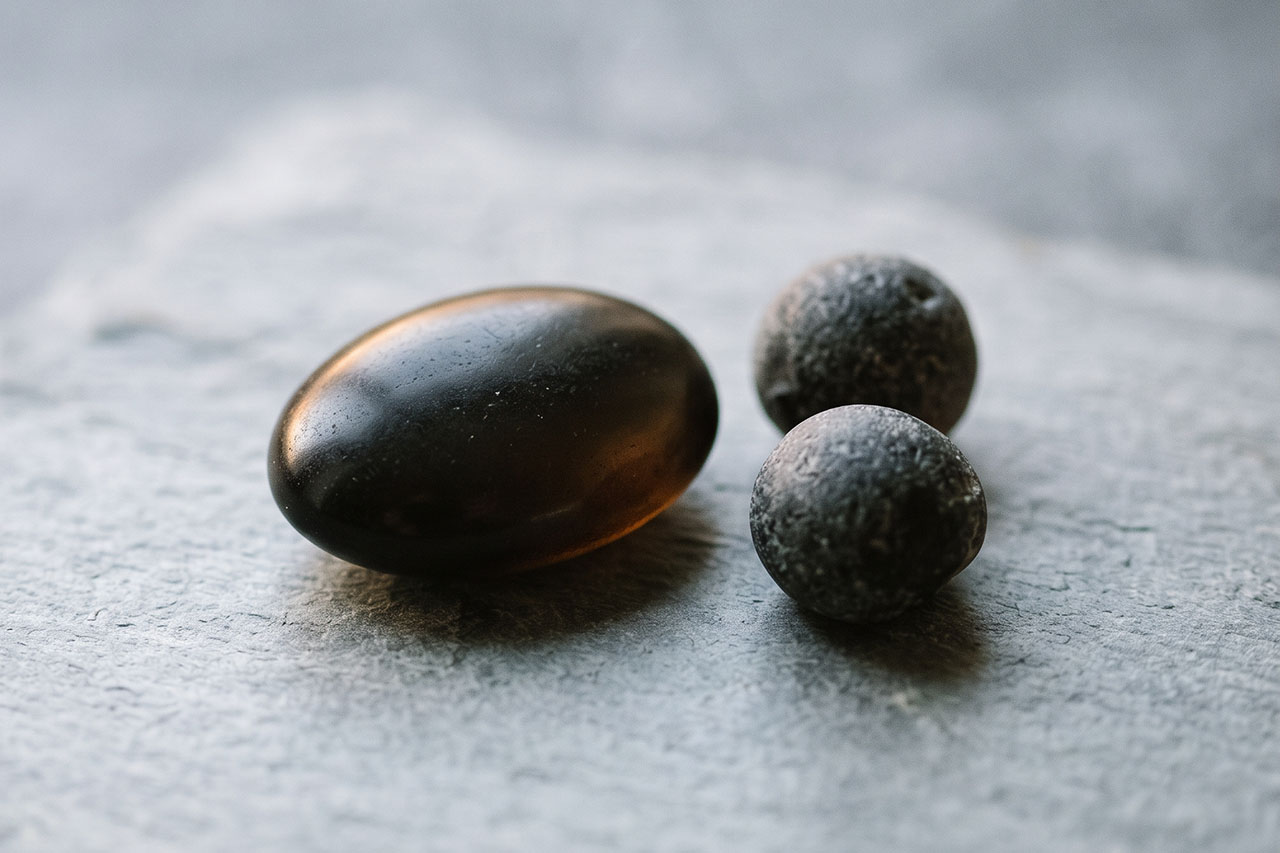
They are obsidian, which is volcanic glass. Geology.com describes them as small nodules of about an inch or less, found in volcanic areas of the American southwest. Because obsidian is glass rather than a crystal, it has no crystal faces and no true termination, a useful thing to know if you have ever seen one sold as a point. A nodule is the same material with its edges gone.
The name comes from a legend, and it should be told as one. The story, as Geology.com relates it, is of Apaches who, outnumbered and facing defeat in an 1870 engagement, rode their horses over a cliff rather than let their enemy kill them, and of the tears their families wept afterwards turning to stone. That is the account the name carries. Its standing as history is a separate question from its standing as a story, and the story is the reason people reach for these particular pebbles when somebody has died.
Using one, if you want to
There is no method here, and the absence is the true answer as well as the useful one.
The commonest thing anyone does with one is carry it. It goes in a coat pocket and stays there for months, and the reason it works as well as it does is that grief is long and mostly undramatic, and a small object in a pocket is a form of company that asks nothing back. Some people keep one on a shelf beside a photograph, which is nearer to what the Victorians were doing. Some wear a piece, which is nearer still.
If it helps to know that the impulse is not new or silly, the oldest jet objects we have go back a very long way indeed. Geology.com notes a Neolithic burial in France containing a necklace of alternating jet and chalk beads. Putting a black stone in a grave, or wearing one afterwards, is not a recent idea and not a decorative one.
A stone is not treatment. If you are struggling, a doctor or a bereavement service is the right place to take that, and nothing here is offered instead of it. Short of that, there is nothing to get right, and the wider question of what to do with a stone you carry every day sits in how do you use a crystal pouch.
Two years, and no jewellery in the first one. Jet and obsidian both have entries in the Crystalance Mineral Library, if the material interests you. But that was the whole instruction the older practice gave, and what it granted was time.
Sources
- Encyclopaedia Britannica, jet (a dense, fine-grained, compact variety of subbituminous coal, or lignite; hardness 2+; occurs near Whitby, Yorkshire; popular in English jewellery from prehistoric times until the early 20th century, and worn during mourning)
- Geology.com, jet (forms from a single piece of woody material washed into water rather than in a seam; Mohs 2.5 to 4; a strand of beads weighs about 50% less than the same piece in agate, jasper or quartz; Whitby jet deposited about 180 million years ago; greatest popularity from about 1861, after Prince Albert’s death; Neolithic jet and chalk bead necklace from France)
- Whitby Museum, jet and jet jewellery (fossilised driftwood with secondary bitumen impregnation, Lower Jurassic, 183 million years; over 200 jet factories employing 1,500 people between 1860 and 1880)
- Pitt Rivers Museum, University of Oxford, English mourning jewellery (widows expected to mourn at least two years, jewellery permitted only after the first)
- Geology.com, obsidian (apache tears as obsidian nodules of about an inch or less from volcanic areas of the southwestern United States, and the legend behind the name)
- Minerals.net, rhodonite (MnSiO3, Mohs 5.5 to 6, black manganese oxide veins)