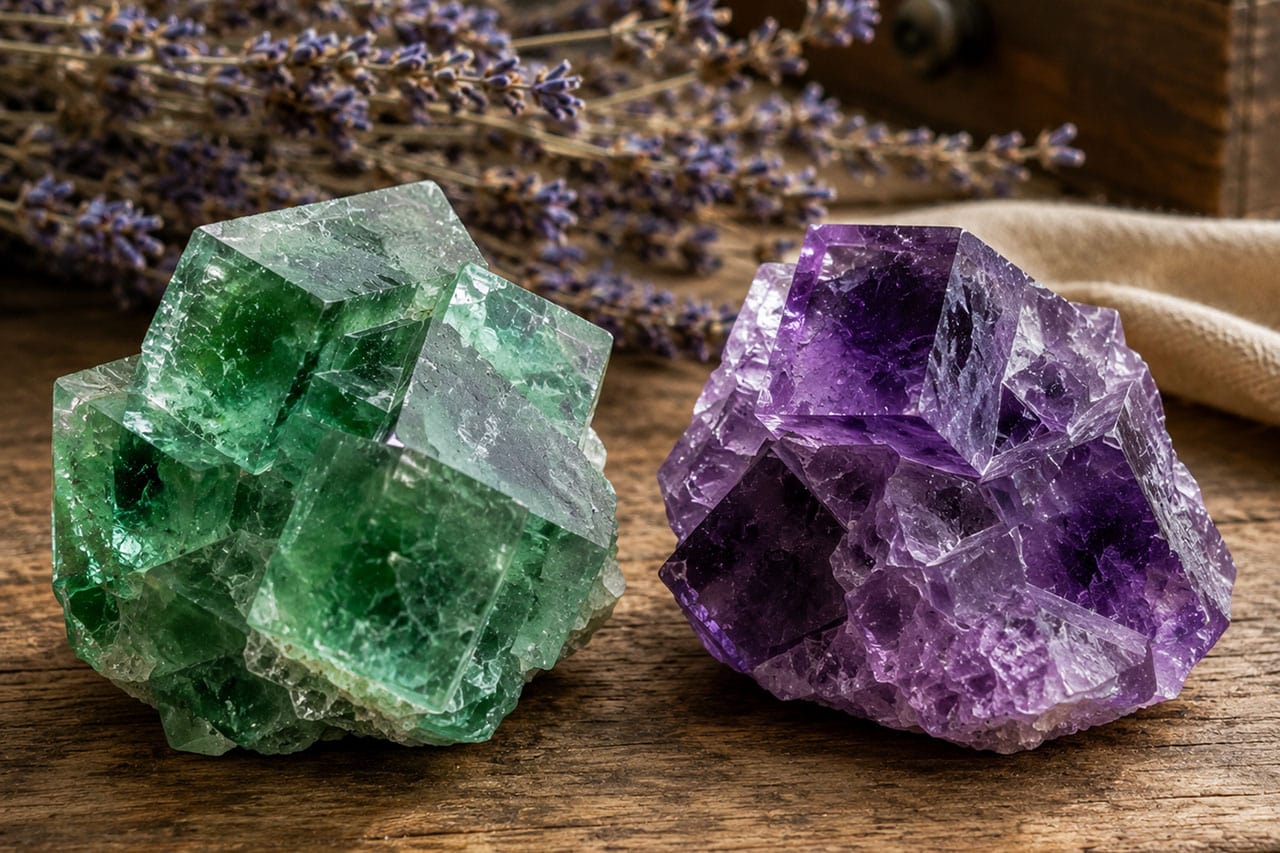
Yes and no. Green and purple fluorite are the same mineral (calcium fluoride, CaF₂), with the same crystal structure and hardness. The colour differences come from trace elements and lattice defects called colour centres, not from any underlying compositional difference. Mineralogically, they are one stone with two faces.
The word fluorescence was named after fluorite. Before George Stokes coined the term in 1852 to describe the glow of certain materials under ultraviolet light, fluorite was already known to mineralogists as the most strikingly photoluminescent of common minerals. The phenomenon was odd enough that the mineral lent its name to the whole class of effects.
That history matters here because it points to something true about fluorite that the modern colour question can overlook. Fluorite’s colours, and its glow, come from the same underlying physics: defects in the crystal lattice that absorb and re-emit light. The colour you see is the part of the spectrum that the defects let through.
So when someone asks whether green and purple fluorite are different, the honest answer requires going one step deeper than the colour itself.
What Fluorite Actually Is
Fluorite is calcium fluoride, the simple compound CaF₂. It crystallises in the cubic system, which means its native crystal habit is cubes or octahedra (eight-sided diamond shapes). Its hardness on the Mohs scale (the standard 1-to-10 scratch resistance scale) is 4, soft enough to be scratched by a steel knife.
This basic profile is the same whether the fluorite in your hand is purple, green, blue, yellow, or colourless. The mineral underneath the colour is one species, with one structure and one chemistry. Variations in colour are about what is happening inside the lattice rather than what the lattice is made of.
The cubic structure also explains why fluorite cleaves so cleanly. Drop a piece on a hard floor and it will break into octahedral fragments along the natural cleavage planes. That tendency makes it useful for collectors who want clean specimens but less useful for jewellery, where impact resistance matters more than geometry.
Why Fluorite Comes in Colours
Fluorite’s colours come from two main sources, and both involve defects in the crystal lattice rather than additions to the chemistry.
Colour centres. A colour centre is a defect in the lattice where an electron is trapped at a position where an atom should be. In fluorite, natural radiation over geological timescales can knock fluorine atoms out of their lattice positions, leaving vacancies. Electrons then settle into these vacancies and start absorbing specific wavelengths of visible light. The absorbed wavelengths are missing from what reaches your eye, so the crystal appears the complementary colour. Purple fluorite, the most common variety, is largely the result of colour centres formed this way.
Trace element substitution. Some atoms of calcium in the lattice can be replaced by atoms of other elements with similar size and charge. Rare earth elements, particularly yttrium and samarium, substitute into the fluorite lattice in certain geological settings and contribute to colour. Green fluorite often shows trace amounts of yttrium and other rare earths that purple fluorite typically does not.
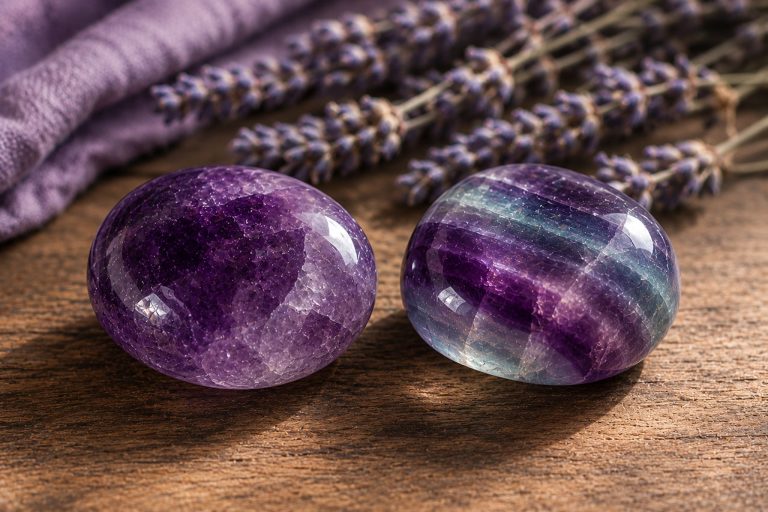
In practice, most natural fluorite shows colour from a mix of both mechanisms. The curious thing is that the same crystal can have purple zones from colour centres and green zones from trace element substitution if it grew through environments that produced both. Single specimens with multiple distinct colour bands are common enough to have their own commercial name: rainbow fluorite.
Green vs Purple Specifically
Now the comparison.
Purple fluorite is the most abundant colour globally. Hues range from pale lavender to deep violet, depending on the concentration of colour centres. Major source localities include Illinois (USA), England (Castleton, source of the historically famous Blue John variety), China, and Mexico. The deepest purples often come from English fluorite, which was the source of much fluorite used in Victorian decorative arts.
Green fluorite is the second most common, with colour ranging from pale apple green to deep emerald. Major sources include Mexico, Argentina, China, and Russia. Some green fluorite shows the rare earth trace element signature mentioned above; a smaller portion derives its colour from a different colour centre configuration than the purple variety.
The two colours often occur together. Rainbow fluorite, which is one of the most popular forms in commerce, shows alternating bands of green, purple, and sometimes other colours within the same crystal, recording the changing chemistry of the fluid the crystal grew from over time.
What’s striking is how often the same locality produces both colours. Castleton in Derbyshire is famous for both purple Blue John and pale green specimens; Chinese mines yield enormous quantities of both. The two colours are not necessarily distinct sources or distinct varieties. They are different snapshots of the same mineral under different growth conditions.
What About the Energetic Claims?
Most crystal sites attach distinct energetic properties to each fluorite colour. Purple for spiritual awareness. Green for healing or growth. Blue for clarity. Yellow for confidence.
These claims are not derived from anything geological. The mineral is the same. The colour comes from defects in a lattice of calcium and fluorine atoms. Consider what would be needed for the energetic claim to track the geology: the colour-centre electron configuration would have to produce a measurable effect on a person holding the stone. There is no evidence this happens.
That does not mean the colour symbolism is useless. People who work with fluorite often report that holding a green specimen feels different from holding a purple one, and the difference may be doing real work for them. The work is psychological and tactile rather than mineralogical. Wellness traditions assigning meanings to colours have their own internal logic, separate from the geology, and those traditions deserve to be understood on their own terms.
The honest framing is simple. If a colour calls to you, that is a real response worth respecting. The colour itself is a defect in a fluorine lattice. Both things can be true.
For more on fluorite specifically and on what makes a mineral a mineral, see the Crystalance Mineral Library. The next time you see green and purple fluorite next to each other in a shop, the same stone is looking back at you from two slightly different histories. What it is and what it has been through can be read separately.