No. Amethyst is a purple variety of quartz, hardness 7. Purple fluorite is calcium fluoride at hardness 4, a different mineral in everything but colour. The two grow into different shapes, and on an uncut crystal the shape is the quickest way to tell which you have.
A lens maker and a crystal shop want opposite things out of fluorite. Britannica’s entry says that clear colourless fluorite of optical quality goes into apochromatic lenses, which are corrected for colour at three wavelengths and for spherical aberration at two, and it gives the reason as fluorite’s low refractive index and low dispersion. Colour is not among the reasons.
Why a fluorite crystal ends up violet at all is a separate question. Amethyst reaches purple by another route inside another mineral. Set the two formulas side by side, silicon dioxide against calcium fluoride, and they share no element at all.
How is anybody meant to know which one they are holding? For an uncut crystal that turns out to be easy. Polished material is genuinely hard, and the line between those two cases runs through a lapidary’s workshop rather than through the minerals.
Cubes against terminated points
The Handbook of Mineralogy opens fluorite’s habit line with cubes, octahedra, rarely dodecahedra, or combinations of those, all of them built from flat faces meeting in straight edges. That line does not stop there. It runs on through rounded and stepped crystals and through nodular, botryoidal material. At the end of it comes massive fluorite, with no geometry at all. Quartz opens somewhere else, with prismatic crystals, which on a shelf means a six-sided column closing in a point.
Both Handbook entries record a maximum size, and neither is modest. Fluorite reaches two metres. For quartz the figure is six metres and thirty-six tonnes, which puts every tumble in every shop bowl at the small end of both minerals.
Symmetry is the reason for the shapes, and it shows up in a second place. Fluorite’s optical class is isotropic, one refractive index, n between 1.433 and 1.448. Quartz is uniaxial, with omega at 1.544 and epsilon at 1.553. Those figures are the Handbook’s. The step from them is ordinary crystallography and not something either entry states. A cubic mineral is optically isotropic, so light travels through it the same way whichever direction the light enters, while light going into quartz off the optic axis splits into two rays that move at slightly different speeds. The fluorite entry hedges even that, adding weak anomalous anisotropism beside the isotropic line, so the mineral is not quite as simple as a one-word class suggests. And the two quartz figures sit close together, close enough that the split is not something an eye picks up in a finished stone. An instrument can see it; an eye cannot.
An uncut crystal therefore settles itself. A violet cube, or a stepped mass of cubes growing into one another, is fluorite. Amethyst comes as a six-sided column with a pointed cap, or as a crust of short ones crowded over grey rock. Neither mineral characteristically grows the other’s form, and nothing has to be tested to see it. Given how much advice in this trade ends with a reader scratching a stone they paid for, that comes as a relief.
Quartz’s entry records over five hundred forms and allows a pseudocubic habit among them, so a blocky quartz crystal is possible. It is not the crisp interpenetrating cube of a fluorite group, and the rule holds for the material a shop stocks.
When the shape has been polished off
One of the fluorite pieces we have catalogued is a spike, about eight centimetres, cut and polished end to end, bought online after we compared several of the towers on offer. Set a polished amethyst tower beside it. Both are violet and both are translucent, and the shape that would have told you which is gone.
Hardness is the widest gap, 7 against 4, and reading it means putting a scratch on something you own. Cleavage is more forgiving. Fluorite parts along perfect octahedral planes, while the Handbook calls quartz’s cleavage rarely observable and poor, so a knocked corner tends to leave fluorite with a clean flat facet and quartz with the curved shell-shaped surface both entries call conchoidal fracture. The fluorite entry also gives the mineral a subconchoidal to uneven fracture, so that tell leans without deciding.
Density costs the stone nothing. Fluorite runs 3.175 to 3.184, higher where rare earths are involved, against quartz at 2.65, which works out at roughly a fifth heavier for a fluorite piece of the same size, a ratio calculated from those two figures rather than quoted from anywhere. Pick both up and the fluorite is the heavier. A scratch would answer faster than weighing does and leave a line across something you paid for, which is a poor trade for what a hand can get in a second.
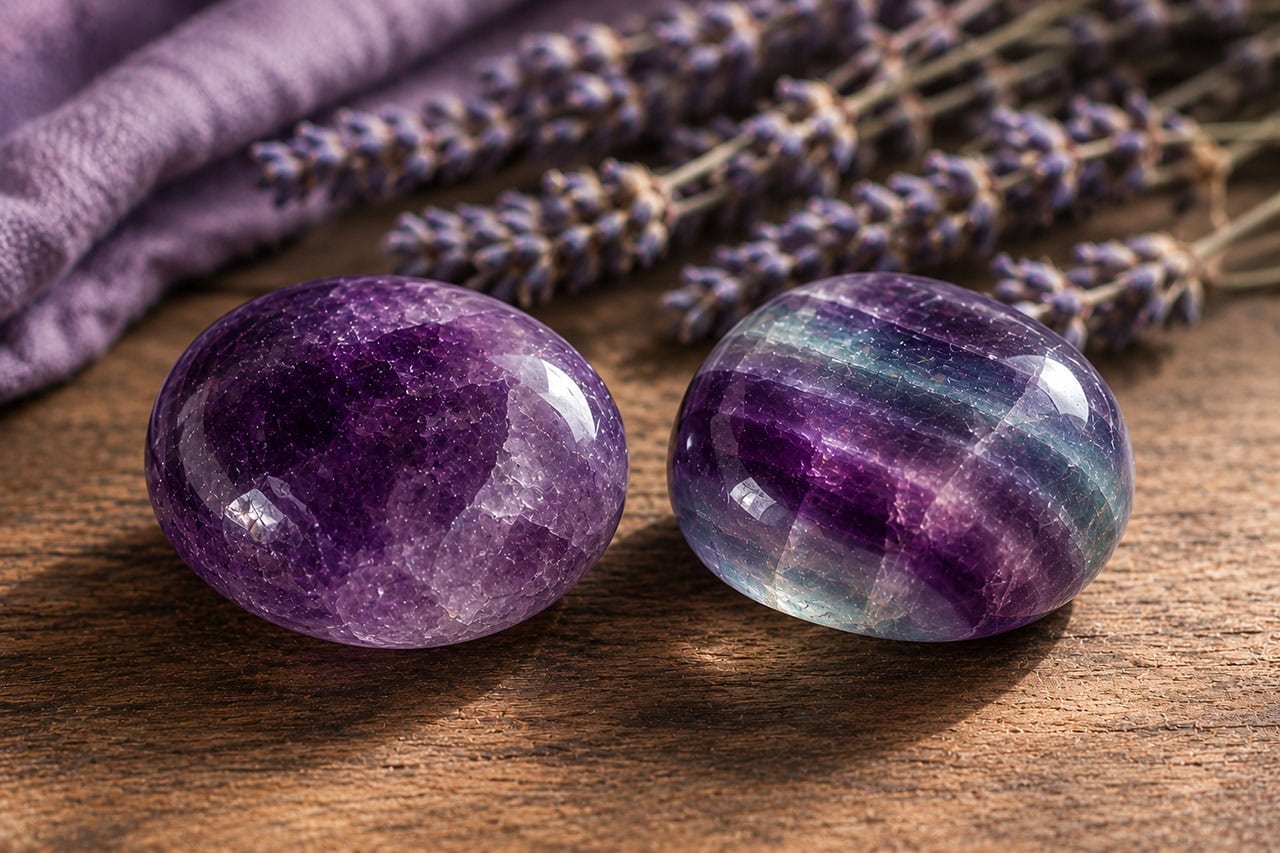
Colour helps in one direction. Rainbow fluorite is the trade name for material banded from violet through to green inside a single crystal. Quartz’s best-known two-colour stone is ametrine, amethyst purple and citrine yellow together, which GIA traces commercially to a single mine in Bolivia, and the two kinds of banding look nothing alike. Rainbow fluorite is a fact about fluorite and not a rule about amethyst, though. Quartz has green varieties of its own, so a violet-and-green stone earns a closer look before anyone decides.
Where each one is asked to sit
Crystal practice keeps these two well apart, which is not a given in a tradition that leans on colour elsewhere. It treats fluorite as the study stone, tied to concentration and to clearing a cluttered head, and puts it on a desk near whatever the work is. Amethyst gets the evening, and the bedside. Amethyst also carries a long association with sleep, and with what practice calls the crown chakra, the energy centre tied to awareness. Neither reading leans on the purple. Fluorite’s rests on a sense that the mineral sorts things out, amethyst’s on the stone being reached for at the quiet end of the day, and the shared colour is the one thing neither of them uses. Those readings belong to the tradition and not to the mineral, and they are the tradition’s to hold.
Hardness cannot say which of the two is better, and it answers a more useful question instead. A stone at 7 goes in a pocket or a bowl with other stones and comes out unchanged. A stone at 4 belongs on a shelf with room around it, since a quartz tumble at 7 will mark it without anyone trying. That is not a ranking, only a shelf-against-pocket decision, and the two numbers make it for you.
The polished pieces are all that is left, and they are the ones the question was really about. A tower has had its answer cut off it, and only its weight and its label remain. Check the label against amethyst’s entry in the Mineral Library and the question closes soon enough. What it does not settle is whether the stone was bought for the mineral or for the colour, and only the buyer knows that.
Sources
- Fluorite as cubic, with the habit line “Cubes, octahedra, rarely dodecahedra, or combinations, with many other forms; rounded or stepped, to 2 m; nodular, botryoidal, rarely columnar or fibrous; granular, massive”, cleavage “{111}, perfect”, fracture “Subconchoidal to uneven”, “Hardness = 4”, “D(meas.) = 3.175-3.184; to 3.56 if high in rare-earth elements”, and “Optical Class: Isotropic; weak anomalous anisotropism. n = 1.433-1.448”: Handbook of Mineralogy, Fluorite.
- Quartz as SiO2 with “Hardness = 7, variable by direction and form”, “Optical Class: Uniaxial (+)” at omega 1.544 and epsilon 1.553, cleavage “Rarely observable, poor”, “D(meas.) = 2.65”, fracture “Conchoidal”, crystals “with over 500 forms noted, to 6 m and 36 t”, and the further habit line “Pseudocubic or dipyramidal to tapering, needlelike, with trigonal outline”: Handbook of Mineralogy, Quartz.
- “Clear colourless fluorite of optical quality is used for apochromatic lenses”, given its low index of refraction and low dispersion, together with fluorite’s use as a flux in steelmaking and aluminium and in hydrofluoric acid: Britannica, fluorite.
- An apochromat as “an objective lens that is corrected for axial chromatic aberration at three wavelengths and spherical aberration at two wavelengths”: Nikon MicroscopyU, apochromat objective.
- Ametrine as a single quartz crystal carrying both amethyst and citrine colour, with the Anahi mine in Bolivia as its only commercial source: GIA, ametrine.