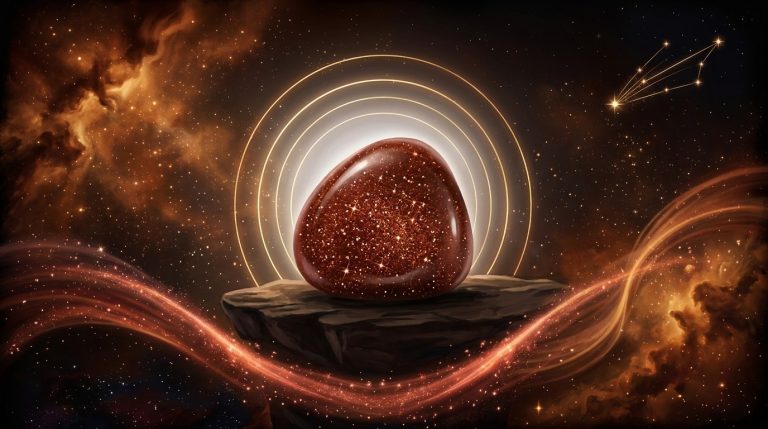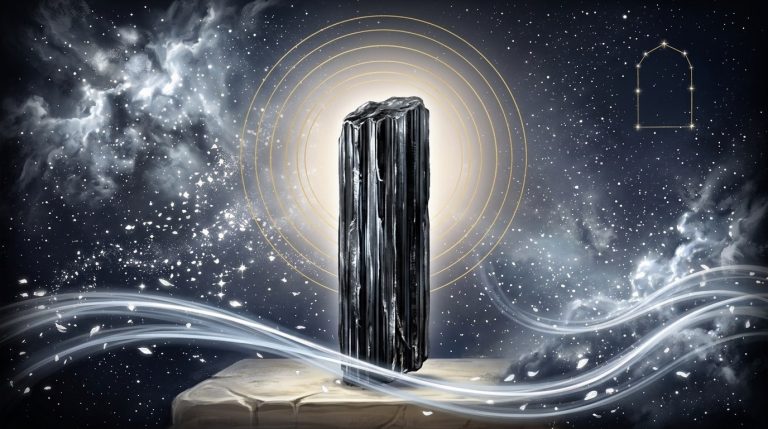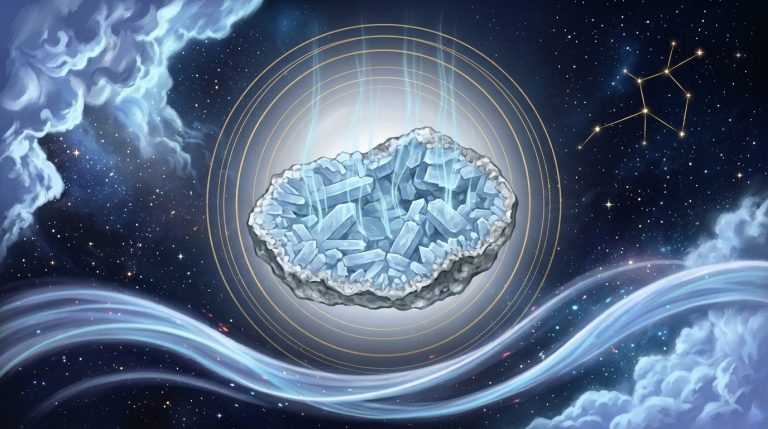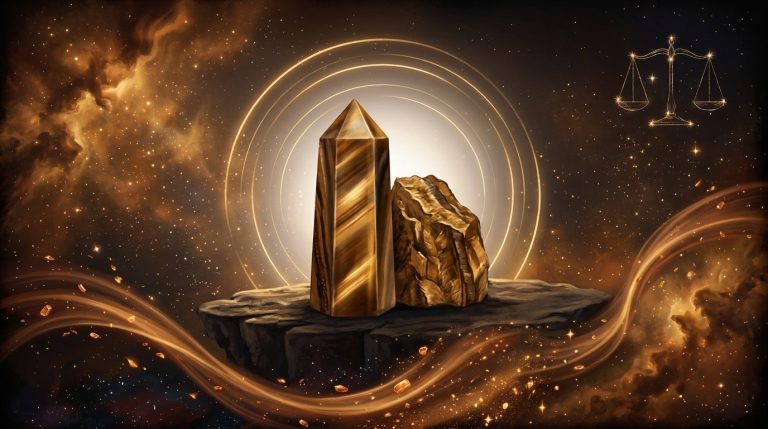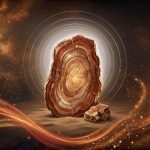
Hematite, red jasper, smoky quartz, moss agate, aragonite and petrified wood are the stones crystal practice names for this, the dense and dark end of the shelf. They are used to feel planted, and the practice pairs them with real contact with the ground.
What the tradition means by connecting with the earth is a sense of belonging to a physical place. A working day rarely supplies one, and the practice’s answer is a stone you can hold while you stand on some ground. The logic is direct. Something that came out of the earth reminds you of the earth. Practitioners lean on that literalness, which is why the list skews towards stones that look like the planet rather than like jewellery.
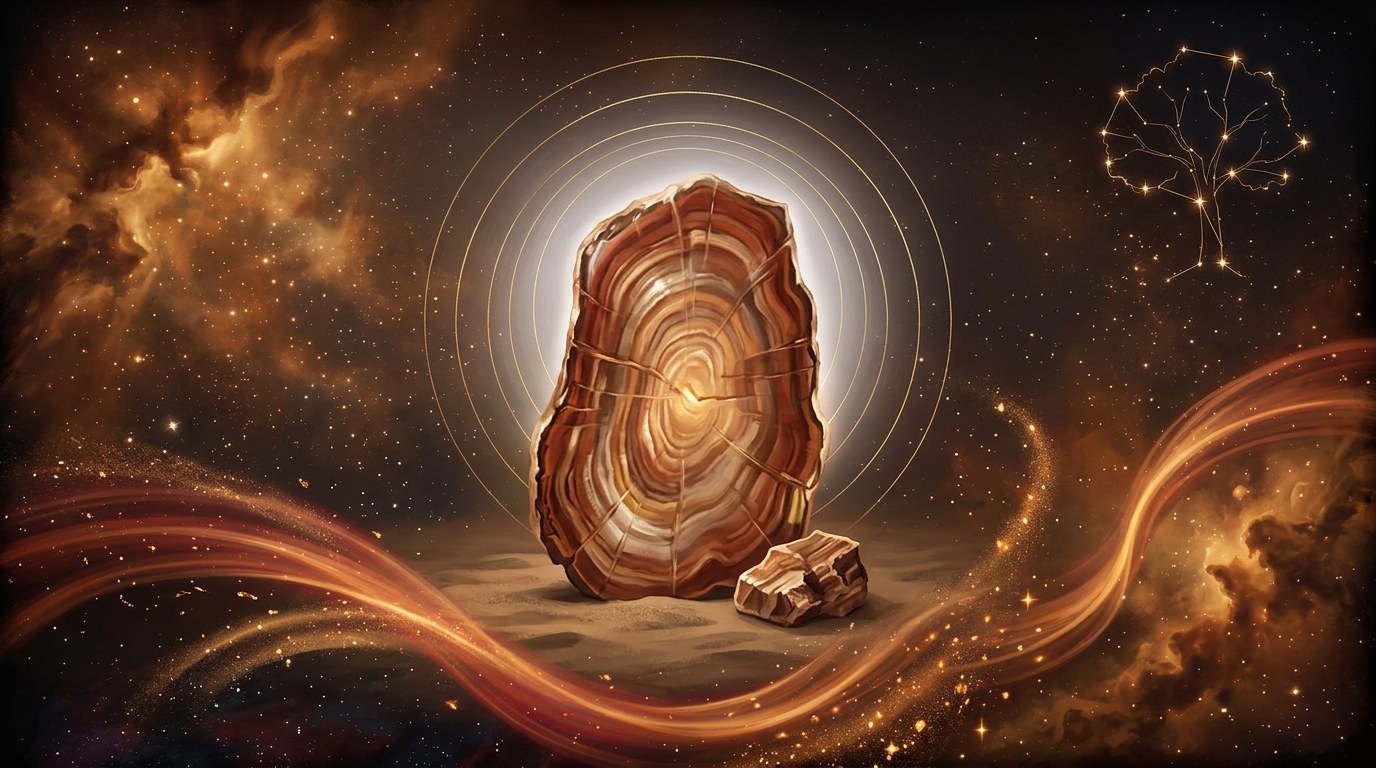
Petrified wood does the heaviest lifting in that list, and the reason is obvious the moment you hold one. A tree that became stone. Pick one up and the growth rings are still there under your thumb, running in bands of rust and honey across a face that takes a mirror polish. Nothing else on a crystal shelf offers a bridge between the living world and the mineral one that you can hold in one hand.
Each stone on that list, though, arrived in front of you by being taken out of the ground and sold to you. The practice is quietest about that, and it points somewhere useful.
What petrified wood is, and what it is not
George Mustoe burned the organic remainder out of twenty-five silicified wood specimens and weighed what was left. The figures run from about 0.65 per cent of the original wood to around 22 per cent. One Triassic specimen from Holbrook, Arizona came in at 0.96 per cent. Mustoe reads the set as consistent with an older estimate that the average is on the order of ten per cent.
Mostly gone, then. The part that is hardest to square with that is the cell structure, because the anatomy is genuinely there, visible under a lens, faithful down to the vessels. Mustoe’s account of it is careful and worth having straight. Silica did not swap itself for the wood molecule by molecule, which he says is impossible on size grounds alone: silicic acid molecules are small and organic molecules are large. What happened instead was simultaneous. Mineral was precipitating in and around the tissue while the tissue was decaying, and the fidelity of what survives depends on which of those two ran faster. In silicified wood specifically, he writes, the visible evidence of cellular anatomy is usually “the result of inorganic mineralization rather than actual tissue preservation.”
Accounts differ on how much survives in any given piece. The National Park Service describes the wood at Petrified Forest as largely permineralized, with a small percentage of woody cell walls preserved in some specimens, and notes that paleontologists usually prefer permineralization and replacement to petrification, because those name a process rather than a result.
What you are holding, then, is not a tree that hardened. It is a mineral portrait of a tree, made by groundwater, in the shape the tree left behind, and the water is at least half the story. The logs at Petrified Forest even come apart as though somebody had cut them, and no saw was involved. Uplift of the Colorado Plateau put the buried trunks under so much stress that they “broke like glass rods”, and the quartz fractured cleanly across the trunk, “giving the appearance today of logs cut with a chainsaw.”
That is a better thing to hold while you think about the ground than a tree that turned to stone. A tree that turned to stone is a story. This is water, silica and a very long wait, and the tree is the mould that shaped it.
Go and pick one up
That points at the part the shelf will not tell you. For this particular practice, the stone you found beats the stone you bought, and in a great deal of the world you are allowed to go and find one.
In the United States the rules for petrified wood sit in the Code of Federal Regulations rather than in agency advice, and they are wider than a first-time collector tends to assume. On public land administered by the Bureau of Land Management and the Bureau of Reclamation, one person may remove up to “25 pounds in weight plus one piece” per day, up to 250 pounds in a calendar year. Pooling quotas with other people to obtain pieces heavier than 250 pounds is not allowed. The material has to be for personal use rather than sold or bartered to commercial dealers, and explosives and power equipment are out unless you hold a museum-piece permit.
There is one strange and rather lovely provision at the top end. No permit is needed at all until a single specimen weighs more than 250 pounds, and above that the permit is granted on a certification that the piece “will be displayed to the public in a museum or similar institution”. The only route to carrying off a petrified log heavier than that runs through a promise to give it away.
The agency in charge of any given area can publish additional rules on top of the federal ones, so those figures are a maximum that local rules may cut, and no promise about a particular patch of desert. BLM’s plain-English guidance also attaches three exceptions to rockhounding for rocks, gems and precious metals: developed recreation sites such as campgrounds, federally designated wilderness where only non-motorised hand tools may be used and the ground may be disturbed only minimally, and existing mining claims, which need the claimholder’s permission. Its petrified wood entry does not repeat those exceptions, but it does open with “unless otherwise specified”, so check the area before you dig.
National parks are the other way entirely. Under 36 CFR 2.1, possessing a fossilized paleontological specimen inside a park is prohibited, alongside removing, digging or disturbing one, and possessing is on that list in its own right. The section opens with “except as otherwise provided in this chapter”, and what the chapter provides is a permit route for representatives of scientific and educational institutions. For a visitor there is nothing to rely on. Outside the United States the rules differ and are worth checking before you go rather than after.
If none of that is available to you, the practice still works with a bought stone, and this is not a reason to feel bad about the piece already on your windowsill. But a stone you carried back from somewhere specific does something a shelf piece cannot, because you know the ground it came from and you were standing on it when you picked it up. That is precisely what this practice is asking for, and it is the one version of it that is not for sale. The Crystalance Mineral Library can tell you which of these you are looking at, which starts to matter a good deal more once you are picking them up off the ground yourself.
Sources
- Mustoe, G. E., “Wood Petrifaction: A New View of Permineralization and Replacement”, Geosciences 7(4), 119, 2017, for the twenty-five measured specimens and their calculated original wood content from about 0.65 to 21.71 per cent, for the Triassic Araucarioxylon from Holbrook, Arizona at 0.96 per cent, for the reading of the set as consistent with a generalised estimate on the order of ten per cent, for the impossibility of molecule-for-molecule substitution of small silicic acid molecules for large organic molecules, and for visible cellular anatomy in silicified wood usually being the result of inorganic mineralization rather than actual tissue preservation: mdpi.com
- National Park Service, “Permineralization and Replacement”, for the silicified wood at Petrified Forest being largely permineralized with a small percentage of woody cell walls preserved in some specimens, and for paleontologists usually preferring permineralization and replacement to petrification because those terms describe the process rather than its stony outcome. The page carries a site-under-development banner: nps.gov
- National Park Service, Petrified Forest National Park, “Petrified Wood”, for the buried trunks breaking like glass rods during the uplift of the Colorado Plateau and the resulting appearance of logs cut with a chainsaw: nps.gov
- 43 CFR subpart 3622, Free Use of Petrified Wood, sections 3622.2, 3622.3 and 3622.4, for the 25 pounds plus one piece per day and 250 pounds per calendar year on Bureau of Land Management and Bureau of Reclamation land, the ban on pooling quotas to obtain pieces larger than 250 pounds, the personal-use and no-sale condition, the prohibition on explosives and power equipment except for holders of museum-piece permits, the permit requirement for a single specimen over 250 pounds with its museum-display certification, and the power of an agency head to publish additional supplementary rules: ecfr.gov
- 36 CFR 2.1(a)(1)(iii), for possessing, removing, digging or disturbing fossilized paleontological specimens in a national park being prohibited, subject to the section’s opening exception, with collection under permit provided for at 36 CFR 2.5: ecfr.gov
- Bureau of Land Management, “Can I Keep This? Recreational collecting on BLM-managed lands”, for the plain-English version of the petrified wood allowance and its “unless otherwise specified” opening, and for the three exceptions attached to its rocks, precious metals and gemstones entry: blm.gov