
Aquamarine
Cyclosilicate (beryl group)
Pale blue, sky blue and greenish blue to deeper blue
Vitreous
7.5 - 8
2.63 - 2.97 (around 2.7 on average)
Hexagonal
Brazil (Minas Gerais), Pakistan, Madagascar, Nigeria, Mozambique, Zambia, Kenya, USA (Colorado), Russia
Common in pale tones; a strong, clean blue in a large stone is uncommon and valued
Be₃Al₂Si₆O₁₈ (beryl), coloured by iron
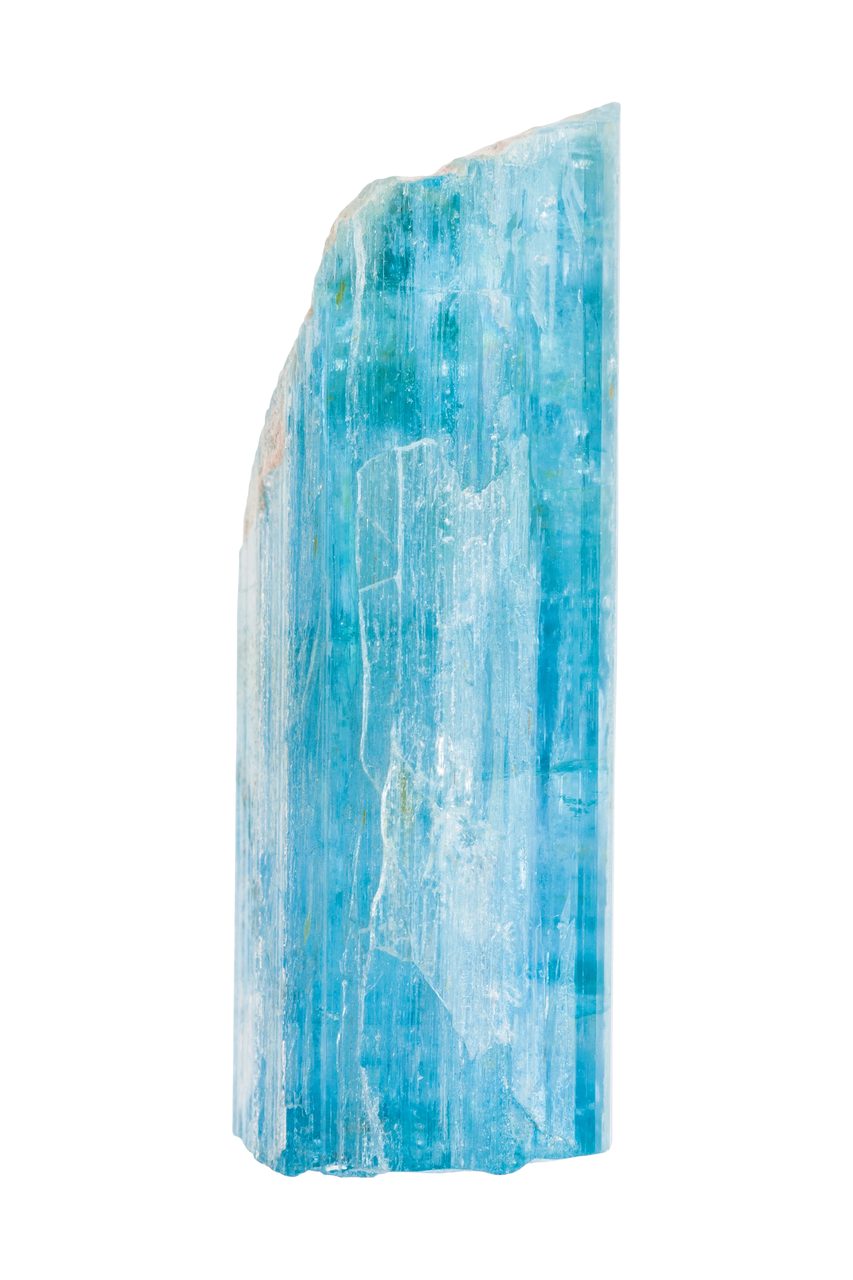
Aquamarine is the blue variety of beryl, the same mineral species that gives us emerald. Emerald is the green to bluish green form, aquamarine the green-blue to blue one, and the difference comes down to traces of other elements inside an otherwise identical crystal. In aquamarine that trace is iron. Most aquamarine is a pale, slightly greenish blue, and GIA notes that heating generally makes it look bluer, which is why so much of what reaches the shops has been gently heated.
Beryl grows in large, clean, well-formed six-sided crystals, and aquamarine is known for it. That habit is what makes very big stones possible. The largest cut aquamarine, the Dom Pedro, was cut from a crystal mined in a Brazilian pegmatite in the late 1980s and named for Brazil's first two emperors. Bernd Munsteiner shaped it into an obelisk about 14 inches tall, weighing 10,363 carats, and the Smithsonian's National Museum of Natural History has displayed it since December 2012.
The name comes from the Latin for seawater, and the lore follows the name. GIA records that ancient mariners believed aquamarine would calm the waves and keep them safe at sea, and that it was thought to bring happiness in marriage. Older beliefs about beryl in general say it protected its wearer in battle and in lawsuits and quickened the intellect.
Brazil's Minas Gerais has been an important source for about two centuries, alongside Pakistan, several African countries and the Mount Antero area of Colorado. Aquamarine is the March birthstone, though on the American list of 1912 it was printed as the alternate to bloodstone. In crystal practice it belongs to the throat and to calm, and its association with water has never left it.
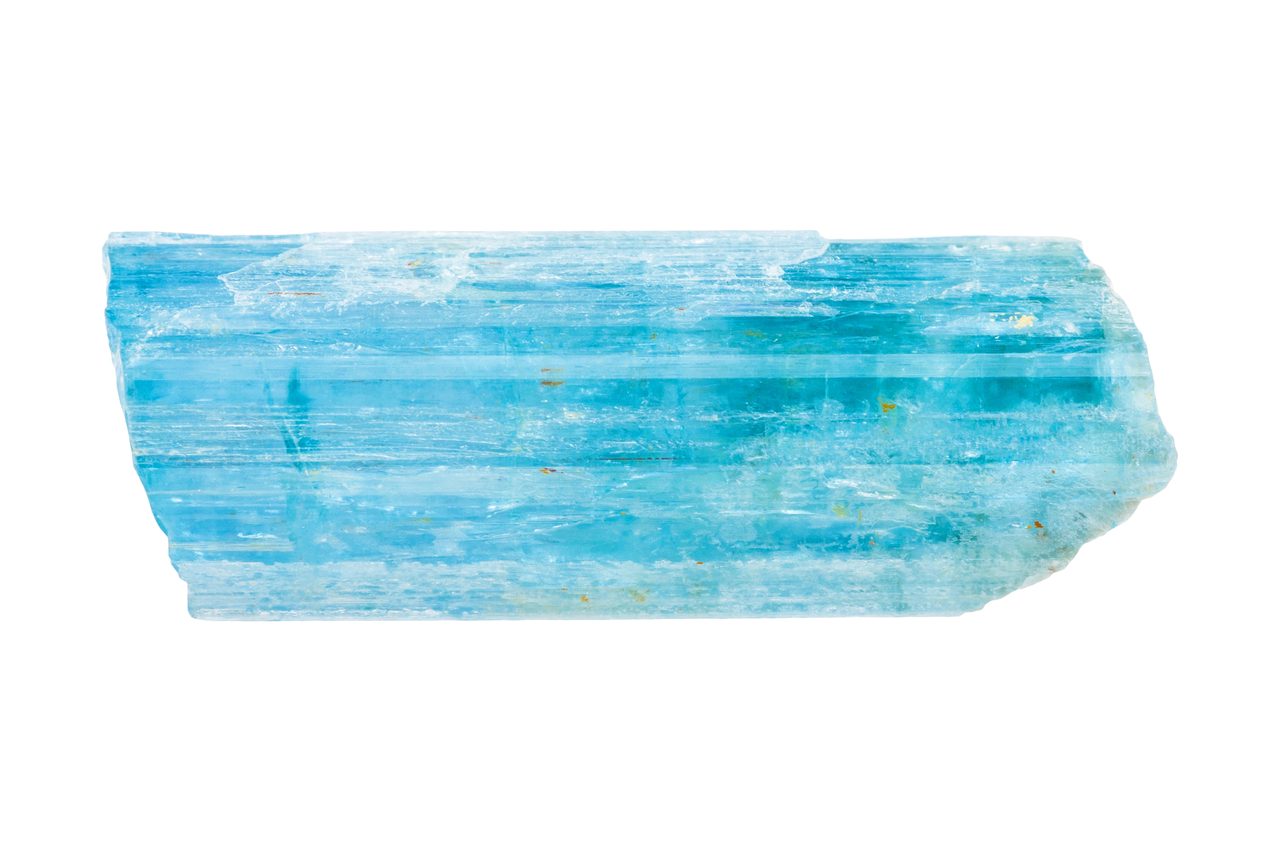
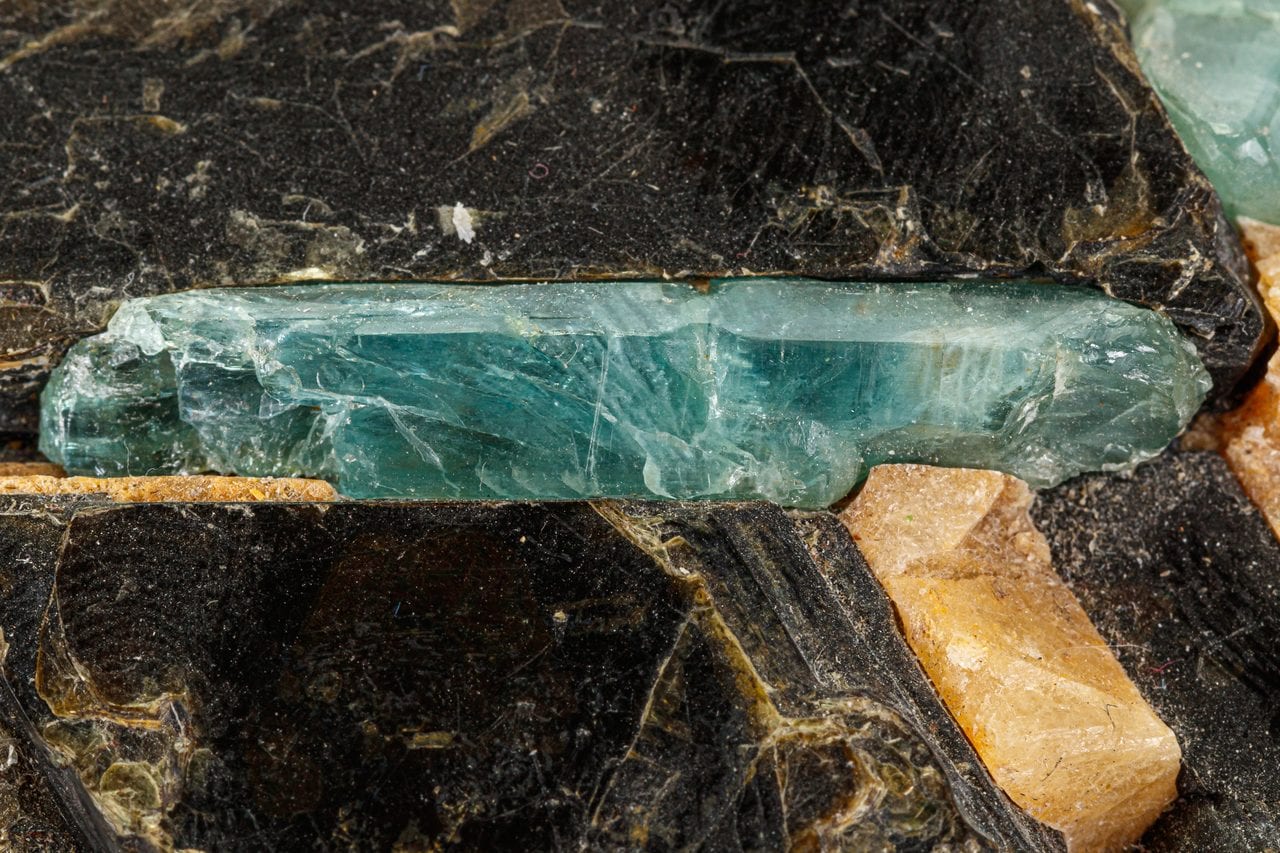
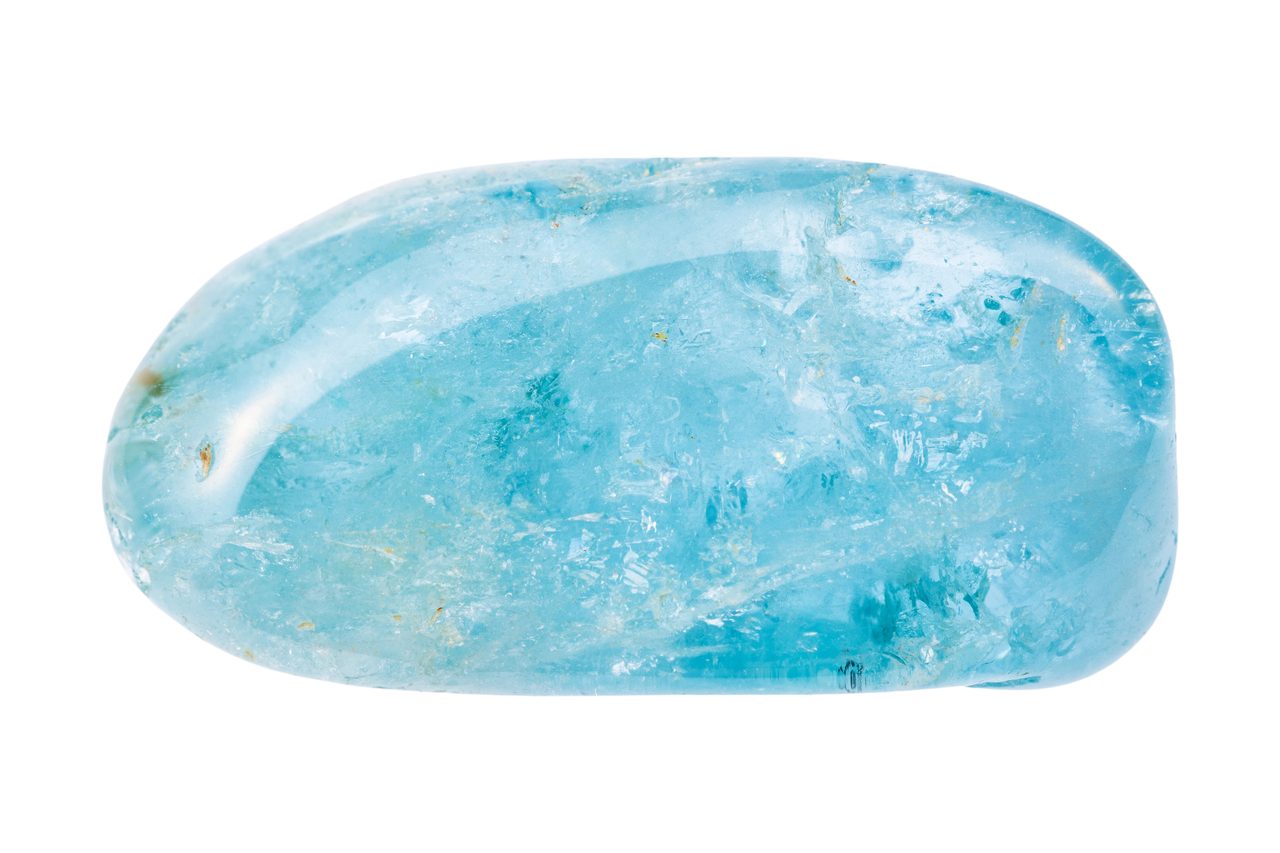
TABLE OF CONTENTS
Properties & Qualities
Physical Properties
Beryl with iron. Aquamarine has beryl's formula, Be₃Al₂Si₆O₁₈, and its hexagonal crystal structure. Iron produces the colour. In ferrous form it leans the stone blue, and in ferric form it pulls it toward green, which is why heat, by shifting that balance, can take a greenish or yellowish cast out of a stone and leave a cleaner blue.
Crystals. Aquamarine grows as long six-sided prisms, often clear enough to facet in large sizes, and GIA notes that its big, well-formed crystals are prized by mineral collectors as well as cutters. Beryl forms in granites and granite pegmatites, coarse-grained rocks where crystals have room to grow.
Colour. The range runs from very pale blue through sky blue and greenish blue to deeper blue. Paler stones are far more common. Deeper colour is easier to see in a larger stone, so size and colour push value up together. The stone is dichroic, showing a stronger blue in one direction than another, and cutters orient it to bring the better colour to the top.
Hardness and durability. At 7.5 to 8 on the Mohs scale, aquamarine is harder than quartz, and GIA calls it durable enough for everyday wear. Its cleavage is imperfect, so it has no easy plane of weakness of the kind that makes topaz risky to knock, though like most gems it is brittle and can chip on a hard edge.
Density and refractive index. Beryl's specific gravity runs from 2.63 to 2.97 in the Handbook of Mineralogy, averaging about 2.7, and aquamarine's refractive index sits at about 1.57 to 1.58. That density is noticeably lower than blue topaz, which helps tell the two apart.
Treatments and look-alikes. Heating to remove a green or yellow tint is routine. A different kind of blue beryl, Maxixe beryl, was found in Brazil in 1917 and owes its deep, sapphire-like blue to colour centres rather than iron. A 1981 paper in Gems & Gemology reports that every specimen on record faded, typically to nearly colourless in one to two weeks of bright sunlight. Irradiated beryl of the same type appeared on the market around 1973, and synthetic blue beryl has also been grown. A 2008 study in the same journal sets out how labs separate all three from natural aquamarine.
Care. GIA recommends warm water, mild dish soap and a soft toothbrush, paying attention to the places where dirt collects behind the stone. Ultrasonic and steam cleaners are usually safe, as long as the stone has no fractures or liquid inclusions.
Metaphysical properties
The sea gives aquamarine its whole traditional character. Sailors' belief that it calmed waves and kept them safe made it a travel and protection stone long before modern crystal practice existed, and that association carries through the later readings: calm, flow, emotional steadiness and courage under pressure.
Modern practice places aquamarine at the throat and links it with speaking, especially with getting something said out loud once a person knows what they want to say. Its pale blue is read as cooling and clarifying, and it is commonly recommended for nerves around speaking, interviews and difficult conversations. Our article on what chakra aquamarine belongs to covers that placement in detail.
GIA adds that faceted aquamarine has been taken to symbolise purity of spirit and soul, and the older beryl beliefs about protection in battle and lawsuits sit behind its reputation as a stone of steady courage.
Practitioners also work with it for a clear, uncluttered mind, which echoes the old idea that beryl quickened the intellect. Its cool tone is set against agitation, so it is chosen for overthinking and for moments when emotion and judgement are pulling in different directions. Some keep it near during study or long stretches of focused work.
Meaning & Symbolism
Physical meaning
Aquamarine's clarity is its physical signature. It grows large and clean, and a good stone lets light pass through with very little in the way. Practitioners read that openness as an image of transparency, of saying what is meant without murk or hidden layers.
Its colour is also a matter of balance. The same iron that makes it blue can make it green, depending on its form, and a little heat tips the balance toward blue. The stone therefore lends itself to themes of adjustment and gentle correction, small changes that settle something into its clearer state.
Aquamarine is dichroic, stronger in colour from one direction than another, and a cutter turns the rough until the better blue faces up. In crystal practice this becomes a picture of perspective, of how a situation can look clearer once it is approached from another side. Its hardness carries a plainer message. A stone sound enough for everyday rings is read as calm that holds up through ordinary days.
Spiritual meaning
Spiritually, aquamarine is read through water. It is associated with tides and with going with the flow of events, and with the idea that calm can be found inside movement as well as in stillness. The sailors' amulet becomes, in modern practice, a stone for steadiness when life feels like rough water.
It is also a stone of truthful expression. Practitioners connect its clarity with honesty of the gentle kind, said with care, and with the courage to speak without needing to win.
Its pale blue, the colour of the seawater its name points to, is read as a meeting point between sky and sea. Practitioners use that image for the link between ordinary life and inner guidance, and some connect the stone with the heart as well as the throat, so that what is spoken carries feeling as well as thought.
The old picture of safe passage has a spiritual form too. Aquamarine is described as a companion for transitions, held by people moving from one stage of life into the next who want to make that crossing with trust.
Healing Benefits
Physical healing
Aquamarine's healing uses belong to tradition and energy work, not to medicine.
In practice it is associated with the throat and voice, and with calm, cool breathing during stressful moments. Its sea lore also links it with travel, and our guide to crystals for travel sets out what has and has not been tested about the wrist point some travellers press on journeys. Some hold it during relaxation exercises as a cool object to rest attention on. A doctor is the right first call for any physical problem.
Aquamarine is not a substitute for medical care. If something in your body worries you, see a doctor.
Emotional healing
Practitioners use aquamarine to let off the tension that builds before something difficult. It is associated with emotional fluency, letting feelings move instead of piling up, and with speaking about them without being swamped.
It is also linked with courage. The protective reading that once belonged to sailors and soldiers is now applied to ordinary pressures: a hard conversation, a presentation, a first day somewhere new. Some people keep it close on those days as a small, cool, physical reminder to breathe.
Practitioners also turn to it when feelings have been held back for a long time and are hard to name. One way of working is to hold the stone while talking a problem through with a friend, letting it set a slower pace. It is associated with patience and a cooler temper, and some people reach for it after an argument, before replying to a message written in irritation.
Spiritual healing
In spiritual healing, aquamarine is placed at the throat to help bring inner truth into words, and used in meditation for a clear head. Practitioners describe its energy as cleansing in the way water is, washing away what has gone stale.
It is also used for compassion and for gentleness toward oneself, especially in periods of change. Water imagery runs through this work, with the stone held during meditations on letting go and on trusting the tide.
One simple practice is to rest the stone at the throat and hum softly on each out-breath, letting the sound loosen whatever feels held there. Some practitioners keep a piece in a small bowl of water on a home altar and sit with it for a few minutes at the start or end of the day. Others picture a pale blue light gathering at the throat as they meditate, then let it spread outward.
Use & Care
How to use
- Throat rest: Lie back for a short while with the stone in the hollow of your neck.
- Before speaking: Hold a piece before an interview, presentation or difficult call as a cue to slow down and breathe.
- Travel: Carry or wear it on trips, especially by water, in the sailors' tradition.
- Everyday jewellery: Its hardness makes it one of the more practical blue stones for rings and bracelets worn daily.
- Short chain: A pendant on a short chain keeps it close to the throat.
- By water: Keep a piece in a bathroom or by a bath for quiet moments, since water does it no harm.
- Meditation: Hold a clear, pale piece and picture slow-moving water while you breathe out.
- On the desk: A tumbled piece beside the phone serves as a cue for calls that need a level voice.
- Bedside: Some people place it by the bed when the mind will not settle at night.
- As a gift: Given to couples, it follows the old lore of happiness in marriage.
- Shared rooms: A raw prism suits the room where household conversations happen.
How to cleanse
- Running water: A rinse under cool running water is safe for polished aquamarine and fits its water lore.
- Moonlight: Set it on a windowsill on a full-moon night, in step with the tides.
- Sea water or salt water: Practitioners near the coast rinse it in the sea, then in fresh water, and dry it.
- Rain: Some practitioners put raw crystals outside during a light shower.
- Sound: Use a singing bowl or chimes nearby.
- Breath: Hold it and breathe out slowly over the stone, with the intention of clearing it.
- Incense: A brief pass through incense smoke is another choice if water is not to hand.
- Wave visualisation: Picture a wave washing over the stone and drawing back out.
- Practical cleaning: Use warm water, mild dish soap and a soft toothbrush, as GIA recommends. Skip ultrasonic and steam cleaners if the stone has visible fractures or inclusions.
How to charge
- Full moon: A night under the full moon is a favourite charge, in keeping with its link to the tides.
- Near water: Rest it by a window that looks onto water, or on a dish of clean water, overnight.
- Daylight: Practice uses short spells of morning light. Keep any very deep blue beryl of unknown type out of strong sun, since Maxixe-type colour fades.
- Spoken intention: Say aloud the thing you are trying to find words for, which suits a throat stone.
- With clear quartz: Practice commonly sets it overnight beside a clear quartz cluster for a boost.
- Seashore: On a coastal visit, rest it on a rock above the waterline for an hour.
- Seashell: Leave it overnight in a large shell, a small nod to its name.
- Amethyst geode: Practice also uses an amethyst geode, a match for the calm both stones are known for.
- Before wearing: Hold it at the throat for a few slow breaths to set it for the day.
Combining with other stones
- Bloodstone: March's other birthstone, and the older one on the 1912 list. The pairing puts a grounding green stone beside a cool blue one. Our March birthstone article covers how each of the two is worn and given.
- Moonstone: Its lunar, tidal reading sits easily beside aquamarine's sea lore, and the two are worn together for gentle expression.
- Amazonite: A blue-green throat stone, paired for clear and calm communication. See Amazonite.
- Clear quartz: Paired to turn up aquamarine's clear, cool reading.
- Amethyst: For calm and meditation.
- Other beryls: Emerald and heliodor share aquamarine's species and are sometimes combined in family sets. See Beryl.
- Sodalite: Another blue stone of clear speech, carried with it before talks or exams. See Sodalite.
- Blue kyanite: Set beside it in throat layouts for calm, direct expression. See Kyanite.
- Blue lace agate: A gentle pale blue throat stone, paired when a softer voice is wanted.
Identification
Can be mistaken for
- Blue topaz: A common substitute, which with rare exceptions is irradiated and heated colourless topaz. It is heavier and has one perfect cleavage. Our aquamarine and blue topaz comparison goes through the differences. See Topaz.
- Synthetic spinel: Blue synthetic spinel has long been used as an aquamarine imitant. It is singly refractive, unlike beryl, which a gemmologist can check.
- Glass: Blue glass imitations can show round bubbles and swirl marks under a loupe.
- Maxixe-type beryl: Deep blue beryl coloured by unstable colour centres. It is genuine beryl, but its colour fades in light, typically within weeks.
- Synthetic blue beryl: Lab-grown beryl, identified by labs from its internal growth features and chemistry.
- Blue zircon: Brighter and more fiery, with strong doubling of the back facets. See Zircon.
- Pale blue fluorite: Much softer, at 4 on the Mohs scale, and easily scratched. See Fluorite.
- Dyed quartz: Pale or crackled quartz beads are sometimes dyed blue and sold as aquamarine. See Quartz (Clear).
How to spot a fake
- Check the colour: Very saturated, electric blue in a small stone at a modest price is more likely blue topaz. Natural aquamarine tends toward soft, slightly greenish blue.
- Compare the weight: Topaz is noticeably denser, so a topaz of the same size sits heavier in the hand.
- Use a loupe: Gas bubbles and swirl lines point to glass.
- Check bead cracks: Blue pooling in fine cracks or round drill holes suggests dye.
- Try a dichroscope: This small gemmologist's tool can show natural aquamarine's two blues, while glass shows a single colour.
- Ask about heat: Heating is expected and acceptable. Irradiation, or "blue beryl" with no further explanation, deserves a follow-up question.
- Ask for a report on expensive stones: A gem lab can separate aquamarine, topaz, synthetic spinel, Maxixe-type and synthetic beryl with certainty. For the wording sellers use around treated stones, see what "natural" means when buying crystals.
Sources: GIA, Aquamarine Description; GIA, Aquamarine History and Lore; GIA, March Birthstones; Handbook of Mineralogy, Beryl; Smithsonian, World's Largest Cut Aquamarine, the Dom Pedro (press release, 2012); Nassau, "Nonfading Maxixe-Type Beryl?", Gems & Gemology, Winter 1981; Adamo et al., "Aquamarine, Maxixe-Type Beryl, and Hydrothermal Synthetic Blue Beryl", Gems & Gemology, Fall 2008; The Jewelers' Circular, 14 August 1912.