Here is our position, stated plainly. “Natural” is the single most abused word in the crystal trade, and most of the time it tells you almost nothing. A stone can be entirely natural and still be dyed, heated, irradiated, coated, reconstituted, or sold under a name that belongs to a different mineral. The word that is supposed to reassure you is doing dishonest work. What you actually want to know is narrower and more useful: what, if anything, was done to this stone, and is the name on the tag the real one.
Most sites will tell you to “buy natural crystals” as though that settles the matter. It does not. It is a comforting phrase that survives precisely because it is vague. So rather than repeat it, we want to take the word apart and show you what it hides, what it does not, and the questions that expose the difference. The aim is not to make you suspicious of everything. It is to make you precise.
What Most Sites Get Wrong
The common framing treats “natural” as a switch with two settings: natural and good, or fake and bad. Reality does not divide that cleanly. A great deal of the crystal market sits in a wide middle ground where stones are genuinely natural material that has been altered in some way, and where the alteration is neither hidden nor disclosed, just quietly assumed.
The problem with the binary is that it lets a seller answer “yes, it’s natural” with a clear conscience while telling you nothing that matters. Dyed agate is natural agate. Heat-treated citrine is natural quartz. Irradiated blue topaz is natural topaz. Every one of those stones came out of the ground, so every one of them can be called “natural” without anyone technically lying. The word is true and useless at the same time.
What you are usually trying to find out is not whether the raw material was mined. It is whether the colour, the clarity, or the identity in front of you is the one nature produced, or one that a workshop produced. Those are different questions, and “is it natural” collapses them into one.
The Four Things “Natural” Usually Hides
Most alteration in the crystal trade falls into a handful of categories. None of them makes a stone fake. All of them are things the word “natural” can be used to paper over.
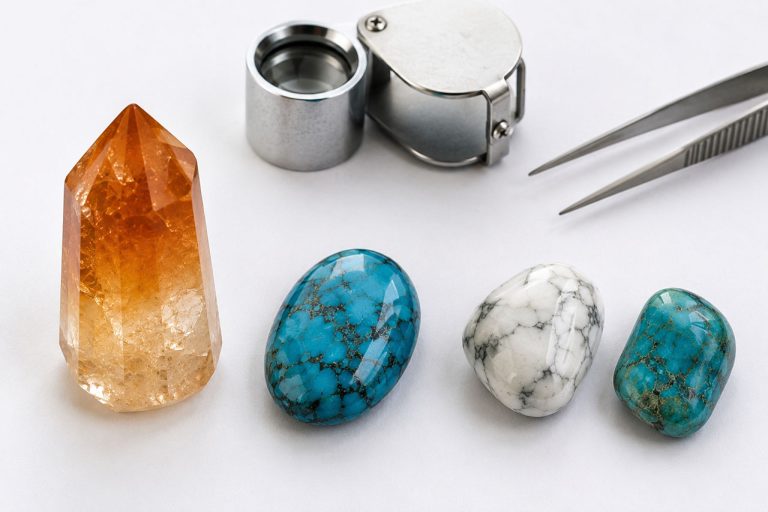
Dye. Porous stones take colour readily, and the trade has dyed them for a very long time. Grey chalcedony becomes vivid “black onyx” through an old sugar-and-acid process. Pale, chalky howlite and magnesite are dyed blue and sold as “turquoise.” Agate slices are dyed in colours no agate ever grew. The gemmological record documents the pattern in detail: laboratories have described dyed quartzite passed off as “lavender jadeite,” with the dye visibly concentrated along surface-reaching cracks rather than distributed the way natural colour would be, and dyed magnesite whose porosity makes it a convincing stand-in for other ornamental stones (GIA, Gems & Gemology, Summer 1991; GIA, Gem News on dyed magnesite). The stone is natural. The colour is not.
Heat. Gentle, ancient, and extremely common. Most commercial citrine is amethyst or smoky quartz that has been heated until its purple or grey turns golden. Much of the “citrine” on the market has never been the naturally golden variety at all. Heat is stable and accepted, but a heated stone and a naturally coloured one are not the same object, and they should not carry the same price or the same story.
Irradiation. Less intuitive, equally routine. Nearly all vivid blue topaz begins as colourless or pale topaz that is irradiated and then heated to fix the colour (Gabriel & Co., blue topaz vs aquamarine). The trade names Sky Blue, Swiss Blue, and London Blue are all treated colours, not grades of a natural blue. Some smoky quartz is darkened the same way. The treatment is standard and stable. It is still treatment, and “natural” glides right over it.
Coating and reconstitution. Aura quartz, with its metallic rainbow sheen, is ordinary quartz bonded with a microscopically thin layer of vaporised metal. “Reconstituted” turquoise and amber are ground fragments bound back together with resin. These are further from natural still, and the word is stretched furthest to cover them.
The Trade-Name Problem
Alteration is only half of it. A stone can be one hundred percent natural, untreated, exactly what it appears to be, and still be misdescribed, because the name is wrong. This is where “natural” is least protective, since it says nothing at all about identity.
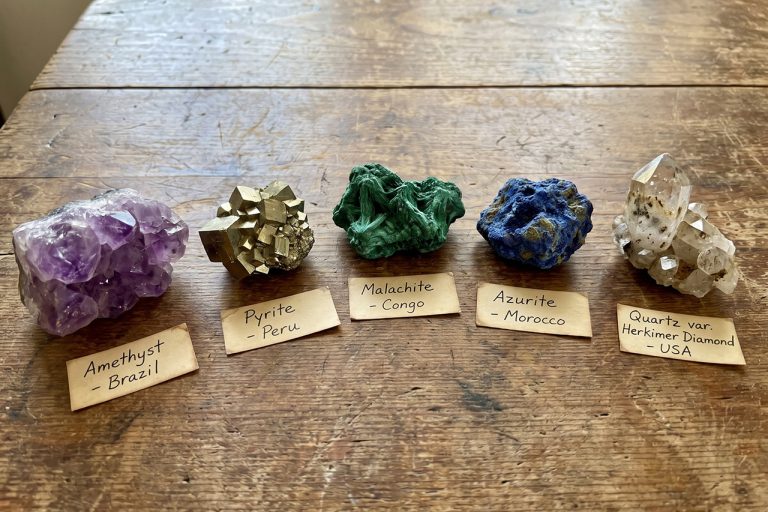
The trade runs on evocative names, and many of them belong to no mineral in particular. “New jade,” “olive jade,” and “Korean jade” are usually serpentine, a softer, cheaper stone wearing jade’s prestige. “Opalite” is manufactured glass, not a variety of opal, whatever the name implies. “Cherry quartz,” “blue goldstone,” and “opalite” are all glass. Among the specimens we have worked with at Crystalance is a piece of grape agate, the botryoidal purple chalcedony from Mamuju in Sulawesi, sold everywhere under a name that is pure marketing, “grape agate” is not a mineralogical term at all, though the stone beneath it is perfectly real chalcedony. The name is invented; the mineral is genuine.
The lesson is that “natural” and “correctly named” are separate guarantees, and a seller can give you the first while quietly withholding the second. A dyed howlite “turquoise” is natural howlite. A serpentine “new jade” is natural serpentine. In both cases the material is real and the name is a costume. When you ask about a stone, the mineral name matters more than the poetry, and a seller who reaches for the poetry when you ask for the mineral is telling you something.
How to Spot Added Colour
You will not always have a laboratory, but added colour often leaves visible clues, and a few of them are worth carrying in your head. Dye is the easiest to catch. Because it enters through pores and cracks, it tends to pool where the stone is most porous rather than sitting evenly through the body. Laboratories describe exactly this pattern in dyed material: colour concentrated along surface-reaching fractures instead of distributed the way natural colour would be (GIA, Gems & Gemology, Summer 1991). Under a loupe, look for colour that is stronger in the crevices than on the flat faces, or a rim of intense colour around a paler core. A cotton bud with a little acetone rubbed on an inconspicuous spot will sometimes lift dye, though a good permanent dye will not budge.
Unnatural uniformity is another tell, and it points the opposite way. A colour so perfectly even that it looks printed, across a large stone or a whole strand of beads, is often too consistent to be natural, since real minerals tend to vary in saturation and zoning across a single piece. Vivid, saturated colour that a mineral does not usually reach on its own, the electric blue of treated topaz, the neon of dyed agate, is a prompt to ask how the colour got there. None of these checks is conclusive on its own, and none replaces a report for an expensive stone. But together they are usually enough to tell you whether a question needs asking.
Natural Does Not Mean Untreated, and Untreated Does Not Mean Better
It would be easy to read all this as an argument that treated stones are inferior and only untreated ones are worth owning. That is not our position, and it would be wrong.
Heat and irradiation are stable, permanent, and centuries old in some cases. A heat-treated citrine is a real, durable, attractive stone. Treated blue topaz is bright, hard, and excellent value. Dyed black onyx is genuine chalcedony that has been coloured by a process the Romans already used, and there is nothing shameful about owning it. The issue has never been that treatment ruins a stone. Plenty of treated stones are lovely and worth buying.
The issue is disclosure and price. A treated stone should be sold as what it is, at the price its treatment warrants, not passed off as a scarcer natural version at a natural version’s price. The harm is not the heat or the dye. The harm is the silence around it, and the premium that silence lets a seller charge. Judged honestly and priced honestly, treatment is simply part of the trade. Judged by the word “natural” alone, it disappears from view, which is exactly the problem.
The Questions That Actually Work
Because “is it natural” is too blunt, replace it with questions that cannot be answered truthfully and vaguely at the same time. A seller who knows their material will answer these without friction. A seller who dodges is answering in a different way.
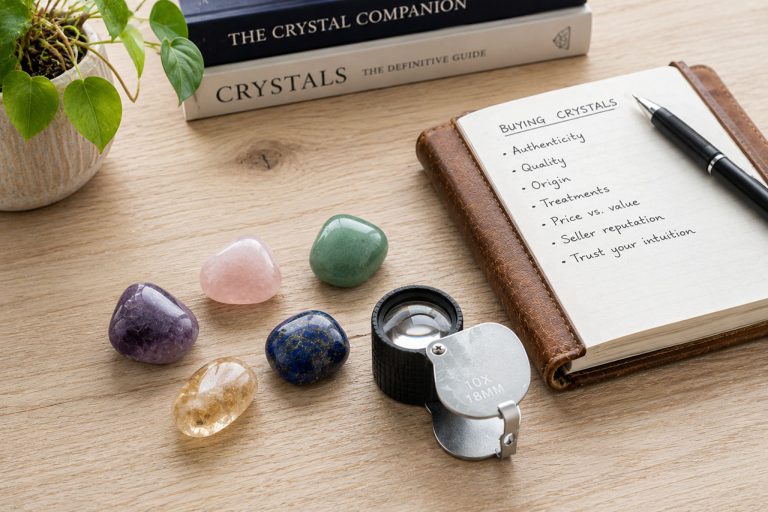
Ask what the mineral is, by its real name, not its trade name. “Is this jadeite, nephrite, or serpentine” is a better question than “is this real jade.” Ask directly whether the colour is natural or added, and if added, whether by dye, heat, or irradiation. Ask where the stone is from, because a seller who can name a locality is usually a seller who knows the rest of the chain too. Ask, for anything expensive, whether it comes with a gemmological report, since a lab is the only party that identifies species and discloses treatment with authority.
Notice what these questions have in common. None of them can be satisfied by the word “natural.” Each forces a specific answer, and specific answers are where honesty lives.
Our Standard
Here is what we hold ourselves to, and what we think you should expect from anyone selling you a stone.
We will not call a stone “natural” and leave it there. If a colour was added, we think you have a right to know how. If a name is a trade name rather than a mineral name, we think the mineral name belongs on the tag beside it. And if a seller cannot or will not tell you what was done to a stone or where it came from, we treat that silence as information in its own right. The absence of an answer is an answer.
This connects to a broader standard we keep about provenance: a seller’s ability to name a stone’s country of origin is a basic test of legitimacy, and the inability to name it is itself telling. The same instinct applies to treatment. A trade that traffics in vague reassurance depends on buyers not asking the next question. The remedy is simply to ask it, and to buy from the people who answer plainly.
None of this should make crystals less enjoyable. Knowing that your citrine was once amethyst, or that your black onyx was dyed the way Roman carvers dyed it, does not diminish the stone. It grounds your relationship to it in what is real rather than what is implied. A natural stone, honestly described, is worth more than a natural stone hiding behind its own adjective.
If You Only Remember One Thing
“Natural” is a floor, not a guarantee, and often it is not even the floor you think. The useful questions are narrower: what mineral is this really, what was done to its colour, and where did it come from. Ask those three, and the word “natural” stops mattering, because you will already know everything it was supposed to tell you and everything it was hiding.
For accurate, plain-language entries on the minerals behind the trade names, see the Crystalance Mineral Library. And when a stone is sold to you as simply “natural,” treat that as the beginning of the conversation, not the end of it.