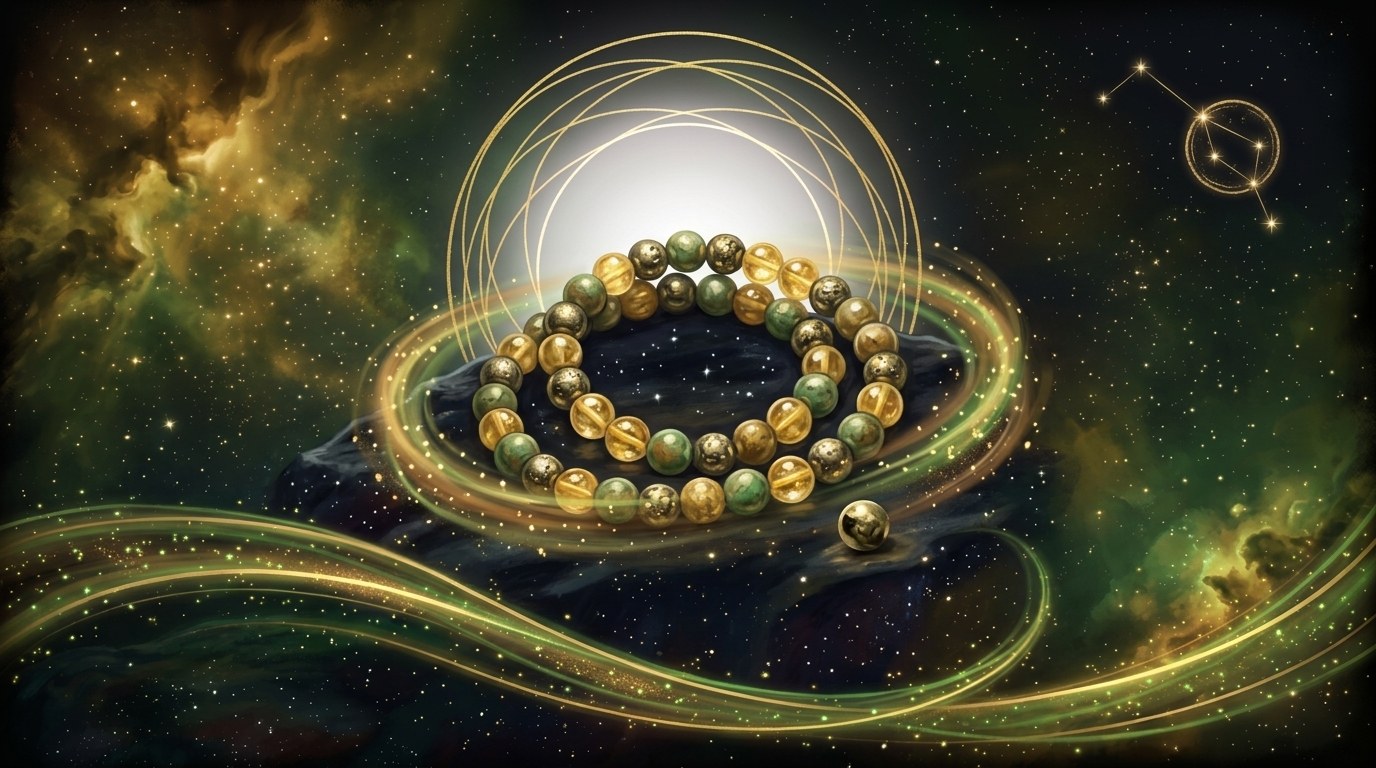
Wear it where you will see it, and restring it once a year. Pyrite, citrine and green aventurine are the usual beads, and the wearing is straightforward. The part that decides how long you keep it is a length of elastic with a working life of months.
Every other crystal object you own is permanent. A tumble in a drawer will outlive you. A cluster on a shelf is doing in fifty years exactly what it does today.
A beaded bracelet is not like that. It is the one thing on the shelf with moving parts, in the sense that something in it is under load every time you put it on, and things under load have a service interval. Nobody sells it to you that way, and the result is that most money bracelets end their lives on a floor rather than in a drawer.
Wearing it, the easy half
The mechanism people are sold is atmospheric and the one that operates is duller and better. A bracelet is the crystal format you cannot forget about, because it is on the arm you type with. You see it before lunch a dozen times without deciding to, and crystal practice uses that: pyrite for confidence with money, citrine for abundance, green aventurine for opportunity, all worn rather than placed so the association is around when a financial decision is.
That needs one honest line under it. Nothing on your wrist moves money. What a worn object does is keep a subject in the room, and if the subject is your own finances, that is not nothing.
Setting an intention when you first put it on earns its place, because it fixes what the object is for. Weekly cleansing schedules and rules about who may touch it are both available and both traditional, and neither is load-bearing. A rule that is making you anxious about a bracelet has stopped doing its job.
The service interval
If your bracelet goes over your hand without a clasp, it is strung on elastic cord, because elastic lets a shop sell one size to everybody.
Elastic is a consumable. It stretches under the daily pull of going over a hand, it takes on hand cream and soap and sweat, it goes brittle, and then it lets go, usually while you are pulling a sleeve down. Hot water and detergent age it faster than anything else you will do to it, which makes the shower the single most useful thing to take it off for.
Put it on a schedule. Roughly once a year for a bracelet worn daily, and sooner if you can see the cord through the gaps between beads or if the bracelet has gone visibly looser on the wrist than it was. Restringing on a date is a five-minute job in your own time. Restringing after a failure is twenty beads under a supermarket shelf.
That is the entire argument of this article, and it needs saying because everything else written about money bracelets is about meaning, and meaning is not what will end this one.
What the practice says about a break, and why it agrees
Crystal practice does have a reading for a broken bracelet, and it is a generous one. The break is commonly taken as completion rather than loss: the piece took something, or the thing you set it for has moved on. You will hear that from practitioners and from sellers, and it is a kinder response to a spilled bracelet than most people manage on their own.
Set beside it is the plain account, which is that a piece of nine-month-old elastic did what nine-month-old elastic does.
Those two do not have to fight, and the useful thing is that they point the same way. Neither of them says throw the beads out. The stones are undamaged, the object is repairable, and treating a snapped cord as the end of the bracelet is the one response that is definitely wrong. If you hold the first reading, restringing is how you begin the next chapter of the object. If you hold the second, restringing is maintenance. Either way you are threading beads on a Sunday.
A harder bead will not save you
There is a particular disappointment waiting for anyone who tries to buy their way out of this by choosing tougher stones.
Bead cards and product pages quote Mohs numbers, and the number does not answer the question being asked of it. The Mineralogical Society of America describes the scale as a measure of the relative hardness and resistance to scratching between minerals. Scratching. It is a chart of what will mark what, and it says nothing about whether a bead survives a fall onto tile, the failure mode a bracelet really has.
Green aventurine is a nice illustration of how little the number settles. Geology.com puts it at 6.5 to 7 and then adds that a lower apparent hardness is observed if mica inclusions are abundant, because aventurine is quartz or quartzite full of small flakes, most often fuchsite, and those flakes are what give it the sparkle you bought it for. The thing that makes the stone look like aventurine is the same thing that softens it. Even on the scale’s own terms the answer is a range rather than a figure.
None of which helps with drops, because nothing on that card was measuring drops. The precaution that works is the cord you replaced before it was old.
Restringing, and the bead that rolled under the fridge
A metre of 0.8mm or 1mm elastic and a big-eye needle cost less than a coffee at any bead shop. Thread it, pull it firm without stretching it tight, tie a surgeon’s knot, put a dab of clear glue on the knot and hide it inside the largest bead. Do it once and a broken bracelet stops being a small tragedy.
If a bead is genuinely lost, restring with what you have. Eleven beads instead of twelve is still the object you set an intention on, and unless you bought a piece built to a stated count, nothing in the practice depends on the number. The Crystalance Mineral Library follows pyrite’s iron sulphide chemistry and the rest of the material side.
Buy the elastic when you buy the bracelet. That is the thing nobody sells you, and it is the thing that keeps the bracelet on your wrist.
Sources
- Mineralogical Society of America, Mohs scale of hardness: “Mohs’ hardness is a measure of the relative hardness and resistance to scratching between minerals.”
- Geology.com, aventurine: a variety of translucent quartz or quartzite with abundant small plate or flake-shaped inclusions, most commonly fuchsite; Mohs 6.5 to 7, with “a lower apparent hardness observed if mica inclusions are abundant”.