Hold the stone while you say the sentence, out loud, and say it again tomorrow. Practice holds that the stone carries the quality you are reaching for, so that speaking in contact with it puts you nearer to that quality. Choose the stone to match the sentence.
I am worthy of the work I do. Said once, out loud, with a piece of rose quartz closed in the hand. There is nothing else to the outward form of a crystal affirmation, which is why the practice gets described as simple and then left there.
What practice says is going on underneath is a good deal more specific. The stone carries a quality. Speaking while you are in contact with it puts you in that quality’s company, and the pairing, repeated, builds an association strong enough that later the stone by itself brings the state back.
Every rule worth following comes out of that account, including one that lets you skip a step most instructions insist on.
What practice says the stone is carrying
The word you will meet first is vibration, and it repays unpacking rather than stepping around. In crystal practice a stone’s vibration is the quality it is held to be associated with, so rose quartz is spoken of as vibrating with warmth toward yourself and amethyst with a settled head. Nothing about that has been demonstrated in a laboratory, and practitioners who use the word are describing a correspondence rather than making a measurement.
The account matters here because it does real work. If the stone carries the quality, then the affirmation is not a request aimed at the stone. It is you naming something out loud in the presence of a physical object already associated with it, and the two together are supposed to move you toward the thing named. The stone is not being asked for anything. It is company.
That is where crystal affirmation work quietly parts from intention work, which treats the stone as somewhere a sentence is stored and comes with its own rules about cleansing and about overwriting one sentence with the next. Those are set out in how to set intentions with crystals and none of them apply here.
Two consequences follow immediately. You can use one stone for several sentences without them interfering, because nothing is being written onto it. And there is no required cleansing step before you begin, because there is nothing on the stone to clear. Cleanse it if the ritual settles you into the practice, and know that you are doing a separate thing rather than a first step.
The stone has to be one your hands find
Contact is doing the work in the practice’s own account, so a stone you rarely touch cannot do it.
A cluster on a high shelf is a lovely object and a poor affirmation stone. What works is small, polished and kept somewhere your hand goes without being sent: a coat pocket, the inside pocket of a bag, a bracelet, the corner of a desk where your wrist rests, the nightstand you reach across before the light goes out.
Size decides more here than the shopping lists suggest. A palm stone you can close a hand around gives you a lot to hold and is easy to leave in a drawer. A pocket tumble is harder to lose track of and offers less to grip. Neither is better. The test is whether you can say where the stone will be at four this afternoon.
Raw pieces are a mixed choice for carrying. Anything with an edge, and anything that sheds, makes itself unwelcome in a pocket quickly, and a stone that has become an irritation stops getting picked up. Polished material asks nothing of you, which is what you want from an object whose whole function is to be handled without a decision.
Saying it
Out loud is the standard instruction, and the reason usually given is that speech is harder to do inattentively than thought is. A whisper counts. In a shared house, mouthing the words with the stone in your fist counts too.
Practice offers counts, and three, seven and twenty-one all turn up depending on which teacher you are reading. Treat the number as a container rather than a target. What the count is for is stopping you from saying the sentence once and drifting off, and a practitioner who says it twice with full attention is closer to the practice as described than one who reaches twenty-one on autopilot.
Time of day comes down to when you will really do it. Morning is the common recommendation. Evening works. What decides it is whether there is an existing habit to hang the new one on, so the kettle boiling, or the moment the bedside light goes off, will hold a practice better than a slot you have to defend.
Give one arrangement a couple of weeks before judging it. When it is not working, start with the sentence rather than the stone. Buying a new crystal is the more satisfying move and rarely the one that was needed.
Which stone for which sentence
Practice sorts these by the quality the sentence is reaching for, on the same principle the whole account runs on.
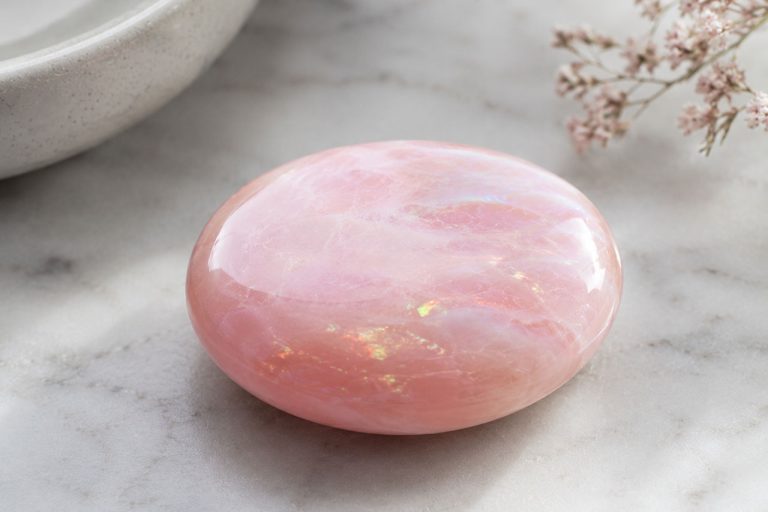
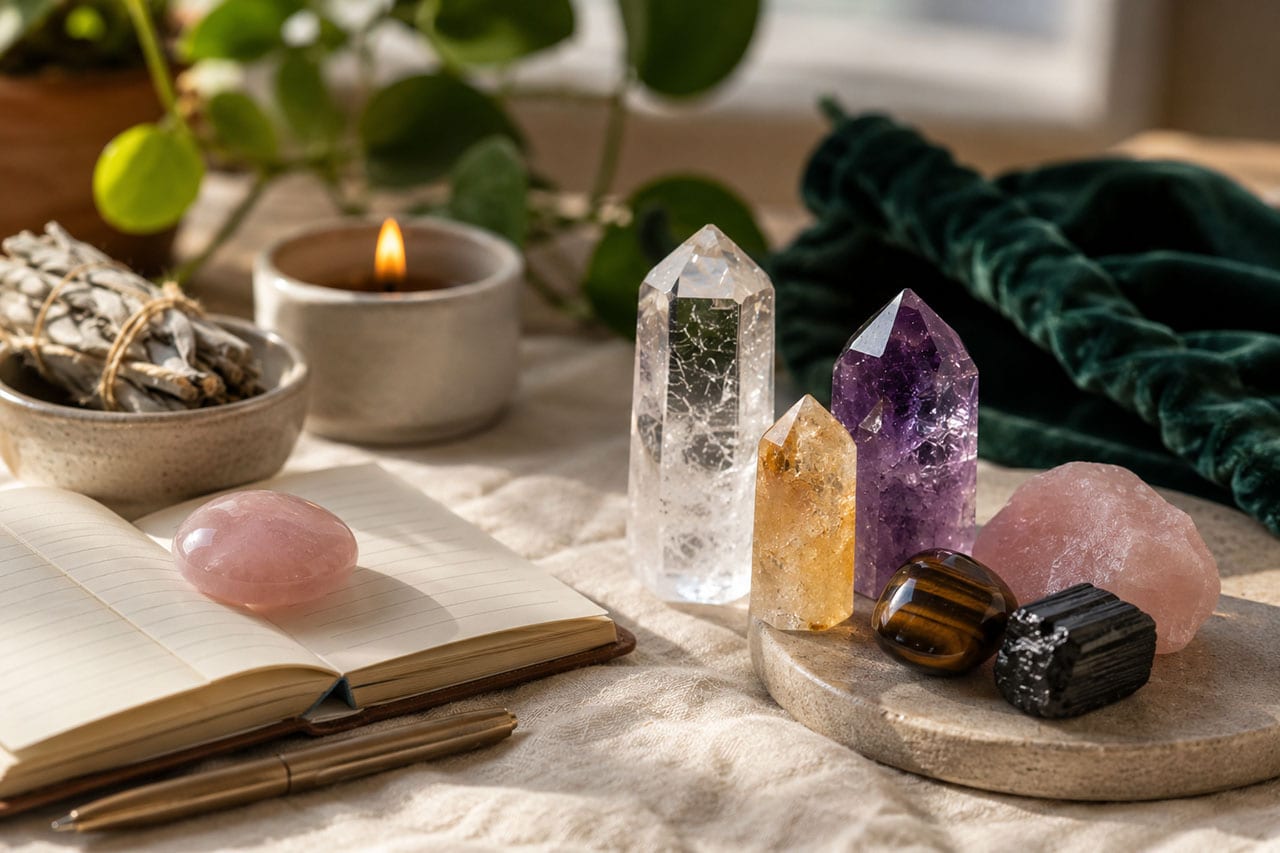
Sentences about warmth toward yourself go to rose quartz. It occurs almost entirely as massive material rather than as crystals, and the pink is attributed to microscopic pink fibres of a borosilicate with properties very like dumortierite. Sentences about a settled head go to amethyst, whose purple comes from trace iron built into the growing quartz and then irradiated by gamma rays from radioactive material in the host rock. Amethyst has one practical vulnerability worth knowing, which is that some of it fades under prolonged exposure to direct sunlight or bright display lamps.
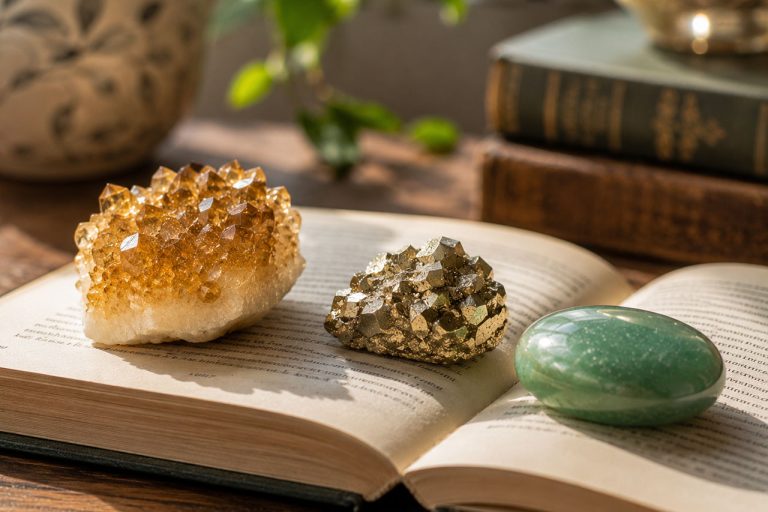
Sentences about doing something rather than feeling something go to citrine for openness and opportunity, and to tiger’s eye when the thing to be done needs nerve at a particular hour. Sentences about ending or refusing something go to black tourmaline, which practice keeps as its boundary stone.
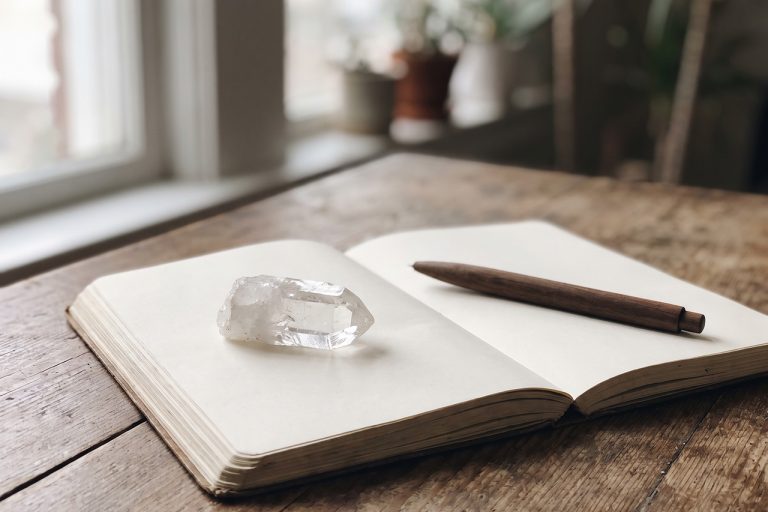
Clear quartz sits outside the sort. Practice treats it as an amplifier, which is a fair description of a stone with no strong single association, and it is the sensible pick when you own one stone and have several sentences. What each of these is as a mineral, underneath the association, is what the Crystalance Mineral Library takes up.
Write the sentence first and choose the stone after. It is the harder order, and it produces a sentence you can say without wincing.