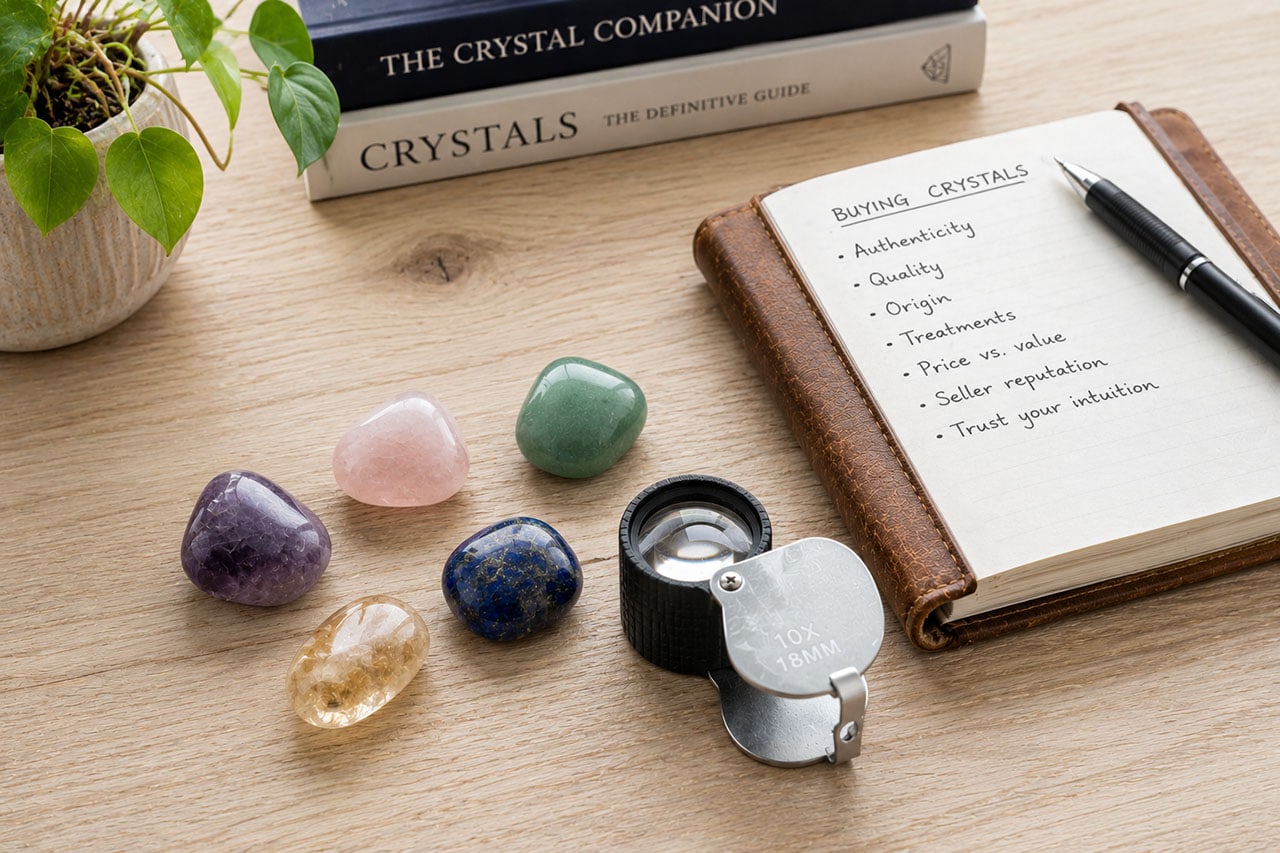
The single question that sorts honest sellers from the rest is: where did this come from? Country of origin, ideally region or mine. A seller who can answer has likely sourced legitimately. A seller who can’t has not. The rest of this guide is about what to do with that information.
Most crystal buyer’s guides will tell you how to spot a fake. They will tell you to look for inclusions, weigh the piece in your hand, check that the colour saturation is right for the species. They are not wrong, but they are not telling you the rest. The piece you are looking at probably is what it is sold as. The harder question is whether the seller knows where it came from.
At Crystalance, we have spent time writing about specific crystals (why lepidolite is expensive, what counts as a crystal, mineral or rock, crystal shapes) and the pattern keeps surfacing. The buying problem is not mostly about authenticity. It is about provenance. The mineral underneath your purchase is usually real. What you cannot usually learn is where it came from, who mined it, how it was extracted, and what happened to it on the way to the shelf.
This is the editorial position we have arrived at, and the standard we hold ourselves to. Here is the guide that comes out of it.
What Most Crystal Sellers Won’t Tell You
The conversation in most crystal shops, online and in person, focuses on three things: what the stone is called, what it is associated with metaphysically, and how much it costs. The conversation that does not happen, in most cases, is about where the stone came from.
This omission is structural. Most retail crystals reach buyers through a long supply chain. Mine, wholesaler, importer, distributor, retail seller, buyer. Each link in that chain strips off context. By the time a piece sits on a shop shelf in San Francisco or London, the information about its specific locality, its mining conditions, and its treatment history has typically been lost. Not hidden. Lost.
Most sellers will tell you the country of origin if you ask. They will tell you “Brazil” or “Madagascar” or “China” without specifics. Some will tell you the region. Very few will tell you the mine, the company, or the extraction conditions. Of those who can, most are specialty dealers in the collector-grade market, not the average crystal-shop seller. Mainstream mineral data sites like mindat.org track localities for almost every commercially-available mineral; the information exists. The supply chain is what has stopped passing it along.
The truth is more interesting than the standard buyer’s-guide framing suggests. The authenticity question (is this stone really what it is sold as?) gets most of the attention because it is solvable and visually checkable. The provenance question (where did this come from?) gets less attention because the honest answer is uncomfortable: most retail sellers do not know.
The One Question That Sorts Honest Sellers From the Rest
Where did this come from?
The question is short. The answer reveals more about the seller than about the stone. A few patterns are worth knowing.
The full answer. A specialty dealer with collector-grade material will often know the mine, the country, sometimes the year of extraction. They will mention it in the listing without being asked. This is the gold standard, available at the gold-standard price tier.
The good answer. A seller who can name the country and the region (Minas Gerais in Brazil, Antsirabe in Madagascar, Mibladen in Morocco) without hesitation has done the work to source from importers who track origin. This is the realistic upper bar for most mainstream retail.
The acceptable answer. A seller who can name the country but not the region has sourced from a wholesaler that tracks origin loosely. This is the mainstream baseline. It is not nothing.
The thin answer. A seller who has to check, or who answers vaguely (“Asia”, “somewhere in Africa”), has sourced from a wholesaler that does not track origin. This is common in mass-market retail and is what most online crystal shops actually look like.
The bad answer. A seller who cannot answer at all, or who deflects the question, has sourced from an undifferentiated importer pool. The mineral is probably real. The provenance is genuinely unknown.
Consider what this tells you. The question “where did this come from?” is not a trick. It is a sorting mechanism. The answer reveals the supply chain the seller is operating in, which reveals the kind of buyer the seller is set up to serve. We do not recommend stones from sellers who give the bad answer. The mineral may be fine. The relationship is not one worth paying for.
The Other Things to Ask
Country of origin is the centerpiece, but a few other questions sharpen the buying decision.
Has this been treated? Heat treatment, irradiation, dyeing, and stabilisation are all common in mainstream commercial crystals. Most commercial citrine is heat-treated amethyst. Some “turquoise” is dyed howlite or stabilised lower-grade material. Bright pink lepidolite is sometimes colour-enhanced. The treatment is not always bad (heat-treated amethyst-to-citrine has been done for centuries and the result is structurally citrine), but the disclosure should be available. A seller who cannot or will not say is keeping information from you.
Is the price tier consistent with the quality tier? Very cheap polished pieces from aggregator platforms are often mass-produced or treated material. Very expensive pieces from specialty sellers are usually collector-grade or rare. Mid-tier mainstream pricing is the most variable, and the country-of-origin question is the best way to sort within that tier.
What is the form? Natural pieces (clusters, points, geodes) carry provenance baggage. Lapidary pieces (spheres, palm stones, towers) carry less. A sphere can be made from any chunk of material; a cluster requires preserved matrix from a real locality. The form determines what provenance information is even possible.
Is the seller someone you can ask follow-up questions of? A specialty dealer with a real shop or a maintained online presence can answer questions over time. An anonymous aggregator listing cannot. The ongoing relationship matters more than most buyer’s guides acknowledge.
How to Read a Listing or Shop Display
A working translation guide.
“Natural” or “authentic”. These words are nearly meaningless in crystal retail. Almost all commercial crystals are “natural” in that they are real minerals from the ground. The word does not address treatment, locality, or sourcing ethics. Ignore it as a quality signal.
“Ethically sourced”. Sometimes meaningful, often not. The phrase has no certification standard in the crystal industry. A seller using it may have done real work, or may be using it as marketing. Country-of-origin specificity is a better proxy.
“Genuine” or “real”. Defensive language, usually deployed when buyers are anxious about fakes. Like “natural”, it tells you the seller is selling real minerals (the bar is low), not that the sourcing is good.
Vague locality (“Asia”, “Africa”, “South America”). Supply chain has lost the country. The seller is reselling from undifferentiated importers.
Specific locality (city, region, named mine). Sourcing chain is intact at least at the importer level. This is what you want to see.
Treatment language (“enhanced”, “stabilised”, “heat-treated”). Disclosure happening. Pay attention to what is being disclosed and decide whether you care.
Price wildly below market. Almost always indicates dropshipped material, treated stones sold as untreated, or composite/reconstituted material. The cheapest tier of crystal retail is rarely a bargain. It is usually a different category of product.
“Crystal” applied loosely. The seller may be using “crystal” for things that are technically rocks, mineraloids, or composites. The category claim is fine if the buyer understands what they are getting.
Red Flags
Specific patterns that should make you walk away.
No country of origin, even when asked directly. The single biggest red flag. If a seller will not name the country, walk away. The mineral may be real. The relationship is not worth your money.
“Activated”, “charged”, “cleansed” as quality claims. These are practice terms, not product terms. A seller using them as differentiators is marketing belief language, not selling on quality.
Unrealistically saturated colour at low price. Heavily dyed material or composite/reconstituted pieces are the most common explanation. GIA has documented dyed magnesite passing for other ornamental materials and dyed quartzite sold as lavender jadeite. Real saturated material commands real prices.
No return policy on physical items. Even small online sellers should accept returns on damaged or misrepresented pieces. A no-return policy on opaque sourcing is a buyer-trap pattern.
Health or psychological claims that go beyond tradition. Crystals do not cure illness. Sellers who imply they do are either confused or dishonest, and either way the relationship is suspect. (For more on the honest framing of crystal-and-practice claims, see what crystals help with anxiety and calm.)
Bulk lots of mixed material at clearance prices. Mass-market aggregator listings selling “lots” of mineral pieces are usually reconstituted material, dyed pieces, or end-of-batch material from larger commercial runs. Fine for casual decor; not what you are paying for if you are paying for collector or practice quality.
“Reiki-infused” or other practitioner-blessed marketing. Adds nothing to the mineral. The price premium is for the marketing, not the stone.
Our Standard
Here is what we hold ourselves to at Crystalance, and what we recommend any honest buyer hold their sellers to.
Country of origin, named. Not “Asia”. The specific country, ideally the region.
Treatment disclosure. If the stone has been heat-treated, irradiated, dyed, or stabilised, that information should be available. We do not penalise treatment when it is disclosed. We do penalise treatment when it is hidden.
Price tier consistent with quality tier. If a piece is priced like collector-grade material, it should come with collector-grade information (named locality, treatment disclosure, return policy). If it is priced like mass-market material, the price should be honest about what it is.
No supernatural health claims. Crystals can support practices that have psychological and emotional effects. They do not cure illness or replace medical care. A seller who claims otherwise has crossed a line worth caring about.
A real human you can ask follow-up questions of. This is the simplest filter. A specialty dealer, a long-running shop, a verifiable online presence. Anonymous one-time-purchase aggregator listings do not pass.
These are not radical standards. They are what any serious mineral retailer in the broader collector market already does. The mainstream crystal-shop world has drifted from them because the supply chain rewards anonymity over disclosure. The drift is not inevitable. Asking the questions, repeatedly, is what shifts the market.
We are not the first publication to make this argument. We probably will not be the last. The point of writing it down is to make the standard repeatable, so that “where did this come from?” becomes a normal opening question rather than a rude one.
For the specific pieces this guide is built on, see why lepidolite is expensive on commodity-market pricing, can you give a crystal as a gift on lower-stakes gift purchases, and the Crystalance Mineral Library for stone-by-stone reference. The buying standards are not separate from the practice standards. A crystal you bought from someone who knew what they were selling is a different object from a crystal you bought from someone who did not. Both might be real minerals. Only one is part of a relationship worth keeping.