Most of what a shop sells as a crystal is one. Crystallographers settle the question by whether a solid’s atoms are ordered, and they settle it with an X-ray beam rather than by eye, which is why looking hard at a polished stone cannot answer it.
The International Union of Crystallography keeps an online dictionary, and its entry for the word crystal offers two definitions rather than one. The first is the one everybody expects: a solid is a crystal if its atoms, ions or molecules form, on average, a long-range ordered arrangement. The second is stranger. A solid is a crystal, it says, if it has essentially a sharp diffraction pattern.
That second sentence describes a result, not a substance. Fire X-rays at the thing, and if most of the scattered intensity arrives in sharp peaks rather than smearing out, it is a crystal. No clause about faces, points, terminations or clarity appears anywhere in either version. One definition names the arrangement and the other names what an instrument sees when the arrangement is there.
All of which leaves the person holding a polished blue lump in a shop some distance from the definition.
The definition is a measurement
The two IUCr definitions are given as direct space and reciprocal space, which is a way of saying the same thing seen from two ends. Direct space describes the arrangement. Reciprocal space describes what the arrangement does to a beam passing through it. The dictionary’s own wording on the second is careful: “essentially” a sharp diffraction pattern, since “most of the intensity of the diffraction is concentrated in relatively sharp Bragg peaks, besides the always present diffuse scattering.”
The reason both entries exist is that the older idea of order turned out to be too narrow. The dictionary notes that in aperiodic crystals, meaning incommensurate structures and quasicrystals, the arrangement is not periodic in three dimensions and is nevertheless still fully ordered, following mathematical rules of its own. A pattern that never repeats can still be a pattern. That was awkward enough to force the definition to move.
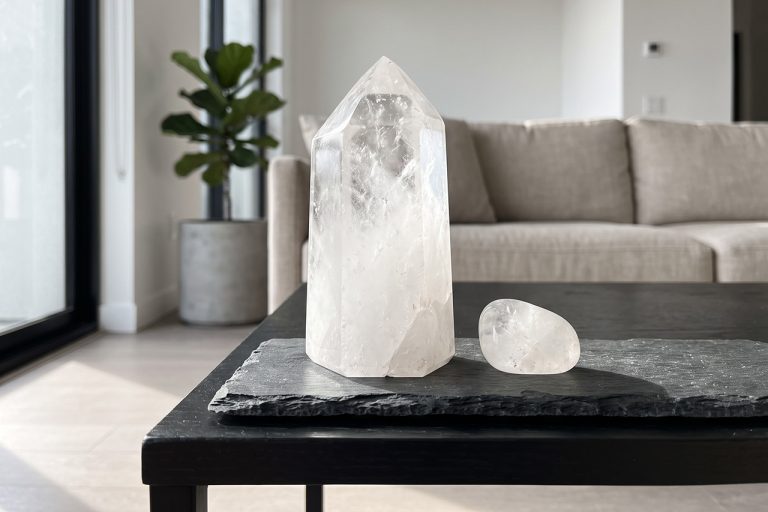
None of this is a test anybody can run on a shop counter, and that is where a buyer has to start. A buyer cannot see order. What a buyer can see is the small set of things order sometimes produces, and the trouble is that those things are unreliable in both directions. Flat faces appear when a crystal had room to grow, are absent when it did not, and are removed by polishing in any case. Transparency and colour are beside the point entirely. A stone can be a textbook crystal and show none of the signs, and a great deal of what a shop stocks is in exactly that position.
The stones with nothing visible are the crystalline half
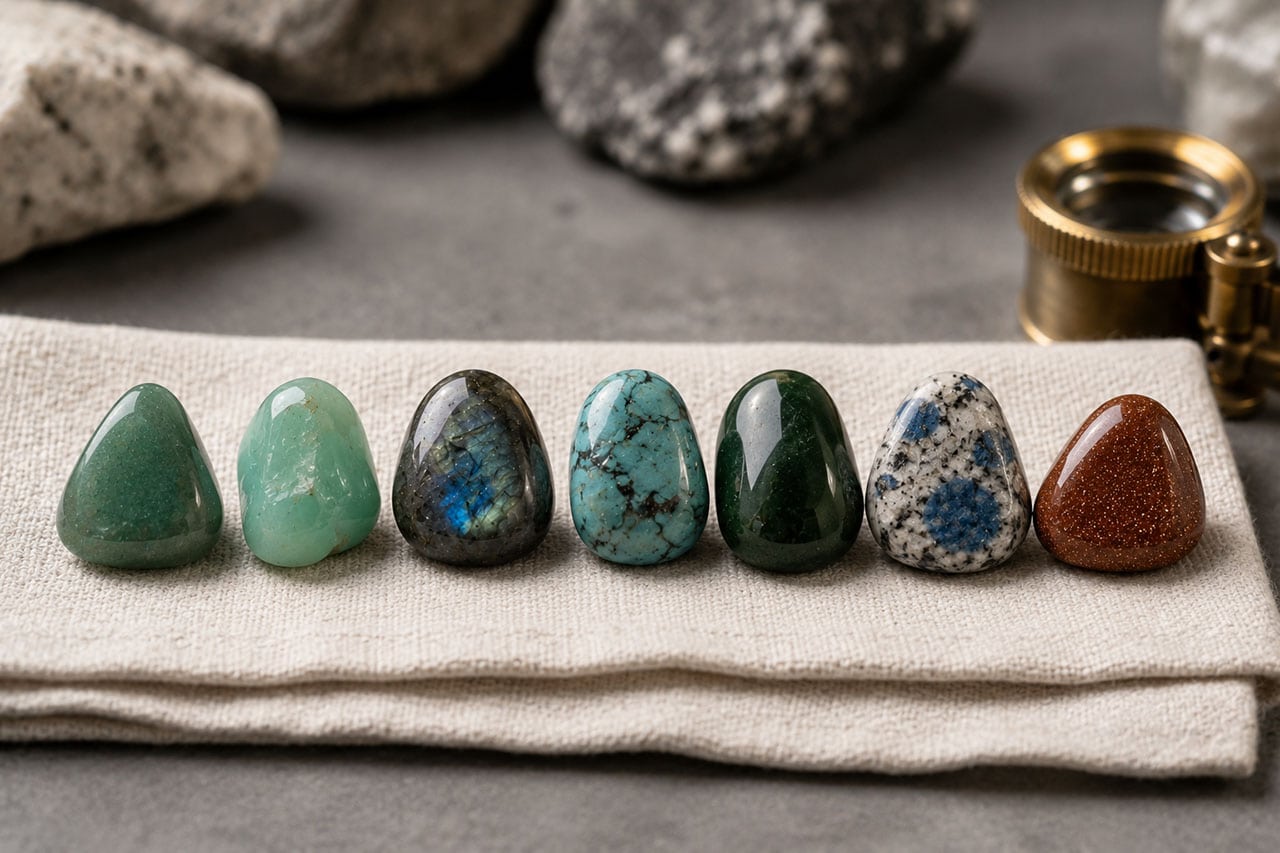
Consider what a piece of carnelian looks like. Warm orange, translucent, waxy, no faces, no points, no visible grain of any kind. If a shop shelf has a stone that looks less like a crystal than that, it is probably an agate sitting next to it.
Both are chalcedony, and chalcedony is quartz. A 2024 comparative study in Mineralogical Magazine opens by restating the settled structural picture in one clause: the microcrystalline fibrous varieties called chalcedony “consist of 50-100 nm alpha-quartz crystallites arranged in a fibre-like texture.” Fifty to a hundred nanometres, which is small enough that several hundred of the larger ones laid end to end would cross a single human hair. Every one of them is quartz with a quartz lattice.
Agate, jasper, carnelian, onyx and chrysoprase are all crystalline, then, and the chalcedony itself will not show you a crystal at any magnification your eye can manage. The word for material like this is cryptocrystalline, meaning the crystals are there and hidden rather than absent, and it covers a large share of what people buy. Agate is the instructive case, because a nodule of it often does carry visible quartz points in a central cavity, and those grew later in an open space. The banded part, the part that is agate, shows nothing. The stone that looks least like the textbook picture is therefore not the exception to the definition, it is a large part of the middle of it.
Orbicular jasper makes the point by accident, and there is a polished piece of it in the collection behind this article. Creamy pale background, dark golden-brown circles scattered across the surface, so evenly spaced and so sharply edged that a first reaction is to wonder whether somebody painted them on. That surface is doing nothing a crystal is supposed to do. It is quartz all the way down.
Why the shop word got wider
The commercial use of “crystal” is not a corruption of the mineralogical one. It grew to cover a different job.
On a shelf, the word does rough duty for a mineral or mineral aggregate that has been shaped, polished and offered for sale, which is a category defined by what has happened to a stone rather than by what its atoms are doing. That is a reasonable thing for a shop to need a word for, and no other word does it. Gemstone means valued enough to cut and set, which is about the market. Mineral means a species and rock means a mixture, which are both about the substance. None of them is what a person means when they say they bought a crystal at the weekend.
Trade names sit on top of that and widen it further. Grape agate is the clean example. It is sold as agate and it is chalcedony in a botryoidal habit, meaning a surface of tightly packed rounded masses, which is a description of shape rather than of the banded structure agate is named for. Nothing is being faked and the material is exactly what it appears to be. The name is doing marketing work and descriptive work at once, and only one of those jobs is being done well.
Where this stops being harmless is the handful of materials that are neither mineral nor aggregate, and that handful stays small. The commoner situation by a long way is a real mineral under a name that describes something else about it.
A better question to ask at the counter
Since the definitive test needs a diffractometer, the useful move is to stop asking the question the instrument answers and ask the one a seller can.
“Is this a crystal” has no answer that can be given across a counter. “What is this” does, and it is a question a seller either can answer or visibly cannot, which is itself information. A good answer names a species or a variety, and it names them separately from the trade name if the two differ. A weak answer repeats the label on the tray. That distinction takes about four seconds to draw and tells you more about the shop than about the stone.
The follow-up worth having ready is whether the material has been treated, because that question does bear on what you are buying and a species name will not cover it. Dyeing, bleaching and coating leave a stone entirely crystalline and entirely not what it looks like. That is the one place where the strict definition fails to protect anybody at all.
Chalcedony has its own page in the Crystalance Mineral Library, which is where the structure and the varieties are set down, and reading it is the fastest way to see how much of a shop is one mineral in several costumes.
What a definition written as an experiment quietly admits is that the category was never meant to be read off a surface. Turning a piece to the light and weighing it in a palm are proxies for something nobody in the room can see, and they are decent proxies, which is a different claim from saying they work. Sellers and buyers have got along without the instrument for as long as there has been a trade, and mostly got the answer right.
Sources
- Online Dictionary of Crystallography, International Union of Crystallography, entry “Crystal”, last edited 23 March 2021, for both definitions and for the note on aperiodic crystals.
- Monico, Cantaluppi, Diella, Gatta, Adamo, Fumagalli and Marinoni (2024), “Similarities and differences among selected gemmological varieties of chalcedony: chemistry, mineralogy and microstructure”, Mineralogical Magazine 88(2), 136-146, for the 50 to 100 nm alpha-quartz crystallites.
- GIA, Gemstone Treatments, for the definitions of dyeing, bleaching and surface coating.