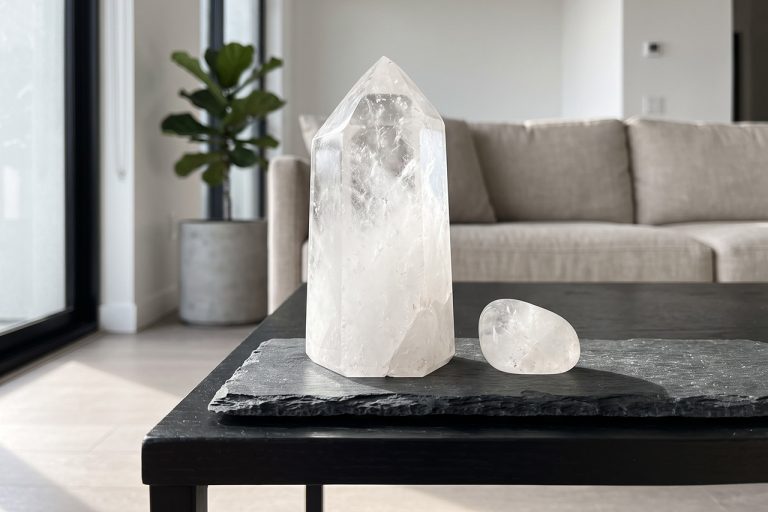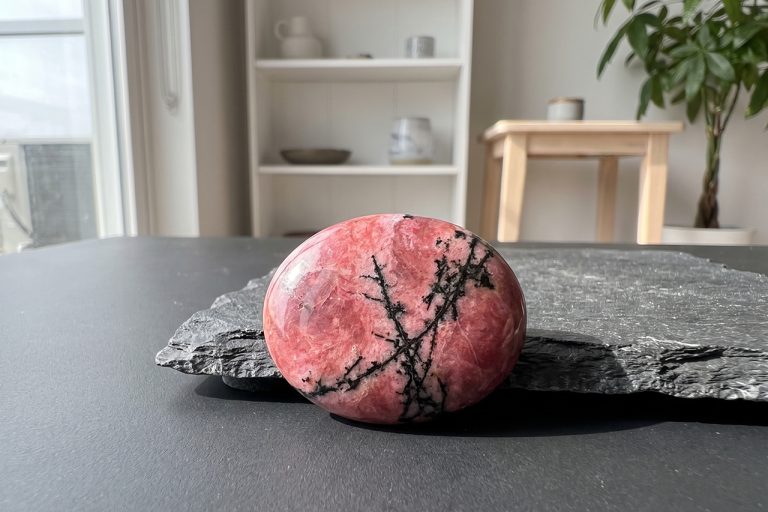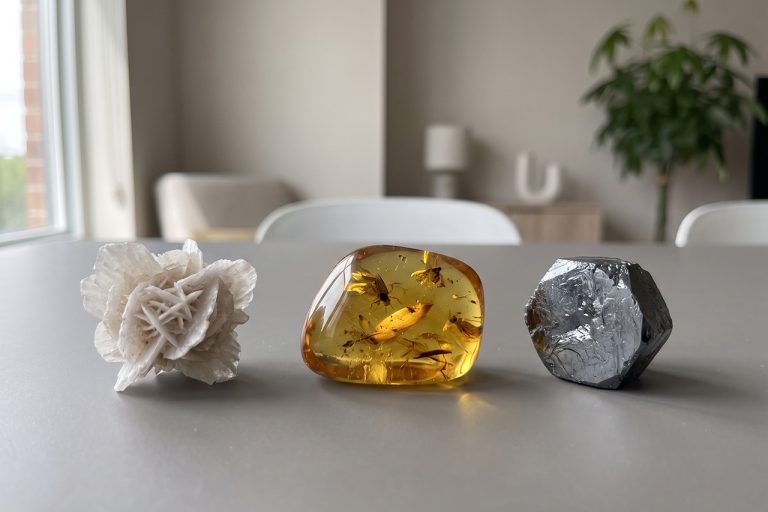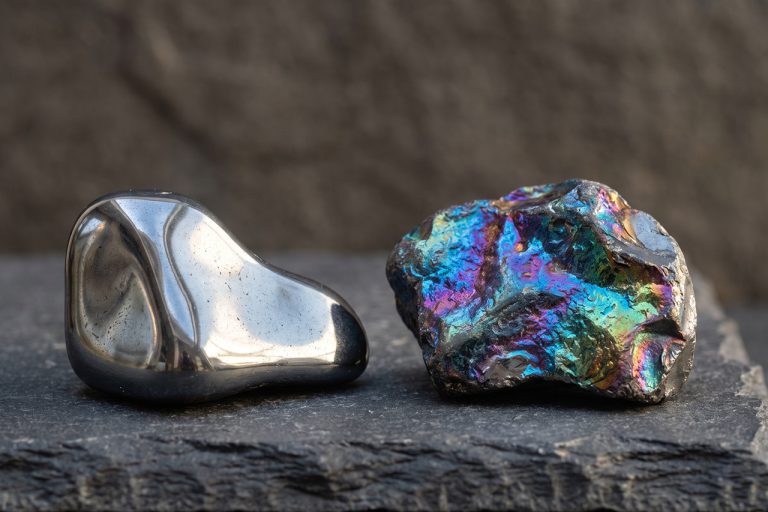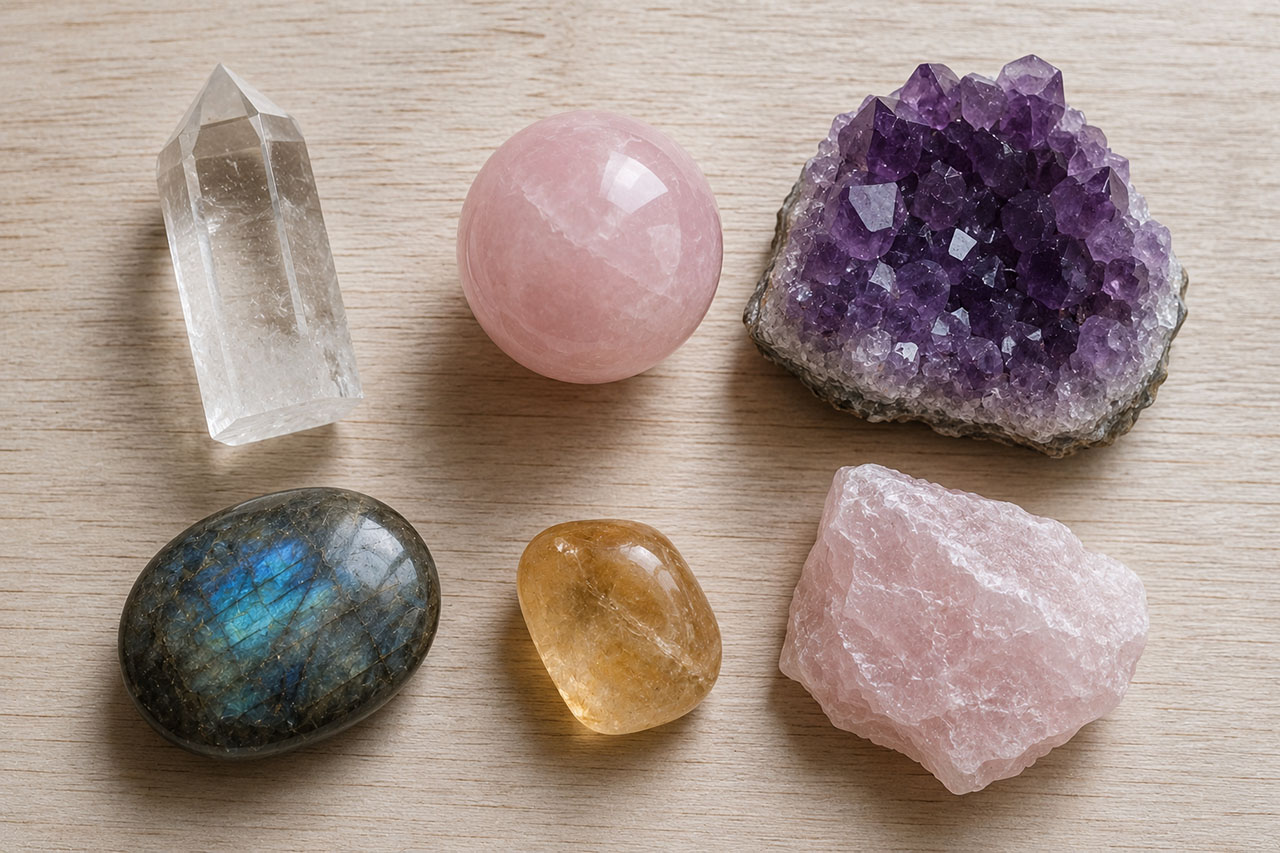
Two families. Clusters, natural points, geodes and druse are shapes the crystal grew into underground. Spheres, towers, palm stones, slices and hearts are shapes a cutter gave it afterwards. The second group is far larger on a shop shelf than most listings suggest.
Before a cutter touches a piece of tiger’s eye or star sapphire, they have to decide which way up the rough will sit, and getting it wrong wastes the stone. GIA’s note on phenomenal cabochons gives the rule in one line: “for best results in star and cat’s eye material, the base of the cabochon should be cut parallel to the inclusions to produce an even effect across the dome of the cabochon.” Cut it at some other angle and the band still exists in the material, but it will not run evenly across the finished dome, and putting that right means going back into the stone and losing weight.
That is a decision made in a workshop, by someone who never met the buyer, about a piece of rock nobody had yet seen the inside of. The same note explains why those stones are domed at all rather than faceted: the needle-like inclusions that produce the effect “would otherwise not be visible in a faceted cut.”
The shape on the shelf, then, is not packaging. It is a reading of the stone, made once and permanently, and a fair amount of what a piece does in the hand was settled by that reading rather than by the mineral.
The shapes that grew that way
A small group of forms are geological, and naming them precisely matters because the rest are not.
A cluster is a group of separate crystals grown from a shared surface, each with its own faces and terminations, sitting on the matrix they grew off. A natural point is a single crystal that reached a proper termination, meaning the geometric tip a crystal closes itself with, though the base has usually been snapped or ground flat where the piece came away from its host. A geode is a hollow nodule lined on the inside with crystals. Druse, or druzy, is a crust of very small crystals across a surface.
These four carry information. The flat underside of a cluster was a cavity wall. The size of the crystals in a geode records how the cavity filled. Break the object and you damage a record, which is a real reason to prefer them intact rather than a sentimental one.
One species can arrive in most of these forms without any help. The Handbook of Mineralogy sets out quartz’s habit in a single run: prismatic crystals with rhombohedral terminations reaching six metres, then pseudocubic, dipyramidal, tapering, needle-like, drusy, fine-grained to microcrystalline, massive. Every one of those is quartz having grown differently, and the list is longer than the lapidary catalogue that follows it.
These are also the shapes a seller cannot produce on demand, and that turns out to matter more than anything above.
The shapes somebody chose
Everything else on a shelf is lapidary work, and the useful way to read the list is by what each form shows you and what it takes away.
A sphere shows the whole surface. There is no back to a sphere, no side kept away from the light, so every inclusion and every crevice is on display at once. Turning one is the only way to see all of a stone. A white agate sphere of five centimetres, kept on a stand, sits on a desk near where this was written, and its surface is not a continuous polish at all. Open crevices and small holes run through it. That is the reason it was bought rather than a defect anybody overlooked. A closed, evenly finished sphere of the same material would be a duller object, and a sphere is the one form that could not have hidden the difference either way.
A slice does the opposite. It shows one plane through the stone and nothing else, and that plane was chosen. Agate banding and septarian cracking are invisible until somebody cuts, and where they cut decides the picture. The septarian nodule beside it was polished on the outside and opened along one side, and the pocket of small dark crystals that opening reveals is visible only because of where the saw went.
A tower or polished spike gives the stone a vertical axis it never had, standing it up so that one direction through the material becomes the direction you look along. In banded material that is a real decision, since the bands can be made to run up the piece or across it depending on how the rough is oriented on the saw.
Then there are the forms that conceal on purpose. A palm stone is worked to the scale of a hand and the geometry goes with it. Tumbling takes away more still, fractures included, since a rounded and evenly polished surface gives the eye nothing to catch on. And a carved heart is not pretending to tell you anything about the stone. It is a gift object, and gift objects have their own honest job.
Practice attaches meanings to these forms, and that tradition should be met on its own terms. Crystal practice holds that a point directs energy along its axis and a sphere sends it out evenly in all directions, and people who work this way often report that holding a sphere feels unlike holding a point. What is fair to say alongside that is where the geometry came from. A lapidary chose it, working from the rough in front of them. Whatever a shape does for someone is happening between the object and the person holding it, which is not nothing, and is not a property of the mineral.
What this changes at the till
One practical consequence runs through all of it, and it is the one that costs money.
Any large enough piece of the same material can be worked into the same lapidary form again. A cluster has no second copy. One consequence of that asymmetry turns up in online listings, where a photographed piece and a shipped piece are not always the same object. A fluorite tower ordered here on the strength of a specific listing image arrived as a different tower from the same batch, with a different shape and a different arrangement of colour. Nothing was concealed and nothing was claimed either. The question that would have settled it in advance is one sentence long. Is the piece in the photograph the piece I will receive?
Asking it about any form does no harm, and it does more work on the lapidary ones, because a tower or a sphere has near-identical siblings in the same crate in a way a cluster generally does not. Sellers who photograph the specific item often say so in the listing without being asked.
The other consequence is quieter. Shape is a finishing decision, so it tells you nothing about what the stone is, and two objects that look like different worlds can be one species. Anyone unpicking which is which is going to end up reading species pages rather than product pages, and the Crystalance Mineral Library is where those live.
There is an oddity in that arrangement. Clusters, geodes and druse are the forms carrying the geological record, and they are the ones ground away to make towers and spheres, and yet the sphere, which takes the most grinding of any of them, is also the form that leaves the material with nowhere to hide.
Sources
- Sharon Bohannon, “Optical Effects of Phenomenal Cabochons”, GIA, 11 November 2016, for the cabochon orientation rule and why phenomenal material is domed rather than faceted.
- Handbook of Mineralogy, quartz: hexagonal, point group 32, hardness 7, habit running from enantiomorphic prismatic crystals with rhombohedral terminations to drusy, microcrystalline and massive forms.