Here is our position. Most of the time, the phrase “ethically sourced” on a crystal listing means nothing, because the person selling the stone has no way of knowing whether it is true. The supply chain that carries a crystal from the ground to a shop is long, informal, and largely untraceable, and a sticker cannot fix that. This does not mean sourcing is hopeless or that you should give up caring. It means the useful questions are narrower and harder than the label suggests, and that one question in particular separates a real answer from a marketing line.
Most sites treat “ethically sourced” as a reassurance to be printed and moved past. We think it deserves the opposite treatment: to be taken seriously enough to ask what could possibly stand behind it. When you follow that thread, you find a trade that is more complicated, and more human, than the wellness framing usually admits. That is uncomfortable, but it is where honesty starts.
What Most Sites Get Wrong
The standard claim is a closed loop. A retailer writes “ethically sourced” on a product page, and a buyer reads it as a guarantee. Neither end of that loop is usually connected to anything. Many crystal sellers make the claim with no mechanism whatsoever to verify it, no chain of custody, no supplier audit, no documentation that would let anyone check (We Are Restless). The words are doing emotional work, not evidentiary work.
This is not always cynical. A small shop may genuinely believe its wholesaler’s assurances, which rest on their supplier’s assurances, which dissolve somewhere upstream into a market where no one is tracking anything. The claim can be sincere and still be unfounded, because sincerity does not create traceability. That is the gap most “ethically sourced” labels fall into: they express a hope, and present it as a fact.
The wrong the phrase commits is not usually a lie. It is a claim to knowledge that the seller does not have, dressed as a promise. Once you see that, you stop asking “is this ethically sourced” and start asking “how would you know,” which is a much more revealing question.
How Crystals Actually Reach You
To understand why the label is so weak, you have to look at how a crystal actually travels. The romantic image is a single miner and a single stone. The reality is a chain with many hands and very little paperwork.
A large share of the world’s decorative crystals and mineral specimens comes from artisanal and small-scale mining, often shortened to ASM: small groups working surface deposits and shallow pits with hand tools, frequently without formal permits or regulation (Stack of Stones). Madagascar is a striking example. Its mineral economy is overwhelmingly artisanal, and the bulk of the island’s crystal output passes through artisan hands before it ever reaches an exporter (Beyond Bohemian). Much of the rose quartz, celestite, labradorite, and quartz that fills shops worldwide begins in exactly this kind of informal digging.
This sits alongside the industrial side of the mineral world, where the geology is better documented. The US Geological Survey tracks global production of the mineral commodities that overlap with the crystal trade, and its work on lithium-cesium-tantalum pegmatites (USGS deposit model) describes the same rock formations that yield collectible tourmaline, kunzite, and lepidolite. But the industrial record documents tonnages and ore grades, not the provenance of the single polished heart in a gift shop. The specimen trade rides alongside industrial extraction without inheriting its documentation.
The result is a chain where the digger, the local buyer, the regional consolidator, the exporter, and the retailer are often five different parties in three different countries, and where the stone’s history is lost at the first handoff. By the time it reaches you, its origin has usually been rounded off to a country name, if that.
The Part the Labels Skip
There is a human cost inside this chain, and the cheerful “ethically sourced” framing exists partly to avoid mentioning it. We think it should be mentioned, carefully and without sensationalism.
Artisanal mining is frequently dangerous and unregulated. Workers often labour without safety equipment or health care, for low pay, in conditions that would be illegal in the countries where the stones are eventually sold. Child labour is part of the picture in some regions. Reporting and advocacy on Madagascar’s mines has cited figures in the tens of thousands of children working in mining nationally, a figure worth treating as reported rather than precise, but not one to wave away (We Are Restless). The environmental toll of unregulated digging, erosion, water contamination, and land disturbance, adds another layer.
We raise this not to make anyone feel guilty for owning crystals, and not to claim the trade is uniquely villainous. Many industries share this shape. We raise it because a stone marketed for its calming, high-vibration properties is still a physical object pulled out of the ground by real people, and pretending otherwise is its own small dishonesty. Taking a stone seriously means taking its origin seriously, including the parts that are not serene.
Why Traceability Is So Hard
If the demand for ethical sourcing is real, why has the supply of proof not caught up? The honest answer is structural. Artisanal supply chains are difficult to verify end to end. Records are inconsistent or absent, multiple buyers stack between the digger and the exporter, and there is no widely adopted third-party certification for decorative crystals the way there is, imperfectly, for diamonds or for some coloured gemstones (Stack of Stones).
The economics work against traceability too. Crystals are low-value per piece compared with fine gems, so the cost of auditing a chain often exceeds the value of the goods moving through it. No one in the chain is paid to keep the paperwork that would make “ethically sourced” checkable, so the paperwork does not exist. The label floats free of any system that could anchor it.
This is why we distrust confident ethical claims more, not less, when they are unusually specific and cheap. A mass-market tumbled stone sold for pocket change, stamped “ethically sourced from happy miners,” is making a claim that its own price makes almost impossible to have verified. The claim and the economics contradict each other.
What Actually Matters
None of this means you are powerless, or that every purchase is compromised. It means the levers that actually work are more modest and more honest than a sticker.
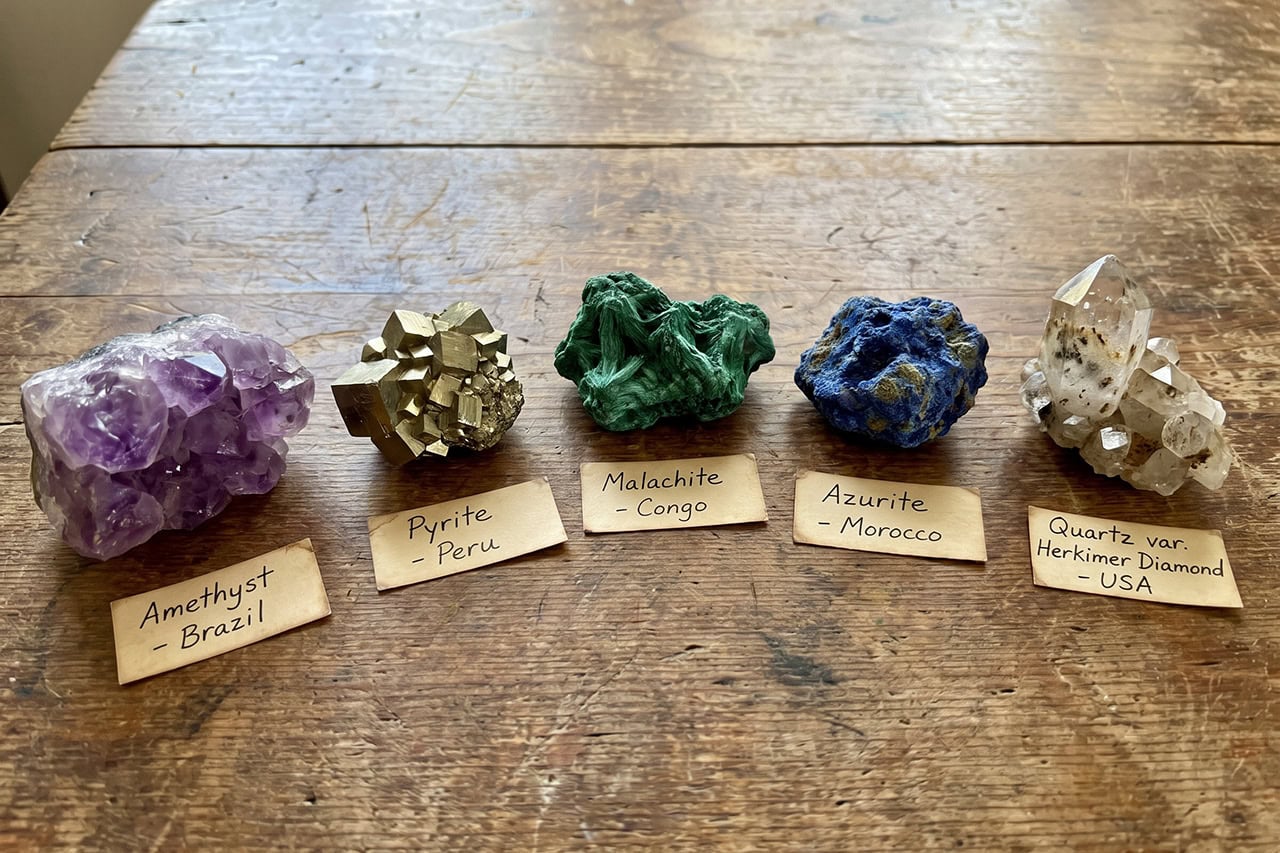
The first and most useful is provenance disclosure. A seller who can name where a stone came from, a country at minimum, ideally a region or a named mine, is a seller who is closer to the source and knows their chain. We treat the ability to name origin as a basic legitimacy signal, and the inability to name it as its own quiet answer. The absence of locality information is information.
Second, favour sellers who buy closer to the source and are candid about what they do not know. The most trustworthy sourcing language we have encountered is not “ethically sourced,” which claims total knowledge, but something more like “bought directly from a dealer at this locality, and here is what we can and cannot confirm.” Honesty about the limits of one’s knowledge is a better sign than a confident blanket claim. Among the specimens we have worked with at Crystalance, the ones with the clearest histories came from named dealers tied to specific localities, a vanadinite from Mibladen in Morocco, a grape agate from Mamuju in Sulawesi, precisely because those sellers dealt in provenance rather than slogans.
Third, buy fewer and better. A trade driven by cheap, high-volume, disposable stones is structurally the one least able to source responsibly, because its margins cannot support the diligence. Buying less, and valuing what you buy, quietly rewards the part of the market that can afford to know where its stones come from.
Responsible Is Not the Same as Perfect
There is a trap on the other side of all this, and it is worth naming so you do not fall into it. Once you understand how compromised the chain is, it is tempting to hunt for the perfectly clean stone, the one mined with no hardship, traded with full paperwork, guaranteed harmless. That stone mostly does not exist, and sellers who promise it are usually the least trustworthy of all, because they are claiming a certainty the trade cannot produce.
Responsible sourcing, realistically, is not a stone untouched by difficulty. It is a chain that is shorter, better documented, and more accountable than the average, run by people who can tell you where a stone came from and are honest about what they cannot confirm. Artisanal mining is not villainous by definition either. For many communities it is a genuine livelihood, and the goal of ethical buying is not to shut it down but to reward the parts of it that treat people and land better. The realistic aim is a better chain, not a pure one. Holding out for purity tends to end in either paralysis or gullibility, and neither helps the miners at the far end of it.
That is why we frame the whole question around disclosure rather than guarantees. A seller who says “here is where it is from, and here is what I know and do not know” is being more responsible than one who says “one hundred percent ethically sourced,” even though the second sounds better. Honesty about limits is the most reliable ethical signal the trade currently offers, precisely because it is the one that cannot be faked by a confident sentence.
Red Flags
A few patterns reliably mark sourcing claims that are not worth trusting. Treat them as prompts to ask more, not necessarily as proof of wrongdoing.
Be wary of “ethically sourced” with no detail attached, since a real answer names something. Be wary of a seller who cannot state a country of origin, because origin is the floor of traceability and its absence usually means the chain is unknown even to them. Be wary of prices that are implausibly low for hand-mined material, since someone in the chain is absorbing that gap and it is rarely the retailer. And be wary of sourcing language that sounds designed to reassure rather than to inform, warm adjectives where you expected a place name.
Our Standard
Here is what we hold ourselves to. We will not describe a stone as “ethically sourced” as a decoration. Where we can name an origin, we name it. Where we cannot, we say so plainly rather than reaching for a comforting phrase we cannot stand behind. Country of origin is the floor, not the ceiling, and a sourcing claim that cannot clear even that floor is a sticker, not a practice.
We would rather tell you honestly that a stone’s deep history is unknown than imply a certainty we do not have. That is less flattering than a confident green label, and we think it is worth more, because it is the only kind of claim you can actually rely on. The trade will improve when buyers reward disclosure over reassurance, and that shift starts with the questions you ask before you pay.
If You Only Remember One Thing
“Ethically sourced” is usually a hope wearing the costume of a fact. The question that actually works is simpler and harder: where is this stone from, and how do you know. A seller who can answer is closer to the source and more accountable for it. A seller who cannot has told you, without meaning to, how little stands behind the label.
For plain, accurate entries on the minerals and their major localities, see the Crystalance Mineral Library. When a stone is sold to you as “ethically sourced,” ask where it is from, and let the quality of the answer decide how much the phrase was worth.