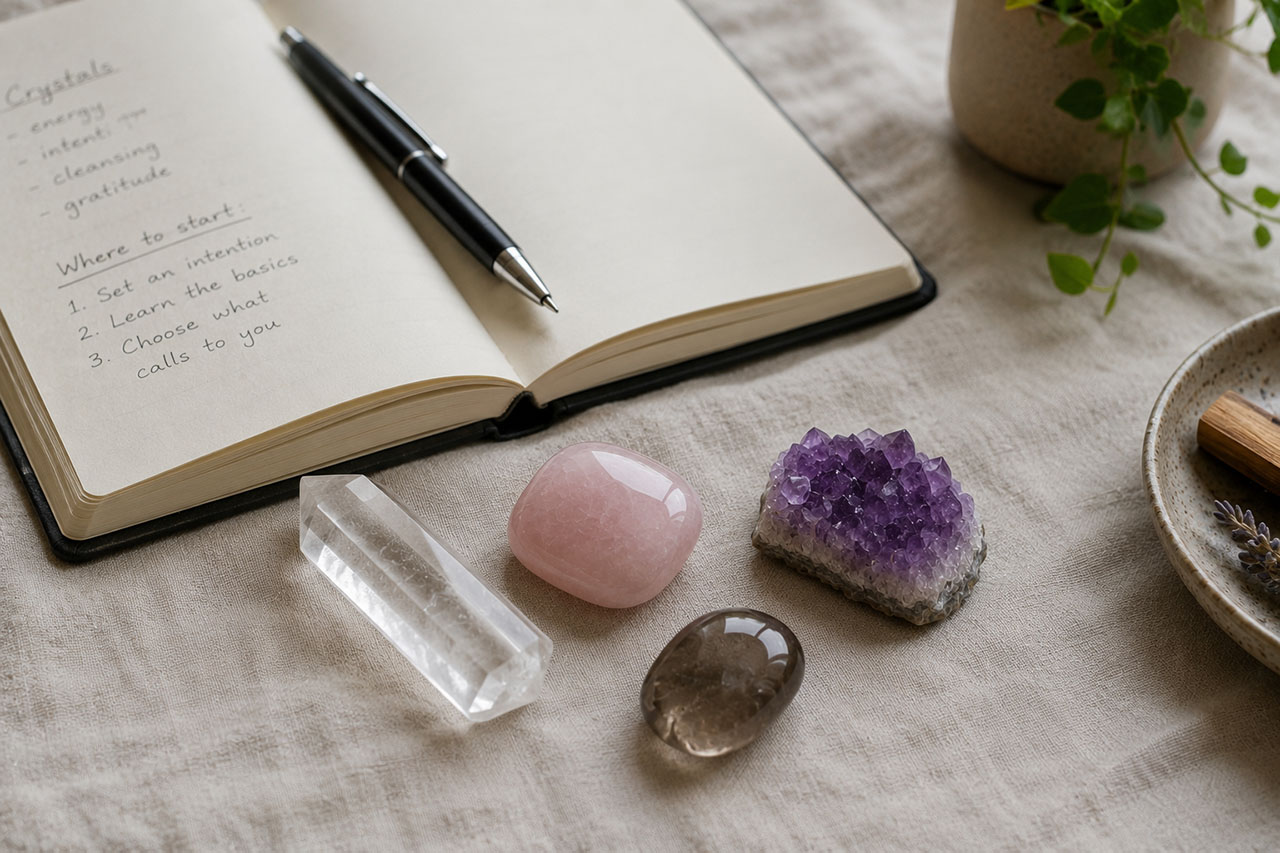
The most useful first move with crystals is learning what a crystal actually is before deciding what it means. The mineralogy comes first, the practice comes second, and both layers can be real at once. Here is the working guide to starting from scratch, honestly.
Most beginner’s guides to crystals start with which crystal you should buy first. They will tell you it depends on your sun sign, your chakra imbalance, or the energy you want to attract. They are not wrong that these matter to people who already work with crystals. They are wrong to start there with someone who has not.
The first move with crystals, the move that pays off across whatever you do with them afterward, is learning what they actually are. A crystal is a specific kind of mineral with a specific kind of structure. Knowing that, even at a basic level, changes how you read every listing, every shop display, and every claim made about the stones afterward. The mineralogy is not the romance. The mineralogy is the floor under the romance.
At Crystalance, we have spent a long time writing about specific crystals (pricing, treatments, sourcing, identification, practical use) and the pattern that keeps surfacing is that beginners who start by understanding what they are buying make better decisions for the next decade of working with crystals than beginners who start with a recommendation chart. Here is the working guide to starting that way.
What a Crystal Actually Is
A crystal, in the strict mineralogical sense, is a naturally occurring inorganic solid with a defined chemical composition and an ordered atomic structure. That is the definition used by the International Mineralogical Association and by serious mineral databases like mindat.org. It distinguishes crystals from rocks (aggregates of minerals), from mineraloids (substances that look like minerals but lack the crystalline structure), and from manufactured materials that get sold under crystal trade names.
Most of the things sold as crystals in shops are crystals in the strict sense: quartz, amethyst, citrine, rose quartz, fluorite, calcite, tourmaline, and so on. Some popular “crystals” are not, technically: amber is fossilised resin, obsidian is volcanic glass, goldstone is manmade glass, K2 stone is a rock containing a mineral. These are not less beautiful or less interesting; they just are not crystals in the strict definition. (For the longer version of this distinction, see what counts as a crystal and mineral or rock.)
Why this matters for beginners: the word “crystal” on a shop shelf does not mean what it means in a textbook. A piece labeled “rose quartz” is rose quartz. A piece labeled “obsidian” is volcanic glass that has been called a crystal by the trade. Both are legitimate to buy and work with. But knowing which is which means you understand what you have, and that understanding compounds over time.
The smallest amount of mineralogical literacy is the highest-impact move a beginner can make. It does not require memorising chemistry. It requires reading the strict definition once, knowing the three categories (mineral, rock, mineraloid), and applying them as you encounter stones.
How to Pick Your First Stone
The conventional advice is to start with a recommendation chart matched to your sun sign, current emotional need, or chakra imbalance. We do not recommend this approach for a first purchase.
The better starting move is to walk through a crystal shop (in person if possible) or browse a curated online seller and pick the stone you find yourself returning to. Visual attraction, tactile preference, or simple curiosity. These are reliable indicators of which stone you will actually engage with over time. A stone you find aesthetically dull, but bought because a chart said you should, will sit in a drawer.
A few practical considerations for first-purchase form:
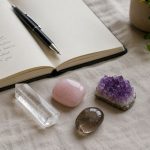
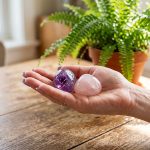
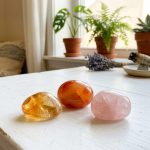
Start with a tumbled stone or palm stone. Affordable, tactile, no risk of breaking. Easy to carry. The default low-stakes entry point.
Skip towers, spheres, and large polished pieces for now. These are higher-investment objects that make more sense after you have spent time with smaller pieces and know what you respond to.
Skip jewellery as a first purchase. A piece you can hold and put down lets you actually examine and notice it. Jewellery becomes a daily-wear object that is harder to engage with attentively.
Consider the quartz family as defaults. Clear quartz, rose quartz, amethyst, smoky quartz. All four are widely available, affordable, easy to find in honest sourcing tiers, and well-documented. Rose quartz especially is a low-stakes starting stone for emotional or self-compassion practice. (For more on rose quartz specifically, see what does rose quartz actually do.)
For the broader question of which shape to buy, see what are crystal points, spheres, clusters, and other shapes.
How to Take Care of It
Most basic crystal care is simpler than the wellness market suggests. A few principles handle the vast majority of cases.
Most crystals do not need to be cleansed daily. The cleansing-and-charging industry has built a complex product category (selenite plates, copal incense, sound bowls) around an instinct that many traditional crystal practitioners hold less rigidly. For a starting practice, occasional cleansing (monthly or after significant use) is fine.
Some crystals are not safe in water. Selenite dissolves. Malachite contains copper and can release toxic compounds. Pyrite oxidises. Lapis lazuli can fade. As a default, do not put your crystal in water unless you have checked that it is safe. The quartz family (quartz, amethyst, citrine, rose quartz, smoky quartz) is generally water-safe.
Sunlight fades some crystals. Amethyst, rose quartz, fluorite, and others can lose colour with prolonged direct sunlight exposure. Keep coloured crystals out of strong direct sun if you want them to maintain their colour over years.
You do not need to “activate” your crystal. This is mostly a recent commercial framing. Older crystal practice does not require activation. If you want to set an intention while holding the stone, that is a reasonable practice. The stone does not require a ritual before it “works”.
For specific cleansing methods, see what is copal and how do you use it to cleanse crystals. For combining or wearing multiple crystals, see can you wear multiple crystals at once.
How to Buy Without Getting Confused
The buying landscape for beginners is full of marketing language that obscures what is actually being sold. A few principles that simplify it.
Ask where the stone came from. Country of origin, ideally region. A seller who can answer has done the work. A seller who cannot has sourced from undifferentiated importers and probably does not know the supply chain.
Treat “natural” and “authentic” as nearly meaningless. Both words are used commercially to imply quality without conveying information. Most retail crystals are “natural” in that they are real minerals. The word does not address treatment, locality, or sourcing.
Watch for treatment that is not disclosed. Most commercial citrine is heat-treated amethyst. Most affordable “turquoise” is dyed howlite or magnesite. Some bright lepidolite is colour-enhanced. Treatment is not inherently bad, but undisclosed treatment is.
Match price tier to expectations. Very cheap polished pieces on aggregator platforms are usually treated, composite, or substituted material. Specialty dealers with named locality information are more expensive and worth it for serious purchases.
For the full version of these standards, see how to buy crystals without getting ripped off. For the treatment side specifically, see what most crystal sites won’t tell you about treatments. For an example of how broader commodity markets affect crystal pricing, see why lepidolite is expensive.
What’s Worth Trying and What to Skip
A few practical categories worth knowing about as a beginner.
Worth trying (low-stakes, well-documented):
- Carrying or wearing a small tumbled stone for a few weeks and noticing if you respond to it
- Pairing a stone with an intentional practice (breathing, meditation, journalling) and seeing if the practice gets easier
- Building a small collection of three to five stones over time, learning each one before adding the next
- Reading the Crystalance Mineral Library entry for whichever stone you own
Worth approaching with skepticism:
- Crystal water and gem essences (water that has been exposed to a crystal). The chemistry is not what the marketing suggests; the practice can be meaningful if you understand what is actually in the bottle. See what is gem essence.
- Crystal recommendations based purely on your sun sign or chakra chart, without your own input
- “Activated”, “charged”, or “reiki-infused” as price-premium marketing
- Money-attracting bracelets sold as if the bracelet itself produces wealth (see what crystals are for wealth and money for the honest version)
Worth skipping:
- Health and healing claims that go beyond tradition. Crystals do not cure illness. A seller or article that suggests otherwise is either confused or marketing.
- Very cheap aggregator-platform bulk lots if you are buying for practice (fine if you understand they are decor-quality)
- Any seller who cannot or will not answer questions about sourcing or treatment
The principle underneath all of this is the same: be honest with yourself about what the stones can and cannot do, and the practice you build on top will be more durable than one built on overpromises.
Our Standard for Beginners
What we hold ourselves to at Crystalance, applied to the beginner case.
Learn what you have before you learn what it means. The mineralogy comes first because everything else builds on it.
Pick by attraction, not by prescription. A stone you respond to does more for your practice than a stone someone else picked for you.
Buy from sellers who can answer questions. Country of origin, treatment status, return policy. These are normal questions. Sellers who answer them are sellers worth a relationship with.
Treat the practice as practice, not magic. Crystals can serve as anchors for intention, attention, and ritual. They do not produce outcomes on their own. The work is yours.
Build slowly. A small collection of stones you actually engage with is worth more than a large collection you do not. Start with one. Add as you have reasons to.
These are not radical standards. They are what serious crystal practitioners across both the metaphysical and mineralogical communities tend to converge on after enough time with the topic. The mainstream beginner-content market often pushes in the opposite direction (buy this kit, follow this chart, activate this stone) because that is what monetises. We think the honest approach monetises slower but builds something that lasts.
Crystals are interesting because they are real minerals with real geological histories and real cultural significance. They are also, for many people, anchors for emotional and spiritual practice that has its own real value. Both things can be true. The beginner who holds both layers without collapsing them into either pure science or pure mysticism is the beginner who will still be working with crystals in twenty years.
For specific starting points, see the Crystalance Mineral Library for whichever stone you have or are considering. For broader buying standards, see how to buy crystals without getting ripped off. For low-stakes first purchase advice (gifting), see can you give a crystal as a gift. Start with one stone. Hold it. Notice it. Read about it. The rest unfolds from there.