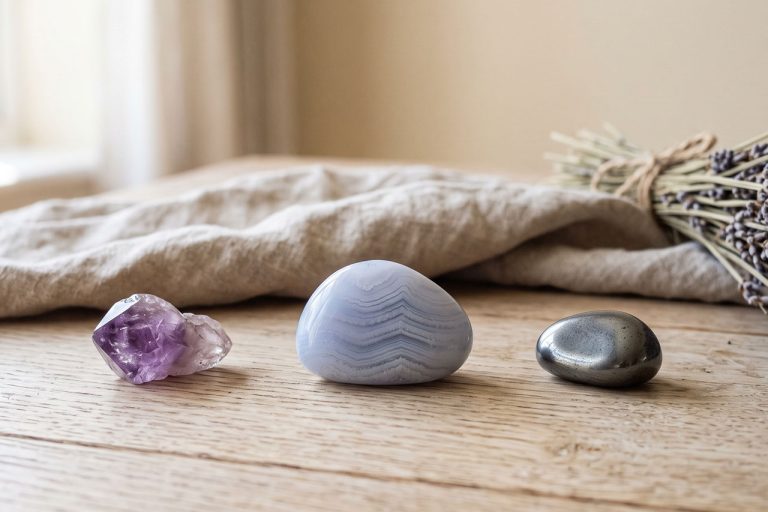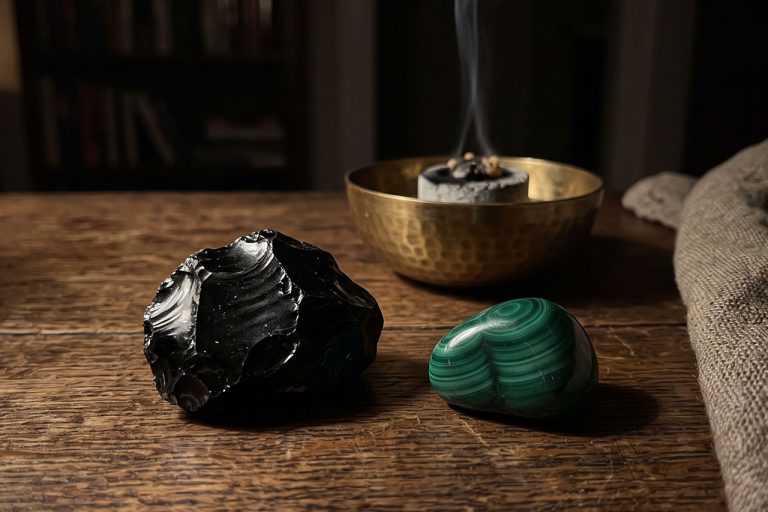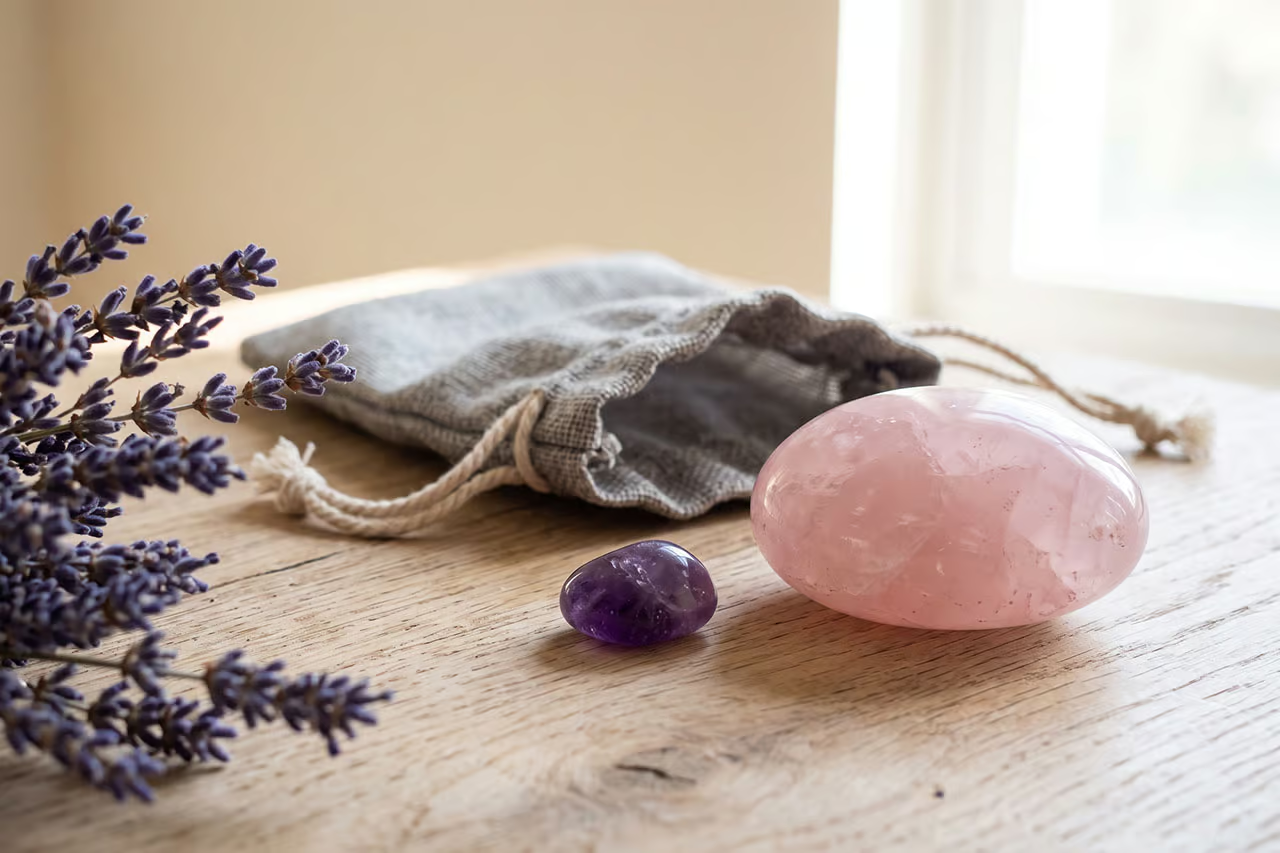
Rose quartz, amethyst, citrine and black tourmaline survive being given, and hardness is most of the reason. Crystal practice says a great deal about choosing a stone for yourself and nothing about choosing one for somebody else, so ordinary gift sense makes the call.
There is no matching procedure for the other case, and that absence is what this question is really about. Ask a shop how to pick a crystal and you will get one. Walk the shelf slowly and notice which one you keep going back to. Pick that one up and see whether you want to put it down again. People use this, and it works on its own terms.
Now try to follow it on behalf of your sister, who is at home and does not know you are in the shop.
The one rule people worry about
The thing that stops people is a line you hear in crystal circles: the crystal chooses its person. Take it seriously, because it is not silly. It describes something people genuinely experience in a shop, that one stone out of forty seems to have your name on it, and it gives that experience a shape and a vocabulary.
What it does not do is forbid anything. Read it as instructions and it is guidance for a person buying for themselves, telling them to trust a reaction rather than a chart. There is no clause about third parties, because the sentence was never pointed at them. A belief about how you should shop is not a rule about what you may give.
The worry it produces is real all the same, and it is usually the fear of getting it wrong for someone. That fear is answerable, and the answer is not metaphysical.
Every instruction points at the person buying
Look at the whole choosing vocabulary and the same thing keeps showing up. Hold it and see how it sits in your palm. Go with the one you were drawn to before you read the label. Both of those require the future owner to be standing there with a hand out.
Your sister is not there. She cannot be, that is what makes it a surprise. The method therefore has nothing to say, and no substitute instruction is waiting behind it, which means the decision falls back on the same things that decide any gift. Will she like looking at it. Does it suit the way she lives. Will it still be in one piece at Christmas.
The last of those is the one people skip, and it is the one with teeth.
Hardness is what settles it
The Mineralogical Society of America gives the Mohs scale as a measure of the relative hardness and resistance to scratching between minerals, running from talc at 1 to diamond at 10. Quartz sits at 7, which covers rose quartz, amethyst and citrine, and tourmaline at 7 to 7.5 covers schorl, the best-known black member of that group. Gypsum, the mineral selenite towers are made of, sits at 2. Calcite is 3 and fluorite is 4.
Those numbers matter more for a gift than for anything you buy yourself, and the reason is simple. You know the care rules. She does not, and they do not come with the box. A gifted crystal tends to end up in the shallow dish by the front door with the keys and the loose change, and a quartz at 7 comes through that looking exactly as it did.
A selenite tower does not. Gypsum is second from the bottom of a ten-point scale, and a set of keys landing on it leaves a mark you cannot polish out. Calcite at 3 and fluorite at 4 are in the same territory. None of those is a bad stone and all of them are lovely things to own. They are just objects that ask the owner to know something, and a gift arrives without the knowing.
The steer is boring: for someone new to this, buy at 7 unless you have a reason not to. If you do want to give something softer, give it somewhere to live at the same time, a small dish or a stand, so the object arrives with its own place to sit. There is more on what else goes wrong with a crystal gift, treatments and sizes and the rest of it, in can you give a crystal as a gift.
The birthstone shortcut
For a lot of people the default answer to this question is the birthstone, and it is a decent instinct, because it looks personal and the recipient already knows theirs.
Know what you are giving, though. The birthstone list is a jewellery trade standard. Its ancestor was adopted at the seventh annual convention of the American National Retail Jewelers’ Association, held in Kansas City in August 1912, and the trade press of the time printed the list in full. It has been changed since, in a revision in 1952 and with spinel added as recently as 2016, so the list you will be handed in a shop today is not the 1912 one. Six of the twelve months read differently now.
None of that spoils it. A convention is a perfectly good thing to give somebody, and there is something nice about handing over a stone that a room full of retail jewellers argued about in Missouri. It does mean two practical things. A birthstone gift is not an inheritance from antiquity, whatever the card says, so do not build the card around that. And several months land on gem-trade stones rather than crystal-shop stones, so the shortcut can send you to a jeweller when you meant to visit the shop with the tumbles in trays.
Handing it over
The last thing is the sentence you say when you give it, and it does more work than the choice of stone.
Resist attaching a job to it. “This is for your anxiety” is a different object from “I saw this and thought of you”, and the first one quietly tells a person what you think is wrong with them. If you picked amethyst because she has had a rough autumn, the giftable half of that thought is that you were thinking about her in a shop. The rest can stay where it is.
Say what caught your eye. The colour, or the fact that it is the exact pink of her kitchen. That gives the object somewhere to start without handing over an assignment, and it leaves her free to look up what it is associated with, or not to. The same logic runs through what crystals are good for friendship, where the stone is doing a similar job between two people.
The Crystalance Mineral Library records hardness and care notes for all four, and it is a page to open before you buy rather than after.
Choose it for the pink, hand it over with a sentence about the pink, and the same stone does more work than it would with a chakra printed on the label.
Sources
- Mineralogical Society of America, the Mohs hardness scale (talc 1, gypsum 2, calcite 3, fluorite 4, apatite 5, orthoclase 6, quartz 7, topaz 8, corundum 9, diamond 10; “Mohs’ hardness is a measure of the relative hardness and resistance to scratching between minerals”)
- Minerals.net, tourmaline (Mohs 7 to 7.5; schorl, black in colour, one of the three best-known members of the group)
- Print sources, held in the project’s 1912 verification memo and not available online: The Jewelers’ Circular and the Horological Review, 14 August 1912, reporting the seventh annual convention of the American National Retail Jewelers’ Association at Kansas City, 6 to 9 August 1912, with the adopted list printed in full; Jewelers’ Circular-Keystone, August 1952, p. 219, for the revision, which that report describes as concerning the months of June and December; and the joint Jewelers of America and American Gem Trade Association announcement of spinel, 7 June 2016.