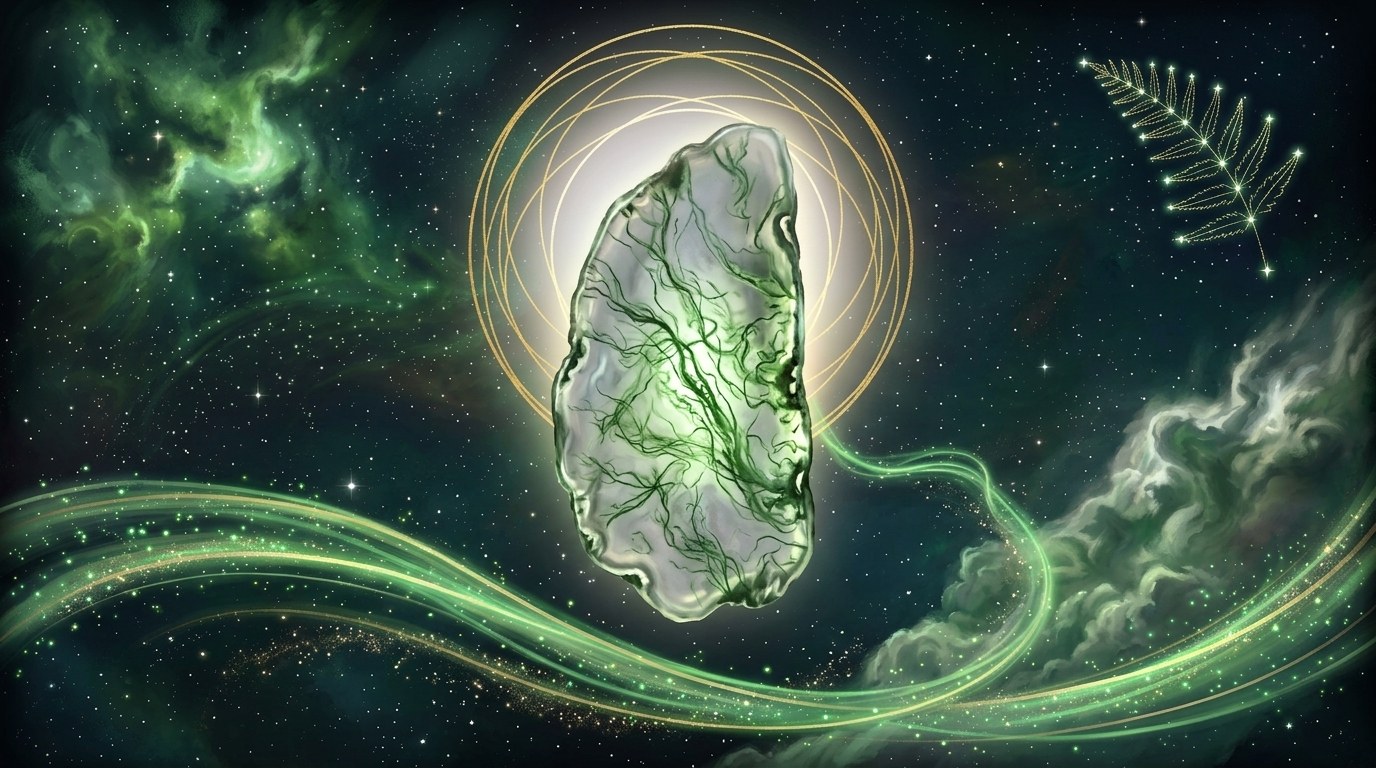
Moss agate goes to people in the middle of something slow, and it is one of the few entries on the shelf that does not offer to speed anything up. What it asks for is the willingness to keep going at whatever rate the thing moves.
Practitioners hand it to somebody eighteen months into a recovery, or three years into a business, or in the second winter of a garden, and the reason they give is not that the stone helps. It is that the stone is a reminder of a particular shape of effort: the kind where nothing visible happens for a long stretch and the only available discipline is to keep turning up. Sitting with a stone that looks like something growing is a way of putting that in your hand. Those are claims about a practice, made in the practice’s own terms, and they are more honest than most of what a shelf offers, because the entry promises no shortcut.
There is a second reason to take the resemblance seriously, and it arrived in July 2025.
The man who ruled it out
Stanislas Meunier was a geologist at the Museum national d’Histoire naturelle in Paris, and in 1892 he wrote a short piece on dendrites for La Nature that was translated the same year for an English readership. He spends his first two pages on the older habit of seeing pictures in stones, quoting a 1709 book whose author found, in one specimen, a plain crossed by a river and bordered by wooded hills pierced with caves.
Then he turns to the trade name arborized agate and to what it assumes. The name, he writes, “shows that a vegetable origin was at first attributed to these accidents.” He had the specimens to argue from, including one he captions “Arborized Agate; that is, agate inclosing a dendrite deep in its mass”, from his own museum’s collection. Dendrites “have none of the characteristics of the vegetable ramifications with which we are at first inclined to compare them”, he says, and then, of the microscope, that “when we study them under a sufficient magnifying power, the crystalline structure of most of them appears distinctly.”
Then he went and tried to make some. “But the experiment has not been successful, and, instead of the desired black deposit, we get only chocolate-brown flakes having no resemblance to the substance of the dendrites.” Only after he analysed the natural ones, found traces of iron in them and added ferric salts to his manganese solution, did he get a black compound “presenting in many cases the exact form of the dendrites of Nature”. Even then he thought his own inferior, and blamed his process for being too quick.
Japan, 2025
Nine researchers collected green moss agates from Miocene volcanic rocks at Bodai in Ishikawa and Imakane in Hokkaido, and looked at the filaments, which turned out not to be manganese and iron at all. They are made largely of celadonite, a green mica, and the authors are careful even about that: telling celadonite from its close relative glauconite by analysis alone was not possible, and they settle on celadonite on the strength of the volcanic host rock and the shape of the threads.
The celadonite is sitting in voids. Something organic was there first, was corroded away, and the space it left filled with mineral. In places the original had not entirely gone: “In certain portions of these filamentous fabrics, carbonaceous matter, representing the remnants that resisted corrosion, was detected.” Carbon isotope measurements on those remnants put eleven of fifteen sampling spots in the biogenic range.
The other four spots are the ones that cannot be called. They may have picked up surface contamination during polishing, and their values sit on the boundary between the biogenic and inorganic fields, so the authors decline to place them. Their conclusion is correspondingly narrow: “some filamentous fabrics observed in green-colored moss agates worldwide should be reconsidered as being of biogenic origin”, and such fabrics are worth investigating as potential fossils. That does not overturn Meunier, whose dendrites were a different thing in a different colour. What it does is take one class of inclusion out from under his conclusion.
Tobacco water on wet slip
While all of that was being worked out, the pattern was having a second career.
In the late eighteenth century, merchants in London were importing a semi-precious stone from Arabia to set in jewellery, shipped out through the Yemeni port of Mocha, and the trade name that stuck to it was mocha stone. The Victoria and Albert Museum has one, in a gold mount, catalogued as mocha stone under object number 1215-1869. It came from a clergyman’s bequest of gems that the museum notes are mounted as rings although they may never have been intended to be worn.
The potters were at it in the same decades. Staffordshire began producing an earthenware decorated with dark branching patterns in imitation of the stone, and the technique stayed in production across Britain for close to a hundred and fifty years. Llewellyn Jewitt, going through old invoices for his 1878 history of British ceramics, found “mocoe tumblers” listed by the firm of Lakin and Poole between 1792 and 1796.
A visitor watched it being done in 1833 and wrote down what he saw. A brush loaded with a dark liquid was touched to the wet slip in two or three places, and then, in his words, “The fluid instantly spreads and runs into these ramifications.” The liquid was a preparation of tobacco water, and surviving period recipe books call for printer’s ink, hops, tansy and urine.
The V&A’s label on one of the mugs, made around 1800, ends by saying where the ware got its name: “It is named after the patterns found in mocha stones (moss agates).”
How firmly to hold the correction
Somebody will tell you, sooner or later, that the moss in moss agate is not moss. It is the correction everybody who reads about this stone eventually meets, and it has been true for a hundred and thirty years.
The accurate answer now is that it depends which threads you have. Black and brown dendrites branching like frost on a window are manganese and iron, and Meunier settled that with a beaker and a failed first attempt. Green filaments in a piece from volcanic rock are the ones a team of mineralogists has argued may be the corroded remains of something that was alive. No shop counter separates the two, and the trade uses one word for both.
That is a smaller certainty than the one on offer before, and it suits what people use the stone for. Nobody three years into a business needs a tidy answer about anything. The practice has always asked them to sit with a process they cannot see the end of, and it now turns out that the object it hands them is one too. For what the quartz underneath the pattern is, and how it differs from a jasper, the Crystalance Mineral Library covers chalcedony.
Sources
- Meunier, Stanislas, “Dendrites”, Popular Science Monthly vol. 41, May 1892, pp. 84 to 87, translated from La Nature; Meunier was a geologist at the Museum national d’Histoire naturelle. For the vegetable origin the name assumes, the crystalline structure under magnification, the arborized agate specimen from his museum’s collection, the failed manganese-only synthesis and the ferric salts that fixed it, his verdict on his own results, and the 1709 landscape reading: wikisource.org
- Akahane, H., Shimizu, M., Ogawara, T., Ito, M., Yoshioka, T., Sawada, H., Miyajima, H., Momma, K. and Imai, H., “Biogenic filamentous fabrics in green colored moss agates within Miocene volcanic rocks in Japan and the associated formation of celadonite”, Scientific Reports 15, 25072, 11 July 2025, open access, for the Bodai and Imakane localities, the celadonite and glauconite identification and its caveat, the voids left by corroded biogenic material, the carbonaceous remnants, the eleven of fifteen isotope spots and the four that may be contaminated and cannot be placed, and the conclusion about some green-coloured moss agates worldwide: nature.com
- Carpentier, D. and Rickard, J., “Slip Decoration in the Age of Industrialization”, Ceramics in America 2001, Chipstone Foundation, for the stones shipped through the port of Mocha and the name that followed, for Jewitt’s 1878 record of mocoe tumblers on Lakin and Poole invoices of 1792 to 1796, for the recipe books calling for printer’s ink, hops, tansy and urine, for the tobacco-water and the 1833 eyewitness account, and for production continuing for nearly 150 years: chipstone.org
- Victoria and Albert Museum, ring, museum number 1215-1869, chalcedony (mocha stone) set in gold, from the bequest of the Reverend Chauncy Hare Townshend, whose gems the museum notes are mounted as rings although they may not have been intended to be worn: vam.ac.uk
- Victoria and Albert Museum, mug, Staffordshire, about 1800, museum number C.15-1916, lead-glazed earthenware with mocha decoration, for the museum’s account of the technique and of the name: vam.ac.uk