No scheme certifies a decorative crystal, so a listing that says “ethically sourced” rests on nothing that either of you can check. What a seller can supply instead is the place a stone came from, and the precision of that answer is the test.
The United States Department of Labor keeps a list of goods produced by child labour or forced labour. In its current form it runs to 204 goods from 82 countries and areas. Two of the rows say mica. For India: “There are reports that children ages 5 to 17 are engaged in collecting mica from abandoned mines, primarily in illegal mining operations in India.” For Madagascar: “There are reports that children ages 3 to 17 produce mica in Madagascar, primarily in the southern provinces of Androy, Anosy, and Ihorombe.”
Three more rows sit under gems. India, Zambia, and tanzanite from Tanzania.
Read that quickly and it sounds like a verdict on the shelf you were about to buy from. The list is making a narrower statement than that. It pairs a country with a good, drawing on reporting and research, and its own wording keeps saying so: there are reports. It does not follow a shipment, and it can tell you nothing about the object in your hands.
Between a documented harm and a particular stone there is a distance that cannot be closed from a shop counter, and that is where this has to start.
A list of goods, and what is on it
Because the list is built for procurement, it names goods rather than shipments. A company importing at scale can consult it, see that a good it buys has a history in a country it buys from, and decide what to do about that before it signs anything. The audience is people with contracts and auditors.
A person buying a tumbled stone has none of that. The list still tells them something real, which is that the trades next door to theirs have been looked at and found to have a problem, and that the problem is ordinary rather than exotic. Mica is a good example precisely because it is unglamorous. The Department of Labor funds a project in the Anosy region of southern Madagascar, where the poverty rate is 96.7 percent, in a country where it estimates 10,000 children work in mica production. That is a story about what small-scale mining looks like where it is the work available, and crystals are one of the things such mining produces.
The gems rows point at the same condition. Informal mining runs alongside the licensed kind in both India and Zambia, and for tanzanite the production area in Tanzania is small enough that the two sit within sight of each other. How a pit is run does more work here than which mineral comes out of it.
Crystals come out of the same kind of ground and often the same kind of operation. Small pits with few records, and material sold onward at the first opportunity to whoever turns up with cash. Some of it is a by-product of larger industrial workings, dug for something else and picked over afterwards for what will sell to collectors. The rest is dug by hand by people for whom it is a living.
Where your own amethyst sits in that is not written down, and no amount of care taken at the point of sale will recover it. The information was never created.
The obligation stops at four metals
There are instruments with real force in this area. They exist, and they point elsewhere.
The European Union’s supply chain regulation for minerals from conflict-affected areas states its purpose in its first article: “This Regulation establishes a Union system for supply chain due diligence (‘Union system’) in order to curtail opportunities for armed groups and security forces to trade in tin, tantalum and tungsten, their ores, and gold.” Its annex lists what falls inside. Tin, tantalum, tungsten and gold, as ores, oxides, carbides, wire, powder and foil. No silicates, and nothing else a crystal shop would recognise.
The machinery is broader than that purpose clause suggests, and that matters before anyone concludes the regulation is only about warlords. Article 4 requires an importer to build its due diligence on standards “consistent with the standards set out in the model supply chain policy in Annex II to the OECD Due Diligence Guidance”, a separate document with its own reach. Whatever that model policy covers, though, it covers it for four metals.
The Kimberley Process is the other scheme people have heard of. It is not an obligation on importers in the same way, being a certification arrangement between participating states, and it is narrower still: rough diamonds only, built against a problem defined in the language it was founded on as “rough diamonds used by rebel movements or their allies to finance conflict aimed at undermining legitimate governments”. A polished diamond falls outside it. A quartz cluster was never inside.
Between them, then, one duty covering four metals and one scheme covering one gemstone. Whether their checks would catch what the Department of Labor’s list describes is a question that never arises for a crystal buyer, because the material never enters either scope. The certification you were hoping for was never built.
Buying guides answer this by telling you to choose sellers who say they source responsibly. The advice describes a real difference between shops, and the instinct behind it is right. What it cannot do is give you any way to tell whether the sentence on the listing has anything standing behind it, and that was the part you wanted.
Who paid for the traceability
Mica does have people working on it. There are funded programmes and supply chain mapping, and the Madagascar project above is one of them. That work is real and some of it is good.
Nothing comparable sits at the end of a decorative crystal’s chain. The stone passes from a pit to a local buyer to an exporter to a wholesaler to a shop, and at no point in that sequence does anyone face a question they are obliged to answer. The difference is structural. It also explains what can look like indifference behind a counter. A seller who cannot tell you is usually a seller whose own supplier was never asked.
That points at the only lever available, and it is a small one. A single person asking a single shop where a stone came from changes nothing that week. What it does is put the question somewhere it currently is not, and a shop asked the same thing repeatedly tends to start asking its own supplier, because having an answer ready is easier than losing the sale. Slow, and it is what there is.
Madagascar’s mica goes somewhere specific, and that is the part I took longest to see. The country is the largest exporter of sheet mica, and 87 percent of what it exports goes to China, where it becomes components for the electronics and automobile industries, many of which are then sold into the United States. The chain that has been mapped is the industrial one. It was mapped because carmakers and electronics manufacturers are large and answerable, to regulators and to their own customers, and because somebody at the end of it had to be able to say where the material came from. The traceability was produced by a customer who could insist on it.
What a seller can still give you
There is one piece in my collection that came with paperwork.
A moldavite, natural glass small enough to wear, bought from a collector with an established reputation. It arrived with its origin documented, Moravia in the Czech Republic, and I still have the papers.
Until then I had been holding a rule that a seller who can name the country of origin has cleared the bar. That piece is the reason I no longer think the rule goes far enough. The material occurs in a handful of scattered fields, and a review published in the Bulletin of the Czech Geological Survey names them: southern Bohemia, western Moravia, the Cheb Basin, Lusatia in Germany and Waldviertel in Austria. Moldavites from those areas, the review says, are “the only known European tektites”. The South Bohemian field is much the largest, and the same review puts more than 99 percent of all moldavites in the southern part of one basin and the ground immediately around it. “Czech Republic” was never going to be a difficult answer to give, and it would have confirmed little beyond the piece not being glass from a factory. Moravia is the answer carrying information, and it arrived on paper rather than as a spoken assurance.
Precision is the thing here, rather than the existence of an answer. Country level means something for material with concentrated production and very little for material coming out of many countries at similar quality. Ordinary quartz is the second kind, and a shop that cannot say which of the world’s quartz mines yours came from is not concealing anything.
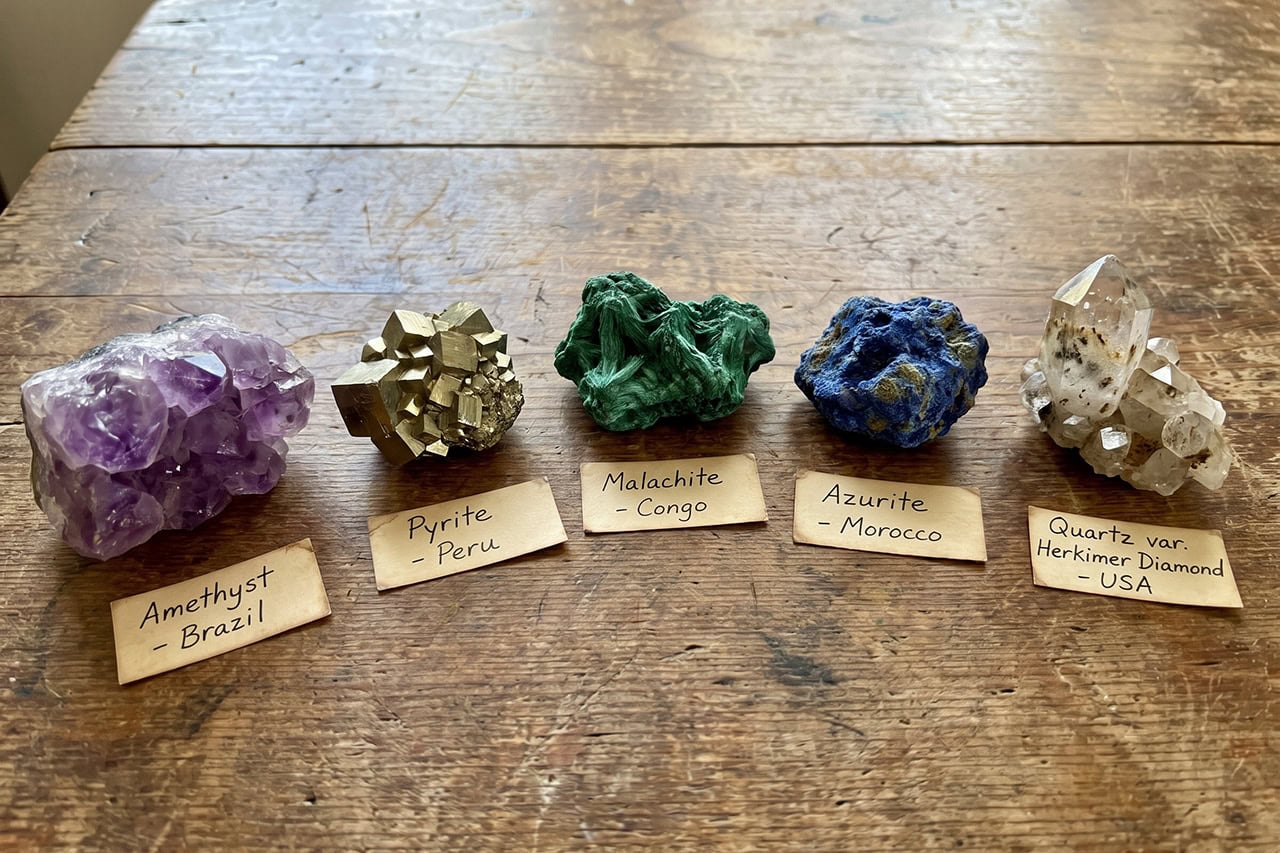
What does a good answer sound like in a shop? Often a region, sometimes a named mine. The test is whether the same answer comes back if you return a fortnight later. It may arrive with a supplier’s name attached, because a seller who buys from a known importer tends to volunteer that unprompted. And the best answer available in the trade is a straight “I do not know, I bought it in a mixed lot”, which beats an invented locality by a distance. A shop willing to say that is being straight about the limits of what it knows, and you can then decide whether to buy the piece anyway, which is a different decision from being told a story.
Where the answer lives is the other half. A locality that comes with the piece, written down, from a seller whose reputation depends on it being right, is a different object from a locality produced across a counter on request. Both beat nothing, and only one survives being checked later, which shows up years afterwards when you are trying to remember what you were told.
A refusal is an answer
I asked a seller directly once where a piece had come from and was told they would not say. I put it down and left, and I would do the same again.
The reasoning is short. Locality information is not proprietary, and passing it on costs a shop nothing. When it does not come, the likeliest explanation is that the chain behind that shop was never asked either, and the next likeliest is that the answer would not help the sale. Neither is a reason to hand over money. There is also a version of this that has nothing to do with ethics. A seller who cannot account for where a stone came from cannot account for what it is either, and the two failures travel together.
That is a firmer line than the buying advice you will commonly read, which puts provenance somewhere in a list of things to enquire about. I would put it first, and treat a shrug as disqualifying on its own, with the one exception noted above for genuinely diffuse material.
What that leaves you with is smaller than a certificate and more honest than a label. Ask where a stone came from, and prefer the seller who answers with a region and can show you where that answer came from. Silence is a reason to leave. The Crystalance Mineral Library records the major sources for each mineral, so an origin that does not appear in a stone’s entry earns a second question before you accept it. A word like “natural” on the same listing has a separate job of its own, and it is not this one. Our bar is a single fact: name the place, or we do not print the claim.
Sources
- US Department of Labor, Bureau of International Labor Affairs, List of Goods Produced by Child Labor or Forced Labor, for the mica and gems entries and the size of the list: dol.gov
- US Department of Labor, Madagascar Shines project page, for the Anosy poverty rate, the national estimate of children in mica production and the sheet mica export share: dol.gov
- Regulation (EU) 2017/821, Article 1, Article 4 and Annex I, for the purpose, the OECD due diligence standard and the scope: eur-lex.europa.eu
- Kimberley Process, for the definition of conflict diamonds and the rough-diamond scope of the scheme: kimberleyprocess.com
- Trnka, M. and Houzar, S., “Moldavites: a review”, Bulletin of the Czech Geological Survey 77(4), 2002, pp. 283 to 302, for the strewn fields: geology.cz