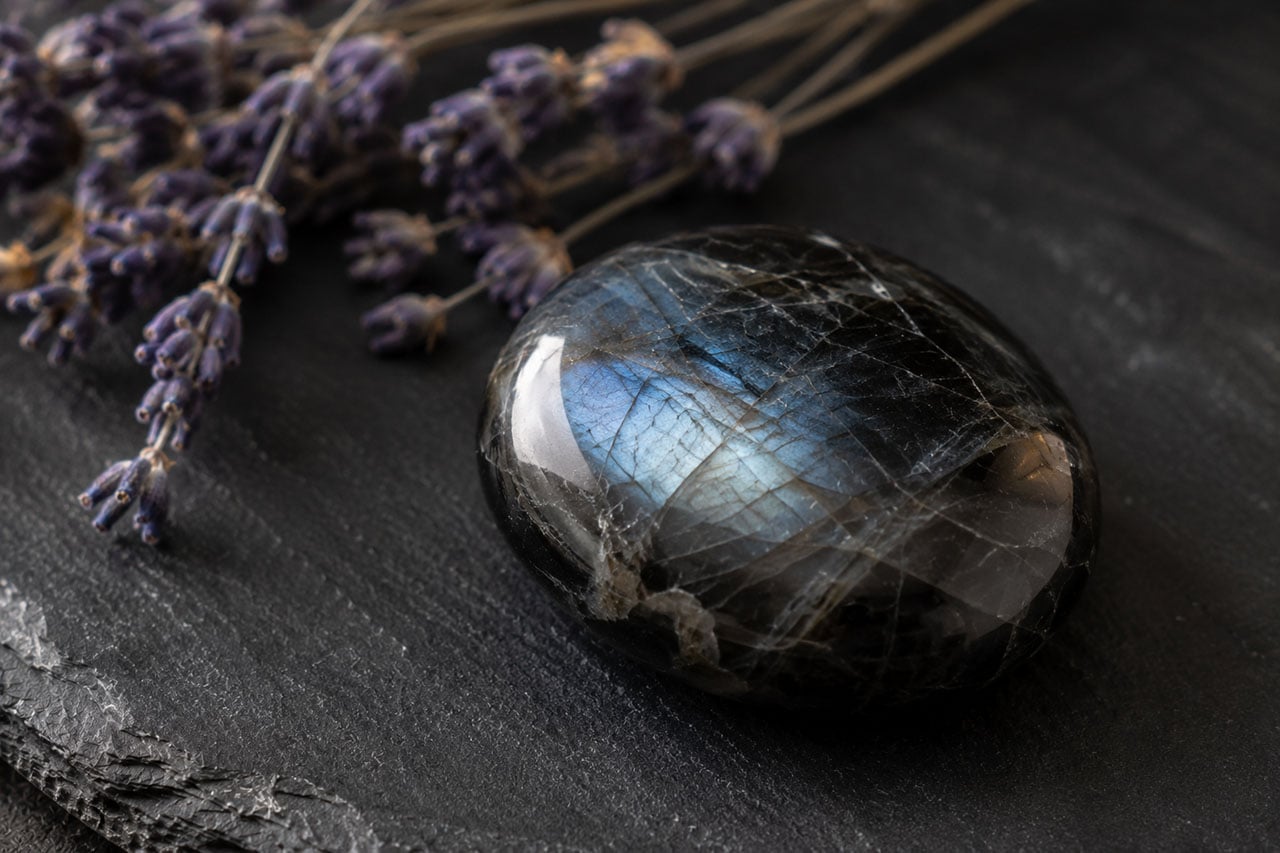
Black moonstone is one of the stones crystal practice associates with the new moon and with beginnings, which is why it turns up so often in fertility work. It is used as a ritual object rather than a treatment, and it does not act on the body.
The chain of reasoning behind that is short and easy to follow. Moonstone goes with the moon, the moon goes with cycles, and cycles go with fertility. Black moonstone is then attached specifically to the new moon, the dark phase where a cycle begins rather than peaks, which puts it at the start of things instead of the height of them. Practitioners assign it to the sacral centre, the energy centre associated with creativity and reproduction, and the usual advice is to keep a piece where you will see it daily or to hold one while setting an intention at the new moon.
Picture what that looks like in a house. Somebody sits down on a Tuesday evening with a dark grey stone in one hand, on a date they have marked, and says something they have not said out loud to anybody. It is a small, private, deliberate act, and it costs nothing, and people who would not describe themselves as spiritual do it and find it steadying.
The tradition being borrowed here, though, is a great deal older than the stone, and it named something else.
The stone Pliny put in that job
In the first century, Pliny the Elder wrote up the aetites, the eagle-stone, and gave it this work directly. Attached to pregnant women or to cattle, in the skins of animals that have been sacrificed, “these stones act as a preventive of abortion”.
The next clause is the one that tends not to travel with the quotation. Care must be taken, Pliny goes on, “not to remove them till the moment of parturition; for otherwise procidence of the uterus is the result. If, on the other hand, they are not removed at the moment when parturition is about to ensue, that operation of Nature cannot be effected.”
The stone is not described as helping. On Pliny’s account it holds, and the holding comes with a deadline and a penalty for missing it in either direction. Take it off early and the pregnancy fails. Leave it on too long and the birth does not happen. A charm with an off switch is a stranger object than a charm.
A section later Pliny credits the stone of Samos with much the same power, and hedges that one, in the Latin, where he states this one flatly. The eagle-stone was not his sole candidate, then, and the ancient record is untidier than any single quotation makes it look.
Hired for the nine months
Skip forward eighteen centuries, to a practice that was still running.
In 1907 the Italian anthropologist Giuseppe Bellucci catalogued the folk amulets of his own country, and gave the pietre gravide, the pregnancy stones, a section of their own. He describes them as clay-and-iron concretions, globular or kidney-shaped, dark brown outside, which make a light noise when you shake them beside your ear, because fragments came loose inside the cavity as the concretion dried.
Then, in a footnote, the detail that reshapes the whole thing. Bellucci records that these stones were generally hired out for the nine months of a pregnancy. The woman left a pledge of value to guarantee the stone’s return, and paid five lire of interest in advance. Bellucci works out what that implies: the stone was being treated as a capital sum of a hundred lire, and a hundred lire, or an object worth as much, is what an owner asked as security or as a price. The payment, he is careful to say, was not for what the stone was worth in itself. It was for what the capital could earn.
There was a market, then, and it was a rental market with an interest rate. The object circulated. A woman had one for a defined stretch, then it went on to the next person who needed it, and the money changed hands for the period rather than for the stone.
That is a report from 1907 about a rural Italian practice, and it is not a claim about Italy today. It is a description of how one long-lived version of this worked, and of what it assumed: that nobody keeps one of these.
The moonstone books of the same years
Moonstone was in the gem-lore books of that period, doing a different job.
Isidore Kozminsky’s 1922 compendium, one of the bridges between Victorian gem antiquarianism and the crystal writing that came later, gives it a full entry. Its virtues are cancer, dropsy and “affections of a watery nature”, fever if applied to the temples, cooled “heated imaginations”, protection against moonstrokes and lunacy, safety at sea, good fortune while travelling, and the symbol of Hope. Reproduction does not appear in it.
The same book does hand childbearing out, and to other stones. Emerald brings “safety in childbirth”. Coral was worn by “women of ancient times” as a charm against sterility. Lodestone “was used during childbirth and in diseases of the generative organs”. Moss agate gets fertility as well, but Kozminsky’s next sentence sends it to fruit trees, horses and cattle, so that one is a farmer’s word rather than a mother’s.
Two compendia are not a survey of a whole tradition. What they show is narrower and still useful: in the standard gem-lore books of that period, moonstone was given other work, and childbearing was given to other stones.
The trade name is not old either. In 1958 the gemmologist B. W. Anderson recorded “black moonstone”, in his own quotation marks, as a name then in use for a Burmese labradorite with a density of 2.69, against ordinary moonstone at 2.57. He was describing the trade of his own decade and said nothing about what the name would come to cover later.
Borrowing the better instruction
None of this is a reason to put your stone down. A reading that arrived recently is not a false one, and the link between the moon, the dark phase and beginning again holds as symbolism whatever century assembled it.
What the older version offers is a better instruction, and it is the one thing here worth borrowing. Give it an end. Decide now, while you are calm, what stretch of time this stone is for, and what happens to it when that stretch closes. The Italian version had the ending built into the arrangement: you had it for the months you needed it, and then it went to somebody else.
You can do that without a rental market or an interest rate. Set the piece aside when the period it was for has closed, or pass it to the next person you know who is somewhere near where you have been. A stone with an ending written into it is easier to live with through a hard stretch than one that sits on a shelf collecting significance and never stops.
Fertility is not something a stone acts on, and the practical part of this belongs with a doctor. What black moonstone can be is a small marked object that says a period is happening and that periods end. There is an entry on the feldspars in the Crystalance Mineral Library if you want to know what these trade names are sitting on top of.
Sources
- Pliny the Elder, Natural History, book 36, the chapter on aetites, translated by John Bostock and H. T. Riley, 1855, for the four kinds of eagle-stone, for the stones acting as a preventive of abortion when attached in the skins of sacrificed animals, and for the removal rule in both directions: perseus.tufts.edu. The Latin, including “non nisi parturiant removendi; alioqui volvae excidunt”, and the following section giving the stone of Samos the same power with a hedge (“volunt et partus contineri adalligato eo”), is at penelope.uchicago.edu
- Bellucci, G., Il feticismo primitivo in Italia e le sue forme di adattamento, Perugia, 1907, section “Pietre della gravidanza o pietre gravide”, for the description of the concretions and the noise they make, and for the footnote recording that they were hired out for the nine months of a pregnancy against a pledge, with five lire of interest paid in advance, on a notional capital of a hundred lire: archive.org. Read from the archive’s scanned text, whose optical character recognition is imperfect; the figures above are given in English rather than quoted in Italian for that reason
- Kozminsky, I., The Magic and Science of Jewels and Stones, New York: G. P. Putnam’s Sons, 1922, entry Moonstone at pp. 265 to 267 for the complete virtue list, and the entries for emerald, coral, lodestone and moss agate for the childbearing and fertility assignments, including the sentence sending moss agate’s fertility to fruit trees and livestock: archive.org
- Anderson, B. W., Gem Testing, 6th edition, London: Heywood & Company, 1958, p. 261, for “black moonstone” as a trade name of that period for a Burmese labradorite at 2.69 against ordinary moonstone at 2.57: archive.org
- Wellcome Collection, “Four eagle-stone geodes. Woodcut, 1599”, work frg5ye2t, Public Domain Mark, reproducing a plate from Ferrante Imperato, Dell’Historia Naturale, Naples, 1599: wellcomecollection.org