Yes. Nothing points at a problem with polished shungite against skin, and the black marks a raw piece leaves are ink on your wrist rather than a health worry. The part of a shungite bracelet worth asking about is the metal it is strung on.
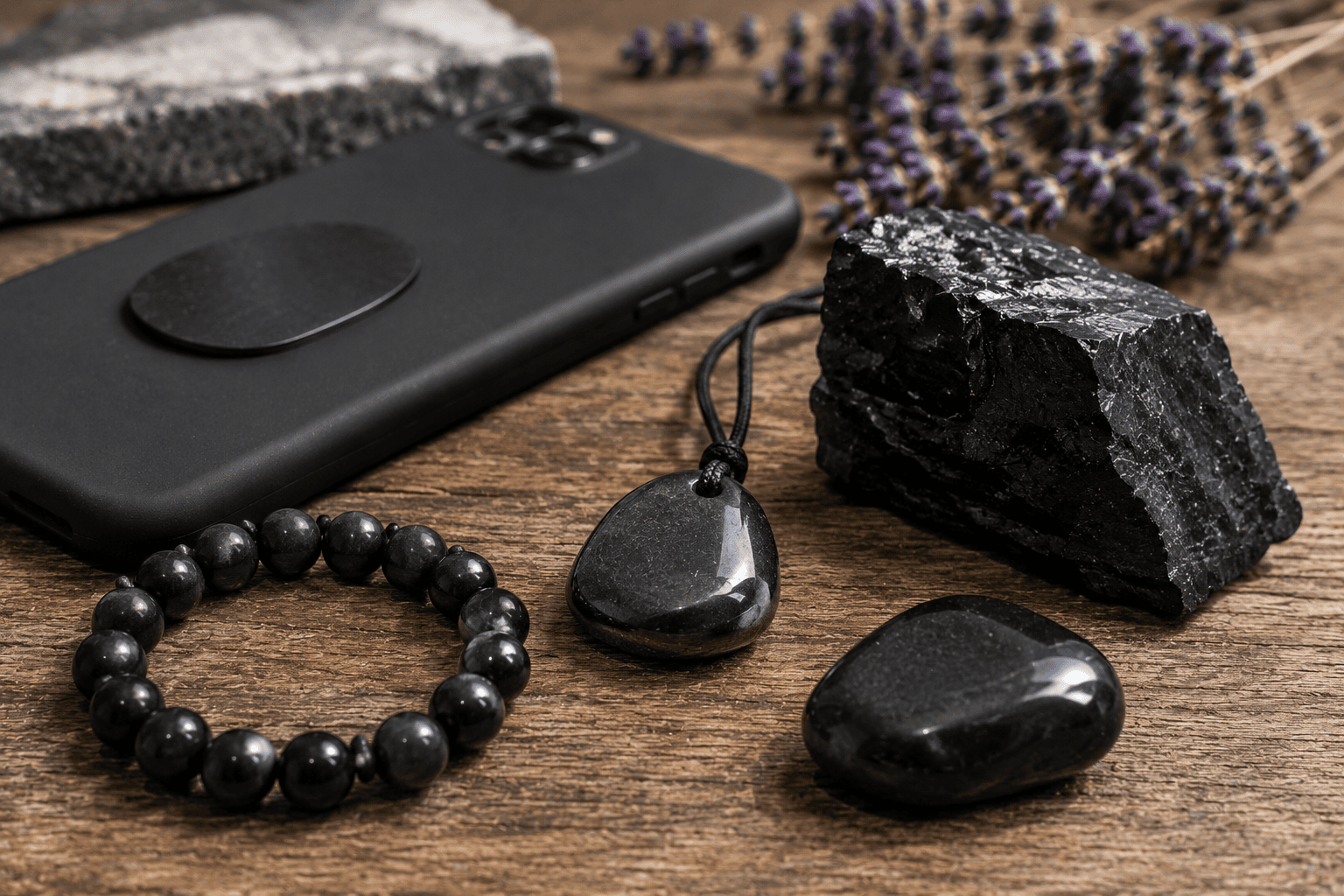
Crystal practice attaches a schedule to nearly every stone it recommends. You hold one for a few minutes. You set one down somewhere and come back to it in the evening. Shungite is given a different instruction, and it is the reason this question keeps getting asked: practice tells you to keep it on. The bracelet you wear to work and to bed. The pendant that goes under a shirt and stays there.
That instruction is more specific than it sounds. “Keep it on” describes an exposure condition, and it happens to be the exact condition under which the safety question about any worn object stops being trivial and starts having an answer. An hour is nothing. A year against the same square centimetre of skin is a different proposition, and the people who write rules about jewellery treat it as one.
What the practice asks of it
The protection reading is what puts shungite on a cord in the first place. Crystal practice describes it as a stone that sits between you and whatever the day is doing, and it comes with no method attached, which is rare for anything given that job. There is no timing, no placement on the body, nothing to hold. You put it on and you forget about it, which is precisely what people like about it.
The other half of shungite’s practice is not about the body at all. The stone gets propped beside a router or stuck to the back of a phone, and that placement is a separate argument with a separate answer, covered in how to use shungite. What is left here is the part that touches you.
A black stone, then, worn continuously, on a cord or a chain.
What has been measured, and in what
Shungite has been studied for what it puts into water. That work is careful, and it belongs to the usage article, not to this one. The medium is where it stops being relevant here. Water is a solvent, applied to a stone in a jug for days at a stretch. Skin is not a solvent, and a result from one does not carry to the other in either direction.
What shungite releases onto skin has not been measured. That is a gap and not a warning. In practice it means that if you go looking for a study clearing a shungite pendant for daily wear you will not find one, and if you go looking for a study that condemns it you will not find that either.
People do notice the marking. Rough shungite leaves a grey-black smudge on skin and on pale cotton, the way a soft pencil does, because that is roughly what is happening. It washes off. Marking is a laundry problem, and the reason polished pieces dominate the jewellery shelves.
The part of the bracelet nobody asks about
Beads, a wire or a cord, and a clasp. Only one of those has a rule attached to it, and it is not the beads.
The clasp is metal, and so is the wire the beads are strung on if it is not a cord, and metal in prolonged contact with skin is one of the few things about jewellery that is properly regulated. In the EU, entry 27 of Annex XVII to REACH covers articles intended to come into direct and prolonged contact with the skin, and it names them: earrings, necklaces, bracelets and chains, anklets, finger rings, wrist-watch cases, watch straps. Those articles may not release nickel above 0.5 micrograms per square centimetre per week. Posts that go through a piercing get a stricter limit, 0.2. Coated pieces have to hold the 0.5 figure for at least two years of normal use, so a plating that wears through is not a loophole.
Somebody has had to put a number on the word “prolonged”. ECHA settled one in 2013 and the European competent authorities approved it the following April: prolonged contact means contact of potentially more than either ten minutes on three or more occasions within two weeks, or thirty minutes on one or more occasions within two weeks. That is guidance for applying the restriction and not text inside the regulation, and the difference matters if a seller is ever shown it. It is also a fairly exact description of what crystal practice tells you to do with shungite.
Nickel is the metal that rule exists for, and nickel allergy is the common one. The US Agency for Toxic Substances and Disease Registry, citing the Cleveland Clinic, puts it at an estimated ten percent or so of the American population, in the form the profile calls contact dermatitis. That is a lot of people to be handing an object described as something you keep on.
None of which is a shungite problem. It is a bracelet problem, and it applies just as much to the amethyst bracelet next to it on the tray. The difference is that nothing else on that tray comes with an instruction to wear it constantly, so shungite is where the question earns its keep.
Ask what it is fastened with. Sterling silver, gold, a stated stainless grade or a plain cotton or leather cord are all fine and all cheap. A vague answer, or an unnamed silver-coloured alloy on a piece you have been told to keep on, is the one case where I would put it back. If you already own one and your wrist is fine, it is fine.
Shungite is a strange and genuinely old material, and the Crystalance Mineral Library is the place to read about what it is made of.
The rule on the clasp applies to every bracelet in that shop, and to nothing on the crystal shelf as such. It is the only written limit in play on wearing an object against your skin all day, and it says nothing at all about the stone.
Sources
- REACH, Annex XVII, entry 27, nickel (EUR-Lex)
- Nixon, Higgins, Maor, Rajgopal Bala, Lalji and Heim, “Does clinical testing support the current guidance definition of prolonged contact for nickel allergy?”, Contact Dermatitis 79 (2018), 356 to 364. PubMed Central
- Toxicological Profile for Nickel, October 2024 (Agency for Toxic Substances and Disease Registry)