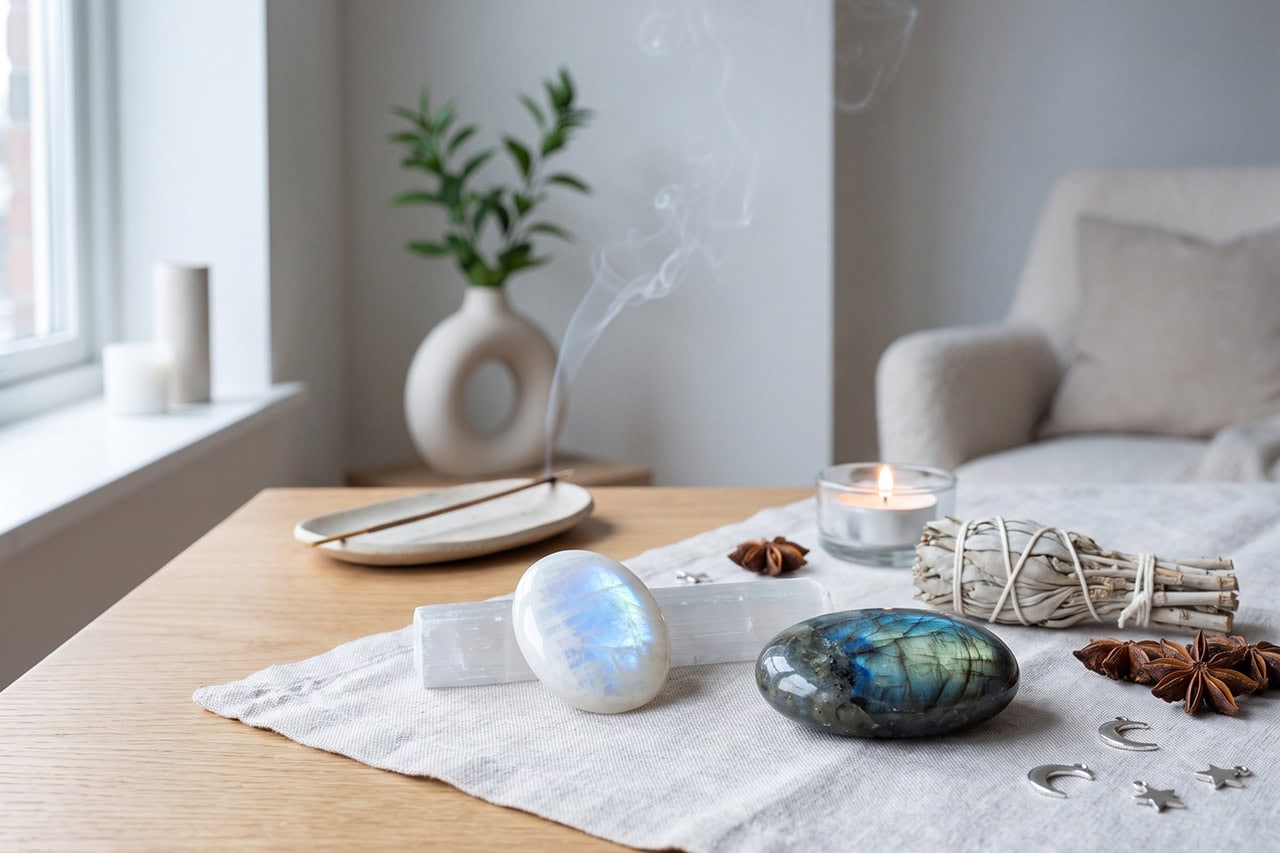
Moonstone, labradorite, selenite and pearl, mostly. Look at what the connection is made of, though, because in Scott Cunningham’s 1988 encyclopedia, the reference shelf’s standard, the moon turns up as a date far more often than as a source.
Page 9 of Scott Cunningham’s Encyclopedia of Crystal, Gem & Metal Magic holds the book’s definition of charging a stone, and it runs to four lines. Hold it in the hand you push energy out of. Picture what you need. Pour energy out of your body and into the stone. Then the sentence that says where the power came from: “This energy is personal power. It resides within all of us.”
The moon is not in that paragraph. It is not anywhere on that page, and it is not in the chapter the page sits in.
It arrives thirty-two pages later with a different job.
Page 41, and the lunar lines after it
Page 41 is about scrying with a crystal sphere, and it is where moonlight first does anything in this book. “The Full Moon is an ideal time to cleanse and ‘charge’ a crystal with your magical intent, in this case, successful scrying.” An ideal time. Three sentences on, the book says what the moonlight is doing while you stand out there holding the sphere up: “See it (through visualization) flooding the crystal, attuning it with your energy.” Yours, again, and the parenthesis is the practitioner doing the work.
Read the rest of the book’s lunar instructions in a row and the shape is hard to miss. Beryl scrying, page 77, should be done only during the waxing moon for the strongest results, and Cunningham prefixes even that with “according to ancient magical directions”. A moonstone divination on page 115 happens “at least three days after the Full Moon.” Lodestones on page 165 get cleansed in salt water every full moon, where the salt water does the cleaning and the moon supplies the interval. Pearls, page 123, are used by some people “only at night, during the Moon’s domain.” The moonstone entry on page 114 manages to contradict itself inside one paragraph, noting that some work the stone while the moon waxes and others prefer the waning for divination, the sort of disagreement that survives when what a rule governs is a diary rather than a mechanism.
Every one of those lines is an appointment.
I should be straight about where the book breaks that pattern, because it does, twice. Further down page 41 comes “moonlight is used to purify crystal spheres”, and page 89 says a crystal sphere “can be exposed to the light of the Full Moon to strengthen its powers.” Neither sentence has a practitioner in it. The tradition is not tidy here, and anyone who tells you it is has not read the pages. What I would hold is that the definition on page 9 is the load-bearing one, that it puts the energy in your hand, and that page 41 finds its way back to that position four sentences after wandering off it.
What the moon is doing while you wait, and what to do about your diary
Set your stones out once the moon is up, the instruction goes, and bring them in before morning. That assumes the moon keeps to the shift.
Mostly it does not. Royal Museums Greenwich points out that the moon is up in daylight regularly, being near enough and bright enough to survive a sky the stars cannot, and that you are likeliest to catch it “between a wide crescent and a thin gibbous Moon”, close to the quarters, when it is lit enough to see and far enough from the sun to look at safely. Armagh Observatory and Planetarium adds the timing: before full moon, look for the daytime moon in the afternoon, and after full moon, look for it in the morning. Armagh then adds this. “At Full Moon, the Moon rises in the east at exactly the same time as the Sun sets in the west, and that is the only night in the month when the Moon is in the night sky all night long.”
The only night in the month. Every other night of the cycle it is drifting through somebody’s Tuesday afternoon, ignored by everyone, including the people who own labradorite.
None of which is an argument against going outside. It is an argument about what going outside is for. Standing in the garden at eleven at night with a bowl in your hands is something you did on purpose, on a date you had to look up, and the looking-up is not decoration on the practice.
The practical version of all this is duller than the shelf card. Whatever you do with your stones on a full moon, the thing you are choosing is an interval. Roughly four weeks, set by something outside you that you cannot negotiate with, cannot forget to wind, and will not let you quietly stretch to six weeks and then to never. That is the whole of the offer, and it is a good one, because a practice with no interval in it becomes a practice you did twice in March.
Put the next one in the calendar you keep dentist appointments in. Not a moon app that pings you, not a mental note, and not the vague sense that one is coming up. The same calendar as everything else you turn up to, three or four weeks out, with a time on it, and the one after that entered before you go to bed.
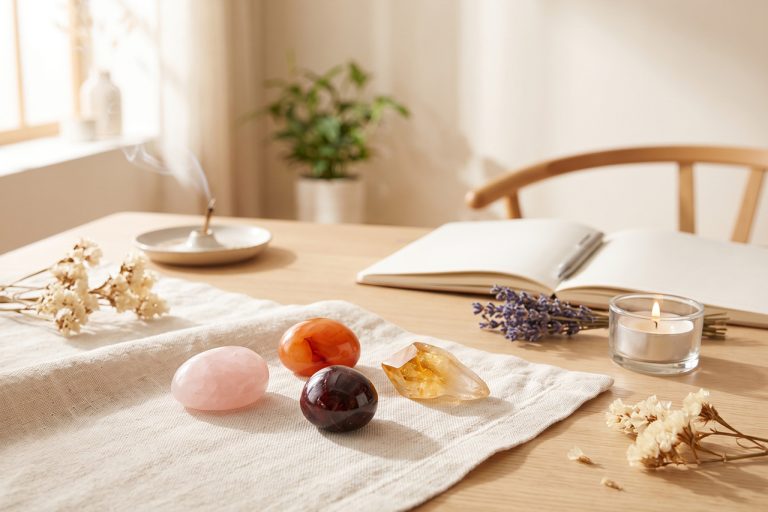
The stones at the top of this page do not mind either way. What an interval buys you is that you will pick them up again in April, rather than finding them dusty in September.
If you want to know which piece will survive a pocket between appointments, carrying moonstone goes through that, and the Crystalance Mineral Library has the profiles for the rest.
One mineral does have a literal claim to the title and it has never been on a shelf. Tranquillityite came back from the Sea of Tranquillity with Apollo 11 and was named for the place in 1971, and of the three minerals new to science in those samples it was the one that stayed lunar, which is why Birger Rasmussen calls it “the moon’s own mineral”. Then Rasmussen’s team found it in ordinary dolerite in Western Australia, and has since turned it up at six more sites there.
Sources
- Scott Cunningham, Cunningham’s Encyclopedia of Crystal, Gem & Metal Magic, Llewellyn, copyright 1988, pp. 9, 41, 77, 89, 114 to 115, 123, 165: openlibrary.org
- Royal Museums Greenwich, “Everything you’ve ever wanted to know about the Moon”: rmg.co.uk
- Armagh Observatory and Planetarium, “The Moon in the Daytime”, Sinead McNicholl, 2012: armaghplanet.com
- Handbook of Mineralogy, tranquillityite: rruff.info
- Birger Rasmussen, “‘Moon rocks’ made here: tranquillityite discovered in Western Australia”, The Conversation, 2012: theconversation.com