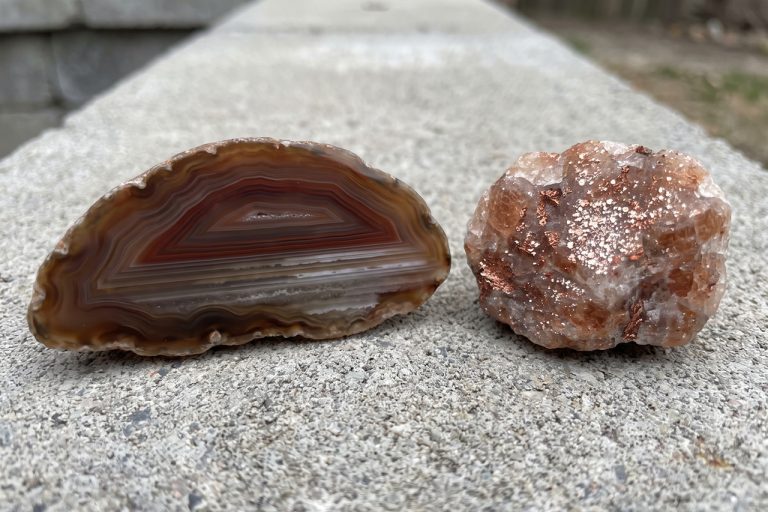

Citrine, green aventurine, pyrite and carnelian are the names you will be given, and crystal practice asks you to hold one while stating what you are after. The stones are the part the sources disagree about. The specificity is the part they all share.
Attraction work, as crystal practice describes it, is a small set of instructions. Pick a stone associated with the thing you want and keep it somewhere you will meet it, in a pocket or on a desk, and be clear with yourself about what you are asking for. Practitioners will tell you the stone keeps the intention in view rather than doing the work itself, and the better ones say so without being asked.
That is a reasonable practice and this article is not going to talk you out of it. What is odd is where the two halves of it came from, because they do not appear to have come from the same place, and the founding books of one half barely mention the other half.
The book that named the law has no gemstone in it
The phrase most of this vocabulary rests on has a book attached to it. William Walker Atkinson published Thought Vibration, or The Law of Attraction in the Thought World in 1906, and it is where the modern usage settles into its final shape. Atkinson’s own framing: “We speak learnedly of the Law of Gravitation, but ignore that equally wonderful manifestation, The Law of Attraction in the Thought World.”
Read the book cover to cover and you will not find a gemstone in it. No quartz, no amethyst, no citrine, no carnelian. The word “stone” turns up seven times and every one is a figure of speech, stone walls and casting the first stone and a stone thrown into water. The word “crystal” appears once, in a publisher’s advertisement bound in with the text, listing other occult titles the firm sold, among them one on crystal gazing. The only other trace of it is “crystallized”, in the preface, and that is describing a magazine article of Atkinson’s rather than a stone.
Neither of the books either side of it names a gemstone either. Ralph Waldo Trine’s In Tune with the Infinite of 1897 states the law directly, “The law of attraction works unceasingly throughout the universe, and the one great and never changing fact in connection with it is, as we have found, that like attracts like”, and applies it to money at length, without a gemstone anywhere. Prentice Mulford’s Your Forces, and How to Use Them had the phrase carrying the same sense by the volume copyrighted 1888, thought drawing to itself “by the same law of attraction”. His metaphor for how it works is a magnet.
Two of the three carry nothing of the kind at all. Trine’s book has no jewel, no talisman and no amulet in it any more than Atkinson’s does. Mulford is the exception, and being exact about him matters, because he does not name a stone but he does open the door: “There is the germ of a truth in the idea of the amulet or charm, or relic of saint, or bead blessed by the pope, possessing a certain power or virtue.” His reason is his own, that any material substance worn or touched by a person absorbs part of that person’s thought, and it is not the reason the lapidary tradition gives. The door is open in 1888, in one of the three books, and on his own terms.
The stone books were already saying it, for their own reasons
Meanwhile, and apparently without any contact between the two, the people writing about stones were making the attraction claim on their own account.
William and Kate Pavitt’s Book of Talismans, Amulets and Zodiacal Gems came out in 1914, eight years after Atkinson. On the jacinth: “The popularity of this stone in India is as great as ever, and at the present time it is worn as an antidote against poison, to attract riches, honour, and wisdom, and to drive away evil spirits.” Note the first clause, which the sentence is usually quoted without. The Pavitts are reporting a practice they locate in India, and they treat the medieval European material as a separate matter in the sentence that follows.
Where they get it from is the other point. Their sources are Camillus Leonardus, Marbodus, Pliny and the Reverend C. W. King, which is to say the lapidary tradition, running back through the Middle Ages to the classical world. That tradition had been saying that certain stones draw wealth and favour for centuries before anyone in Chicago wrote about thought vibration. It reached the Pavitts by its own route and it owes New Thought nothing.
The phrase “law of attraction” does not occur in their book at all.
Somebody watched the revival happen and called it a newspaper story
The two halves are welded together now, and the join is more recent than either piece. There is one contemporary observation of the welding, and it reaches us at second hand.
George Frederick Kunz, Tiffany’s gemmologist, passed it on in 1915, taking it from a published Folklore paper on a meeting of the English Folklore Society. One member, he writes, “expressed the opinion that the revival of interest in amulets and talismans and in all sorts and kinds of ‘mascots’ was largely due to the articles printed about such things in certain of the daily and weekly papers.” The Society’s president, Dr Gaster, closed the discussion by saying that “from his experience the modern belief in amulets as aids to luck was genuine and widely spread.”
Two things in that, and they sit together comfortably. The belief was real and it was everywhere. And the one member who spoke to where it came from, inside a learned society devoted to studying exactly this, thought he was watching a media phenomenon rather than the survival of something unbroken.
That is where it leaves you. Nobody can hand you a document joining the lapidary tradition to the law of attraction, because as far as the founding texts of either go, no such document was written. Mulford’s charm passage is the nearest thing to one, and he gets there by his own route without a lapidary in sight. What you have instead is an old claim about stones and a young claim about thought, put together somewhere in the last hundred years by people who did not write down that they were doing it.
What has been measured, and on whom
One study bears on this, and it is not about crystals.
Lucas Dixon, Matthew Hornsey and Nicole Hartley built a scale for manifestation belief and ran it across three samples totalling just over a thousand people, publishing in Personality and Social Psychology Bulletin in 2025. Over a third of their participants endorsed manifestation beliefs. Those who scored higher “perceived themselves as more successful, had stronger aspirations for success, and believed they were more likely to achieve future success”, while scores “did not differ significantly by age, gender, or income”. Higher scorers were also more drawn to risky investments, and more likely to report having been bankrupt. The authors are careful that their design is correlational, and their paper says nothing at all about objects or stones.
What the scale tracked, then, was mostly self-perception, and it did not vary with income. The two findings with money in them are of different kinds: one is an appetite for risk and the other is an outcome, and neither of them is earnings. Whatever the belief does on this evidence, it shows up in how people see themselves and in what they are willing to stake, and that is the part to hold in mind before you build a decision on it.
Take the practical version from the one part both traditions agree on. Every text in this article, on either side of the divide, asks for something specific, a named stone for a named purpose or a clearly held request. Vagueness is the one thing none of them permit. Write the thing down, then, on paper, in one sentence, specific enough that in three months you could say without arguing with yourself whether it arrived. Keep the stone next to the paper if you like the stone. One stone in particular has had the money claim tested against it, in what citrine is supposed to do about money, and the Crystalance Mineral Library covers the rest of them as materials. The sentence is the part you will still have in three months.
Sources
- Atkinson, W. W., Thought Vibration, or The Law of Attraction in the Thought World, Chicago: New Thought Publishing Co., copyright 1906 (this printing 1908), for the gravitation sentence, and for the absence of any gemstone from the book: archive.org
- Trine, R. W., In Tune with the Infinite: or, Fullness of Peace, Power, and Plenty, Thomas Y. Crowell, 1897, for “The law of attraction works unceasingly throughout the universe”: gutenberg.org
- Mulford, P., Your Forces, and How to Use Them, Vol. II, New York: F. J. Needham, copyright 1888, for the phrase already carrying the manifesting sense, and for the magnet: archive.org
- Pavitt, W. T. and Pavitt, K., The Book of Talismans, Amulets and Zodiacal Gems, Philadelphia: David McKay, 1914, for the jacinth passage in full, for the sourcing to Leonardus, Marbodus, Pliny and King, and for the absence of the phrase “law of attraction” from the book: archive.org
- Kunz, G. F., The Magic of Jewels and Charms, Philadelphia and London: J. B. Lippincott, 1915, p. 371, for the Folklore Society member on the newspapers and for Dr Gaster’s closing remark. Kunz is reporting the meeting at second hand from a published Folklore paper: archive.org
- Dixon, L. J., Hornsey, M. J. and Hartley, N., “‘The Secret’ to Success? The Psychology of Belief in Manifestation”, Personality and Social Psychology Bulletin 51(1), 2025, pp. 49 to 65, for the scale, the proportion endorsing manifestation beliefs, the self-perception findings, the absence of a difference by income, the risky-investment finding, and the authors’ own note that any implication of causation is speculative: sagepub.com