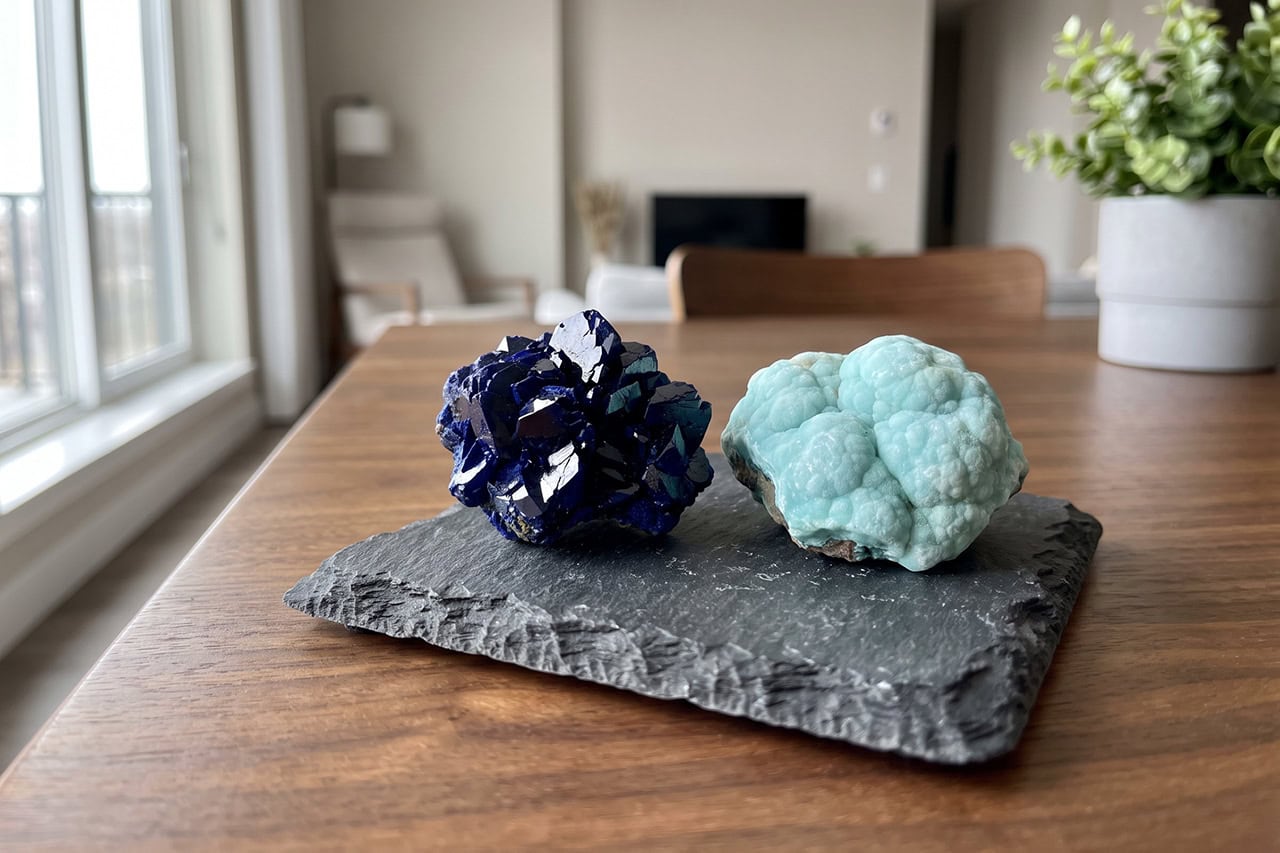
Azurite is a crystal by every measurement anybody has taken. Chrysocolla is an approved mineral species whose samples came back non-diffracting under X-ray, and whose reference entry still lists its space group as undetermined. Both answers are yes, and one of them is unfinished.
In 2012 three researchers in Queensland put chrysocolla from Arizona, the Congo and Nevada under a powder X-ray beam. The method reads the pattern that comes back when X-rays glance off the ordered ranks of atoms in a solid, and different arrangements return different patterns. Chrysocolla returned no pattern. “The XRD patterns show that the chrysocolla mineral samples are non-diffracting,” Frost, Xi and Wood wrote, and they took the blank result as evidence that the samples were clean, since nothing else had shown up in them either.
That is an odd thing to find in a mineral the IMA has carried as an approved species since 1980. Azurite, sitting in the same oxidised copper ore, gives a pattern without any trouble, and the Handbook of Mineralogy records over a hundred crystal forms for it. The two turn up in the same hand specimen often enough to be sold together, and their reference entries do not look remotely alike.
The species with a hundred forms
Azurite is a copper carbonate hydroxide, Cu3(CO3)2(OH)2, and the Handbook of Mineralogy gives it as monoclinic in space group P21/c with a measured density of 3.773. Its colour line reads “Azure-blue, Berlin blue, very dark to pale blue”, one of the few species where the name and the colour say the same thing. Hardness is 3.5 to 4. That is soft, softer than a steel blade, and the cleavage line adds the other half of the handling advice: perfect on {011}, though the Handbook qualifies it as interrupted, with weaker directions besides. A mineral with a perfect cleavage and a hardness under 4 will part along a plane long before anything scratches it.
The habit line runs long. “Crystals are typically complex, with over 100 forms recorded, to 30 cm”, the Handbook says, tabular or prismatic, and also “rhomboidal, lenticular, or spherical subparallel aggregates”, along with botryoidal, drusy, earthy and massive material. That range of outward shapes is possible because the inward arrangement is fixed. One way of stacking the atoms, a hundred ways of ending up at a surface.
One of the smaller pieces in the collection behind this article is a vanadinite, palm-sized, its reddish-brown hexagonal crystals standing off the matrix with faces sharp enough that the first reaction is doubt about whether it grew that way. That reaction is the ordinary response to a well-formed crystal of anything, azurite included, and it is the reason the word crystal came to mean a shape at all rather than an internal arrangement.
Nothing about azurite is in dispute. It forms in the oxidised zones of copper deposits where carbonate rock is present. If a seller calls a blue specimen azurite the only real question left is whether they have the species right.
The fields left blank on the chrysocolla page
Open the Handbook at chrysocolla and the shape of the page changes. The formula is (Cu,Al)2H2Si2O5(OH)4 with an nH2O on the end, the n there because the water content varies from piece to piece. Crystal system: “Orthorhombic (?)”. Then point group, space group, Z and calculated density, each given as n.d., not determined. Hardness comes as roughly 2 to 4, a range two whole numbers wide.
Four fields blank, five counting the optical measurement, on a page of a reference work that runs to several dense paragraphs for most species.
The habit line runs “Crystals acicular, to 5 mm, in radiating clusters; fine fibrous, botryoidal, earthy; commonly cryptocrystalline, opaline, or enamel-like.” Commonly is the Handbook’s word for the last three, and those are the forms a shop sells: a smooth blue-green crust, or a fill in a seam of rock with a surface that looks poured.
The reason usually given for calling this material a crystal is that the structure is there and simply too small to see. That explanation is borrowed from chalcedony, where it happens to be true, and it does not survive contact with the measurement. Frost, Xi and Wood’s samples were not too finely crystalline to resolve; they produced nothing to resolve.
Two qualifications belong with that. Their paper covers selected samples from three localities, which is not every piece of chrysocolla ever mined. And the same Handbook page that leaves so much undetermined does print unit-cell edges, given as ranges, together with an X-ray powder pattern credited to the ICDD and headed “Locality unknown”. Somebody, at some point, got enough of an answer to hazard a system and to write down some spacings. What can be said is that the guess still carries its question mark decades later, and that the most direct modern test on three suites of material came back with nothing on it.
The same page carries two figures that help at arm’s length. Measured density runs 1.93 to 2.4, which is light for a copper mineral and lighter than quartz at 2.65, and the hardness range tops out at 4 against quartz’s 7. Read those two entries against each other and a blue-green piece that feels heavy and takes a scratch from nothing is carrying something denser and harder than chrysocolla, whatever the label says. The Handbook does not draw that conclusion. The figures are its own and the division is ordinary.
The name has never been narrow either. The Handbook derives it “From the Greek for gold and glue, for a substance used in the soldering of gold, including chrysocolla as well as other blue and green minerals”, so the word arrived attached to a job rather than to a substance, and it covered several minerals when it did.
Chrysocolla is therefore an approved species with an unfinished file behind it. The trade’s confident yes is the right answer for a reason that has not been established.
Why the two turn up together
Both minerals form in the same place, the oxidised upper part of a copper orebody where groundwater has been working on sulphides for a long time. The Handbook’s association line for azurite opens “Malachite, chrysocolla, brochantite, antlerite, cuprite”, and chrysocolla’s own association line begins with malachite. Copper chemistry puts them next to each other underground.
They are also sequential. Barbara Muntyan, in an abstract written for the 2018 New Mexico Mineral Symposium, surveys Arizona’s pseudomorphs and notes that the most common of them “are the result of alteration in carbonate deposits”, azurite to malachite or to chrysocolla. Bisbee and Morenci are among the localities she names, and she adds that “virtually all of the porphyry copper deposits in the State have produced noteworthy examples”. One blue mineral becoming a green one and keeping the outward shape of the first.
A pseudomorph is the strong version of that: the original mineral gone, the outward form kept. Muntyan describes complete replacements and does not discuss partly altered specimens, so treat the green on a blue piece as an open question rather than a diagnosis. What her account does establish is that green appearing where azurite was is a documented direction of travel and not a sign that two unrelated things were glued together. It also happened underground across geological time, which is a different timescale from a shelf.
Malachite has a page of its own in the Crystalance Mineral Library, carrying the chemistry and the figures. The Arizona pseudomorphs add something a species page has no field for, which is that some green material on the market began as blue.
The two questions come out at different weights. Azurite is a crystal, and nobody has seriously suggested otherwise. Chrysocolla is one too, on the authority of the only body that keeps a list, and its entry in the standard reference still gives the space group as not determined.
Sources
- Frost, R.L., Xi, Y. and Wood, B.J. (2012), “Thermogravimetric analysis, PXRD, EDX and XPS study of chrysocolla (Cu,Al)2H2Si2O5(OH)4.nH2O: structural implications”, Thermochimica Acta, for the non-diffracting X-ray result on samples from Arizona, the Congo and Nevada.
- Handbook of Mineralogy, azurite: Cu3(CO3)2(OH)2, monoclinic P21/c, hardness 3.5 to 4, measured density 3.773, over 100 crystal forms recorded to 30 cm, the colour and association lines quoted above, and occurrence in the oxidised zones of copper deposits associated with carbonate rocks.
- Handbook of Mineralogy, chrysocolla: the formula with its variable water, “Orthorhombic (?)” with point group, space group, Z, calculated density and the optical 2V all given as not determined, unit-cell edges given as ranges, an X-ray powder pattern credited to the ICDD, hardness roughly 2 to 4, measured density 1.93 to 2.4, and the habit and association lines quoted above.
- IMA-CNMNC master list of mineral names, maintained by the Commission on New Minerals, Nomenclature and Classification, for chrysocolla’s entry as an approved species dated 1980 and for the status codes.
- Muntyan, B.L. (2018), “Arizona pseudomorphs”, abstract for the 39th New Mexico Mineral Symposium, New Mexico Bureau of Geology and Mineral Resources, for azurite altering to malachite or chrysocolla in carbonate deposits, for the Bisbee and Morenci localities, and for the note that virtually all the state’s porphyry copper deposits have produced examples.