Yes. A 2025 survey worked through iridescent iron oxide from named localities in Brazil, Mexico, Italy and five American states. The colour is structural and not a pigment, and how deep the structure sits is disputed. Coated grey hematite is sold under the same name.
Two teams of researchers, publishing twenty-two years apart and agreeing on very little, put electron microscopes on iridescent hematite and came back with the same geometry. The 2018 study describes “the threefold trellis network generated by the hematite nanoparticles”, seen most clearly in images of fracture surfaces. The 2025 study reports “nanocrystals arranged in three directions (120° apart)”. Three directions, both times.
The rods themselves are nothing alike, measured at 200 to 300 nanometres long and 50 to 60 wide in one study and at widths of 5 to 35 nanometres in the other, and the two accounts put them in different places. The arrangement is the part that survives between them.
None of it bears on whether the material is natural. Every sample in both studies came out of the ground, and the 2025 list of where reads like a field-trip itinerary: Mina do Andrade and the Pico Mine in Minas Gerais, the El Salvador Mine at Sierra Mojada in Mexico, Graves Mountain in Lincoln County, Georgia, Quartz Mountain in Douglas County, Oregon, the Whittaker Iron Mine in Inyo County, California, Dequesne in Santa Cruz County, Arizona, and Rio Marina on Elba. Graves Mountain is a place people go with a hammer.
Colour without anything coloured in it
Hematite has two colours and neither of them is green. It is iron oxide, and the Handbook of Mineralogy gives the mineral as “Steel-gray, may have iridescent tarnish, dull to bright red” with a streak, the powder it leaves on unglazed porcelain, of “Cherry-red or reddish brown”. Grey lump, red line.
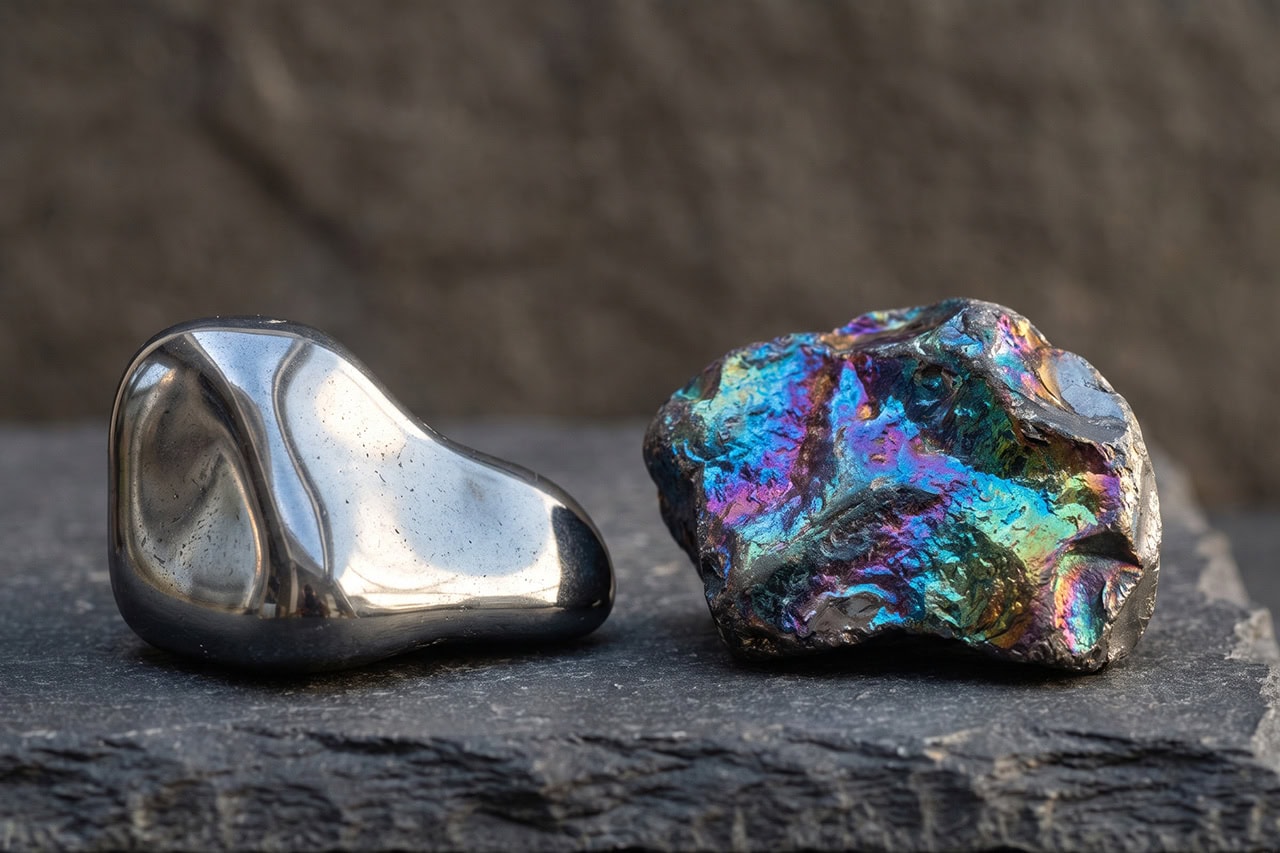
An iridescent plate is the same iron oxide and shows green, magenta and gold across its face. Nothing was added. Both published accounts locate the colour in a dimension instead of a substance, and there they stop resembling each other.
Xiayang Lin, Peter Heaney and Jeffrey Post, writing in Gems & Gemology in 2018 about material from the Andrade mine in Minas Gerais, measured the gaps between neighbouring rods within a layer at 280 to 400 nanometres, which they describe as “generating a diffraction grating for visible light”. George Rossman and Chi Ma, in Minerals in 2025, report films “that range from tens to hundreds of nanometers thick” and conclude that the films produce the interference colours. Those two figures overlap at one end and sit a decade apart at the other, so presenting them as one answer is tidying.
Both descriptions share a kind of explanation. Where a green mineral is green because of what it is made of, a green patch on a hematite plate is green because of how far apart two things sit, and the colour moves when the stone does. Interference depends on the path light takes through the structure, so the angle of the eye is part of the effect and not an accident of viewing.
Where the two accounts part company
Chi Ma and George Rossman attributed the colour to a thin surface film of aluminium phosphate in 2003. That stood for fifteen years.
Lin, Heaney and Post set it aside in 2018, writing that “the iridescence should not be attributed to a thin film of Al phosphate, as previously suggested by Ma and Rossman (2003a)”, and placing the periodic structure in the hematite itself. The observation they lean on comes with its limit attached in the same sentence: “Even when the iridescent Andrade hematite was freshly fractured, all surfaces exhibited intense rainbow colors, leading us to interpret the iridescence as a bulk character, or at least as a pervasive character, rather than as the result of a single surface coating.”
The 2025 paper puts films back. Rossman and Ma examined Andrade material among the rest and state flatly that they “were not able to confirm these conclusions in any of our samples”, concluding instead that “the films cause interference colors in the iridescent samples”. They also record that the nanocrystals in those films “have failed to produce either an X-ray powder diffraction pattern, an electron back-scatter diffraction pattern in SEM, or an electron diffraction ring pattern under TEM”.
Neither group has withdrawn. The unsettled part is how deep the coloured structure goes, and nothing in the exchange touches whether the material formed underground.
Three different things called rainbow
A rainbow fluorite spike sits on the shelf here, eight centimetres of transparent purple shading up through indigo and blue into green. The colour there belongs to the mineral. Each band is fluorite of a slightly different composition, and the colour is a fact about the material at that height in the crystal. Cut the piece anywhere and the band you cut through is the colour you get.
Rainbow hematite works the other way round. The material is one substance from top to bottom, and the colour is a property of an architecture built in it or on it. Nothing about the iron oxide changes between a green patch and a magenta one.
Then there is a third thing under the same word, and it is a treatment. GIA describes coating in its own entry, noting that “More modern coating methods use metal oxide thin films” and that “Vapor deposition can coat many types of gems with metal oxides”. A deposited film on a grey hematite plate produces iridescence too. No published figure exists for how much of the material on the market is treated, so a proportion quoted at you was arrived at by guessing. Who is supposed to say is not in doubt. GIA is flat that disclosure “is necessary and legally required for anyone selling a gem (including consumer to consumer trade) to disclose the treatment procedure it may have received”.
The stone underneath the colour
Iron oxide, Fe2O3, hexagonal, hardness 5 to 6 on the Handbook’s figures, which puts it below quartz and means a hematite piece stored loose against quartz-family tumbles will collect the marks rather than give them. Measured density is 5.26, high enough that a hematite bead lifted off a table gives the game away before anything else does.
The lustre reads “Metallic or submetallic to dull”, so a mirror finish is lapidary work and not a property of the mineral, and the tenacity line runs “Brittle; elastic in thin laminae”, which is a compact way of saying that the thin plates this material often comes in behave differently from a solid lump.
The streak stays the one observation available at a kitchen table. Drag a piece along the back of an unglazed tile and hematite marks it cherry-red to reddish brown, whatever the surface looks like. It settles the species and says nothing at all about treatment, so it answers the question underneath this one. Those figures and the rest of the species data are on the hematite page in the Crystalance Mineral Library.
The two groups could not confirm each other’s conclusions, and they still drew the same picture of how the rods lie. Three directions, on material from Minas Gerais and from eight other places, seven years apart.
Sources
- Rossman, G.R. and Ma, C. (2025), “Iridescent Iron Oxides”, Minerals 15(2), 108, for the localities named above, the nanocrystals arranged in three directions 120 degrees apart, the rod widths of 5 to 35 nanometres, the film thicknesses of tens to hundreds of nanometres, the failure to obtain a diffraction pattern by three methods, the inability to confirm the 2018 conclusions, and the conclusion that the films cause the interference colours.
- Lin, X., Heaney, P.J. and Post, J.E. (2018), “Iridescence in Metamorphic ‘Rainbow’ Hematite”, Gems & Gemology 54(1), for the spindle-shaped nanoparticles at 200 to 300 nanometres long and 50 to 60 wide, the threefold trellis network seen on fracture surfaces, the 280 to 400 nanometre spacings generating a diffraction grating for visible light, the freshly fractured surfaces with the bulk-or-pervasive hedge quoted in full, and the setting aside of the aluminium phosphate film explanation of Ma and Rossman (2003a).
- Handbook of Mineralogy, hematite: Fe2O3, hexagonal, hardness 5 to 6, measured density 5.26, colour “Steel-gray, may have iridescent tarnish, dull to bright red”, streak “Cherry-red or reddish brown”, lustre metallic or submetallic to dull, tenacity brittle and elastic in thin laminae.
- GIA, gem treatments, for the definition of coating, metal oxide thin films, vapour deposition, and the disclosure requirement quoted in full.