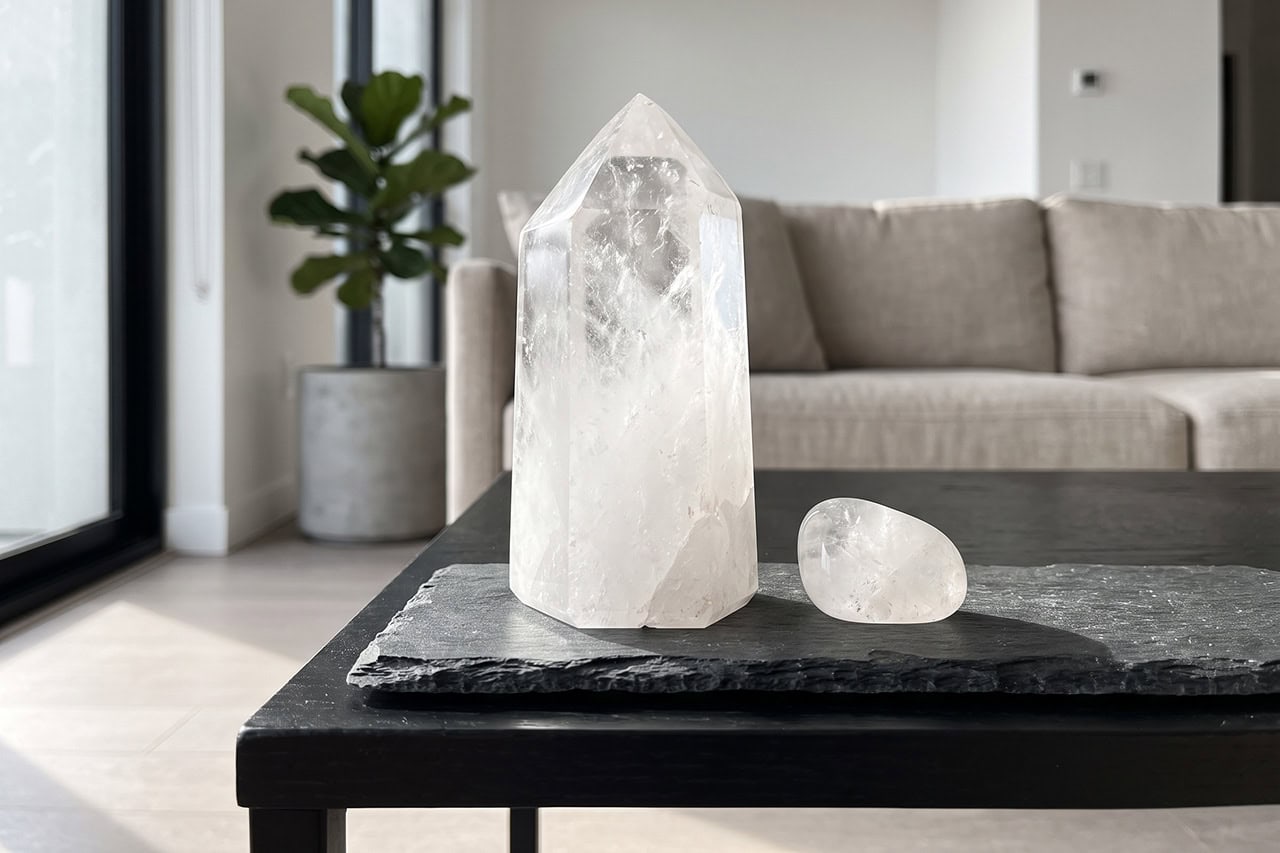
Milky quartz is quartz clouded white by minute fluid inclusions trapped while it grew. It is vein and pegmatite material, and it is the stone the California Mother Lode was dug out of.
A USGS field-trip guide to the gold deposits of the western Sierra Nevada describes the Mother Lode as “a 1 to 4 mile wide system of mineralized rock and en echelon quartz viens [sic] extending for 120 miles through El Dorado, Amador, Calaveras, Tuolumne, and Mariposa Counties”. The veins themselves it gives as “milky quartz, in many places ribboned with bands of slate or schist, minor amounts of sulfide minerals, mostly pyrite, and free gold”.
A hundred and twenty miles of it. The ribboning in that description is the country rock itself, dark slate and schist caught in among the white. The stone that turns up in shops as the mild and inexpensive quartz, the one people get pointed at when clear quartz feels like too much, is the same white material as those hundred and twenty miles of gold veins.
Both facts come out of the same geology, and the geology is not complicated.
What the veins were made of
Quartz precipitates out of hot water moving through cracks in rock. The Handbook of Mineralogy gives its occurrence as “In hydrothermal veins, epithermal to alpine; characteristic of granites and granite pegmatites”, and the USGS guide puts the gold in those same veins. The two have been mapped together across the belt for a century and a half.
Stephen Nelson’s mineralogy notes at Tulane put the cloudiness down to the fluid itself: milky quartz is “a white colored variety with the color being due to fluid inclusions”, and it is “common in hydrothermal veins and pegmatites”. Some of the fluid the crystal grew in never got out. It stayed behind in pockets too small to see individually, and light entering the stone scatters off the boundaries between quartz and pocket instead of passing through. Enough of them and the piece goes white.
That puts milky quartz in a different class from most of the coloured varieties, where the tint comes from something taken into the structure or held in it as a separate mineral. The Handbook groups quartz’s other colours under inclusions of one kind or another, running “rose-pink to rose-red, yellow to yellowish brown, green, blue, bluish violet, brown to black”. White is not one of those. It is the absence of a clear path through the stone, which is why a milky piece with a translucent zone in it is one piece of quartz and not two.
The description stops at fluid inclusions, and no published source identifies the fluid or supports the common line that milky quartz is the most abundant variety of quartz.
The gold association needs the same care in the other direction. Gold-bearing veins in the Sierra Nevada are made of milky quartz. The sentence does not run backwards. The belt is not uniform either. Productive quartz veins “are generally characteristic of the north portion of the Mother Lode, whereas immense persistent barren veins and enormous bodies of carbonate rock associated with mineralized country rock are most common in the southern portion.” Even the productive ones were hard to hold on to. They “pinch and swell abruptly and rarely can be traced for more than a few thousand feet”, so following one was mostly a matter of losing it.
The belt is still on the map. Highway 49 is “commonly known as the Mother Lode Highway” and “connects many of the towns and mining camps that sprang up along the belt soon after the California gold rush began in 1849”. A road numbered for the year, running the length of a quartz vein system. Where the veins did hold something the figures are hard to take in, and the Jackson-Plymouth district is given as the most productive of the Mother Lode, “with reported production in excess of $160 million”.
The white rock survived all of it, and there is an enormous amount of it. Every quartz vein that never held any gold is still where it was, and the Handbook’s occurrence line closes by listing quartz as “a residual mineral in soils and sediments”, meaning that when the rock around it breaks down the quartz stays. White lumps in a field and white pebbles in a stream bed are the ordinary end of that process.
The same guide records placer gold in the western Sierra in deposits of two ages, the older of which are “chiefly quartz gravels in relict early Tertiary river channels”. Quartz gravel is what a vein turns into. Those channels were taking the white rock apart and rounding it off tens of millions of years before anybody arrived to dig at the veins themselves.
What the cloud does to the stone
A white lump of it does not look like quartz, and the Handbook explains that in four words. Its lustre line reads “Vitreous; waxy to dull when massive”. People expect quartz to look like glass. Massive quartz looks like candle wax or old soap, so it gets picked up and put down again as something else. The measured density is slightly lower too, 2.59 to 2.63 against 2.65 for the crystal.
White calcite is what it gets mistaken for, and cleavage separates them. Calcite has one perfect direction of cleavage that repeats in three, so a broken piece drops into blocks with flat faces and a leaning, rhomb-shaped look. Quartz’s cleavage the Handbook calls “Rarely observable, poor”, and a broken piece of quartz does not do that. Hardness is 3 against 7, a wide gap, while the densities sit close enough together that weight settles nothing: calcite 2.71, massive quartz 2.59 to 2.63.
Then the tenacity line, which reads “Brittle, tough when massive”. Brittle and tough are not opposites in mineralogy: brittleness describes how a material fails, and toughness describes how much it takes to make it fail. A lump of interlocking quartz grains stands up to more than a single terminated point of the same species before anything happens to it.
Aggregates do not behave that way as a class, and a raw schorl specimen in the collection here makes the opposite case. Black, deeply striated, it parts along the boundaries between its own columns under nothing worse than being set down, and the Handbook gives schorl as brittle with an uneven to conchoidal fracture. Two tenacity lines from the same reference book, opposite outcomes. The deciding factor is how the parts are joined and not whether the object is a single crystal.
For milky quartz the consequence is small and mildly cheering. Of everything on a quartz shelf, the cloudy massive material is the form that reference line puts on the sturdy side.
The Crystalance Mineral Library entry for clear quartz is an entry for this stone too, since nothing in the chemistry separates a clear point from a white lump. The separation is a matter of how much of the growth fluid stayed inside.
Highway 49 still runs the length of the belt, past the towns. The rock it is named for is the same white, waxy, unremarkable material that fills quartz veins the world over, and in the Sierra foothills, in runs of a few thousand feet at a time, some of it had gold in it.
Sources
- Dodge, F.C.W. and Loyd, R.C. (1984), “Gold Deposits of the Western Sierra Nevada”, USGS Open-File Report 84-169, for the Mother Lode’s extent through five counties, the vein mineralogy of milky quartz with slate or schist ribboning, pyrite and free gold, the pinch-and-swell behaviour of the veins, the north-and-south split between productive and barren veins, the early Tertiary quartz-gravel placers, Highway 49 and the 1849 date, and the Jackson-Plymouth production figure.
- Nelson, S.A., EENS 2110 Mineralogy course notes, Tulane University, for milky quartz as a white variety coloured by fluid inclusions and common in hydrothermal veins and pegmatites.
- Handbook of Mineralogy, quartz: SiO2, hardness 7, measured density 2.65 and 2.59 to 2.63 when massive, lustre “Vitreous; waxy to dull when massive”, tenacity “Brittle, tough when massive”, the colour line quoted above, and occurrence in hydrothermal veins and granite pegmatites.
- Handbook of Mineralogy, calcite: CaCO3, hardness 3, measured density 2.7102, cleavage perfect on {1011}, fracture conchoidal.
- Handbook of Mineralogy, schorl, for the brittle tenacity and uneven to conchoidal fracture of the black tourmaline species.