Adamite
Arsenate
Yellow, green, violet, pink, colorless, white
Vitreous
3.5
4.32 - 4.48
Orthorhombic
Mexico (Ojuela Mine), Greece (Laurion), Chile, Namibia (Tsumeb)
Uncommon to rare in fine specimens
Zn₂(AsO₄)(OH)

The first specimens came from Chañarcillo, in the Atacama Desert of Chile, by way of Gilbert-Joseph Adam, a French mineralogist and collector. Charles Friedel analysed them, found a zinc-rich mineral that was not olivenite, and published the description in 1866. He named it adamite, after the man who had supplied the material.
That is worth getting right, because a lot of pages say Adam discovered and identified it himself. He did not. He supplied it, and Friedel did the chemistry.
Adamite is a basic zinc arsenate. Two zinc atoms, one arsenate group, one hydroxyl. It forms as a secondary mineral in the oxidised zone of hydrothermal deposits that carry both zinc and arsenic, which is a narrow enough set of conditions to explain why the good localities are few and famous. Ojuela in Mexico. Lavrion in Greece. Tsumeb in Namibia. Each one an old, heavily worked ore body where the upper levels sat and weathered for a long time before anyone dug them.
The arsenate part of that formula is not a technicality, and it is the reason this page reads differently from most crystal pages about most minerals. Arsenic is a structural component here, not a trace impurity. It is roughly a quarter of the mineral by weight, bound into the crystal lattice, chemically stable while the specimen is dry and intact. That last clause is doing a lot of work. Everything in the care and usage sections below follows from it, and quite a lot of what circulates online about adamite does not.
What draws people to it is the colour. Cuprian adamite from Ojuela is an electric yellow-green that photographs almost badly, in the sense that pictures of it look edited when they are not. Cobaltian material runs pink to violet. Plain adamite is honey-yellow and, in good crystals, glassy and sharp. The rosettes and radiating fans it forms on limonite matrix are among the more photogenic things in secondary mineralogy.


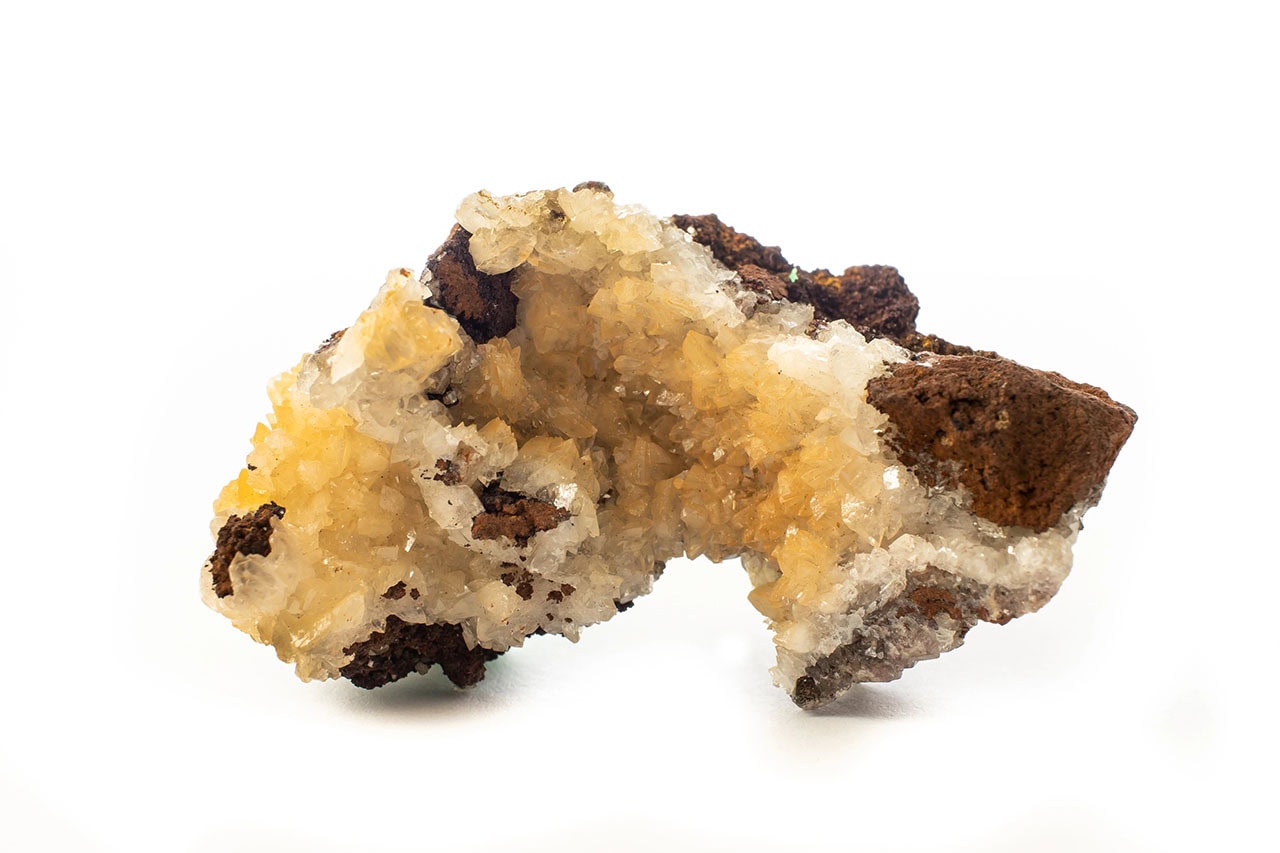
TABLE OF CONTENTS
Properties & Qualities
Physical Properties
The chemistry. Zn₂(AsO₄)(OH). Adamite sits at the zinc end of a solid-solution series with olivenite, the copper arsenate, and the two are isostructural, meaning they share a crystal architecture and swap metal atoms freely. Copper substituting into adamite gives the green material usually labelled cuproadamite. In 2006 the IMA approved zincolivenite, CuZn(AsO₄)(OH), as a distinct species sitting at the ordered midpoint of that series. The practical consequence is that a fair amount of green material sold as adamite has never been analysed closely enough for anyone to say which species it actually is. Not fraud. Just an unanswered question sitting in a lot of specimen boxes.
The habit. Crystals elongate along one axis and reach up to 8 cm in exceptional material, though most are far smaller. They can also be equant, with the {101} and {110} faces dominant. More commonly adamite appears as radial aggregates, fanlike rosettes, and crystalline crusts spread across the host rock. On Ojuela material that host is typically brown limonite, and the contrast between rusty matrix and green crystal is most of why those specimens sell.
Lustre, and a correction. Vitreous. Glassy. Not adamantine, despite what a surprising number of pages claim, and it is not hard to see how the error started: adamite sounds like adamas, the Greek root behind diamond and adamantine. The name has nothing to do with it. It honours a 19th-century Frenchman called Adam. Hardness does not decide lustre (cerussite, at 3 to 3.5, is adamantine), and if you want the actual mineralogy of shine we cover it in which crystals are the sparkliest.
Hardness and durability. 3.5, which is soft. Good cleavage on {101}, poor on {010}, uneven to subconchoidal fracture, brittle throughout. The delicate crusts and rosettes that make adamite worth owning are also the first thing to shear off if a specimen gets knocked or packed carelessly.
Density. 4.32 to 4.48, which is high, and this is genuinely useful in the hand. Adamite is noticeably heavy for its size, considerably denser than quartz at 2.65. Heft is one of the more reliable informal tests you have with this mineral.
Fluorescence. Many adamite specimens fluoresce, and some phosphoresce, under both short and long wave UV, often strongly. Sources describe the colour differently: the Handbook of Mineralogy gives lemon-yellow, while fluorescent-mineral references record green to yellowish green. Copper-bearing adamite usually glows less brightly than pure material, though some green Ojuela pieces still glow strongly, and some specimens do not glow at all. Fluorescence can support an identification, but it is not a pass-or-fail test.
Where it forms. A secondary mineral in the oxidised zone of zinc-bearing and arsenic-bearing hydrothermal deposits, associated with smithsonite, hemimorphite, scorodite, olivenite, calcite, quartz and iron-manganese oxides. That association list is worth reading twice, because half of it turns up again under misidentification.
Metaphysical properties
Adamite has no traditional record. None.
It was described in 1866 from a drawer of Chilean specimens, spent the following century as a collector's and researcher's mineral, and reached the wellness market only when supply from Mexico made attractive specimens widely available. There is no classical lapidary entry, no folk practice, no cross-cultural thread to pull on. What circulates now is recent, and in adamite's case unusually recent.
The current attributions run to joy, creative confidence, and solar plexus work, sometimes extended to the heart. You will also find claims about light body repair, clearing ancestral patterns, and reigniting dormant abilities. Those phrases entered circulation over the past two or three decades of English-language crystal publishing. They are not ancient, they are not documented anywhere before that, and pages presenting them as inherited wisdom are guessing.
Which does not mean nobody should find the associations useful. People have always assigned meaning to striking objects, and a mineral that glows under ultraviolet light and comes out of the ground the colour of a highlighter is going to attract the vocabulary of light and energy no matter what century it is discovered in. The honest framing is that this is a young tradition, still forming, and interesting partly because we can watch it happen.
Meaning & Symbolism
Physical meaning
The symbolism people reach for is drawn almost entirely from two observable things: the colour and the glow.
Bright, saturated, hard to ignore. A mineral that looks like it is lit from inside gets read as vitality, visibility, energy that shows rather than energy that hides. Add fluorescence, where the stone answers a light you cannot see with one you can, and the metaphor writes itself.
The formation story supplies the other half. Adamite grows in the oxidised zone, the weathered upper part of an ore body where the original sulphides have broken down under water and air. It is what happens after decay. Ordinary metal ore, chemically dismantled, recombining into something you would put on a shelf. If a mineral is going to stand for anything about what comes out the far side of a slow difficult process, this one has the chemistry for it.
Spiritual meaning
Read through the modern attributions, adamite's profile is about visibility. Being seen, taking up space, expressing something rather than holding it in. It gets described as a permission stone more often than a protective or grounding one, which puts it in a fairly small category.
The consistent theme is outward movement. Nothing in the modern framing suggests retreat, shielding, or quiet. Whether that says anything about the mineral or only about how humans respond to a bright yellow-green object is not a question the geology can settle. Worth noticing, though, that the associations line up almost perfectly with what the specimen looks like on a table. That is usually a sign you are looking at recent attribution rather than inherited practice.
Healing Benefits
Physical healing
There is no traditional record of adamite being used for any physical complaint, and no documented modern application either. The claims in circulation, including ones naming specific glands and at least one named clinical condition, are not supported by anything and we will not repeat them here.
Safety. Adamite is a zinc arsenate. Arsenic is a structural component, not a contaminant, and makes up a substantial fraction of the mineral by weight.
The practical risk is lower than that sentence sounds, and it is worth being precise rather than alarming. A dry, intact adamite specimen sitting on a shelf is not doing anything to you. Arsenate minerals are poorly soluble in neutral water, and brief handling is ordinary collector practice. The risk vectors are dust, dissolution and ingestion. So:
- Never in elixirs, gem water, drinking bottles or anything else that touches something you will swallow. Not for a minute, not "sealed", not in a bottle with a separate chamber. See what crystals are good for water bottles and which crystals should not be put in water.
- Never soaked, washed under a tap, or left out in rain.
- Never cut, ground, sanded or tumbled without proper dust extraction. Arsenate dust is the real hazard and lapidary work is how it gets made.
- Wash your hands after handling. This is standard practice for arsenates and sulphides among collectors and it costs nothing.
- Not on skin for extended periods, and not as jewellery.
- Keep it out of reach of children and pets, and out of the kitchen.
None of this makes adamite unusually dangerous to own. It makes it a mineral with rules, like realgar or cinnabar, and the rules are easy.
Emotional healing
The modern attribution centres on joy, and specifically on joy returning rather than joy arriving. The framing you find repeatedly is about reconnecting with enthusiasm after a flat period, and about noticing the patterns by which people talk themselves out of wanting things.
Taken as a description of a mood rather than a mechanism, that is coherent enough. It also sits oddly well with the object itself. There is something genuinely lifting about a bright specimen on a grey day, and nobody needs a theory of energy to explain why.
What the geology cannot tell you is whether the stone does anything. What it can tell you is that this particular use, holding it and looking at it, is also the safest thing you can do with adamite, which is a rare case of the metaphysical recommendation and the mineralogical advice pointing the same direction.
Spiritual healing
The visibility theme carries through here: the associations cluster around being willing to be seen, and around expression that has been suppressed. Compassion and heart-work get attached secondarily, usually alongside the solar plexus framing.
If you work with adamite this way, the honest description is that you are using a vivid object as a focus for attention. That is what people have done with objects in every contemplative tradition on record. The stone holds still and reminds you. What happens after that is not the mineral's doing.
Use & Care
How to use
Adamite is a display and contemplation mineral. Its softness, its cleavage and its arsenic content between them rule out most of what people do with tumbled quartz, and the honest list is short.
- On a shelf, in a case, matrix down. This is the main use and there is no shame in it. A good Ojuela plate is a genuinely beautiful object and display is what it is for.
- Under UV, occasionally. Adamite that fluoresces does something worth seeing. Use eye protection with short-wave lamps, keep exposure brief, and do not expect every green Mexican piece to glow.
- Held briefly, with dry hands, then wash them. Fine for meditation or focus work. Short sessions.
- Never as jewellery, never carried loose, never in a pocket. Soft, cleavable, and arsenic-bearing. Three separate reasons, any one of which would be sufficient.
- Not in a crystal grid on the floor or anywhere it gets handled repeatedly, and not somewhere a child or a cat can reach it.
- As a teaching specimen. Adamite is a good demonstration of the oxidised zone, of solid solution between species, and of why heft is a real diagnostic property. It earns its place in a collection on those grounds alone.
How to cleanse
Every method here is chosen around two facts: the mineral is soft and cleavable, and it contains arsenic.
- Dry methods only, without exception. No water, no salt water, no rain, no rinsing. Water is both a physical risk to the specimen and the mechanism by which arsenic goes anywhere.
- Smoke or sound. Non-contact, no moisture, no mechanical stress. If you want a cleansing ritual for adamite, these are the two that cost the stone nothing.
- A soft dry brush for dust. Nothing wet, nothing abrasive, no compressed air near delicate rosettes, and no ultrasonic cleaner.
- Never salt. Abrasive, hygroscopic, and it introduces exactly the moisture you are trying to avoid.
- Never buried in soil. Damp ground damages the specimen, and an arsenate does not belong in a garden.
- Moonlight on a windowsill if the ritual matters to you. Indoors, dry, harmless.
How to charge
No traditional charging practice attaches to adamite, because no tradition attaches to adamite. What follows is general practice filtered for a fragile, arsenic-bearing mineral.
- Keep it out of strong direct sun. Prolonged UV and heat are a real risk to coloured secondary minerals, and there is no upside.
- Moonlight indoors, overnight. Cool, dry, undisturbed.
- Intention setting while holding it, briefly. Dry hands, short contact, wash afterward.
- On a quartz cluster, matrix to matrix. Mechanically fine as long as the adamite rests on host rock rather than on crystal faces.
- Not buried, not in water, not in a pyramid outdoors, not anywhere it can get wet. Several popular charging methods are simply unavailable for this mineral.
Combining with other stones
Nothing traditional exists here, and the pairing lists in circulation are invented. What can be said usefully is geological. In the ground, adamite keeps company with smithsonite, hemimorphite, scorodite, olivenite, calcite and quartz, all of them products of the same oxidised zone. A display grouping built on that has an actual logic behind it: one ore body, one weathering process, six outcomes.
For intention work, the modern associations point toward bright, outward, expressive stones rather than protective or grounding ones. Beyond that, anyone handing you a definitive adamite pairing list is making it up, and several of the combinations you will find recommended involve stones people are told to carry, which for adamite is bad advice regardless of what it is paired with.
Identification
Can be mistaken for
Adamite's colour range is wide enough that the confusions run in several directions at once, and its own association list supplies most of the culprits.
- Olivenite. The copper arsenate at the other end of the same series, isostructural and often intergrown. Olivenite runs olive-green to brown rather than yellow-green. Honestly, this is less a misidentification than a boundary problem, and zincolivenite sits between them as an approved species since 2006. Analysis settles it. Eyes do not.
- Legrandite. The other famous yellow Ojuela arsenate, and the one that causes real confusion because both come out of the same mine. Legrandite forms sharper, more elongated prismatic crystals and is typically a deeper, purer yellow.
- Smithsonite and hemimorphite. Both zinc minerals, both associated with adamite in the same deposits, both capable of appearing in botryoidal or radiating pale forms.
- Austinite and conichalcite. Green calcium-zinc and calcium-copper arsenates, same environments, similar habits. Genuinely difficult without analysis.
- Prehnite. Turns up on lists as a lookalike for green material. Prehnite is much lighter in the hand, which separates them quickly.
- Dyed or coated material sold as "green adamite." No crystal habit, no heft, uniform colour. This is a market-stall problem rather than a mineralogical one.
If you are working through this kind of question generally, what counts as a crystal is a useful companion piece.
How to spot a fake
Outright fakes are less common than misidentification and optimistic labelling, which is the usual pattern for minerals that are uncommon but not valuable enough to make forgery worth the trouble. What you actually meet is mislabelled material from the right mine, dyed material from nowhere in particular, and species boundaries nobody has tested.
- Weigh it in your hand. At 4.32 to 4.48 specific gravity, adamite is markedly heavy for its size. A green crust that feels light is almost certainly something else. This is the single most useful field test you have.
- Do not use fluorescence as a pass or fail test. Many adamites glow green to yellow under UV, but copper-bearing material is often weaker and some specimens do not glow at all. A non-glowing green specimen is not a fake, and a glowing one is not proof on its own.
- Look for real crystal habit. Radiating fans, rosettes, and small sharp crystals on matrix. Dyed material shows no crystal faces and pools colour in the recesses.
- Ask about locality and expect a specific answer. Ojuela Mine, Mapimí, Durango. Lavrion. Tsumeb. Chañarcillo. These are named, documented places and any serious seller knows which one a specimen came from. Vagueness is informative. Our guide to what "natural" actually means when buying crystals covers the language sellers use around this.
- Expect green material to be sold honestly as cuprian. A seller who understands the adamite-olivenite series will tell you their green piece is copper-bearing and may not be pure adamite. A seller who insists it is definitively adamite, without analysis, is overselling.
- Ask whether it has been stabilised or consolidated. Delicate arsenate crusts sometimes get treated to survive shipping. Disclosed, that is fine. Undisclosed, it is not, and an oddly uniform plasticky sheen is the tell.
- Treat unusually cheap "Ojuela adamite" as suspect. Good Mexican material is not expensive by mineral standards, but it is not nothing either, and the gap between the two is where mislabelled crust lives. Our guide on buying without getting ripped off covers the general shape of that problem.
There is something fitting about a mineral this bright being one you are told mostly to leave alone. Adamite is beautiful, genuinely uncommon, and asks for a kind of appreciation that stops at the glass. Not every stone is meant to be carried.
Sources: Handbook of Mineralogy: Adamite (Mineralogical Society of America); Mineral of the Month: Adamite; Zincolivenite (Mindat).