Lapis Lazuli
Metamorphic rock; its blue mineral, lazurite, is a tectosilicate of the sodalite group
Greenish blue to violet-blue, with white calcite and gold-coloured pyrite flecks
Vitreous to greasy when polished
5 - 6, depending on composition
2.5 - 3.0
None as a rock; lazurite is cubic
Afghanistan (Badakhshan), Chile, Russia (Lake Baikal), Tajikistan, Myanmar, USA
Widely available; even, dark blue with little visible calcite is the most valued
A rock; mainly lazurite, Na₆Ca₂Al₆Si₆O₂₄[(SO₄),S,Cl,(OH)]₂, with calcite (CaCO₃) and pyrite (FeS₂)
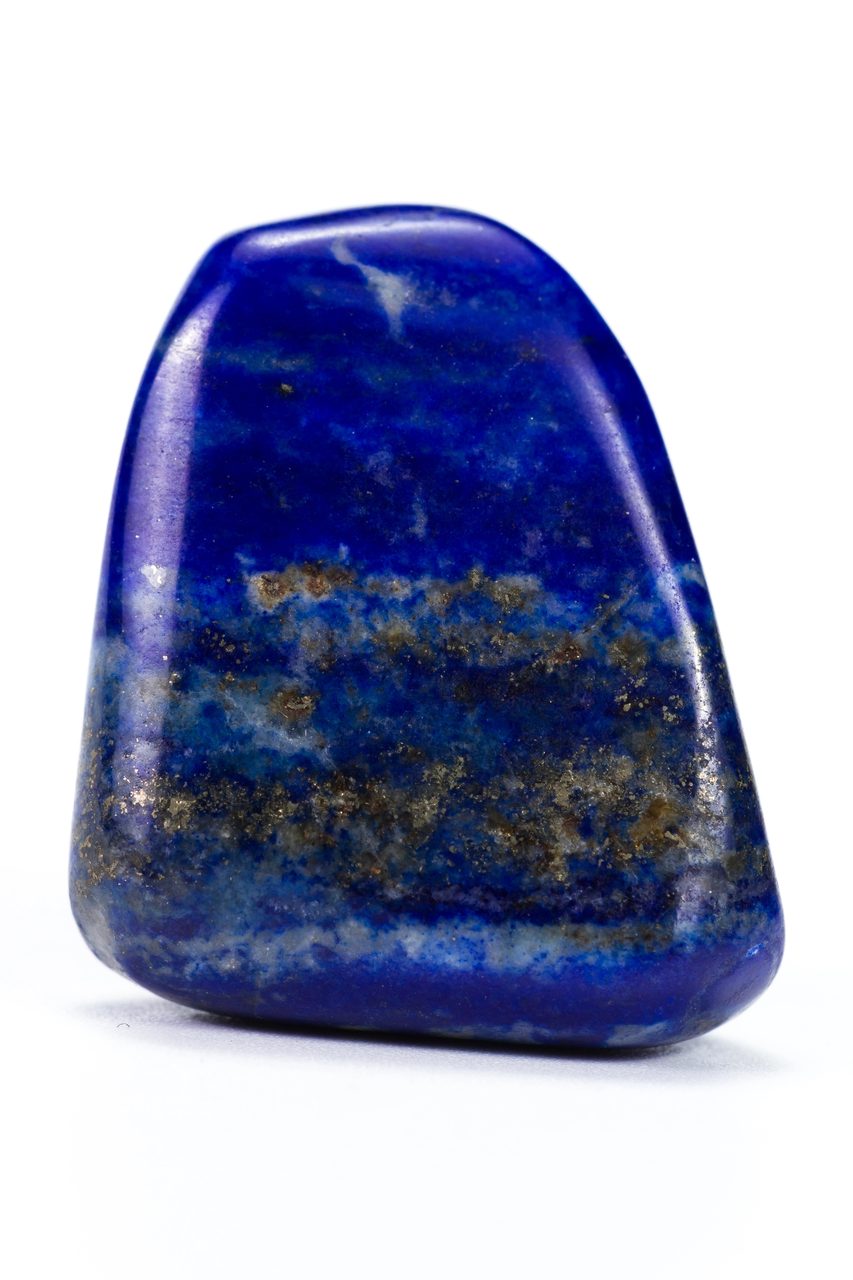
Lapis lazuli is a rock. Its blue comes from lazurite, a mineral of the sodalite group, its white veins and patches are calcite, and the small gold specks are pyrite. GIA adds diopside, amphibole, feldspar and mica as lesser companions. Every piece mixes these in its own proportions, and the price follows the mix: the darker and more even the blue, and the less white calcite showing, the more a piece is worth.
GIA puts the link between people and lapis at more than 6,500 years and calls the mines of Badakhshan, in the northeast of present-day Afghanistan, the world's oldest known commercial gemstone sources. They were producing by 700 BC, when the region belonged to Bactria, and Marco Polo described them in 1271. Caravans carried the stone to the Mesopotamians, Egyptians, Persians, Indians and Greeks, who made it into game boards, bowls, dagger handles and amulets.
Ground and refined, lapis became ultramarine, the most costly blue a painter could buy. Winsor and Newton, the paint makers, record that it was once reckoned more precious than gold, and that from about 1400 it was often used for the robes of the Virgin Mary. A synthetic French ultramarine replaced it in 1828.
Afghanistan is still the classic source, with Chile and the Lake Baikal region of Russia among the others. On the American birthstone list of 1912 lapis was December's alternate stone, and the 1952 revision dropped it for zircon. In crystal practice it is a stone of truth and inner sight, worked mainly at the throat and the brow.
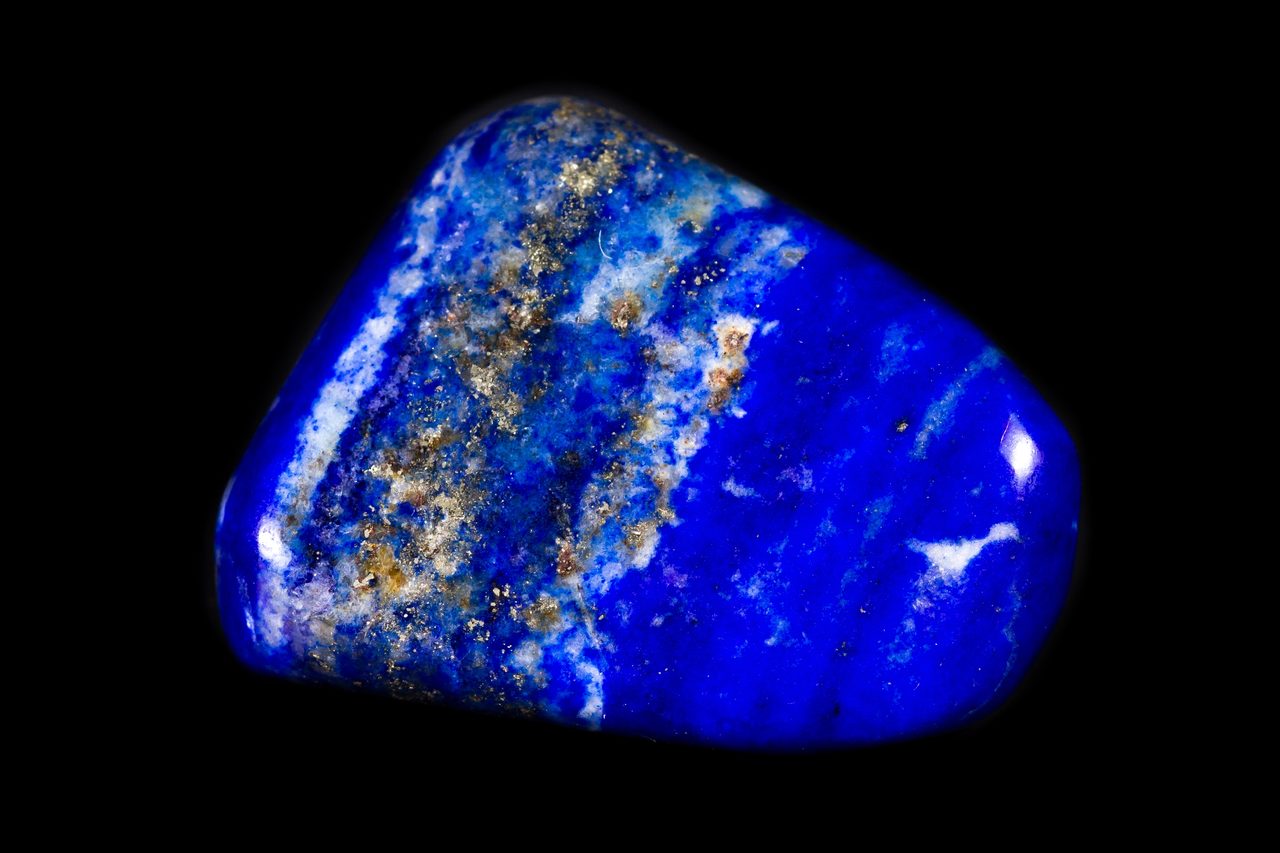
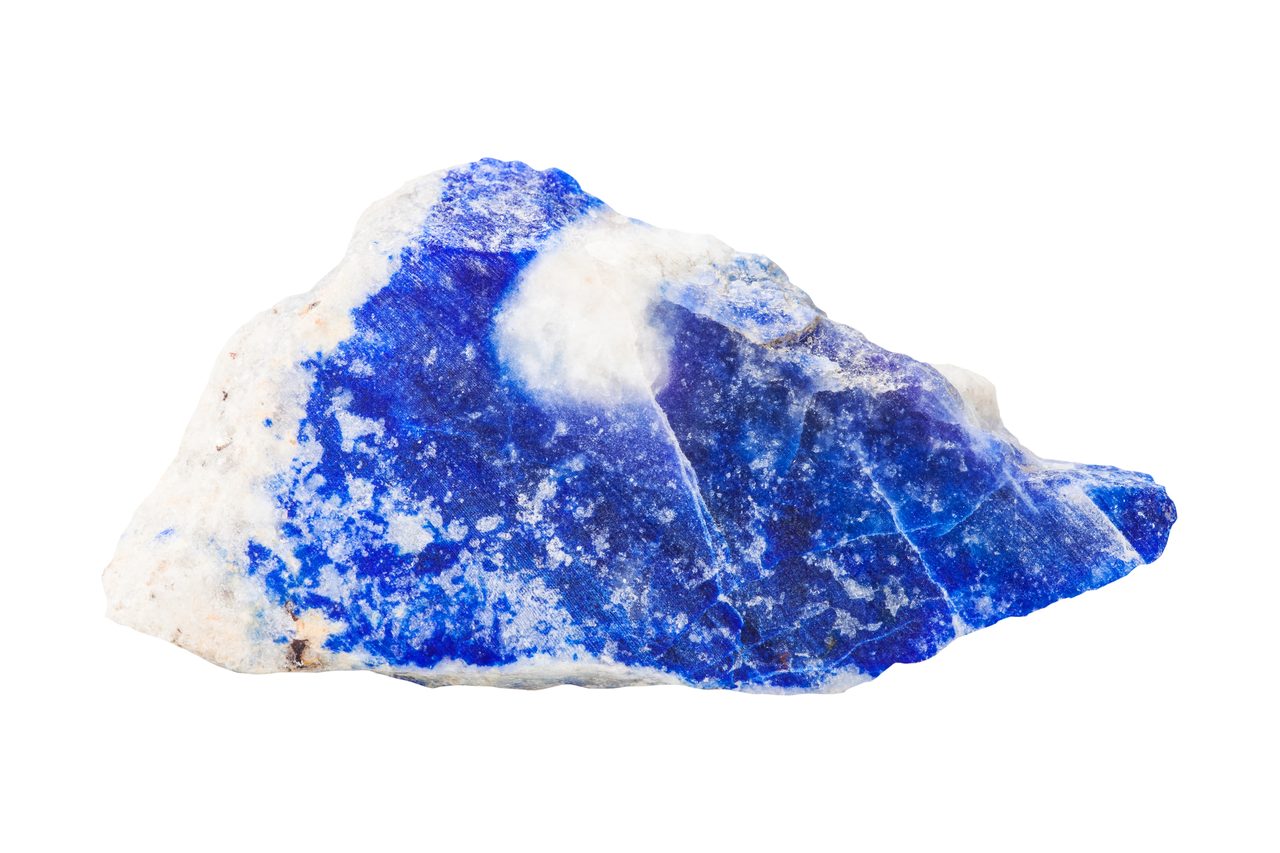
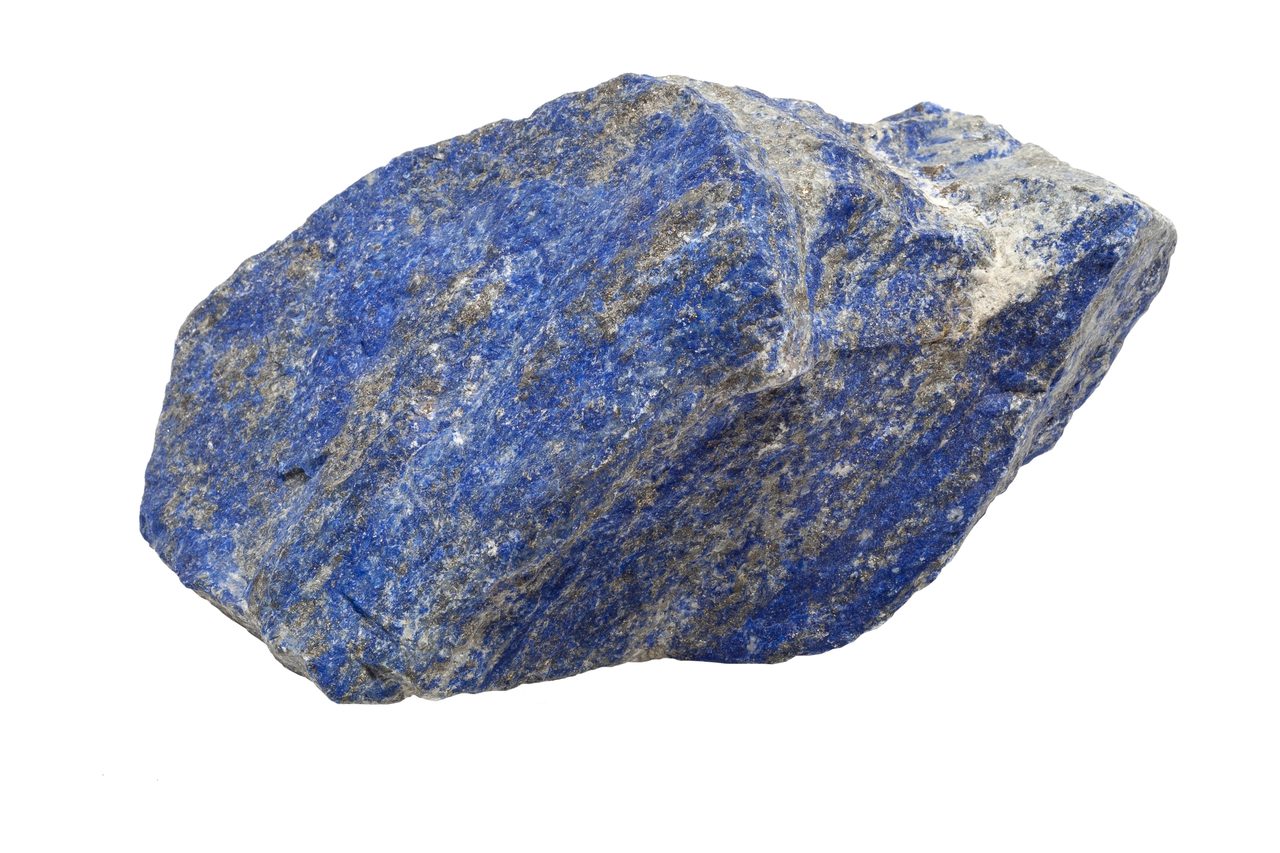
TABLE OF CONTENTS
Properties & Qualities
Physical Properties
What it is made of. Lazurite, the blue mineral, is a sulfur-bearing member of the sodalite group, which makes it a close relative of sodalite itself. Calcite is calcium carbonate, the same mineral that makes up limestone and marble. Pyrite is iron sulfide, the brassy mineral sold on its own as fool's gold. The flecks are never real gold. Since the three sit together in different proportions from piece to piece, hardness, weight and colour all vary with them.
How it forms. The Handbook of Mineralogy describes lazurite as a contact metamorphic mineral of limestones. Lapis forms where limestone was altered by heat from nearby igneous rock, which is why the blue so often comes threaded with white calcite, the mineral of the original limestone. Lazurite rarely grows as separate crystals. When it does, they are deep blue dodecahedra, and Sar-e-Sang in Badakhshan is the locality the Handbook singles out for them.
Colour and grade. GIA gives the colour range as greenish blue to violetish blue. The most prized material is a uniform dark blue to violetish blue with no visible calcite, and small, evenly scattered pyrite flecks count in its favour. Pieces heavy in calcite look paler and greyer, and are graded lower.
Hardness and toughness. GIA places lapis between 5 and 6 on the Mohs scale, depending on what it is made of, and rates its toughness as fair. The calcite is the soft part, at 3, so white areas scratch first. Lapis is softer than the quartz-family stones it often shares a dish with, and it picks up marks from them.
Weight and optical data. GIA gives a specific gravity of 2.75, give or take 0.25, and a refractive index of about 1.50. The stone is opaque. Lazurite alone is lighter than the average, at about 2.4, while pyrite is much denser, so a piece rich in gold flecks sits heavier in the hand. Lazurite leaves a bright blue streak on unglazed porcelain, a property gemmologists use to separate it from sodalite, which streaks white.
Treatments. GIA describes three common ones. Paler lapis may be dyed a deeper blue, and that dye can come off when rubbed with acetone or denatured alcohol, so dyed pieces are sometimes sealed with wax or plastic. Wax sealers can break down with heat or solvents. Undyed lapis may be impregnated with wax or oil to improve colour and lustre, a treatment GIA rates as only fairly stable and a gemmologist can detect.
Metaphysical properties
Crystal practice reads lapis as a stone of truth, wisdom and inner sight. Worn at the throat, it is meant to help with honest speech, especially when honesty is the harder option. The third eye is where practitioners place it for insight and self-knowledge. Practitioners treat it as a weighty, serious stone, and much of that weight comes from its long history as a costly material carried a very long way. It is also linked with study and learning, and some keep a piece close while reading or writing.
Lapis also has a medical history. A 2019 study of lapis in medieval dental remains notes that Dioscorides listed it among his remedies, and that lapis was swallowed as medicine in the medieval Mediterranean and Islamic worlds. Modern practice keeps the idea of lapis as a healing stone and works with it by touch and placement.
Its reputation for calm, which it shares with other blue stones, is a newer layer than the truth-and-status reading. Our piece on what blue stones symbolize traces where that layer came from.
Meaning & Symbolism
Physical meaning
Lapis is a mixture. Three minerals with different hardness, colour and chemistry make one rock, and the blue reads as one colour from a distance even though it is broken up close. In practice that becomes an image of a life made of unlike parts that still work as one.
The gold in the blue is the other image people reach for. Pyrite flecks across dark lazurite are commonly compared to stars in a night sky, and the stone is used in practice as a reminder of scale, of how small a single day's worries are against something larger.
The white calcite is the mineral of the limestone this rock once was, left behind when heat from nearby rock turned the rest blue. Some practitioners take that as an image of change that keeps a trace of where it began. Its softness adds a quieter point. Lapis marks more easily than the quartz beside it, and handling it with care is read as part of working with it.
Spiritual meaning
Spiritually, lapis carries authority. For thousands of years it went to the people and places that could afford it, and in practice that history turns into dignity and a sense of being answerable for what one says.
It is also read as a stone of inner vision. The deep blue is linked with looking inward, and lapis is used in meditation aimed at self-knowledge, including the less flattering parts. Practice sums it up as seeing clearly and speaking plainly, starting with oneself.
Ground into ultramarine, lapis was often used for the robes of the Virgin Mary, and practitioners read that choice as a sign of what people set apart as sacred. In spiritual practice the stone is used for prayer, vows and contemplation that ask for sincerity.
Its use for amulets in ancient cultures lies behind its protective reputation. Some practitioners carry lapis as a quiet guard during meditation and ritual, and others wear it as a pendant for the same reason.
Healing Benefits
Physical healing
Lapis in crystal healing is a matter of practice and tradition, not medicine.
In practice it is placed at the throat for the voice and for speaking, and at the brow during rest when the mind will not settle. Some also keep it nearby after a long day of talking. These associations are symbolic. Historical medicine did swallow ground lapis, but it should not be swallowed today: pyrite and some dyes do not belong in the body. Lapis is not a substitute for medical care. If something in your body worries you, see a doctor.
Emotional healing
Practitioners use lapis when something needs to be said and keeps not being said. It is associated with honest self-expression, with clearing the gap between what a person thinks and what they let themselves say, and with the courage that takes.
It is also linked with self-awareness. Lapis is used for looking squarely at one's own patterns, which practice treats as the step before changing them. Some people keep a piece on the desk during journaling or difficult letters for this reason.
Practice names particular moments for it. A person preparing an apology, turning down a request, or giving feedback they have put off may hold lapis while rehearsing the words out loud. Others pick it up after an argument, when the mind keeps replaying the exchange, and use it to separate what they felt from what they said in the heat of it.
Its emotional reputation is steadying. Practitioners reach for it when a person wants clarity, and pick softer stones when comfort is the need.
Spiritual healing
In spiritual healing, lapis goes on the third eye for inner sight and intuition. Practitioners describe it as a stone for spiritual integrity, and use it for meditation on one's own values.
It is also used for dreams and reflection. Some practitioners keep it by the bed and note dreams in the morning, treating the stone as a prompt to pay attention to what surfaces overnight.
A simple session uses two pieces, one on the brow and one in the hollow of the throat. Practitioners breathe slowly for several minutes, picture the deep blue spreading behind the eyes, and hold a single question in mind. Some close by saying their answer aloud, linking what was seen at the brow with what is spoken at the throat.
For open-eye meditation, the pyrite flecks give the gaze somewhere to rest. One fleck becomes the focus while the rest of the stone softens, and attention comes back to it each time the mind drifts.
Use & Care
How to use
- Throat pendant: Wear it at the base of the throat, the placement practice links with honest speech.
- Before a hard conversation: Hold a piece for a minute beforehand, or keep it in a pocket pouch during the conversation itself.
- Desk stone: Keep it beside you for writing, study or any work that needs a clear head.
- Brow meditation: Lie down and rest a small flat piece on the forehead during meditation focused on insight.
- Journaling: Hold it before writing, as a cue to write what is true rather than what sounds good.
- Bedside: Keep it on the nightstand if you work with dreams, and note them first thing in the morning.
- Ring or bracelet: Choose protective settings and take them off for rough work, since lapis is soft and only fairly tough.
- Before a presentation: Turn it over in your hand while running through your opening lines.
- Values note: Rest it on a short written list of the values you want to keep in view.
- Home altar: Give it a place on a shelf or altar set aside for truth and wisdom.
- Its own pouch: Store it in soft cloth, away from harder quartz pieces that would scratch the calcite.
How to cleanse
- Smoke: Incense, sage or palo santo smoke suits lapis well, since it involves no water.
- Sound: Ring a singing bowl or bell beside it.
- Moonlight: Set it on an indoor sill for the night and collect it before morning sun warms the glass.
- Breath: A few slow breaths over the stone while you hold it is the quickest method practice offers.
- Wipe, do not soak: GIA recommends warm soapy water for cleaning. A damp cloth followed by a dry one is enough, and long soaks are best avoided, since calcite and pyrite both dislike prolonged water.
- Avoid acids and solvents: Lemon juice and vinegar attack calcite, and acetone or alcohol can lift the dye from treated pieces.
- Selenite slab: A night on selenite is a dry option that spares both the calcite and the pyrite.
- Soft brush: Lift dust from carved hollows and bead holes with a clean, dry make-up brush.
- Dry it straight away: After any wipe, pat it dry so no damp lingers along the white veins or around the gold flecks.
How to charge
- Moonlight: The usual method for lapis. Leave it out overnight, especially at the full moon.
- Spoken intention: Say out loud, in one sentence, what you want the stone to help with. For a stone tied to speech, practice favours saying it over thinking it.
- On a quartz cluster: Overnight on a clear quartz cluster is a common amplifying charge, though lapis is softer, so set it down gently.
- With pyrite: Set it next to a piece of pyrite, the mineral already inside it, for the grounded confidence practice gives that pairing.
- Brief sunlight only: If you use the sun, keep it short. Heat can soften the wax used on treated pieces.
- Humming: Hold it near the throat and hum a low, steady note for a minute.
- One honest sentence: Write down what you want to say or understand, then let the lapis sit on that sheet until morning.
- Before study: Hold it while you set out what you mean to learn that day.
- Brow breathing: Rest it on the forehead for ten slow breaths, then put it away until needed.
Combining with other stones
- Pyrite: The pairing lapis already contains. Practice reads it as wisdom joined to the nerve to act on it. The main combinations are set out in what works well with lapis lazuli.
- Sodalite: A close mineral relative, paired for calm, clear communication.
- Tiger's eye: A common pairing, the gold-brown stone's grounded confidence set against lapis's inward clarity. See Tiger Eye.
- Clear quartz: Turns up lapis's own qualities without changing their direction.
- Amethyst: A steady partner for meditation and study.
- Labradorite: Paired for working through a big decision in private.
- Turquoise: Lapis's partner on the December line of the 1912 birthstone list.
- Kyanite: Another throat stone, paired for finding words without getting tangled in them. See Kyanite.
- Rose quartz: Chosen when honesty needs gentleness, so hard things can be said kindly. See Rose Quartz.
- Carnelian: Its warm orange is added for the courage to speak up. See Carnelian.
Identification
Can be mistaken for
- Sodalite: The classic confusion. Sodalite is a single mineral, commonly a softer blue with white veining and rarely any gold. Our sodalite and lapis lazuli comparison sets them side by side. See Sodalite.
- Dyed howlite or magnesite: White, porous stones dyed blue. The colour can look too bright and too even, with dye gathered in cracks and drill holes. See Howlite.
- Dyed jasper: Sold as Swiss lapis. It is a chalcedony-rich rock dyed blue, with no pyrite. See Jasper.
- Gilson lapis: A manufactured imitation, very even in colour.
- Reconstituted lapis: Lapis or other blue powder bonded with resin into blocks. It can contain real lapis but is not solid stone.
- Azurite: A copper carbonate of a brighter, more vivid blue, softer than lapis and commonly mixed with green malachite.
- Dumortierite: A blue, harder mineral without gold flecks. See Dumortierite.
- Lazulite: A different, phosphate mineral with a confusingly similar name. It is not the blue mineral in lapis.
How to spot a fake
- Look at the gold: Pyrite flecks in real lapis are brassy, irregular in size and unevenly spread. Glitter that is perfectly even, or specks that look like painted dots, point to an imitation.
- Expect some calcite: Natural lapis commonly shows at least a little white or grey. Completely uniform, intense blue at a low price suggests dye or a manufactured material.
- Check cracks and drill holes: On beads and carvings, look inside the holes and along any fractures. Dye collects there, and a white core inside a blue bead means a dyed white stone.
- Feel it in the hand: Plastic and resin imitations tend to feel lighter and warmer than stone.
- Use a loupe: Under magnification, reconstituted lapis can show small angular fragments set in a resin binder.
- Ask about treatment: Dyeing and waxing are common and acceptable when disclosed. A good seller will say whether a piece is natural, dyed or waxed, and a gemmologist can confirm it.
- Be wary of the words: Swiss lapis is dyed jasper, and reconstituted lapis is bonded powder. Neither is solid natural lapis lazuli.
- Keep solvents away: GIA notes that dye can come off with acetone or denatured alcohol, so nail polish remover is worth keeping away from any lapis you have not had checked. How sellers word treatments is decoded in what "natural" means when buying crystals.
- Ask where it came from: Afghanistan, Chile and Russia are the main named sources. A seller who can name the source of a fine piece tends to know the material.
Sources: GIA, Lapis Lazuli; GIA, Lapis Lazuli History and Lore; GIA, Lapis Lazuli Care and Cleaning; Handbook of Mineralogy, Lazurite; Winsor & Newton, Ultramarine; Radini et al., "Medieval women's early involvement in manuscript production suggested by lapis lazuli identification in dental calculus", Science Advances 5:1, 2019; The Jewelers' Circular, 14 August 1912; Jewelers' Circular-Keystone, August 1952; Minerals.net, Lapis Lazuli.