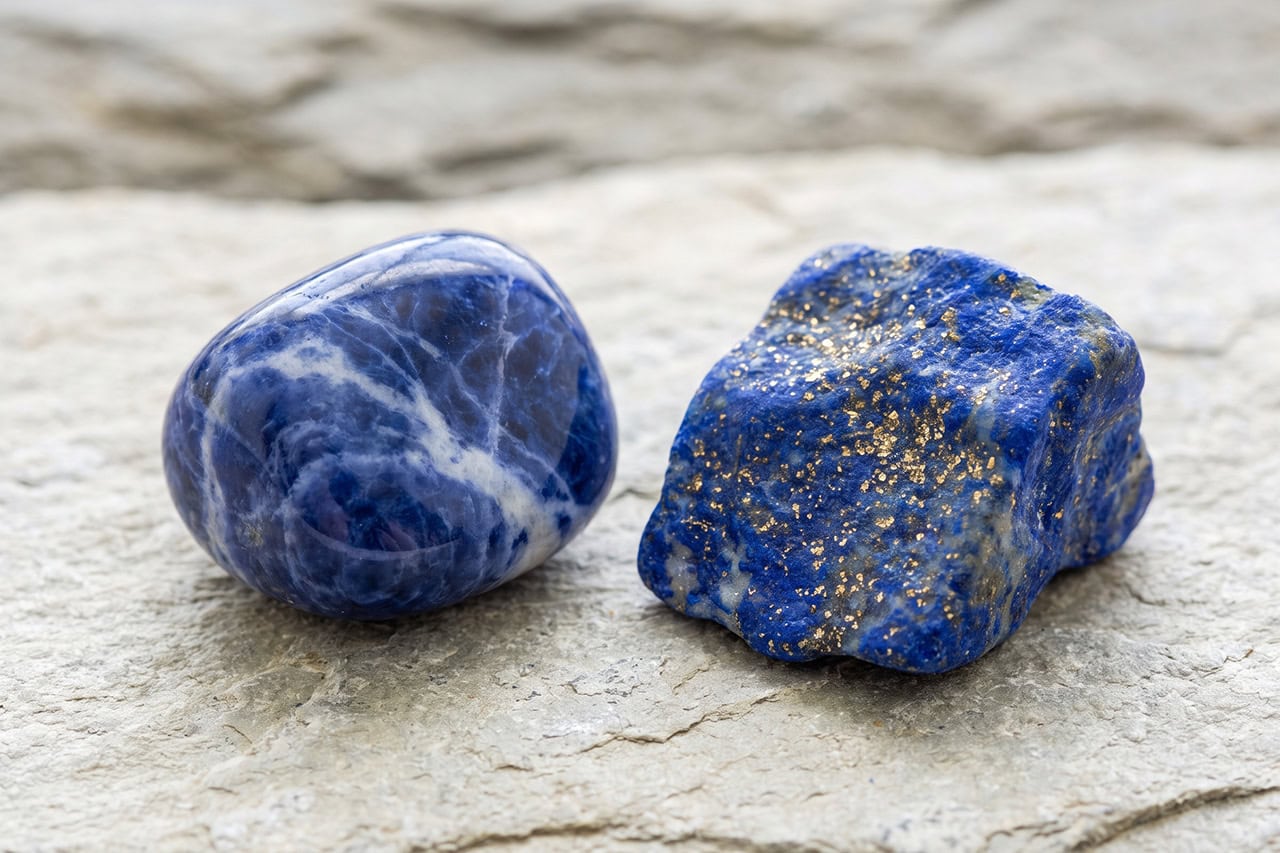
Sodalite and lapis lazuli are both deep blue stones, and they get confused constantly. The quickest way to tell them apart is to look for gold: lapis lazuli usually has small flecks of golden pyrite scattered through it, while sodalite does not. Lapis tends to be a richer, more intense blue; sodalite is often a softer, more denim-like blue with white veining.
Walk into a crystal shop and this is one of the most common mix-ups at the counter. Someone picks up a deep blue stone, turns it over, and asks whether it is lapis. Often it is not. Sodalite is lapis lazuli’s more affordable, more common look-alike, and the confusion is so routine it is worth settling once and for all.
Here is how to keep them straight.
The Quick Tell: Look for Gold
If you only remember one thing, remember this. Lapis lazuli often carries golden pyrite flecks; sodalite does not. Those little metallic gold specks are pyrite, sometimes called fool’s gold, and they are effectively lapis lazuli’s signature. See gold glinting in a blue stone, and you are almost certainly holding lapis.
Sodalite, by contrast, tends to show white or grey veining, streaks of calcite running through the blue, which lapis shows less often. So the two most useful visual cues point in opposite directions: gold flecks lean lapis, white veins lean sodalite.
What’s striking is how reliable this one tell is. Colour can be argued over and lighting can deceive, but pyrite either sparkles in the stone or it does not.
What Each One Actually Is
Part of the reason they differ comes down to what they are, and here the two are not even the same kind of thing.
Sodalite is a single mineral, a member of the feldspathoid family, built from sodium, aluminium, silicon, and chlorine. It is reasonably uniform in composition, which is part of why its blue often looks more even.
Lapis lazuli is not a single mineral at all. It is a rock, a mixture of several minerals, chiefly lazurite (which supplies the deep blue), along with calcite (the white) and pyrite (the gold). That mixed makeup is exactly why lapis has that flecked, mottled, more complex look, and why sodalite, a single mineral, tends to look plainer.
Consider what that means. When you compare sodalite and lapis, you are not really comparing two minerals. You are comparing one mineral against a whole small rock, which is why lapis has more going on in it.
Colour, Veining, and Price
A few more practical differences round out the picture.
Lapis lazuli is usually the more intense, saturated blue, the classic deep ultramarine that made it one of the most prized pigments and gemstones of the ancient world. Sodalite is often a touch darker, greyer, or more muted, more denim than royal, though good sodalite can be a rich blue too.
Both are fairly soft stones. Sodalite sits around 5.5 to 6 on the Mohs hardness scale, and lapis around 5 to 5.5, so neither is as tough as quartz, and both deserve gentle handling.
And price gives its own hint. Lapis lazuli generally costs more than sodalite. So if a deep blue stone with gold flecks is being sold surprisingly cheaply, that is a reason to look a little closer, not to celebrate a bargain.
Telling Them Apart at a Glance
If you have an unlabelled blue stone in hand, run through these quickly:
- Gold flecks? Yes points to lapis (pyrite). No leans sodalite.
- White or grey veining? Common in sodalite, less so in lapis.
- How intense is the blue? A deep, saturated ultramarine leans lapis; a softer, greyer, denim blue leans sodalite.
- Price? Lapis generally costs more. A very cheap “lapis” is worth a second look.
- Streak. Rubbed on unglazed porcelain, sodalite tends to leave a white streak, a test for the confident, though not one to try on a polished piece you value.
No single clue is absolute, but the gold-fleck check alone resolves most cases in a second.
The Older, Grander Stone
Part of why lapis carries more weight, in price and in reputation, is history. Lapis lazuli has been mined from the Sar-e-Sang mines of Badakhshan, in modern Afghanistan, since around the seventh millennium BCE, which makes it one of the oldest worked gemstones on Earth. It travelled vast distances in the ancient world, turning up in Mesopotamian jewellery, Egyptian burial goods, and, later, European painting.
That last use is the famous one. Ground into powder, lapis became ultramarine, the most costly blue pigment available to Renaissance painters, reserved for the robes of the Virgin Mary because it cost more than gold. Consider what that means for the comparison: one of these two stones was, for centuries, the single most precious blue a human being could own.
Sodalite has no such pedigree. It was only formally identified in the early nineteenth century and popularised more recently still. That gap in history is a real part of the difference in feel between them. Lapis is ancient and storied; sodalite is the modern, accessible blue that happens to resemble it.
Do They Do the Same Thing?
Since both are blue throat-region stones, their crystal-practice associations overlap, but they are not identical.
Both are tied to communication and clear thinking, which is why they get grouped together. But sodalite leans cooler and more rational, a stone of level-headed logic and calm speech, which we cover in what sodalite is good for. Lapis carries a heavier, more regal, more ancient association with truth, wisdom, and inner vision, explored in what makes lapis lazuli so powerful.
The curious thing is that the pricier, flashier stone and its humble look-alike ended up so close in meaning. If you want the everyday, budget-friendly thinking stone, sodalite does the job. If you want the storied one with the gold flecks, that is lapis. For more on both, see the Crystalance Mineral Library. One glance for gold, and you will rarely mix them up again.