Prehnite
Silicate (transitional between inosilicate and phyllosilicate); prehnite group
Pale to dark green, yellow-green, yellow, grey, white and colourless; rarely pink
Vitreous, with a weak pearly sheen on the cleavage; rounded masses can look waxy or velvety
6 - 6.5
2.80 - 2.95
Orthorhombic
South Africa (Karoo and Northern Cape), Namibia (Brandberg and Goboboseb), Mali (Kayes Region), Australia (Wave Hill in the Northern Territory, Prospect near Sydney), USA (Paterson in New Jersey, Fairfax quarry in Virginia), Canada (Jeffrey mine, Quebec), India (Mumbai), France (La Combe-de-la-Selle), Austria (Habachtal), Scotland
Common as a mineral; separate crystals are uncommon, and clear material clean enough to facet is scarce
Ca₂Al₂Si₃O₁₀(OH)₂ (calcium aluminium silicate hydroxide); some iron usually stands in for aluminium
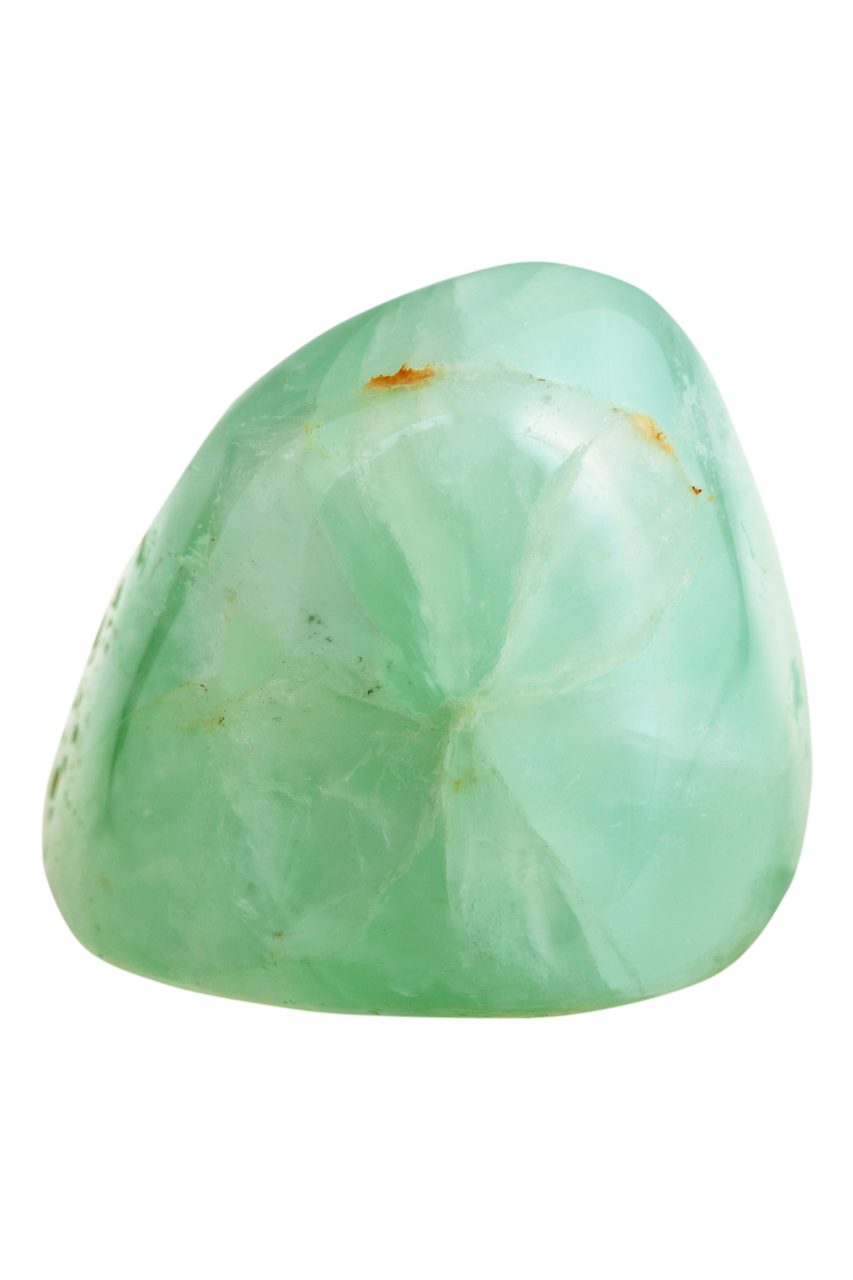
Colonel Hendrik von Prehn, the Dutch officer who commanded the garrison at the Cape of Good Hope in the 1770s, brought the first specimens of this green mineral to Europe, and it carries his name. Prehnite is a calcium aluminium silicate. It grows in the cavities and cracks of volcanic rock, usually as rounded, grape-like crusts and only rarely as separate crystals, and its soft yellow-green colour comes from iron.
Mindat records that the German mineralogist Abraham Gottlob Werner named it in 1788 and that Prehn is credited with finding it in 1774. How the stones reached Werner is not known. A 2024 study of the naming by Bruce Cairncross and Sharad Master lists the names tried before this one, among them émeraude du Cap, chrysolite, prase and chrysoprase, and dates the final acceptance of prehnite to 1793. The same study found no record that the specimens came from Cradock in the Eastern Cape, the place the literature usually gives, and argues that they more likely came from further inland in the Karoo. Its title calls prehnite the first mineral named after a person, though that is a claim rather than an established fact.
Prehnite is cut mainly as cabochons and beads. The International Gem Society notes that translucent Australian material yields faceted stones of up to about 30 carats, and a JCK trade article in 2005 called it a sleeper stone that had suddenly turned up in quantity at the Tucson and Las Vegas shows.
In crystal shops it is sold as a heart stone, under the nickname the stone that heals the healer.
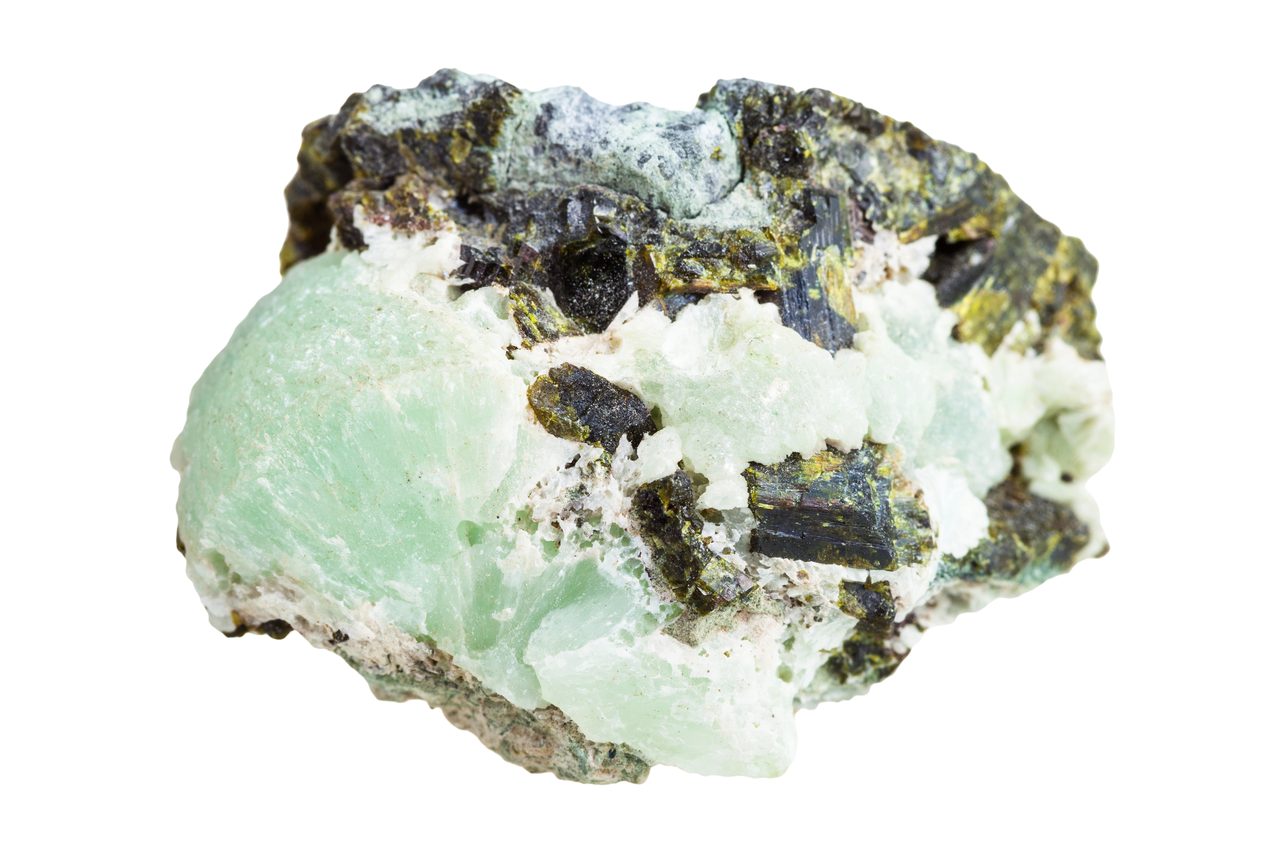
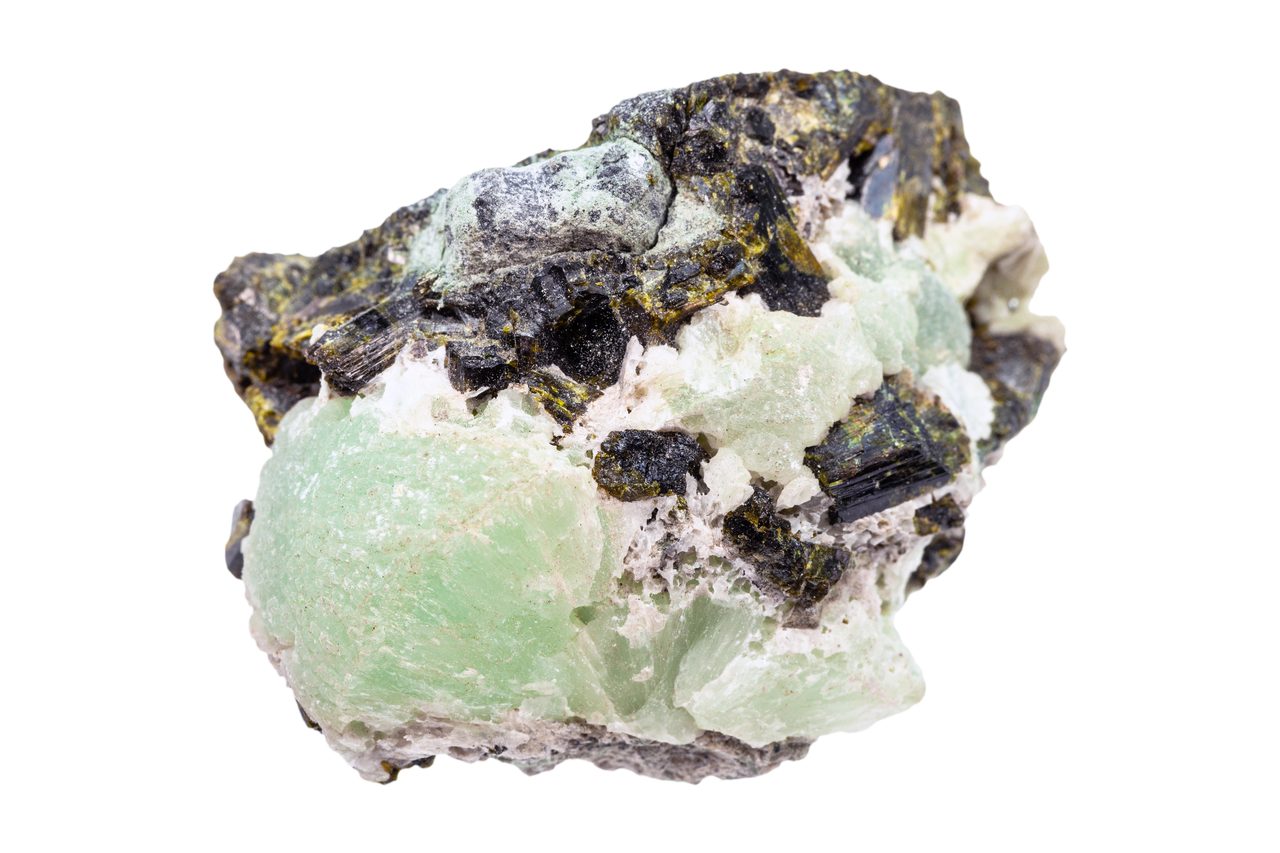
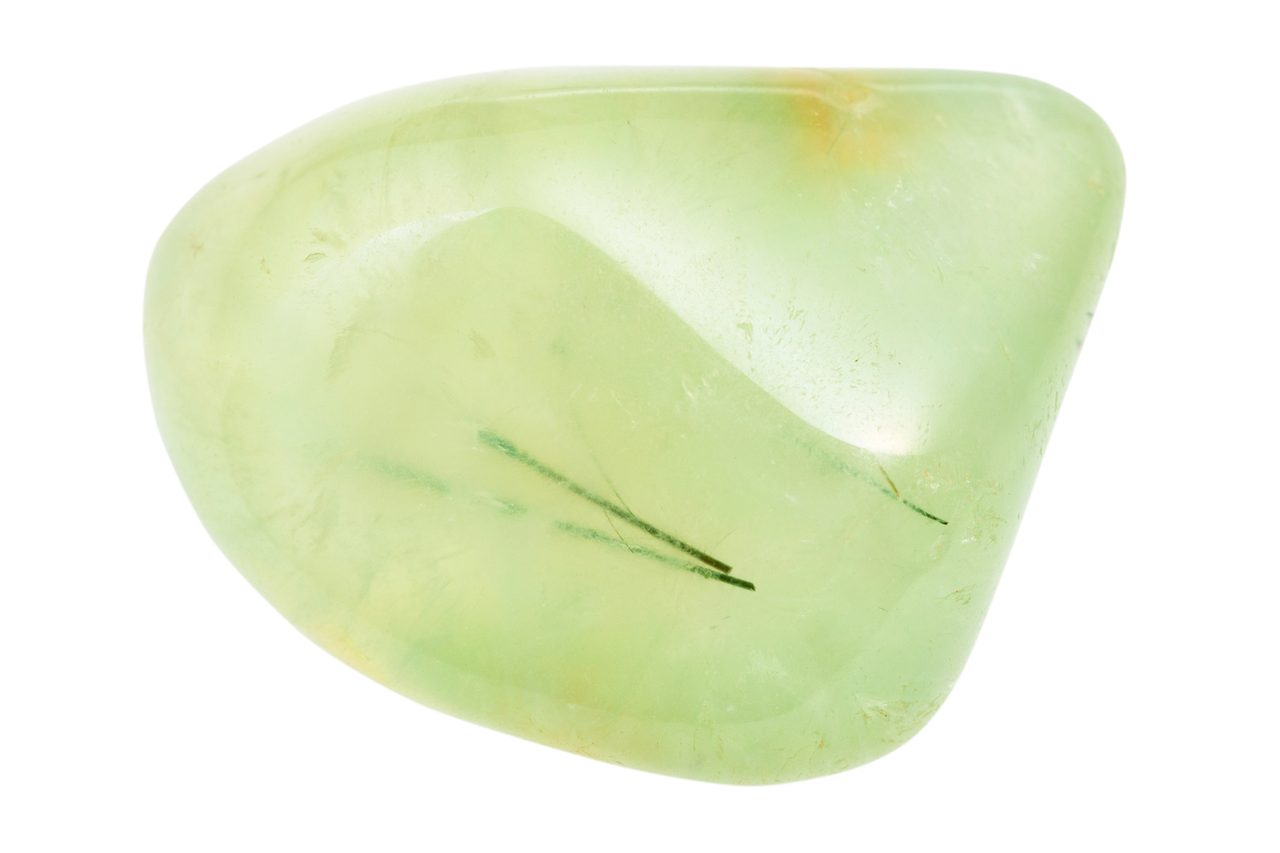
TABLE OF CONTENTS
Properties & Qualities
Physical Properties
Water is bound into prehnite's structure as hydroxyl, and iron replaces part of the aluminium. The International Gem Society notes that its refractive index and other optical figures rise as the iron content goes up. Mindat classes it between the chain and sheet silicates. The Handbook of Mineralogy rates it 6 to 6.5 on the Mohs scale, with good cleavage in one direction, an uneven fracture and a brittle tenacity.
Separate crystals are uncommon. The Handbook describes them as tabular or prismatic and up to 4.5 centimetres long, often with fine lamellar twinning. Far more often prehnite grows as fan-shaped, kidney-shaped, globular or stalactitic masses, or as compact, granular material.
Iron is also the cause of the colour. Wang, Guo and Ge, writing in the Journal of Synthetic Crystals in 2022, found that ferric iron sits in the aluminium sites and ferrous iron in channels of the structure, and that samples with more iron are a deeper yellow-green. A second study the same year, in RSC Advances, heated prehnite in the laboratory. In air it grew yellower and turned brownish yellow at 800 °C, while in a reducing atmosphere it faded towards white, and in both cases it lost transparency. At 800 °C it began to break down into anorthite and wollastonite.
The International Gem Society gives a refractive index of 1.611 to 1.665, with a reading near 1.63 on a standard refractometer, and a birefringence of 0.021 to 0.033. It lists a specific gravity of 2.80 to 3.00, usually 2.88 to 2.94 in gem material, and notes that some stones glow a dull brownish yellow under ultraviolet light and that cat's-eye stones are known.
Prehnite forms at low temperatures. The Handbook describes it as a secondary or hydrothermal mineral of veins and cavities in basalt and similar rocks, and as a typical product of low-grade metamorphism. It is found with zeolites, datolite, pectolite, calcite, epidote and native copper. The traprock quarries of New Jersey have produced masses weighing several tons, according to the International Gem Society.
Two gem sources have been studied in some detail. In the Northern Territory of Australia, exploration reports filed by Pauley and Sielecki describe gem prehnite weathering out of the basalt around Wave Hill. In Mali, Hammer, Brandstätter and Ponahlo of the Natural History Museum Vienna studied pale grey-green material from the Kayes Region in 2004. It held needles of epidote and amphibole with small garnets and magnetite, had an average refractive index of 1.627 and a specific gravity of 2.86 to 2.98, and had been sold for more than three years as garnet with tourmaline inclusions.
Metaphysical properties
Prehnite's place in crystal practice is the heart chakra, the fourth of the seven chakras, and many practitioners add the solar plexus just below it, so the stone is used to join what a person feels with what they decide to do. Two names carry most of its meaning. It is called a stone of unconditional love, in the sense of love that keeps no account. It is also called the stone that heals the healer, a reading that gives it to nurses, carers, parents and therapists, anyone who spends the day looking after other people and goes home with little left.
Some crystal writers also call it a stone of prophecy, and practitioners use it in dream work and for the sense of being ready before a change arrives.
These meanings are young. Prehnite was a collector's mineral until gem material from Australia and Mali reached the market in the early 2000s, and the healer reading is usually traced to Judy Hall's The Crystal Bible, published in 2003. Shop pages that say ancient Egyptians or Roman soldiers prized prehnite give no source for it, and the mineral was unknown to science until Prehn's find in the 1770s.
Meaning & Symbolism
Physical meaning
Prehnite grows in empty spaces. Hot water seeping through cooled lava leaves it in old gas bubbles and cracks, where it fills a hollow slowly, from the walls inward. Practitioners see a tired person in that hollow, and in the slow filling the way rest returns, gradually and from the edges.
It rarely makes a single sharp crystal, gathering instead into rounded crusts and bunches like green grapes, so practice ties it to patience and to growth a thin layer at a time. The stone is also translucent more often than clear. Light passes into it and glows, but nothing behind it comes into focus, and practitioners link that soft glow to intuition, which gives a sense of what is coming without showing the details.
Dark needles of epidote run through some pieces. Practitioners call them a frame inside something soft, the inner structure that lets a gentle person keep going.
Its pale green is the green of new leaves, and owners like to keep it near plants or a window that looks out on trees.
Spiritual meaning
Readiness runs through prehnite's spiritual meaning. Practitioners describe it as a stone for meeting the next thing calmly, a move, say, or a parent who needs more care, by trusting that what is needed will be there when the time comes.
That is where the prophecy name comes from. Practice does not treat prehnite as a way to see the future. It treats it as a way to stop dreading the future, so that a person can prepare in the ordinary way and then rest.
Its green and its rounded, leafy-looking crusts also tie it to gardens and growing things. Some practitioners use it in nature-based practice, setting a piece among plants or carrying one on a walk. Others connect it with nature spirits, and people who work on the land keep it for that reason.
Then there is the naming story. A soldier collected the stone far from home, and others named it after him three years after his death, so practitioners who know the story give prehnite to people whose care goes unthanked.
Healing Benefits
Physical healing
Prehnite has no proven effect on the body. What follows describes how crystal practitioners use it, and none of it takes the place of a doctor.
In energy work the stone is placed over the solar plexus, just below the breastbone, and given to people worn down by long shifts and broken sleep. Practitioners see that tiredness as the healer's version of an empty well. They pair the stone with rest and an early night, and make no claim that it cures anything.
Lasting fatigue has many possible medical causes, and a GP is the person to look into it.
Prehnite is not a substitute for medical care. If something in your body worries you, see a doctor.
Emotional healing
The weariness that comes from caring for others is the emotional ground prehnite covers. People who listen to other people's troubles all day, at a hospital bedside or on a helpline, are given a piece to hold when they get home, as a sign that their own turn has come.
It is also used for worry about what lies ahead. Someone lying awake rehearsing tomorrow's conversations may keep it on the bedside table, and practitioners describe it as a stone that lets a person plan once and then put the plan down.
Prehnite is offered, too, when something cannot be changed, a decision already made or a situation outside a person's control, to help them stop pushing against it.
Some wear prehnite beads on the wrist through a demanding week, where a glance down brings them back to their own breathing. For a wider set of steadying stones, see our guide to crystals for balance.
Spiritual healing
In spiritual healing, prehnite goes mostly into dream work. Before sleep, a practitioner holds the stone, asks one plain question about something they are unsure of, and puts it under the pillow or on the nightstand. A notebook waits beside the bed, and whatever is remembered on waking goes into it, even a single image. After a few weeks the entries are read back together, looking for patterns rather than answers.
A second practice happens outdoors. The person sits with their back against a tree or on a garden step, a piece of prehnite in each palm, and listens to birdsong, traffic and their own breathing. Nothing has to be pictured. The aim is to feel part of a living place again, which practitioners offer as a remedy for the cut-off feeling that follows long stretches of caring for others.
Carers sometimes close a shift with a short version: rinse the hands, then hold the stone until the kettle boils.
Use & Care
How to use
- Below the breastbone: Rest a tumbled stone on the solar plexus while you lie down after work.
- On a long chain: Wear a pendant low enough to sit over the heart.
- Earrings before rings: At 6 to 6.5 on the Mohs scale, with a distinct cleavage, prehnite does best away from the knocks a ring takes. For a ring, a bezel that wraps the edge is the safer choice.
- Beads on the wrist: A strand worn on long working days doubles as a reminder to pause.
- Under the pillow: Slip a small, smooth piece under the pillow for dream work. For placement and comfort, see our article on sleeping with crystals.
- In a work bag: Keep one in a zipped pocket for the break in the middle of a shift and the drive home.
- Among houseplants: A rough piece sits well on the soil of a favourite plant.
- On a planner: Rest it on the week's diary while you plan ahead.
- On a windowsill: Stand a translucent crust where daylight comes through it from behind.
- Outdoors: Take a tumble on a walk and hold it whenever you stop.
- For a carer: A tumble in a small pouch makes a present for someone who looks after others, with a note telling them to rest.
How to cleanse
- Mild soap and lukewarm water: A drop of washing-up liquid and an old, soft toothbrush do the job. Dry it on a towel.
- By hand, not by machine: Prehnite has a distinct cleavage and often many inclusions, so a soft brush is kinder to a cabochon than an ultrasonic tank or a steamer.
- Away from heat: A 2022 laboratory study turned prehnite yellower and less transparent by heating it from 200 °C upward. That is far hotter than anything at home, but keep it out of a jeweller's flame and off radiators all the same.
- Dry brush for specimens: Dust a crust on its rock with a soft paintbrush rather than soaking it, because the matrix often holds other minerals.
- Rainwater: Rinse a tumble in a cup of collected rainwater and let it dry on a towel.
- Incense: Wave a lit stick of incense slowly around it.
- Bell: Ring a small bell over it three times.
- Selenite: Lay it on a selenite slab. How long to leave crystals on selenite has the timing.
- Brown rice: Bury it in a bowl of dry rice overnight and throw the rice away afterwards.
- Waning moon: Leave it out in the nights after a full moon, when practice says the moon draws things away.
How to charge
- Dawn: Give it the first hour of sun on an east-facing sill. Neither the International Gem Society nor the Handbook of Mineralogy mentions prehnite fading in light.
- Among plants: Leave it in the greenest corner of the house for a day.
- Charging plate: Sit it on a selenite or copper plate. We compare the options in our guide to crystal charging plates.
- New moon: Leave it outside on a new-moon night, which practice ties to beginnings.
- Beside epidote: Practice treats epidote as a stone that strengthens its neighbours, and the two often grow together.
- Spoken words: Say aloud who you are caring for this week, and add your own name to the list.
- Before sleep: Hold it while you set the question for the night's dream work.
- Drum: Tap a slow, steady beat on a hand drum near it for a minute.
- Green company: Surround it overnight with tumbles of green aventurine or moss agate.
Combining with other stones
- Epidote: The dark needles inside much Mali prehnite, paired for staying power. See Epidote.
- Datolite: A neighbour from the same basalt cavities, used together for clear thinking. See Datolite.
- Heulandite: A zeolite from the same volcanic pockets, paired for calm. See Heulandite.
- Apophyllite: A familiar partner on basalt specimens from India, used together in meditation.
- Rose quartz: Sits beside it on the heart in self-kindness work. See Quartz (Rose).
- Amethyst: Kept with prehnite under the pillow for dream work. See Amethyst.
- Lepidolite: Paired for unwinding after a long shift. See Lepidolite.
- Fuchsite: A green mica used alongside prehnite in nature practice. See Fuchsite.
- Malachite: A deeper green heart stone, added when change feels hard. See Malachite.
Identification
Can be mistaken for
- Chrysoprase: A nickel-green chalcedony that the International Gem Society rates 6.5 to 7, with no cleavage. The MFA's CAMEO database lists its refractive index at 1.535 to 1.539, well below prehnite's.
- Jade: Hammer and colleagues note that prehnite is used as a jade simulant. The International Gem Society gives jadeite a specific gravity of 3.25 to 3.36, heavier than prehnite. Our comparison of jade and serpentine covers another common stand-in. See Jade.
- Datolite: Pale green, rounded and found in the same cavities, but the Handbook of Mineralogy gives it a lower hardness of 5 to 5.5 and a specific gravity of 2.96 to 3.00. See Datolite.
- Hemimorphite: Also forms grape-like crusts, but it is softer, at 4.5 to 5, heavier, at about 3.48, and often pale blue.
- Smithsonite: Bubbly green and blue crusts that are much heavier, at a specific gravity of about 4.4. See Smithsonite.
- Green fluorite: Softer at Mohs 4 and heavier at 3.18, with perfect cleavage that breaks it into flat, angled faces. See Fluorite.
- Peridot: Chrysolite, one of prehnite's early names, was also an old name for peridot. Peridot is usually clear rather than milky, and heavier, near 3.3 according to the Handbook's forsterite page. See Peridot.
- Garnet with tourmaline: The name under which pale green jewellery from Mali was sold for more than three years, until X-ray diffraction at the Natural History Museum Vienna showed it was prehnite.
How to spot a fake
- Check the label on Mali stones: Green cabochons with dark needles have been sold as garnet with tourmaline inclusions. That material is prehnite under the wrong name.
- Weigh a jade carving: Jadeite is noticeably denser than prehnite, so a specific gravity test separates a carving sold as jade from a prehnite one.
- Look for the needles: Dark green or black needles of epidote are typical of Mali prehnite, and the 2022 Journal of Synthetic Crystals study found epidote inside its samples too.
- Check the colour range: The International Gem Society lists pale to dark green, yellow, yellowish green, grey, white and colourless. A vivid blue or purple "prehnite" falls outside that range.
- Under magnification: Glass gives itself away with round bubbles, while prehnite's rounded masses may show fan-like, radiating growth.
- Treatment questions: The International Gem Society's prehnite page mentions no treatment. The 2022 RSC Advances study changed its colour by heating in a laboratory but did not report heating in the trade.
- Origin: A seller should be able to say where a stone came from.
- Read the word "natural" closely: Our guide to what "natural" means when you buy crystals explains what the label does and does not promise.
- Lab checks: A refractometer reading near 1.63 fits prehnite, according to the International Gem Society, and Hammer and colleagues separated it from jadeite by cathodoluminescence, a method that does not damage the stone.
Sources: Handbook of Mineralogy, Prehnite; Mindat, Prehnite; Cairncross, B. and Master, S. (2024), Prehnite: the first mineral discovered in South Africa and the first named after a person, Earth Sciences History 43 (2), 327-348; International Gem Society, Prehnite value, price and jewelry information; Hammer, V.M.F., Brandstätter, F. and Ponahlo, J. (2004), Prehnite: a new lapidary material, Mitteilungen der Österreichischen Mineralogischen Gesellschaft 149; Wang, Q., Guo, Q. and Ge, X. (2022), Mineralogical characteristics and spectroscopy of yellow-green prehnite, Journal of Synthetic Crystals 51 (4); Wang, Q. et al. (2022), Study of the mechanism of color change of prehnite after heat treatment, RSC Advances; Pauley, G. and Sielecki, R. (2009), Prehnite exploration report, Wave Hill, Northern Territory Geological Survey GEMIS; Roskin, G. (2005), Meet the latest sleeper stone, JCK; International Gem Society, Jade value, price and jewelry information; International Gem Society, Chrysoprase value, price and jewelry information; MFA CAMEO, Chrysoprase; Handbook of Mineralogy pages for datolite, hemimorphite, smithsonite, fluorite and forsterite.