Turquoise
Phosphate
Sky blue, bluish green, apple green, greenish grey; often veined with brown, tan or black matrix
Waxy to dull in massive material; vitreous in rare crystals
5 - 6
2.86 (less in massive material)
Triclinic
China (Hubei), USA (Arizona, Nevada, New Mexico), Iran (Nishapur), Egypt (Sinai), Chile, Australia
Common as a material; compact, evenly coloured sky blue with little matrix is uncommon
CuAl₆(PO₄)₄(OH)₈·4H₂O
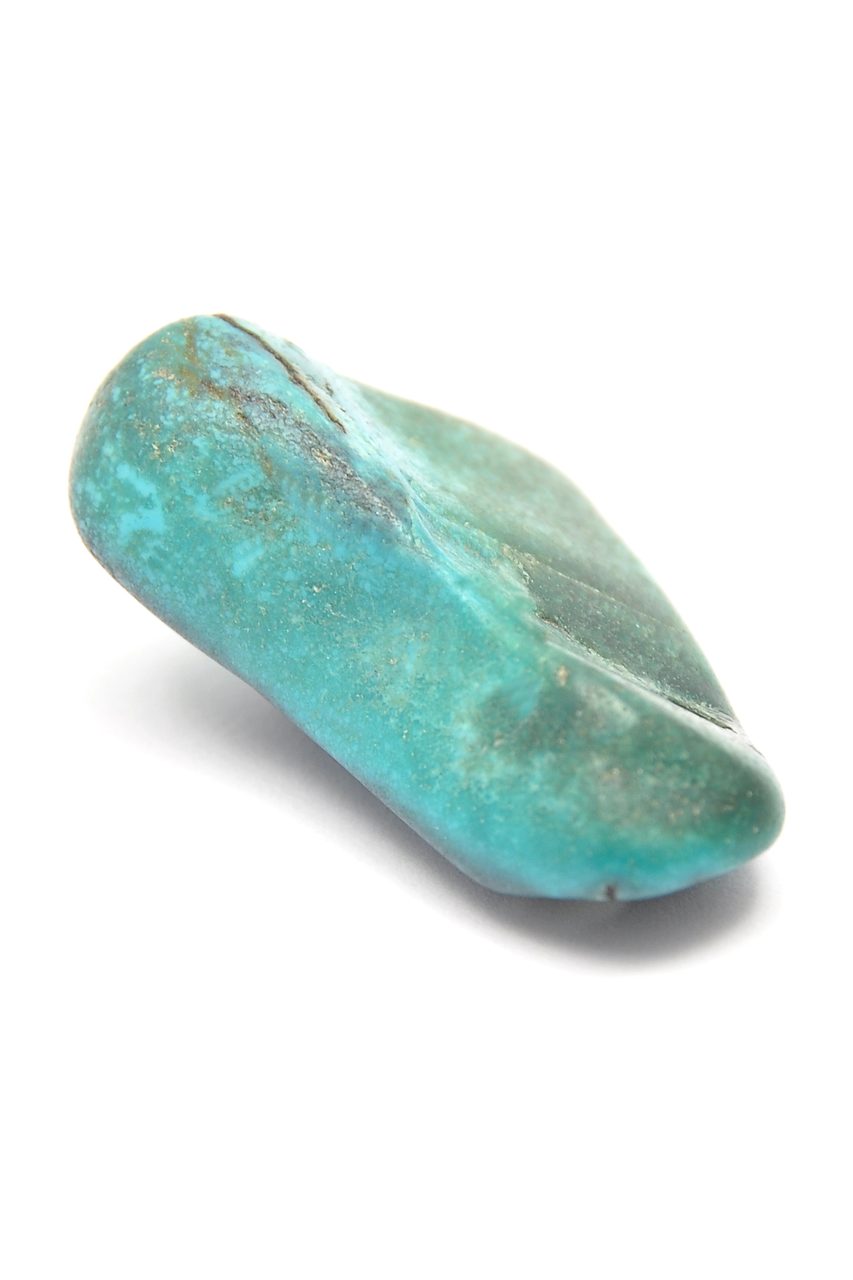
Turquoise is a hydrated phosphate of copper and aluminium, and you will almost never see it as a single crystal. GIA describes it as an aggregate of microscopic crystals packed into a solid mass. How tightly they pack decides most of what matters about a piece. Compact turquoise takes a waxy polish and keeps its colour, while loosely packed material is porous, chalky and dull, and usually ends up treated before it is sold.
It forms only in a few places, all of them dry. GIA describes copper-rich groundwater seeping down through rock and reacting with minerals that carry phosphorus and aluminium. The deposits usually sit in iron-rich limonite or in sandstone, and scraps of that host rock stay in the finished stone as brown or tan veining, called matrix, or as the fine dark net of spiderweb turquoise.
Turquoise fragments from tombs in the el-Qaa region of Sinai date to around 5000 BC, the Metropolitan Museum of Art notes, and GIA records turquoise on the funerary mask of Tutankhamun, Chinese carving more than 3,000 years ago, and more than a thousand years of mining in the Nishapur district of Iran. In the American Southwest it was a ceremonial stone and a medium of exchange. The name came later. It comes from the thirteenth-century French pierre tourques, Turkish stone, probably because the material first reached Europe through Turkish traders.
China is now the largest producer, with most gem material from Hubei Province, and the United States mines mainly in Arizona and Nevada. Turquoise has been a December birthstone since the American jewellers' list of 1912, and it is the gem for an eleventh wedding anniversary. Crystal practice asks it for protection, safe travel and calm, and places it at the throat.
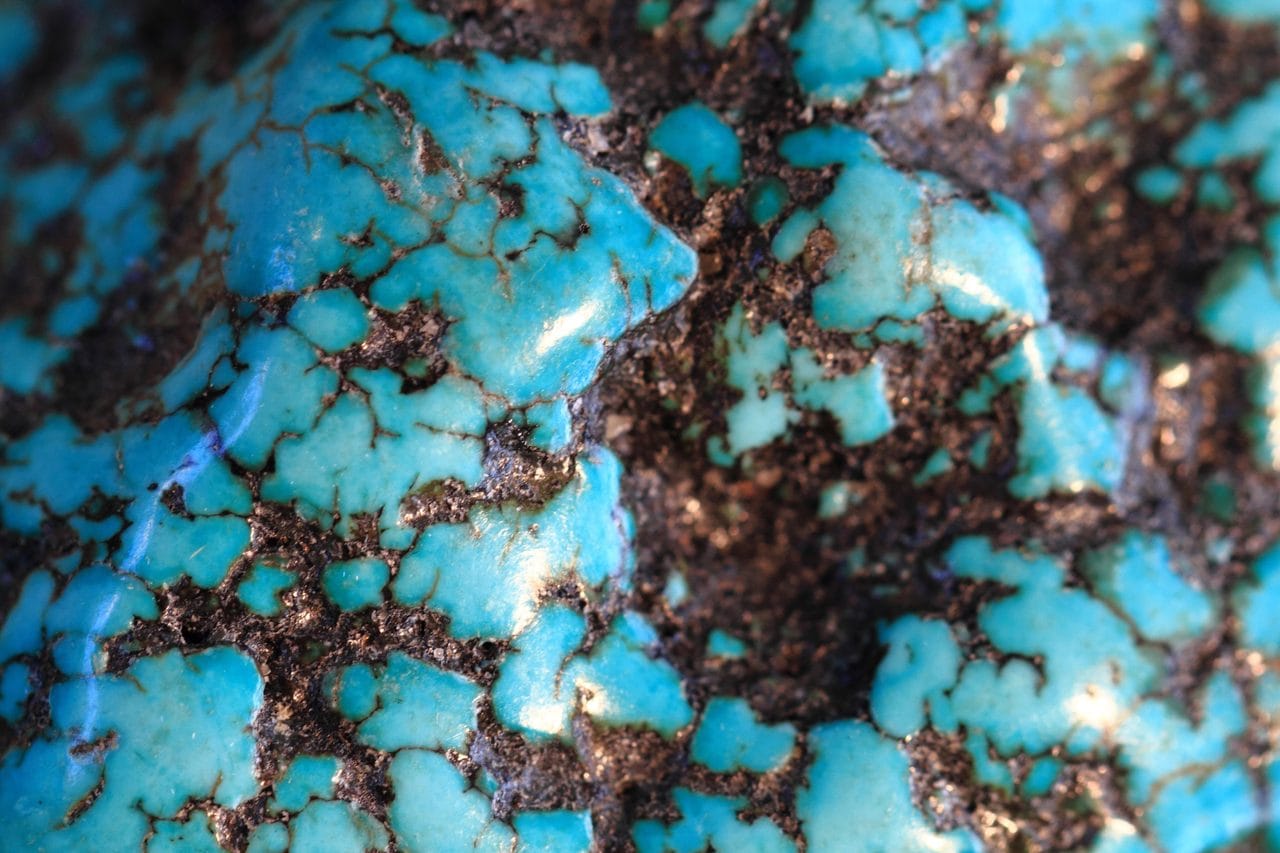
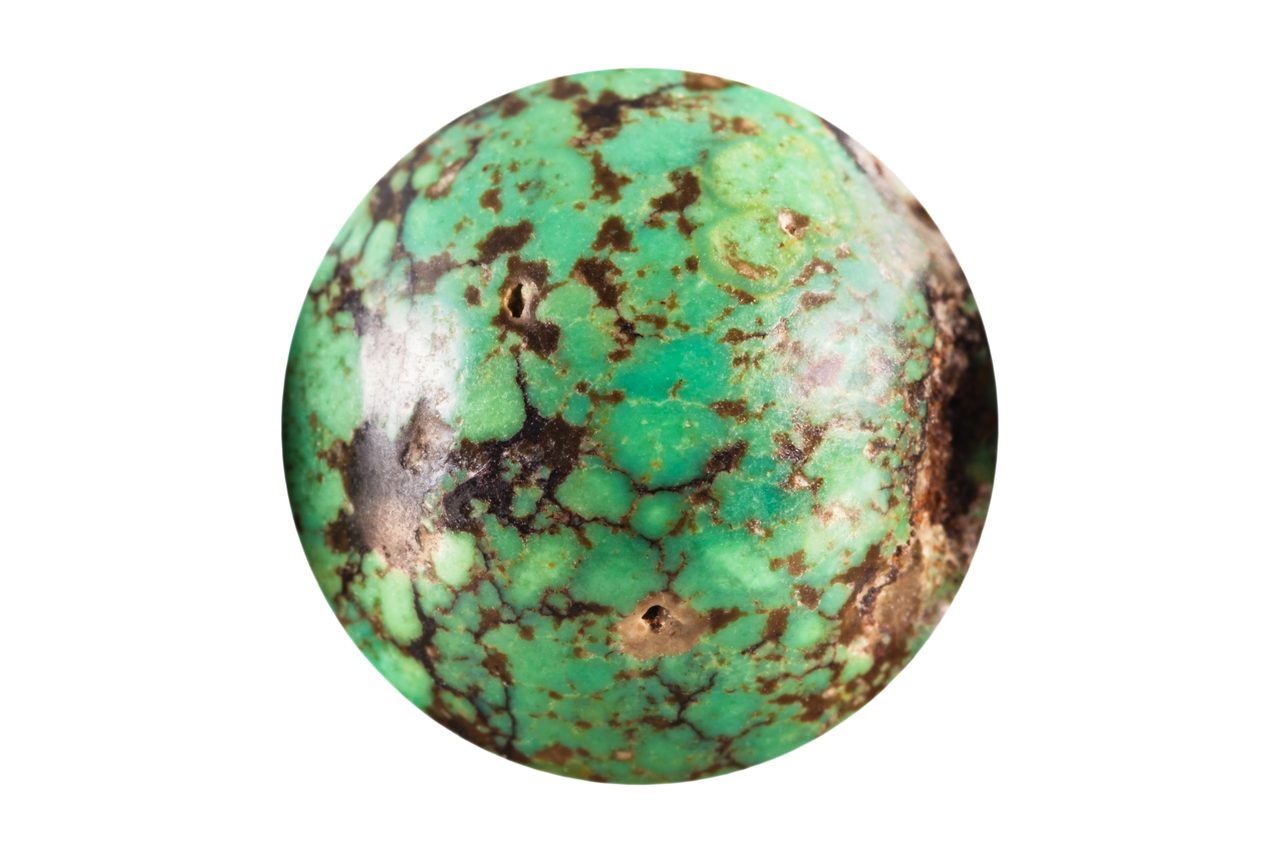
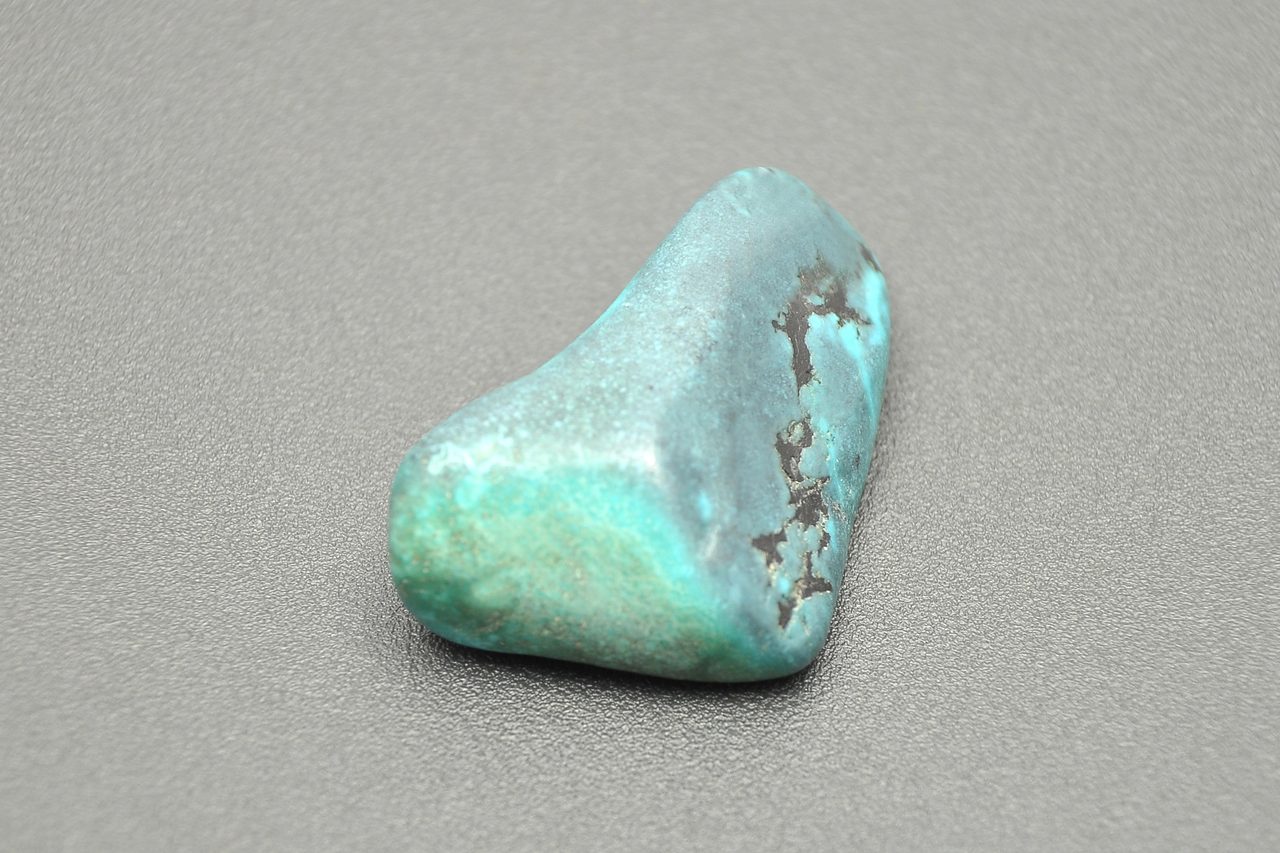
TABLE OF CONTENTS
Properties & Qualities
Physical Properties
What it is. Turquoise has the formula CuAl₆(PO₄)₄(OH)₈·4H₂O and belongs to the triclinic crystal system, though visible crystals are rare and tiny. Copper gives it its blue, and iron in the structure pulls the colour toward green. Its streak is white to pale greenish blue.
Texture and porosity. Fine-textured, low-porosity turquoise polishes to a waxy lustre and is the more valuable. Coarse, porous turquoise polishes dull, and GIA notes it is usually treated to make it smoother and shinier.
Matrix. The brown markings come from limonite and the tan ones from sandstone, both remnants of the host rock. Cutters generally try to avoid matrix, and stones without any rank highest in price. Spiderweb turquoise, with thin web-like matrix contrasting against the blue, ranks next, and some buyers prefer a well-balanced matrix to a clean stone.
Colour and grade. The colour runs from dull greens through grass green to a bright, medium sky blue. The most prized shade, an even, intense robin's-egg or sky blue, traditionally came from Nishapur, and the trade calls it Persian blue wherever it was mined. The Kingman mine in Arizona is known for intense blue, and Arizona's Sleeping Beauty mine was a major producer for more than four decades before it closed.
Hardness and toughness. At 5 to 6 on the Mohs scale, turquoise is fairly soft. Its toughness depends on texture: fair to good in fine material, possibly poor in coarse material. Coarse turquoise is therefore both the more absorbent and the more breakable.
Weight and optical data. The Handbook of Mineralogy gives a measured specific gravity of 2.86, less for massive material, and refractive indices of about 1.61 to 1.65. Turquoise is opaque to semitranslucent.
Light, heat and chemicals. GIA describes turquoise as generally stable to light. High heat can discolour and break it, acids can damage it, and cosmetics, skin oils and perspiration can discolour it over time. Heat and solvents can also damage the surface of treated pieces.
Treatments. Treatment is the norm for turquoise. GIA lists dyeing, and enhancement with epoxy or acrylic resin for hardness or colour, and notes that cavities are sometimes filled with metal-loaded epoxy to imitate pyrite. Waxing and oiling are also used. Stabilised turquoise is genuine turquoise impregnated with resin, and reconstituted turquoise is turquoise powder bonded back into a solid. A proprietary method called the Zachery treatment adds no polymer and improves polish while reducing porosity. A 1999 study in Gems & Gemology found that most Zachery-treated stones can only be identified by chemical analysis, from their raised potassium content.
Metaphysical properties
Protection is the oldest thread in turquoise lore. GIA records that from the thirteenth century it was believed to guard its wearer against falls, especially from horses, and to break into pieces as disaster approached. In Tibet, where it is considered a national treasure, it is believed to bring health, good fortune, protection from evil and peace.
Several Native American traditions hold it in particular regard. GIA notes that the Apache linked it to rainbows and believed that turquoise fixed to a bow or a firearm improved its aim, that the Pueblo believed its colour came from the sky, and that the Hopi credited lizards with its origin. Hindu mystics, GIA adds, believed that seeing turquoise after the new moon brought great wealth.
Modern crystal practice keeps protection and adds safe travel, calm and clear speech, the last because its colour places it at the throat in the chakra system. Practitioners also count it among the balancing stones, used for evenness on an up-and-down day. The old belief that turquoise changes colour with its owner's health has a physical basis in the porous stone itself, which our December birthstone article explains.
Meaning & Symbolism
Physical meaning
Turquoise rarely comes without a trace of where it formed. The matrix running through a typical piece is the rock the stone grew in, and the market's habit of prizing a good spiderweb pattern turns that leftover rock into part of the stone's beauty. It makes an easy image for a life that carries its origins openly.
Its softness and porosity make it a stone that is shaped by use. A piece worn daily is changed by the person wearing it, which is why turquoise reads so naturally as a stone of relationship, kept close and lived with.
Turquoise grows only in dry country, from copper-bearing water that seeps slowly down through rock, and practitioners read it as patience, as something built up a little at a time from scarce material. Its colour carries a similar idea. Copper gives the blue and iron pulls it toward green, so a single stone can sit anywhere between the two, and that range is read as adaptability.
Spiritual meaning
Its spiritual reading starts from the Pueblo belief that turquoise took its colour from the sky. It is treated as a meeting point of earth and sky, a piece of the ground that carries the colour of the air above it. In spiderweb turquoise, some practitioners also read the fine dark net through the blue as the threads that tie one life to the lives around it.
Its long role as a protective amulet gives it a second meaning, guardianship. Turquoise is commonly given to travellers and to people starting something new, and in European tradition a turquoise ring given as a gift means forget me not. In practice the stone is read as a bond between giver and wearer as much as a shield.
Anyone working with turquoise in a spiritual way is also working with a stone that is sacred in living Native American traditions. It deserves to be approached with respect, and without borrowing ceremonies that belong to those traditions.
Healing Benefits
Physical healing
Healing uses of turquoise are cultural and energetic traditions. None of them treats illness.
Practitioners place it at the throat and associate it with general wellbeing, a reading that goes back to the Tibetan belief in turquoise as a bringer of health. It is also carried on long trips as a travel stone. Turquoise is a copper mineral and is commonly treated with resins and dyes, so it does not belong in drinking water or elixirs. For anything that worries you about your health, see a doctor.
Turquoise is not a substitute for medical care. If something in your body worries you, see a doctor.
Emotional healing
Turquoise is used in practice for calm and steadiness, particularly in situations that feel exposed or unfamiliar. Practitioners talk about it as a stone for keeping one's footing, with the old protection-from-falling belief turned into an emotional image.
It is also associated with friendship and with speaking openly. Because it is so commonly given as a gift, it carries a reading of loyalty and of being thought of, and people keep a turquoise from someone they love as a reminder of that bond.
Practitioners also suggest it for the nerves that come before speaking up, whether that is a talk at work or a hard conversation at home. One way of working with it there is a pendant worn close at the neck. Another is a small stone turned over in the hand for a minute beforehand, with slow breathing.
Some people keep it beside them while drafting a letter or message they find hard to word. Others carry it in the first weeks after a move, as something familiar in an unfamiliar place.
Spiritual healing
In spiritual healing, turquoise is used for protection and for a sense of connection, to the earth through its matrix and to the sky through its colour. Practitioners place it at the throat or hold it during meditation on gratitude and on the people and places that shaped them.
It is also used when a person feels spiritually scattered, as a steadying stone to return to. Much of that work happens through wearing it, though some practitioners add a short practice of their own.
One simple version starts with the stone resting at the hollow of the throat while lying down. Breathing is kept slow, and attention moves first to the blue, pictured as open air, then to the matrix, pictured as solid ground. The session ends with one thing the person is thankful for, said aloud. Others keep a piece in the palm for a minute before sleep and let go of words said and left unsaid.
Use & Care
How to use
- Have it set: Turquoise has spent much of its history as a worked object, and a ring, pendant or bracelet suits it better than a loose pocket stone. Our article on what turquoise is good for makes the case for this.
- Put it on last: Dress and apply perfume, lotion and make-up first, then put the turquoise on, since cosmetics can discolour it.
- For travel: Wear or carry a piece on trips, the use with the longest line of tradition behind it.
- At the throat: A short pendant sitting in the hollow of the neck suits the practice reading of clear speech.
- As a gift: Give it to someone starting a trip or a new chapter, in the forget-me-not tradition.
- During meditation: Hold a polished piece while focusing on calm and steadiness.
- Take it off for some jobs: Remove rings and bracelets for washing up, cleaning with chemicals, swimming and gardening.
- Give it its own pouch: Harder stones and metal can scratch it, so store it apart in something soft.
- By the front door: Some practitioners keep a piece near the entrance as a quiet guard for the home.
- On the wrist: A bead bracelet keeps the colour in sight through the day, a small cue to slow down.
- Trace the matrix: Follow the dark lines of a spiderweb piece with your eyes for a few slow breaths.
How to cleanse
- Soft cloth after wearing: A dry, soft cloth removes skin oils, the main thing that discolours turquoise over time.
- Smoke: Passing it through incense or sage smoke cleanses it without wetting a porous stone.
- Sound: A singing bowl or bell nearby.
- Moonlight: Turquoise is stable to light, so a night on a windowsill does it no harm.
- Warm soapy water only when needed: GIA advises warm soapy water, not steam or ultrasonic cleaners. Rinse quickly and dry at once.
- Keep it out of salt and soaks: Porous turquoise takes up whatever it sits in, so salt water, long soaks and cleansing solutions are best avoided.
- Breath: Hold it near your mouth and breathe over it gently, with a clear intention in mind.
- Clearing sky: Close your hand around it and picture its blue clearing like a sky after rain.
- Treated pieces too: Stabilised turquoise can be marked by heat and solvents, so the same dry methods suit it.
How to charge
- Sunlight in moderation: Light does not fade turquoise, so a morning on the windowsill is fine. Keep it away from strong heat, which can discolour and crack it.
- Moonlight: Practitioners also charge it under the full moon.
- By wearing it: Some practitioners treat daily wear as turquoise's own charge, in keeping with its history as a stone that is worn.
- With intention: Hold it before a trip or a new start and name what you would like it to protect.
- Beside clear quartz: Rest it next to a clear quartz point for a practice-style boost, keeping the harder quartz from rubbing against it.
- At the new moon: Some practitioners prefer the new moon for setting fresh intentions with it.
- Spoken aloud: Hold it at the throat and say your intention out loud, in keeping with its link to speech.
- Under open sky: On a dry, mild day, set it outdoors for an hour, brought in before any rain.
- Before giving it: Hold a gift piece for a moment and think of the person who will wear it.
Combining with other stones
- Lapis lazuli: A second blue for December. On the 1912 birthstone list lapis was printed as the month's alternate, beside turquoise.
- Malachite: Another copper mineral, paired for protection and steady growth. See Malachite.
- Amazonite: A blue-green feldspar paired for calm communication at the throat. See Amazonite.
- Rose quartz: Adds warmth to a gift stone, a natural pairing for friendship.
- Clear quartz: Practice uses it to strengthen turquoise's protective reading.
- Amethyst: For calm and for meditation on the spiritual side of the stone.
- Sodalite: A second throat stone, paired when the aim is clear, honest speech. See Sodalite.
- Black tourmaline: Carried with turquoise on travel for a double layer of protection. See Black Tourmaline.
- Chrysocolla: A fellow copper mineral in blue-green, worked with it for gentle communication.
- Carnelian: Its warm orange sits opposite turquoise's blue and lends confidence when speaking.
Identification
Can be mistaken for
- Dyed howlite: The best-known imitation, a soft white stone dyed blue, its grey veins posing as matrix. Our turquoise and howlite comparison covers it in detail. See Howlite.
- Dyed magnesite: Another porous white stone dyed to look like turquoise.
- Reconstituted or block turquoise: Ground material set in resin and cut from the resulting block. It may contain some turquoise but is not solid stone.
- Plastic and glass: Cheap imitations, commonly too even in colour and sometimes with moulded or painted matrix.
- Gilson turquoise: A laboratory-made material with turquoise's composition, generally very uniform.
- Chrysocolla: A softer blue-green copper mineral, commonly mixed with quartz.
- Variscite: A green aluminium phosphate that can resemble green turquoise.
- Amazonite: A blue-green feldspar with visible cleavage and a slight sheen. See Amazonite.
- Smithsonite: A blue-green zinc carbonate, noticeably heavier and with a pearly, more translucent look. See Smithsonite.
How to spot a fake
- Distrust the perfect stone: Large, vivid, completely even blue at a low price is rarely untreated natural turquoise.
- Look at the matrix: In natural stone the matrix follows the cracks and veins of the piece. Painted or moulded lines that sit on the surface, or repeat in a pattern, point to an imitation.
- Check cracks and drill holes: Dye pools in fractures and around holes, and a bead that is white just inside the hole is dyed howlite or magnesite.
- Be careful with gold flecks: GIA notes that cavities in some turquoise are filled with metal-loaded epoxy to imitate pyrite.
- Learn the four labels: Natural, stabilised, reconstituted and imitation describe very different materials at very different prices. A good seller names the category without being asked.
- Weigh it in your hand: Plastic feels noticeably light and warm next to a stone of the same size.
- Ask about Zachery treatment: On expensive pieces, ask whether the stone was Zachery-treated. Only a lab can confirm it.
- Ask where it was mined: Named mines and regions, such as Kingman, Sleeping Beauty, Nishapur or Hubei, are a better sign than a vague "genuine". The trade's wording for treated stones is unpicked in what "natural" means when buying crystals.
Sources: GIA, Turquoise Description; GIA, Turquoise History and Lore; GIA, December Birthstones; Handbook of Mineralogy, Turquoise; Fritsch et al., "The Identification of Zachery-Treated Turquoise", Gems & Gemology 35:1, 1999; Schorsch, "Turquoise in Ancient Egypt", The Metropolitan Museum of Art, 2018; The Jewelers' Circular, 14 August 1912; GIA, Gem Treatment Disclosure and U.S. Law, Gems & Gemology, Summer 2004.