A great deal of cheap “turquoise” is not turquoise at all, but howlite dyed blue. Genuine turquoise is a copper-based mineral with a natural blue-green colour; howlite is a white or grey stone that takes dye extremely well, which makes it the most common turquoise imitation on the market. The main tells are hardness, how the colour sits in the veins, and price.
If you have ever bought an inexpensive turquoise bracelet, there is a real chance you were sold dyed howlite. This is one of the most widespread substitutions in the whole crystal trade, and it is usually not even hidden, just left unsaid. Learning to spot it protects your money, and, as it happens, it also introduces you to a genuinely nice stone in its own right.
Let’s separate the two.
What Each Stone Is
They start from completely different chemistry, which is the root of every difference between them.
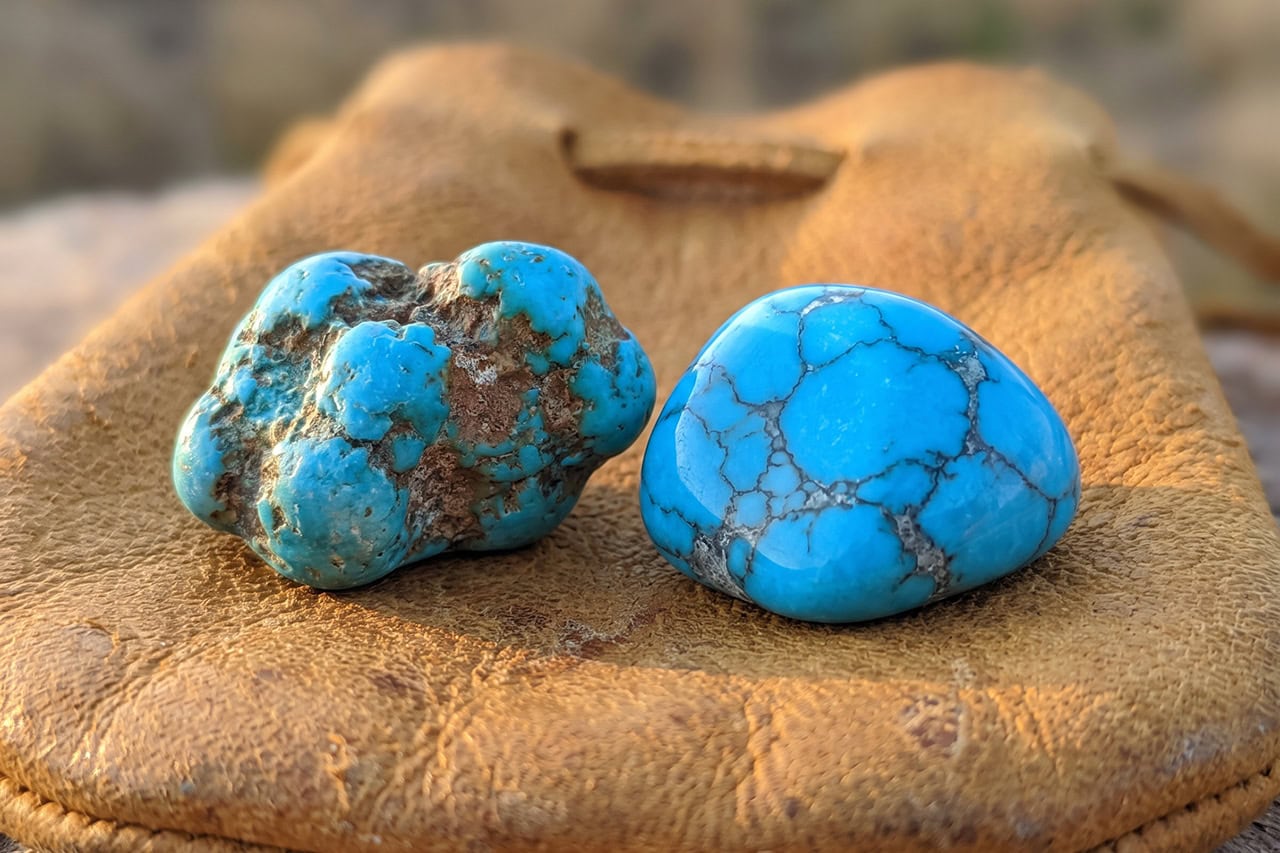
Turquoise is a hydrated copper aluminium phosphate, and copper is what gives it that natural robin’s-egg blue to blue-green. It is a genuinely ancient, prized stone, and real turquoise is rarely cheap.
Howlite is a calcium borosilicate, naturally white to pale grey, threaded with grey or black veining. On its own it is a soft, chalky, porous stone. That porosity is the whole problem: howlite soaks up dye readily, and dyed a strong blue, it does a convincing impression of turquoise, veins and all.
What’s striking is how well the disguise works. Howlite’s natural grey-black veining, once the white body is dyed blue, mimics the brown or black matrix of real turquoise closely enough to fool a casual eye.
How to Tell Them Apart
Several quick checks will separate genuine turquoise from dyed howlite. No single one is foolproof, but together they are decisive.
- Hardness. Turquoise sits around 5 to 6 on the Mohs scale; howlite is softer, around 3.5. Howlite scratches far more easily, so a stone that marks readily is suspect.
- Dye in the veins. This is the big one. On dyed howlite, colour often pools and darkens in the cracks and veins, and can look slightly uneven or concentrated there. Natural turquoise colour sits more consistently in the body of the stone.
- The acetone test. Rub an inconspicuous spot with a little acetone or nail-polish remover on a cotton bud. If blue transfers onto the bud, the stone is dyed.
- Too-even, too-bright colour. A large, solid, vividly even blue at a low price is a warning sign. Natural turquoise of that quality is expensive and rarely perfectly uniform.
- Price. If it is cheap, be suspicious. Real turquoise commands real prices, and a bargain “turquoise” is very often something else.
Consider using two or three of these together rather than trusting one. Hardness plus dye-in-the-veins plus a sensible look at the price will catch most imitations.
Why Howlite Became the Stand-In
Howlite did not set out to be a fake. It became the go-to turquoise imitation because of three convenient facts about it.
First, it is naturally white and very porous, so it drinks up dye evenly and holds a strong, uniform blue. Few stones take colour so willingly. Second, its natural grey-to-black veining happens to resemble the matrix, the web of host rock, that runs through much natural turquoise, so a dyed piece looks convincingly like the real thing. Third, it is common and cheap, so there is money to be made turning an inexpensive white stone into a lookalike of a costly blue one.
Consider that combination. A porous white stone, veined like turquoise, available for next to nothing, is almost purpose-built to imitate an expensive gem. The wonder is not that dyed howlite is everywhere, but that anyone expected otherwise.
The Magnesite Cousin
Howlite is not the only impostor. Magnesite, a magnesium carbonate, is another white, porous stone dyed blue to imitate turquoise, and it behaves much like howlite. One neat way to tell howlite from magnesite, if you ever need to: magnesite fizzes on contact with a drop of dilute acid, and howlite does not. For the buyer, though, the practical point is the same. Cheap, evenly dyed blue stones are frequently one of these two, not turquoise.
Is Dyed Howlite a Scam?
Here is the honest, two-sided answer. Selling dyed howlite as genuine turquoise, at turquoise prices, is dishonest. But dyed howlite sold plainly as dyed howlite is a perfectly reasonable, affordable decorative stone, and there is nothing wrong with owning it if you know what it is.
More than that, natural white howlite is a lovely stone on its own terms, calming, marble-like, and often used in its undyed form for its own soothing associations. It does not need to pretend to be turquoise to be worth having. The problem was never the howlite; it was the mislabelling.
Buying Real Turquoise With Confidence
If you do want genuine turquoise, a little knowledge goes a long way, because even among real turquoise there are grades of treatment.
Much natural turquoise is soft and porous, so a lot of it is stabilised, impregnated with resin to harden it and hold its colour. Stabilised turquoise is still real turquoise, just treated, and it is entirely legitimate when sold as such. Reconstituted turquoise, by contrast, is real turquoise ground to powder and bonded back together, a further step removed. And then there is outright imitation, the dyed howlite and magnesite we have been discussing.
The through-line for a buyer is disclosure. A trustworthy seller will tell you plainly whether a stone is natural, stabilised, reconstituted, or an imitation, and will price it accordingly. The warning signs are a solid, vivid, evenly blue stone at a suspiciously low price, and a seller who cannot or will not say how it was treated. For the fuller picture on the stone itself, see what turquoise is good for.
Common Questions
Is all cheap turquoise fake? Not all, but a lot of it. Genuine turquoise can be affordable in small or lower-grade pieces, but a large, solid, vividly even blue stone at a bargain price is very often dyed howlite or magnesite. Price is a clue, not a verdict.
Can dyed howlite be worn like turquoise? Physically, yes, but the dye can fade or rub off over time, especially with water, sweat, and sunlight. Treat it as the dyed stone it is, and do not expect the colour to be permanent.
What is “white turquoise”? Often not turquoise at all. Much “white turquoise” is actually white howlite or magnesite, sometimes left natural, sometimes dyed. If a seller offers it, ask what the mineral genuinely is.
So the goal is not to fear cheap blue stones, but to know what you are buying. Ask whether a stone is natural turquoise, treated turquoise, or dyed howlite, and a reputable seller will tell you. For more on genuine turquoise and its impostors, see the Crystalance Mineral Library. An honest stone at an honest price is always fine; it is the quiet swap that is worth guarding against.