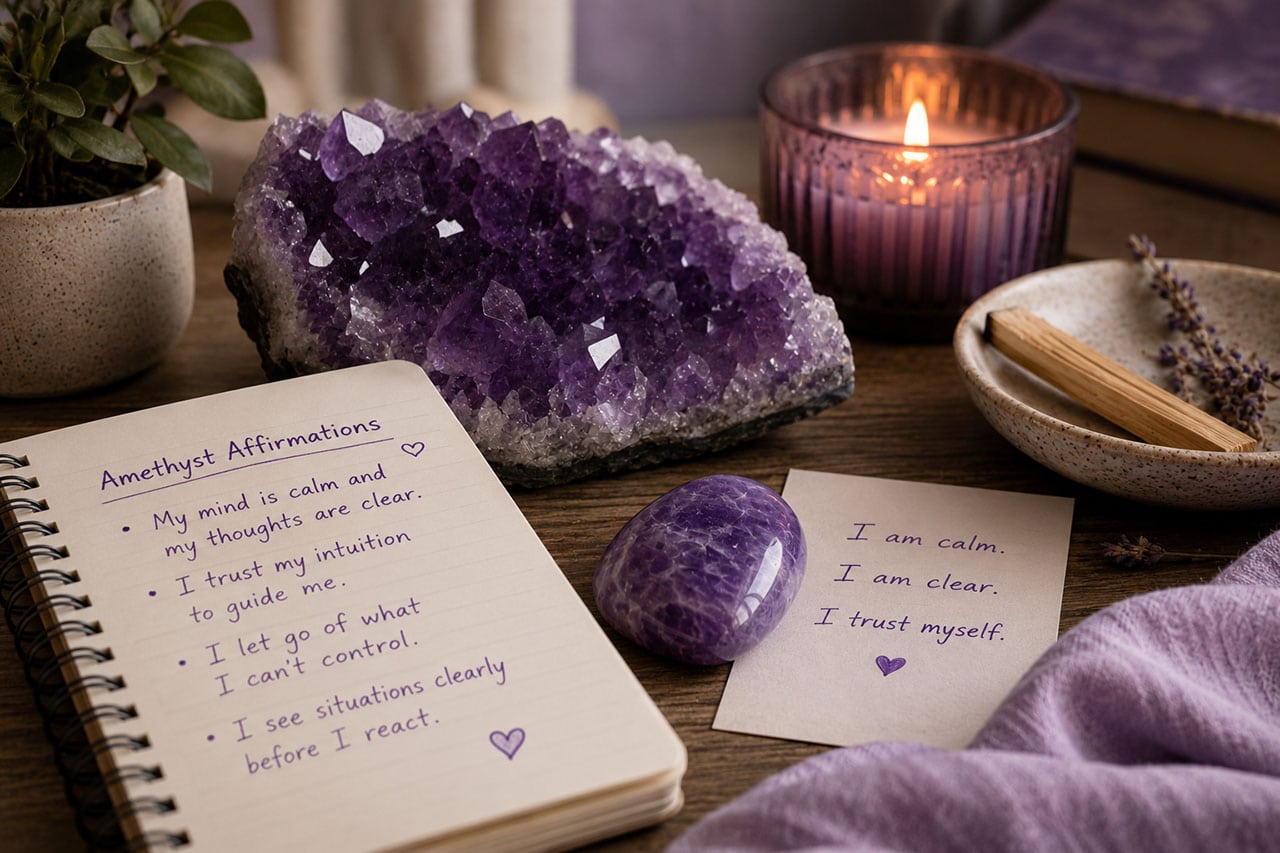
Amethyst affirmations are short sentences repeated while holding amethyst, which practice puts with calm and clear thinking. Write yours in a phrasing you can believe today, rather than in the present tense the standard advice insists on.
I am calm and clear in my thinking. That is the version the standard advice keeps reaching for, and it arrives with the same instruction attached every time. Present tense. Positive. Phrased as though it were already true.
That instruction is the part of affirmation practice that has been through a laboratory, and it did not come out the way the advice assumes.
The present-tense rule is the part worth loosening
In 2009 three Canadian psychologists, Joanne Wood, Elaine Perunovic and John Lee, ran two experiments on exactly this kind of sentence and published them in Psychological Science. Participants were asked to repeat “I’m a lovable person”, or to think about the ways in which it was true. Among those who came in with low self-esteem, the people who repeated the statement finished feeling worse than the people who had not repeated it at all. Among those with high self-esteem, repeating it helped, though only to a limited degree.
The paper also reports that the low self-esteem participants who were asked to consider how the statement was both true and not true came out better than those told to focus only on how it was true.
Nothing in that study is about crystals, and nothing in it says affirmations do not work. What it says is narrower and more useful. A flat present-tense claim about yourself is a claim, and if part of you does not accept it, saying it out loud invites that part to answer back. You finish the sentence further from calm than you started it, having just held an argument with yourself while holding a stone.
The rule to relax, then, is the one about speaking as though it were already done. The phrasings that survive contact with a real morning are the ones with somewhere to go. I am learning to think clearly under pressure. I am becoming someone who does not decide anything at midnight. Some practitioners drop the statement form altogether and use a question, and asking yourself what a clear head would do about this before you answer the email is a perfectly good affirmation even though it does not look like one.
The test runs in your own head in about four seconds. Say the sentence and listen for the rebuttal. If a voice arrives with a counterexample, the sentence is too strong for today, and the version that admits the gap is the one to say for a while.
Why amethyst, and how to keep it in reach
Practice puts amethyst with the crown and third eye chakras, which in plain language means the two positions practice associates with awareness and with intuition, and it gives the stone calm and quiet as its lane. That is why it turns up under sentences about a settled head rather than under sentences about money or nerve. It is also cheap, common and hard to get wrong, which is a large part of why it ends up in so many beginners’ hands.
The purple has a real explanation and it is a good one to hold in mind while you are holding the stone. Iron gets caught up in the quartz as it grows, and then, after the crystal has formed, gamma radiation from the rock around it works on that iron and turns it purple. Amethyst sits at 7 on the Mohs scale and does not break along cleavage planes, so it survives being carried in a pocket. Its one genuine vulnerability is light. Some amethyst fades under prolonged exposure to direct sunlight or bright display lamps, which matters here because a nightstand and a windowsill are both obvious places to keep a stone you use every morning, and only one of them is safe for it over years.
Our own amethyst is a small geode, about the height of a large coffee mug and heavy enough to stay where it is put. The points at the centre are noticeably darker than the ones around the rim, and the gradient only shows properly when light catches it at an angle. That turns out to suit this practice. An object you look into gives you something slightly different depending on where the sun is, and a stone that looks identical every morning is a stone you will eventually stop seeing.
Where it lives should follow how you really work. Held in the hand for a few minutes with the sentence said out loud is the standard version and the one to try first. Sitting on a desk in view, with the sentence said whenever your eye lands on it, is a smaller version that survives a busy week. Beside the bed, said once before the light goes off, suits people who find mornings hostile. The wider set of options, and how an affirmation stone differs from an intention stone, is in how to use crystal affirmations.
What amethyst is as a mineral, and how that iron and that radiation produce the colour, is on the Crystalance Mineral Library’s amethyst page.
The phrasing is the part of this to spend time on. The stone is easy to buy and the routine is easy to describe, and the sentence is the element the research reached.