Crystal points are used to direct intention. The tip is the directional end: tip pointing out releases or sends, tip pointing in receives or amplifies. The most common stones used as points are clear quartz, amethyst, smoky quartz, citrine, and rose quartz. The practice is the same across all of them.
The “what is a crystal point for?” question covers a wide range of uses, but they all come from the same underlying idea: the geometric form of a point gives the stone a directional quality the practitioner can work with. Whether the point grew naturally or was carved later does not change the practice.
Here is the working guide.
What a Crystal Point Actually Is
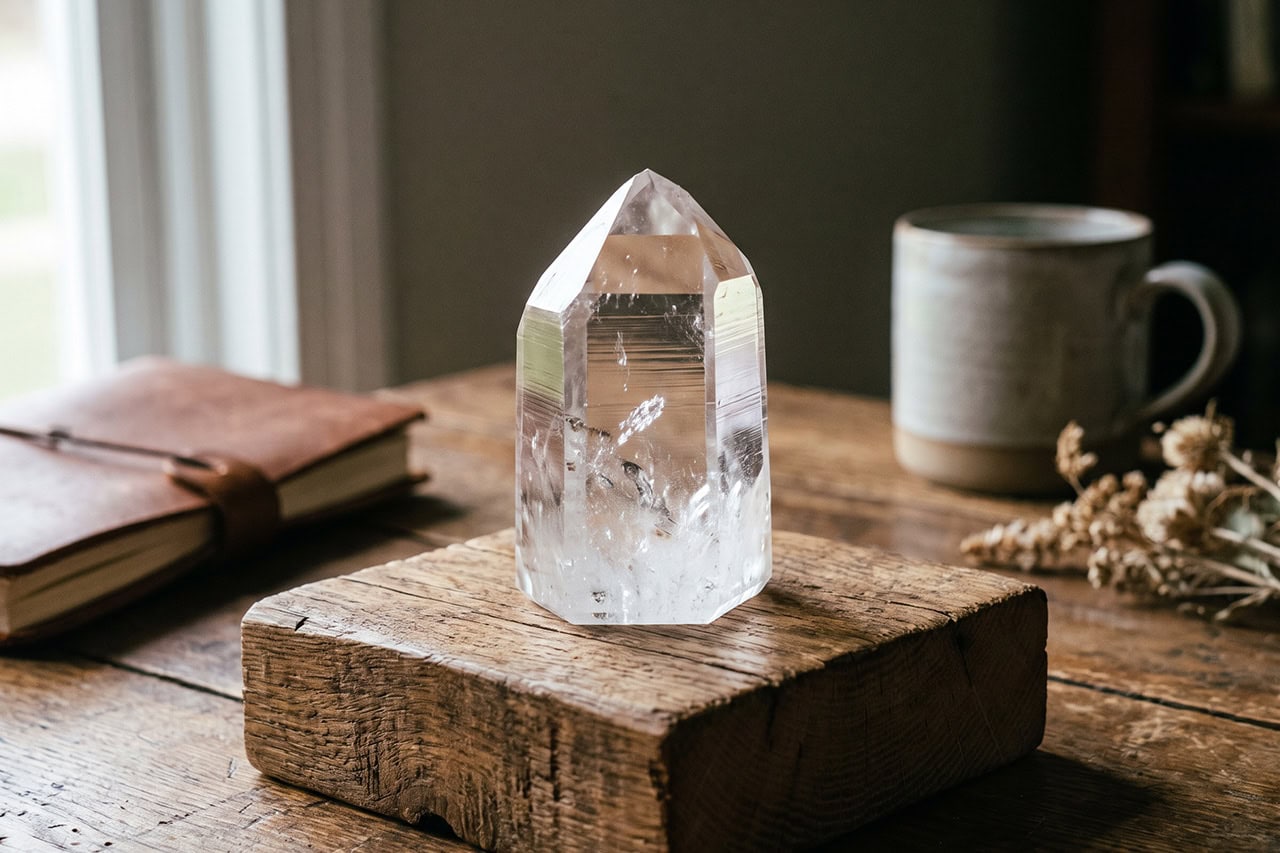
A crystal point is a single-terminated piece of crystal with a defined tip at one end. Two forms are common in commerce.
Natural points. Crystals that grew with their natural termination intact. The hexagonal pyramid at the end of a clear quartz crystal is the classic example. These show the actual crystal structure of the mineral and are often more expensive than carved points of the same stone.
Cut or polished points. Pieces of massive crystal carved into a point shape after extraction. Most amethyst, rose quartz, and obsidian points sold commercially are cut, not naturally terminated. The geometric form is identical from a use perspective; the difference is structural and aesthetic.
For the broader question of which crystal shapes are natural and which are carved, see what are crystal points, spheres, clusters, and other shapes.
The Core Practice
The same practice underlies almost every point use across modern crystal traditions.
Tip-out releases. A point with the tip facing away from you (or away from the centre of a grid) is used to direct energy outward. Used for sending intentions out into the world, releasing what you want to let go of, or projecting protective intention away from a space.
Tip-in receives. A point facing toward you (or toward the centre of a grid) is used to draw something in. Used for amplifying an intention into the practitioner, receiving qualities the stone is associated with, or focusing energy inward.
That binary (out releases, in receives) is the entire mechanism. Everything else is an application of it.
Five Common Uses
Setting intentions. Hold the point in your dominant hand, tip pointing slightly outward, and state the intention. The directional shape gives the intention a physical sense of being aimed somewhere. Useful for action-oriented intentions (sending something forward, starting something new). For more on intention practice, see how to set intentions with crystals.
Crystal grids. Multiple points arranged in a geometric pattern with their tips coordinated. Tips pointing inward toward a central stone amplifies the centre. Tips pointing outward radiates the intention. Common grid shapes (six-pointed star, flower of life) are visual structures for the directional logic.
Energy work and meditation. A practitioner holds the point during quiet sitting, often with the tip directed at a specific area (the heart for emotional work, the third eye for clarity work). The directional aim is the practice element.
Space clearing. A clear quartz or smoky quartz point used to “sweep” the corners of a room, with the tip outward, is a traditional clearing practice. The motion and the tip direction together are the ritual.
On a desk or altar. Placed standing upright with the tip up, a point becomes a stationary intention anchor. The shape is visually striking and the symbolic uplift of the tip pointing up matches aspirational or growth-oriented intentions.
Pairing Points With Different Stones
The stone determines the lane; the point shape determines the directional use.
Clear quartz points. The default. Used as a blank-canvas amplifier for any intention. The most-recommended starting point for anyone working with point practice.
Amethyst points. Used for calm, clarity, and intuitive work. The most common alternative to clear quartz for meditation and bedside placements.
Smoky quartz points. Used for grounding and releasing. The tip-out direction matches the release intention; a smoky quartz point with the tip facing away from the bed is a traditional placement for processing difficult emotions.
Citrine points. Used for abundance and confidence intentions. Tip pointing into the workspace or bedroom matches the receive-into-life pattern.
Rose quartz points. Used for self-compassion and emotional work. Often placed tip-in on the bedside table.
Obsidian points. Used for protection and shadow work. The dark colour and folk-association with cutting through illusion both inform the use.
Where to Place Points
A few standard placements.
Bedside. A clear quartz or amethyst point with the tip facing away from the bed is the traditional placement for restful sleep and dream work. Smoky quartz works the same way for releasing the day.
Desk or workspace. A point standing upright as a visual cue. Clear quartz for general intention, citrine for confidence and focus, fluorite for clarity work.
Window. A clear quartz point in a sunny window catches light and refracts visibly, which is part of the practice’s appeal. Avoid heat-sensitive stones (amethyst, rose quartz) in direct prolonged sun.
Held during practice. Many point uses are not stationary placements but active hold-and-direct practices. The point is meant to be picked up.
The Honest Note
Crystal points do not generate or direct measurable energy in any laboratory sense. What they do is give the practitioner a directional, geometrically clear physical anchor for an intention. The tip-out and tip-in distinction is meaningful because it gives the practice a structure the practitioner can act within. The mechanism is attention and ritual. The point is the cue.
For more on individual point stones, see the Crystalance Mineral Library. The practice of using a crystal point is simpler than the elaboration around it suggests. Pick a point that fits your intention. Direct the tip with care. Hold or place it where the intention needs the cue. The geometry does the work of focusing your attention. You do the work of acting on the intention.