Aventurine goes with luck and opportunity, K2 stone with clear-headedness, ocean jasper with ease. These four are recent arrivals with almost no tradition behind them, and their meanings look a great deal like descriptions of how they look.
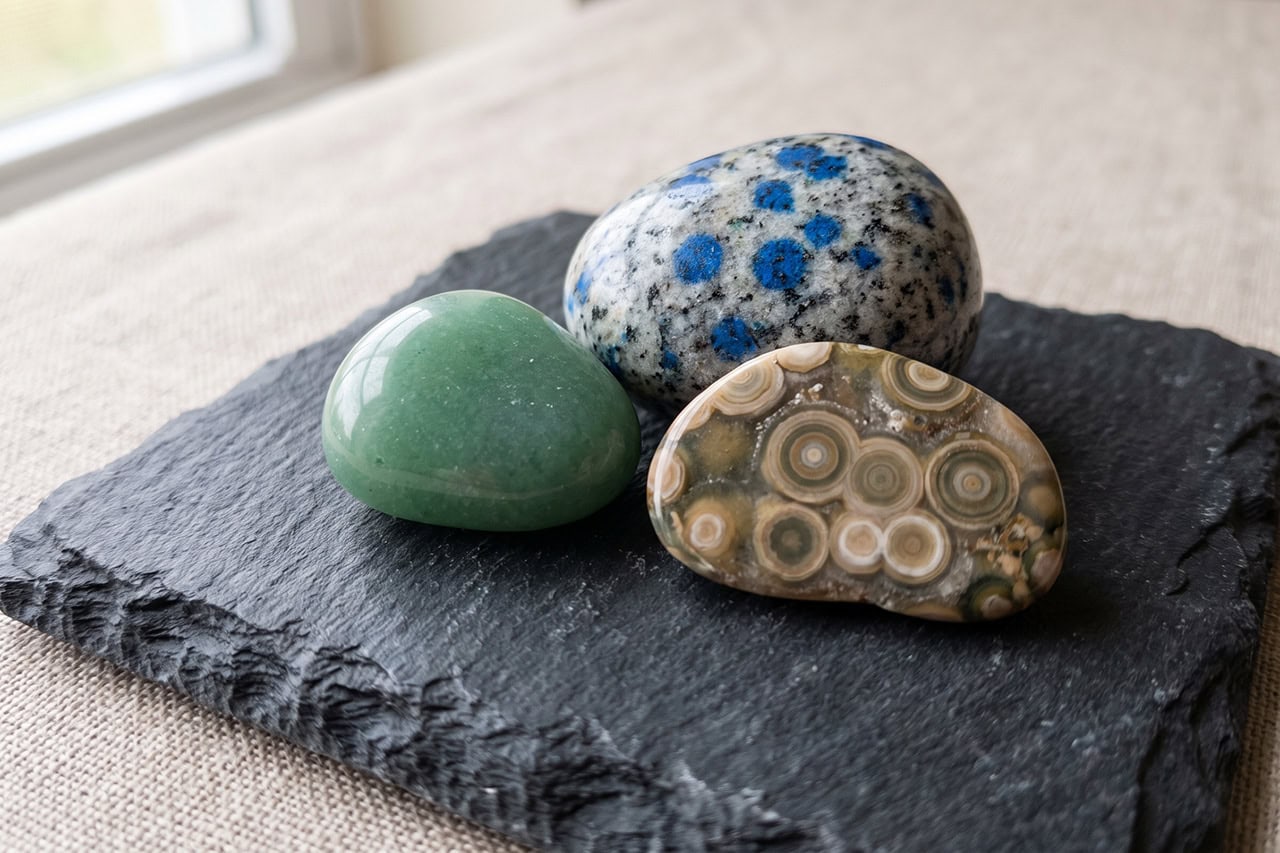
Ocean jasper is patterned with eyes. Small round orbs, cream and pale green and sometimes pink, scattered across a polished face like something biological, or like bubbles caught on the way up.
The meaning attached to it is flow, ease, letting things move. Bubbles rising, and a stone whose reputation is about things moving easily.
I do not think that is a coincidence, and I also do not think it is a scandal. It reads to me like the assignment being made in front of us, and once you have entertained that idea you can watch the same thing happening with the other three. That is a reading rather than a documented history, and I will say where it stops being one.
How a stone with no history gets a meaning
The documented part is how new these stones are.
The Gem Shop, the original US distributor for ocean jasper, dates its arrival at the Tucson Gem and Mineral Show to 2000, from a deposit near the village of Marovato in the Ambolobozo district on the northwest coast of Madagascar. K2 stone is newer still in the shops, quarried at the foot of the mountain it takes its name from on the China and Pakistan border, and the geology reference that describes it is careful to say it is not a jasper or granite in the traditional sense but is called both because of how it looks. Nobody has been assigning meanings to either of these for very long.
The undocumented part, and the part I would not push further than a reading, is that the look then did the work. K2’s blue circles on white suggest sky through cloud, and the meanings that stuck to it are about perspective and the long view. Hand somebody a white stone with sky-blue dots, ask them what it might be for, and they will land somewhere close.
Aventurine works the same way with less to go on. Geology.com describes it as a variety of translucent quartz or quartzite with abundant small plate or flake-shaped inclusions, most commonly fuchsite, a chromium-rich mica, and the light bouncing off those flakes is what produces the sparkle geologists call aventurescence. Green and quietly glittering. Green already carries growth and money in the modern scheme, the sparkle suggests something turning up, and luck and opportunity arrive without anybody needing to have written it down.
Reading it backwards
Try it as an exercise, because it tells you something about the rest of the shelf too.
Take a stone you have never met and describe only its appearance. Deep opaque black with a glassy fracture. Milky pink with no visible crystals. Then guess what crystal practice does with it. You will often be close, and you will be closest with the stones that have the least history, because those are the ones where nothing older got in the way.
Where the guess fails is where an older tradition overrode the look, and that is the useful half of the exercise. A stone whose meaning does not follow from its appearance usually has something behind it, and knowing which of the two you are holding should come before you decide how much weight the assignment carries.
Choosing between them
If the assignment came from the look, then responding to the look is responding to the same thing the assignment responded to. Buying the piece you keep picking up is not a failure of rigour on your part. It is the same move, run once more, by you.
Pick the one you want to keep looking at, then. If you want the practical version of that, the four differ mainly in how they behave as objects, and one of them will disappoint you sooner than the others. Aventurine sits at 6.5 to 7 on the Mohs scale, though geology.com notes a lower apparent hardness where the mica flakes are abundant, so a heavily sparkling piece is a little softer than the number suggests. K2 is the awkward one. The white rock around the spots is hard, but the azurite spots themselves are only about 3.5 to 4, so the blue is the softest part of the stone and the first part a rough pocket will dull. Ocean jasper, silicified all the way through, takes a hard polish and shrugs off ordinary handling.
Beyond that they are used the way any tumbled stone is used, carried or kept where you work. There is no special procedure attached to any of them, and the absence of one follows from everything above. A stone that arrived in 2000 has not had time to grow a ritual.
Ask where it came from
That brings up sea jasper, and the one question to put to a seller.
Sea jasper and ocean jasper are both names for orbicular material out of northwest Madagascar, and the second name has been claimed as a trademark by a seller, and a claimed name is the sort of thing that makes two labels out of one kind of rock. Whether the specific piece in front of you came from the same workings as the specific piece under the other label is not something a chart can settle. It is a question for whoever is selling it.
That is the question to ask anyway. Not what it means. Where it was mined.
Ocean jasper has an unusually romantic answer to that, and the age of the answer matters. The account everyone repeats comes from an advertisement in the May 2000 issue of Lapidary Journal, reproduced on The Gem Shop’s own page: the deposit was at the edge of the ocean, could only be seen and collected at low tide, and had no road, so the material left by boat. The same page then records that in 2006 the last rock from the original first vein was mined. The picture in your head is therefore a quarter of a century old and describes a working that is finished, and material sold as ocean jasper today came out of somewhere else.
None of which makes it a worse stone. It makes the question a better one. A seller who can tell you the district, or who knows that K2 comes out of the Karakoram rather than a laboratory, is a seller paying attention. The Crystalance Mineral Library sorts out what each of these is made of underneath the names.
Sources
- Geology.com, aventurine: a variety of translucent quartz or quartzite with abundant small plate or flake-shaped inclusions, most commonly fuchsite; aventurescence is light reflecting from those inclusions; Mohs 6.5 to 7, with “a lower apparent hardness observed if mica inclusions are abundant”; India is the main commercial producer.
- Geology Science, K2 stone: “not a jasper or granite in the traditional sense, but it’s commonly referred to by these names because of its visual characteristics”; a bright white granite carrying blue azurite deposits, found at the base of K2 on the China and Pakistan border; the host rock 6 to 7 on the Mohs scale, the azurite 3.5 to 4.
- The Gem Shop, Ocean Jasper: the original US distributor’s account. The material was shown at the Tucson Gem and Mineral Show in 2000 and came from near Marovato, Ambolobozo district, northwest Madagascar. The tidal, roadless description is quoted on that page from an advertisement in Lapidary Journal, volume 54 number 2, May 2000, page 33. The page also states that “in 2006 the last rock from the original first vein was mined”.