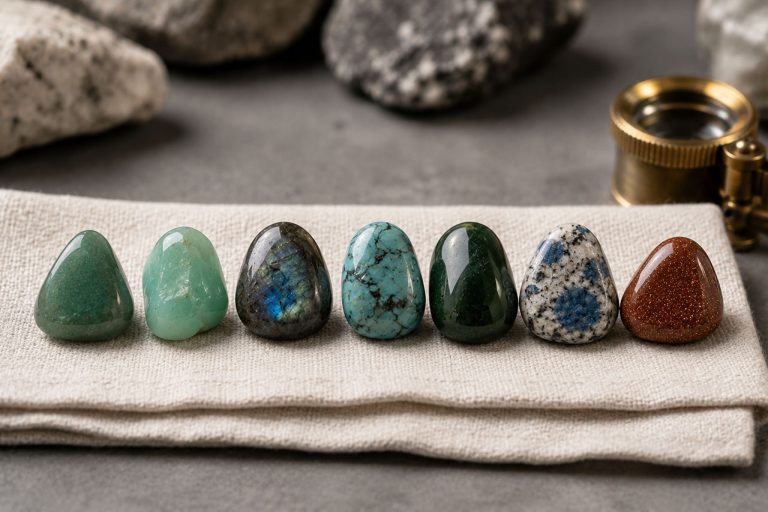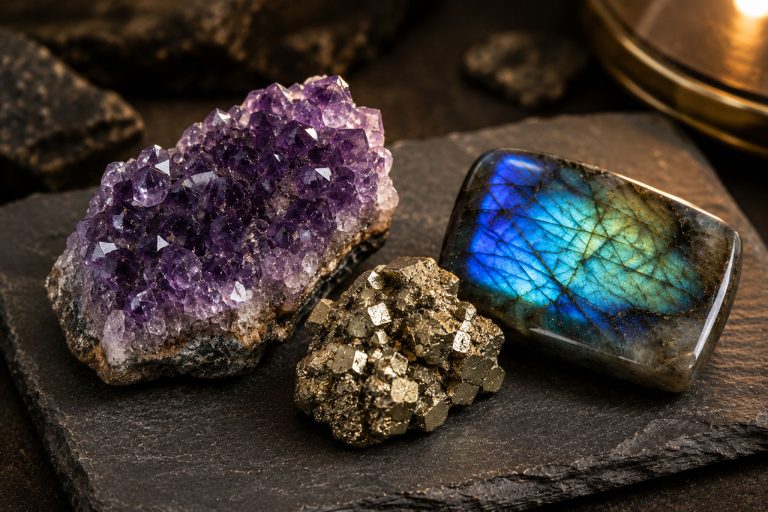
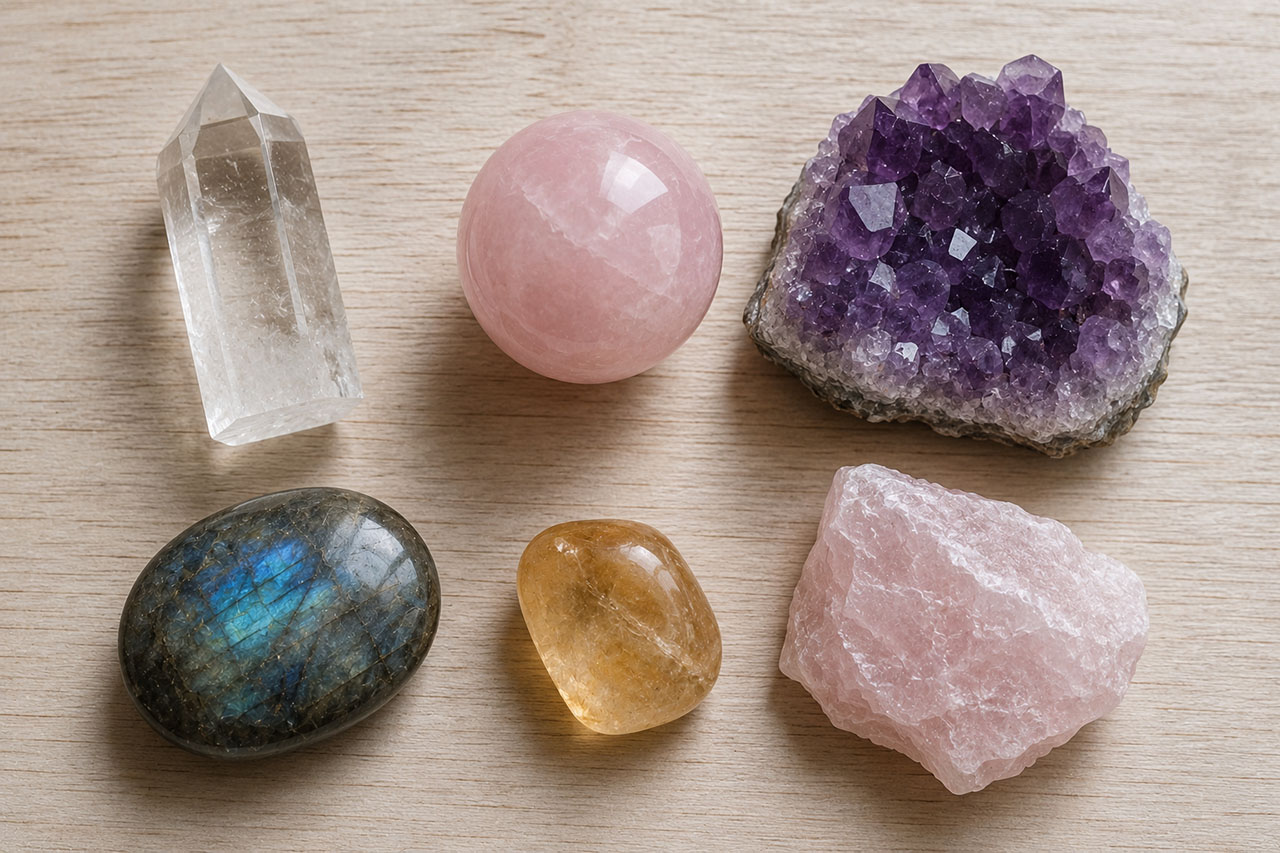
Clusters, geodes, drusy plates and naturally terminated crystals grew that way underground. Towers, spheres, palm stones, pyramids, hearts and most things sold as points were cut. There is a test that separates them, and it predates the crystal trade by three centuries.
The distinction is not usually disclosed and it is not usually hidden either. It simply falls out of the vocabulary, because a shop uses one word, shape, for two entirely different kinds of fact. One kind is a record of how a mineral grew. The other is a record of what a workshop decided to make.
Which would be an unfalsifiable complaint, except that there is a way to check.
The test is the angles, and it is from 1669
In 1669 Nicolas Steno, working on quartz, noticed something that turned out to hold for every mineral. The angles between corresponding faces on crystals of the same species are always the same, whatever the size of the crystal and however lopsided its individual faces may be. Two quartz crystals can look nothing alike, one squat and one needle-thin, and the angle where prism face meets prism face is identical in both.
That is the law of the constancy of interfacial angles, and it is one of the foundations of crystallography, generalised by Romé de l’Isle in the 1780s once Carangeot’s goniometer made the angles properly measurable. The reason it holds is that faces are not arbitrary. They form parallel to planes with a high density of atoms in the lattice, so the outside of a crystal is a direct readout of the arrangement inside it.
Which gives you the check. Natural faces sit at angles fixed by the mineral. Ground surfaces sit at angles fixed by whoever held the piece against the wheel. A natural quartz termination is a six-sided prism capped by rhombohedral faces, and the prism faces carry fine horizontal striations, at right angles to the length of the crystal, that the Handbook of Mineralogy lists as a general characteristic of the species. Grinding removes the striations and sets the tip angles to whatever looks good.
You do not need a goniometer for this in practice. Look for the striations, look for slight asymmetry between opposite faces, and look at whether the tip facets meet at consistent angles or merely at pleasing ones. Machine work is usually too tidy.
What grew, and what was made
The natural forms have proper names in mineralogy, which is itself a signal. The Mineralogical Society of America’s identification key defines drusy as covering a surface in more-or-less outward pointing clusters of small crystals, alongside prismatic, tabular, acicular, botryoidal, reniform, dendritic and massive. These are habit terms, and habit means the shape a mineral tends to grow into.
One of those deserves a footnote because it is routinely misread. Massive, in that list, means no crystal form is visible, not that the material is not crystalline. A massive lump of rose quartz is as crystalline as a quartz point.
Clusters, geodes and drusy plates are all natural in origin, with the working caveat that a geode you can look into has been sawn, and the sawn face is lapidary work on a natural object.
The made shapes have no mineralogical names at all, because they are not mineralogical facts. Towers, obelisks, spheres, palm stones, pyramids, hearts, wands and tumbled stones are all products of what the international jewellery trade standard, the CIBJO Blue Book, calls normal lapidary practices, which it lists as cutting, sawing, grinding, faceting, polishing, carving, engraving and drilling. The same standard defines a crystal as a crystalline solid bounded by natural plane surfaces. A ground point is not bounded by natural surfaces, which is the whole distinction in one clause.
Worth being precise about spheres, since the usual line is that no crystal grows round. Plenty of minerals grow in rounded masses, which is what botryoidal and reniform describe. What no crystal does is grow as a geometric sphere. Those are turned, and the labour is why they cost what they do.
Geodes, vugs, nodules and thundereggs
Four words that get used interchangeably and mean four things.
A vug is the cavity itself. The USGS glossary of karst terminology defines it as a small cavity in rock usually lined with crystals, and a geode, in the same glossary, as a hollow globular body coated on the interior with crystals. A vug is a hole in something bigger. A geode is a discrete object you can pick up.
A nodule or concretion is solid, and it grew outward from a central core, which is the opposite direction of travel. The Kentucky Geological Survey draws the line exactly there, noting that geodes differ from concretions in that they are hollow and the crystals grow inward from an outer shell.
The two are more closely related than that makes them sound. The Iowa Geological Survey’s account of the state’s own geodes has them beginning life as nodules in soft sediment, then losing their interiors to dissolution, then being lined with crystal by groundwater. A geode is a nodule that was hollowed out and refilled from the walls.
A thunderegg is not a geode. It forms in rhyolite and welded volcanic tuff from lithophysae, cavities that open as volcanic glass devitrifies, and its core is chalcedony or agate rather than a crystal-lined void. The rock is different, the mechanism is different, and the shape on a shelf is close enough that the names have collapsed into each other in the trade. Oregon made the thunderegg its state rock, which suggests somebody there minded the distinction.
The names with nothing behind them
Some of the vocabulary has no standing anywhere.
Searching the full text of the CIBJO Gemstone Book, the standard that governs what a stone may be called in the trade, turns up zero occurrences of generator, master crystal, record keeper, wand and Lemurian. Zero for tower, obelisk, sphere and pyramid as well, and zero for geode and drusy, which tells you the standard simply does not address shape. The IMA’s naming commission does not cover it either, since its remit stops at species names.
That is not a small gap. The standard requires new commercial names to be submitted for approval, and none of these ever have been. There is no definition of a generator anywhere, no threshold that makes a crystal a master crystal, and no authority that could adjudicate a dispute about either.
Lemurian is the one worth knowing about specifically. Lemuria was a hypothesis, proposed by the zoologist Philip Sclater in 1864 to explain primate fossils turning up in both Madagascar and India, and it was abandoned once plate tectonics explained the same distribution without a sunken continent. The horizontal striations sold as its signature are the ordinary prism striations the Handbook records for quartz generally.
A sphere is a beautiful object and the hours inside it are real. What the vocabulary cannot do is tell you anything about the mineral, and a chart assigning properties to a form chosen at a workbench is describing the workbench. Species data sits in the Crystalance Mineral Library. The stone is the same stone whichever outline someone ground it into, which is either reassuring or disappointing depending on what you were hoping the shape would do.