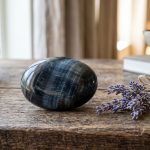

Pink, opaque, waxy in a polish, and often crossed by black veins. That is the shop answer, and the reference literature gives a wider one. The Handbook of Mineralogy’s colour line for rhodonite reads rose-pink to brownish red, gray, or yellow.
Grey and yellow, sitting in the standard reference description of a mineral whose name comes, as the Handbook notes in the same entry, from the Greek for rose.
You will not find them on a product page. Search for what rhodonite looks like and you get the marketable end of the species, which is a fair thing for a shop to sell and a poor description of a mineral. People then bring stones home and wonder whether they were sold the wrong thing, and a description narrower than the material generates that worry all by itself.
Start, then, with why the colour moves at all.
The pink is a competition, and manganese does not always win
Rhodonite is a manganese silicate, and manganese is what makes it pink.
The formula printed nearly everywhere is MnSiO3, which is tidy and memorable and describes a substance nobody has dug up. A 2020 study of Swiss material in Gems & Gemology is direct about it: “The ideal chemical formula is MnSiO3. Rhodonite of this composition has been synthesized but has never been found in nature.”
What occurs instead is the Handbook’s version, (Mn,Fe,Mg,Ca)SiO3. Calcium, magnesium and iron take up positions manganese would otherwise hold, in proportions set by whatever was available in the rock at the time. Every natural rhodonite is one of those mixtures. The pink deepens where manganese predominates and drains away where it does not, and at the far end of that range sit the grey and the yellow the Handbook records.
The colour, in other words, is a reading of the chemistry and not a fixed property to check a stone against. A grey-pink piece is not a poor imitation of a raspberry one. It is the same mineral with a different substitution history, and no threshold anywhere separates them.
The company it keeps underground explains some of that spread. The Handbook’s association line for Franklin, New Jersey gives calcite, willemite and franklinite; for Bald Knob in North Carolina it gives calcite, alleghanyite, tephroite, galaxite, grunerite and magnetite. Those are two different chemical neighbourhoods, both rich in manganese and neither offering the same set of competing elements, and a mineral that takes whatever is going will not come out of them looking the same.
The look-alikes are a shorter list than the internet suggests, and none of them is hard once you know what to hold it against. Rhodochrosite is manganese carbonate rather than silicate, notably softer, commonly banded in pink and white, and it reacts to acid where rhodonite does not. Thulite is a manganese-bearing zoisite, a different mineral group entirely, running peachier. Rose quartz overlaps in nothing but hue: the raw specimen in the collection here, unpolished and about the size of a large book, carries its pink far enough across a room to be startling, and it is still translucent and glassy where rhodonite is opaque and waxy.
A second consequence of the substitutions is that the label on a tray tells you less than it appears to. Two pieces sold under one name can differ in composition, in saturation and in how much iron they carry, and nothing in the trade’s vocabulary distinguishes them. Nobody is being deceived by that. It is simply that the name is a species name and the buyer is choosing an object.
Two things about the stone’s behaviour follow from the structure rather than the colour. It is triclinic, the least symmetric of the crystal systems, and it is a pyroxenoid, meaning its silicate chain repeats in a longer unit than the pyroxene family’s. Crystals occur, tabular with rounded edges and reaching twenty centimetres, and almost nothing in commerce is one. The material sold is massive, cut into cabochons and palm stones.
The property that decides how those survive is cleavage. Rhodonite has perfect cleavage in two directions meeting at 92.5 degrees, and good cleavage in a third. Two near-perpendicular planes running through a stone are two invitations to split along them, and the same 2020 study says what that costs a cutter: the crystals “have perfect cleavage in two directions and low hardness (5.5-6 Mohs), making it one of the most difficult gemstones to cut.” The Handbook puts the hardness range a little wider at 5.5 to 6.5, and the disagreement between those two figures is far less consequential than the cleavage they agree on.
The black is described as being on the outside
The reference line carries a second thing the shop line does not. The Handbook’s full colour entry runs: rose-pink to brownish red, gray, or yellow, “exterior commonly black from manganese oxides.”
Exterior. The feature by which people recognise the stone is described, in the standard reference, as a property of its outside.
Exactly which oxides is a question with one carefully documented answer. The same Swiss study reports that “on the surface, the manganese boulders are black. The alteration layer varies from a few millimeters to one centimeter and is composed of rancieite”, a calcium manganese oxide. That is one locality, one analysis, and a statement about boulder surfaces rather than about the veins in a cabochon cut from material somewhere else. It is the best-documented case there is and it should not be stretched into a general answer. The Handbook says only manganese oxides, plural and unnamed, and the plural is doing honest work.
The Handbook places the black on the exterior and does not describe it as a phase that crystallised alongside the pink. How much of it any given piece carries varies a great deal between deposits, and rhodonite forms, in the Handbook’s account, in manganese-bearing deposits by hydrothermal, contact and regional metamorphic and sedimentary processes. That is close to saying by every route manganese has. Its localities for studied or fine material run from Yekaterinburg in the Urals to the Harstigen mine near Persberg and Långban in Sweden, then on through England, Romania, Italy, Australia, Japan, Brazil, Peru and the United States.
The veining is therefore strong evidence when it is there and weak evidence when it is not. A clean pink piece with no black in it has not thereby failed a test. The one-line identification rule that treats the veining as the deciding feature has the asymmetry backwards, and it is the kind of rule that makes people distrust stones they have no reason to distrust.
The Crystalance Mineral Library is where the figures underneath all this are set down, the formula with its substitutions alongside the two cleavage angles. What no record of that kind carries is the range of ways a species turns up in the world, since that is a property of individual pieces of rock and the pieces are not on file anywhere.
That leaves the original question in a slightly awkward place. What rhodonite looks like has one good answer for the material on a market stall and a wider one in the reference books, and the reference books include grey. Either answer is honest. Only one of them will stop somebody worrying about a stone that turned out paler than the photograph.
Sources
- Handbook of Mineralogy, rhodonite: (Mn2+,Fe2+,Mg,Ca)SiO3, triclinic, hardness 5.5 to 6.5, colour rose-pink to brownish red, gray, or yellow with the exterior commonly black from manganese oxides, perfect cleavage on {110} and {1-10} meeting at 92.5 degrees and good on {001}, crystals tabular with rounded edges to 20 cm and commonly massive, name from the Greek for rose, with the occurrence and locality lines quoted above.
- Caucia, Marinoni, Riccardi, Bartoli and Scacchetti (2020), “Rhodonite-Pyroxmangite from Tanatz Alp, Switzerland”, Gems & Gemology 56(1), 110-123, for the MnSiO3 end member never occurring in nature, the cutting difficulty, and the rancieite alteration layer on the Tanatz Alp boulders.