Agate is the usual answer, and crystal practice reads its bands as two things held side by side without either winning. Pliny gives agate a harmony job too, and his is not that one. It is between the people in a house.
Pliny, writing up what he found in the books of the Magi, records that agates attached to hairs from a hyena’s mane avert discord in the household.
I have read that sentence a number of times and it keeps getting better. Not discord in you. Discord in the house, the shared thing, the atmosphere at a table. And there is a hyena in it.
What Pliny’s agate was for
Start further back. Theophrastus, writing about stones around 315 BC, gives agate a single sentence: the achates is a beautiful stone, it comes from the river Achates in Sicily, and it is sold at a high price. Beauty and money, and nothing else in the sentence.
Pliny gets to it getting on for four centuries later, and opens on a note that will please anyone who has watched a crystal go in and out of fashion. The agate, he says, was once held in high esteem but now enjoys none.
Then he lists the varieties at length, jasper-agate and wax-agate and blood-agate, a tree-agate marked with what look like small trees, one that smells of myrrh when you burn it, and a coral-agate from Crete sprinkled with golden particles. And then he lists what it does. It is thought to counteract the bites of spiders and scorpions, and note that the hedge is his. Indian stones are good for the eyes, and merely looking at them is enough. Held in the mouth, they allay thirst.
The rest he takes from the Magi, and he says so: other differences among agates, he writes, are found in the writings of the Magi. An agate of a single colour makes athletes invincible. Burnt, they avert storms and waterspouts and stop the flow of rivers. A genuine stone will cool the water in a cauldron that is on the boil. And the hyena-mane one, sitting quietly in the middle of that.
Set the athletes aside, since that one is about a person, and the rest have a shape in common. A storm, a river in flood, a boiling pot, a household at each other’s throats. Every one of those is a situation that has got away from itself, and the stone is being asked to settle it down.
The balance is between people
That is a harmony claim. It is not the harmony claim on the packaging.
The reading crystal practice offers now is interior. Your moods are swinging, or you are pulled two ways, or you cannot get your feet under you, and a banded stone stands for holding those halves together inside one person. Perfectly coherent, and you can see where it comes from, because the bands are right there on the object.
The older reading points outward. The cauldron, the river, the room full of people: none of those is inside anybody. The stone is put into a situation, and the situation is what is supposed to change.
Neither of those cancels the other, and I am not going to tell you the modern one is wrong. What the older one does is offer a question that may not have come up, which is whose balance is off. It is possible to want a balance stone in a week where nothing much is wrong with you and quite a lot is wrong with the room you are in. If that is the week you are having, the older reading is already pointed where you are looking, and it has been sitting in Pliny the whole time.
The room rather than the pocket
The practical difference is where the stone lives, and it is a bigger difference than it sounds.
A stone for your own balance travels with you. It goes in a coat, it comes to work, and its whole life is spent within a metre of one person. A stone put in for a household stays where the household is. The kitchen table. The shelf in the hall everybody passes. The room where the arguments happen, which is rarely the room anybody would choose to decorate.
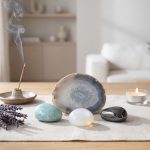
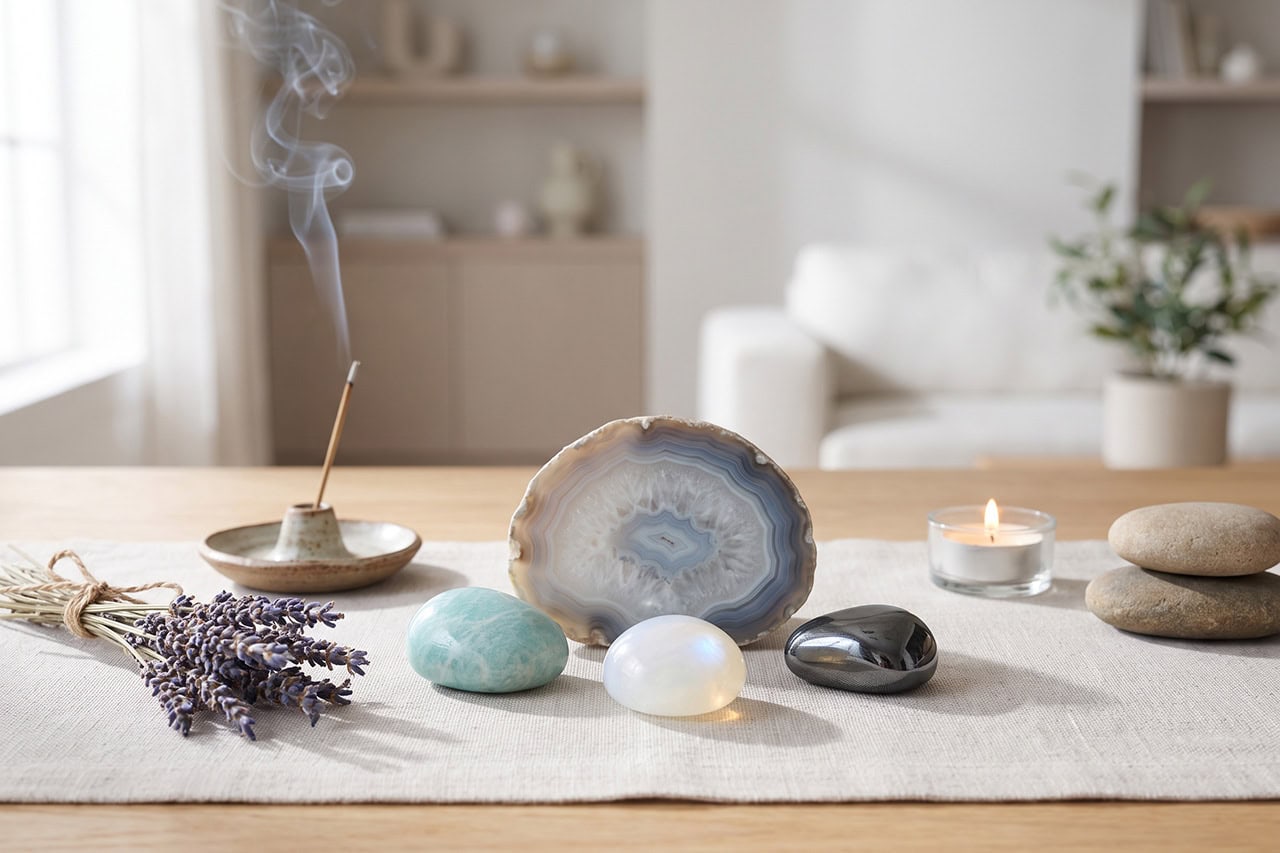
That also changes what you buy without turning into a shopping list. A piece that has to work across a shared room is a different object from one that has to sit in a pocket, and the banding has to be legible from the doorway or it is doing nothing where you put it. A slice or a cut face reads across a room in a way a tumble does not, and what does an agate slice do goes into that form on its own terms.
There is a white agate sphere here, five centimetres across, kept on a stand. Its surface is not a continuous polish at all: open crevices and small holes run through it, and those are the reason the piece is liked rather than a fault anybody is overlooking. It is also, being on a stand, an object that stays put. Stones that stay put get looked at by everybody who comes into the room, which is a different kind of use from the one a pocket stone gets and is easy to underrate.
The part nobody is going to do
Now the hyena.
The instruction as Pliny has it is not agate. It is agate attached to hairs from a hyena’s mane, and nobody reading this is going to supply the second half. That is normal for this literature rather than a problem with it, and what matters is which half of it survives the gap. The recipe does not survive. The aim does: a stone placed into a shared space, on purpose, because the shared space has gone wrong.
That is roughly what somebody is doing anyway when they put a piece of agate on a kitchen windowsill, without knowing they have company going back a very long way.
And a limit, because the line matters more than the lore. Putting a stone in a room does not settle anything between the people in it. What it can do is sit there where everybody sees it, as a standing sign that somebody in the house would like things to be easier. If you want to know what agate is rather than what it has been asked to do, chalcedony and its banded varieties have their own entry in the Crystalance Mineral Library.
Sources
- Theophrastus, On Stones, section 31, translated by Caley and Richards (“The achates is also a beautiful stone; it comes from the river Achates in Sicily and is sold at a high price”)
- Pliny the Elder, Natural History 37.139 to 142, translated by D. E. Eichholz (“The agate was once held in high esteem, but now enjoys none”; the varieties including tree-agate and coral-agate; “It is thought to counteract the bites of spiders and scorpions”; Indian stones good for the eyes merely to look at, and allaying thirst when placed in the mouth; “Other differences among agates are found in the writings of the Magi”, followed by the single-colour stone that makes athletes invincible, the burnt stones that avert storms and waterspouts and stop the flow of rivers, the genuine stone that cools a boiling cauldron, and “Incidentally, when attached to hairs from a hyena’s mane, they avert discord in the household”)