Larimar
Silicate (inosilicate); wollastonite group
Sky blue, light blue, blue-green and deep blue, patterned with white; also white and green, sometimes with red-brown plumes of hematite
Silky to subvitreous; polishes to a glassy shine
4.5 - 5 (dense fibrous material up to about 6)
2.62 - 2.90
Triclinic
Blue larimar: Dominican Republic only, at Los Checheses and Los Chupaderos in the Sierra de Bahoruco, Barahona Province. White and colourless pectolite: Canada, USA, Scotland, Italy, Russia, South Africa and elsewhere
Rare; the blue variety comes from one small deposit, and deep, even blue is the scarcest grade
NaCa₂Si₃O₈(OH) (sodium calcium silicate hydroxide)
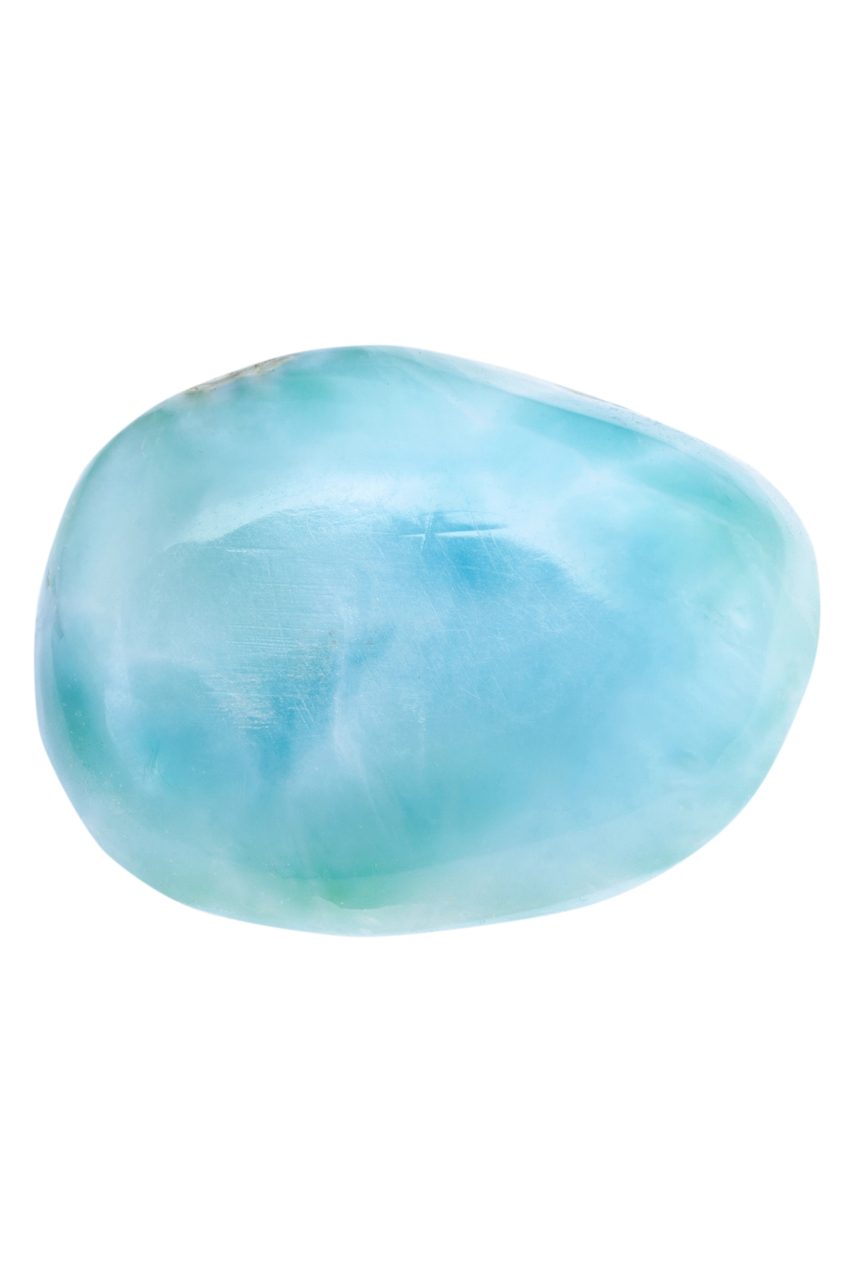
Larimar is blue pectolite. Pectolite is a white or colourless mineral almost everywhere it grows, and it turns sky blue in only one place: a small volcanic deposit in the hills above Barahona, in the south-west of the Dominican Republic. Its white patterning, laid over the blue, looks like sunlight on shallow water.
According to GIA's 1989 study of the stone, waterworn pieces turned up first in the gravels of the Río Baoruco and were traced upstream to their source. Norman Rilling, a Peace Corps volunteer, reportedly found blue stones at Baoruco in 1974, and Miguel Méndez, a local man, became the first supplier to the Dominican trade. The first papers of Méndez's mining venture used the name Travelina, but Méndez renamed the stone larimar, from Lari, his daughter's nickname, and mar, the Spanish word for sea. The International Gem Society gives her name as Larissa. Larimar was in Santo Domingo jewellery shops by 1975. A story about a Barahona priest who asked to mine a blue rock in 1916 turns up in later accounts, but the GIA study leaves it out.
Larimar is cut as cabochons, beads and small carvings, and it is soft for a jewellery stone.
Crystal practice reads it as a stone of calm and of the sea, tied to the throat chakra.
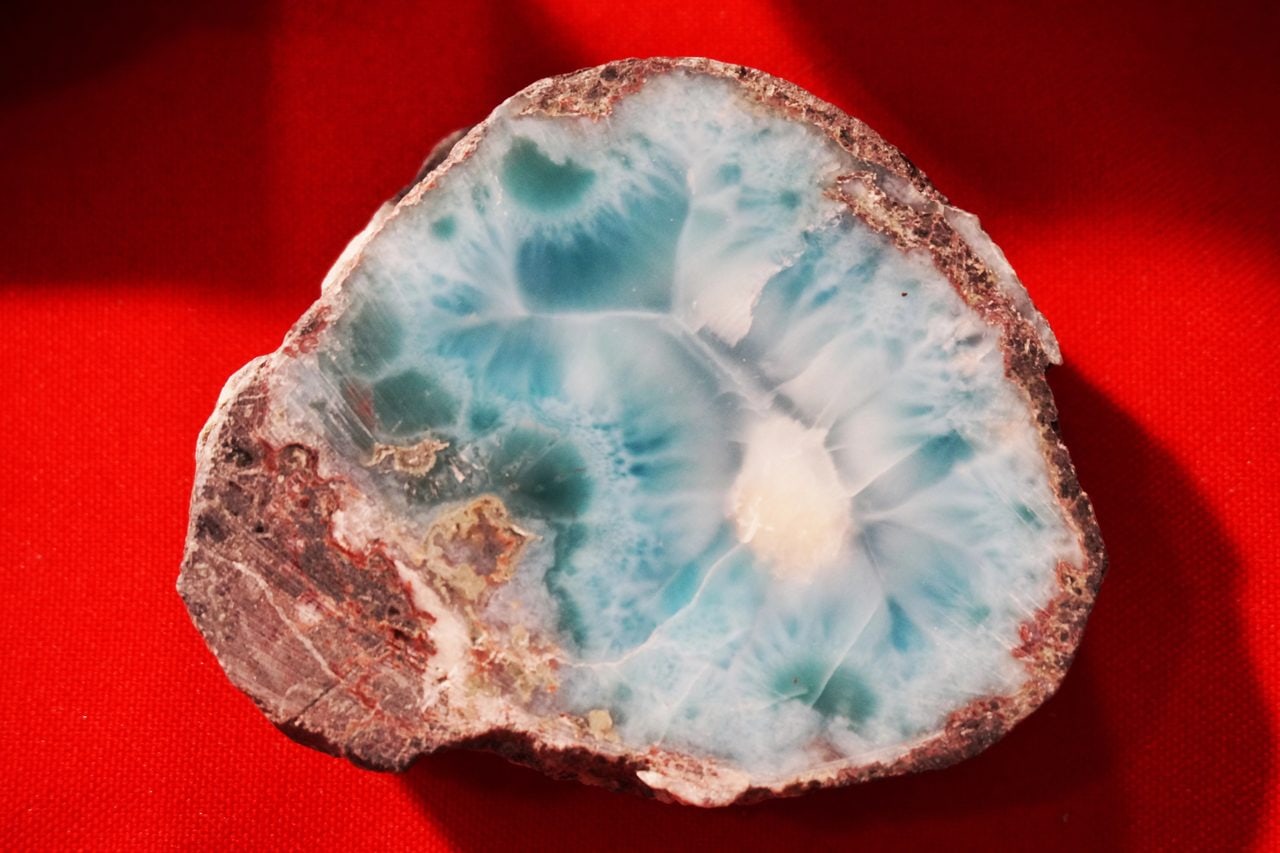
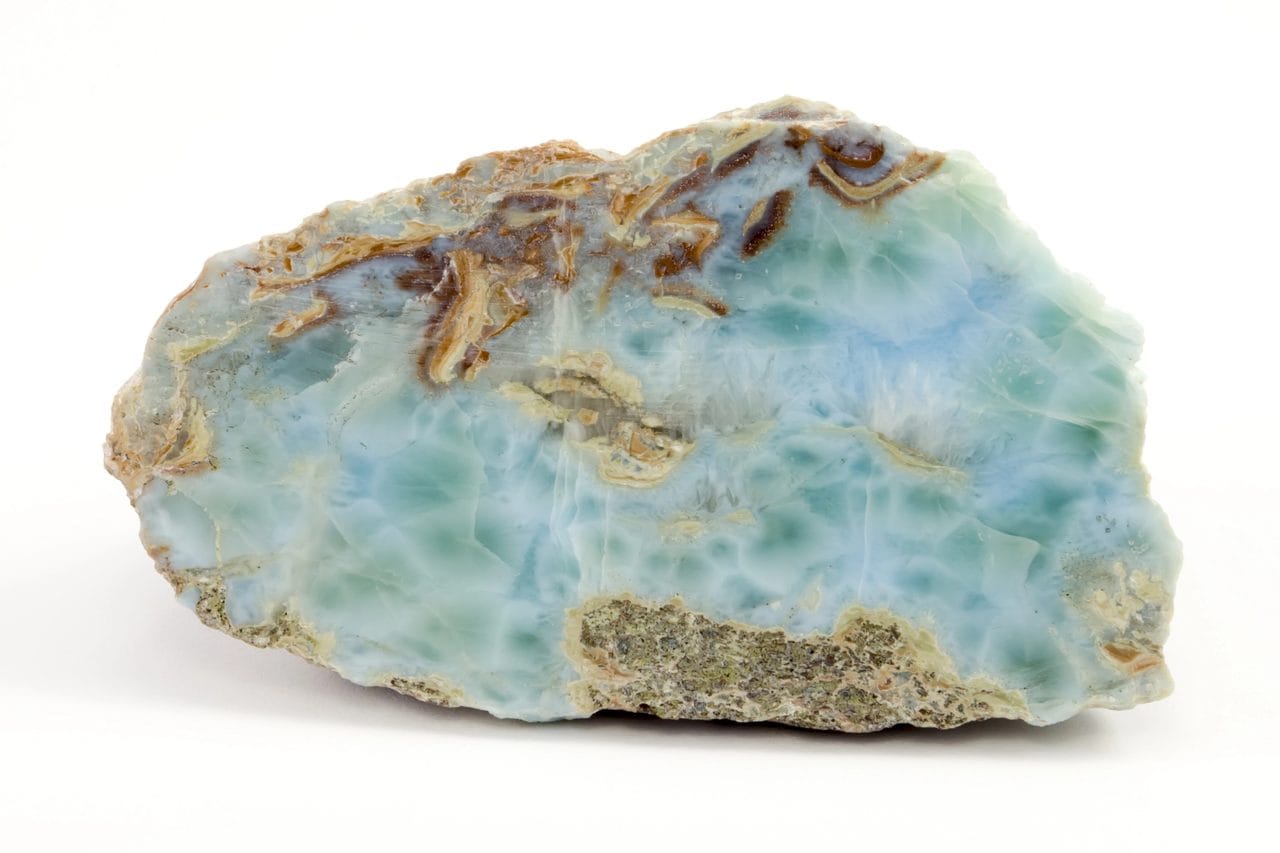
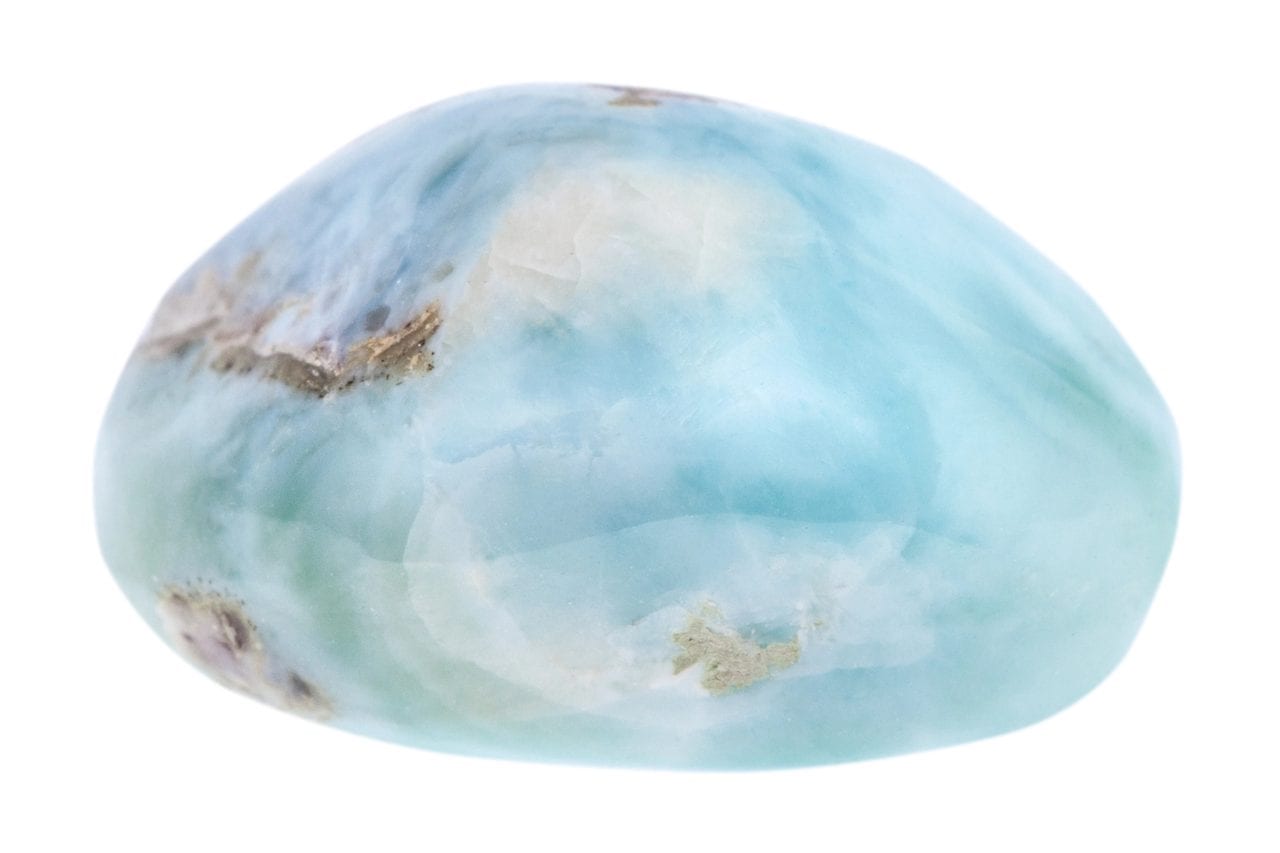
TABLE OF CONTENTS
Properties & Qualities
Physical Properties
A blue pectolite. Pectolite is a sodium calcium silicate of the wollastonite group, and it usually grows as needles or as radiating sprays of fibres. In larimar those fibres pack into dense, rounded masses. The Handbook of Mineralogy rates pectolite 4.5 to 5 on the Mohs scale, with perfect cleavage in two directions, and calls it brittle as single crystals but tough when compact. GIA's 1989 study measured fine fibrous larimar at a little over 5 and up to 6, and rated its toughness as excellent, because the interlocking fibres resist cracking. Carvers work it much as they work jadeite, although pieces thinner than about 2 millimetres can flake.
Where the blue comes from. The 1989 study put the colour down to traces of copper, about 46 parts per million in a well-coloured sample. A 2023 study in the journal Minerals compared trace elements with colour point by point and found vanadium and iron instead, and a 2017 paper in Boletín Geológico y Minero still describes the cause as unresolved. Under long-wave ultraviolet light most larimar glows a chalky green, and deep blue areas glow more weakly.
The sea-wave pattern. The 2023 study found that the pattern depends partly on how the radiating fibres are oriented. Light passes through them differently at different angles, so the depth of colour shifts across a polished face. The white areas are paler pectolite, sometimes with calcite.
Inclusions. Fern-like dendrites of hematite, which the trade calls red plume, grow mostly near the edges of the veins. Tiny black flakes of chalcocite, a copper sulphide, show up as "black eyes", and native copper turns up rarely. Sprays of natrolite can leave small square pits in a polished cabochon.
Optics and weight. GIA's study measured refractive indices of 1.59 to 1.63, and specific gravities from 2.62 for green material to 2.87 for fine, even blue.
How it formed. Larimar fills cavities and veins in altered basalt. The 2017 Boletín paper describes the host as olivine basalt lava flows and breccias, probably Cretaceous in age, altered by hot fluids at roughly 200 to 340 °C. The same fluids replaced buried wood, and GIA reported carbonised logs with pectolite between their growth rings. The 2023 study dated calcite that grew alongside the pectolite at about 400,000 years or younger, which would make the blue fill far younger than the rock around it.
One small deposit. GIA described the deposit as a single volcanic body of about 0.15 square kilometres, and the 2017 paper puts the outcrop at under 0.3 square kilometres. In 1989 GIA described pits dug largely by hand that flooded in heavy rain, so the work stopped and started. GIA notes that the blue variety has only been reported from the Dominican Republic.
Heat, light and treatment. A jeweller's torch turns larimar whiter as small cracks spread through it, and costs it some transparency and toughness. A thin slab held at about 300 °C for ten hours showed no change, and a piece kept under a fibre-optic lamp for more than 50 hours kept its colour. Gamma irradiation turned it violet. Neither GIA nor the International Gem Society knows of any commercial treatment.
Metaphysical properties
Practitioners read larimar's blue and white as the sea on a still day. They give it to people who run hot, quick to anger or anxious and overworked, and use it to cool a room or a mood.
The throat chakra carries most of its work, since practice links the throat with speaking and listening. A practitioner might reach for it when someone needs to say a hard thing gently, or to stop saying too much. Some set it at the heart as well, and read the blue-green pieces as a bridge between what a person feels and what they finally say out loud.
Larimar is mined on one island, a few kilometres from the Caribbean coast, so crystal practice treats it as a stone of the sea and the shore, of tides and holidays. The names Atlantis stone and dolphin stone belong to the crystal trade, not to any older tradition.
And that tradition is young. The stone reached the shops in 1975, which means every meaning given here dates from the last fifty years. Our guide to what blue healing stones are good for covers the throat reading that larimar shares with the other blue stones.
Meaning & Symbolism
Physical meaning
The first pieces of larimar were found as worn pebbles in a river, and practitioners like that the stone came to people by water before anyone dug for it. They read it as a stone that arrives in its own time.
Its pattern looks like light moving over shallow water, and practice turns that into a lesson about feelings, which move and settle and are never quite the same twice. No two pieces match, and owners are encouraged to choose the one whose water looks right to them.
The red plumes of hematite at the edges of some veins are read as warmth inside the coolness, a reminder that calm does not have to mean cold.
Larimar is soft and needs care, and practitioners make that part of the meaning too. A gentle stone asks to be handled gently, much as a calm person asks not to be pushed.
Deep blue is the rarest grade, and practitioners keep those pieces for the times when calm is hardest to find.
Spiritual meaning
Peace, and peace near water in particular, is the spiritual theme. People who grew up by the sea, or who miss it, keep a piece as a bit of the coast at home. Others who are uneasy around water keep one close while they grow used to it.
Practitioners also link larimar to the feminine and to sea goddesses in general, and call it nurturing rather than forceful. The naming story feeds that reading. A father joined his daughter's nickname to the Spanish word for sea, and practitioners have treated larimar as a stone of family love and of home ever since.
On an altar it usually sits beside a bowl of water or a shell. Some people use it in prayers for travellers, particularly for anyone crossing the sea.
During meditation, practitioners say, thoughts arrive one at a time with larimar in hand, like waves, instead of all at once. A few owners take a piece out on the first evening of a holiday to mark the point where work gets put down.
Healing Benefits
Physical healing
Healing practices with larimar belong to crystal tradition and energy work, and they are not a substitute for medical care.
Practitioners associate it with the throat, the neck and the jaw, and with the tension that settles there when a person holds back what they want to say. They also give it to people who feel overheated, in body or temper. The links are symbolic, drawn from its cool colour and its throat placement.
In practice a piece rests at the base of the throat during slow breathing. A sore throat, fever or lasting symptom belongs with a doctor.
Emotional healing
Anger and worry are the two moods practitioners give larimar for, particularly to someone who wants to calm down without being told to.
People who carry too much get it as well, the ones who answer every message and never take a day off. Practice treats the stone as a small holiday held in the hand, and a reminder that rest is allowed.
After an argument it is given to help a person go back and talk again, more slowly. Some hold a piece through a difficult phone call. Others keep one on the desk where the hardest emails get written, or wear it in earrings or a pendant near the throat, close to where the words come from.
Cheer is not the aim. What practitioners describe is a cooler temper and a beat of room before replying, which is often all a tense exchange needs. Our guide to crystals for anxiety and calm covers the wider family.
Spiritual healing
Larimar is the stone practitioners pick for a restless meditation, the kind where the mind will not settle.
A simple layout rests it in the hollow at the base of the throat, with a clear quartz point above the crown of the head. The person lies still and pictures the stone's pattern as shallow water running in and out with each breath. Each wave comes a little slower than the last, until breathing and water move together. A recording of waves does the same job for people who find picturing hard.
Larimar also turns up in work on words spoken in anger. Holding the stone, a practitioner recalls the conversation and imagines those words being worn smooth, the way surf rounds a pebble. Some then write down what they would say now, at a calmer pace. Afterwards the stone returns to its soft cloth, away from harder stones that could scratch it, and the session ends with a few slow breaths.
Use & Care
How to use
- At the throat: Wear a pendant on a short chain so the stone sits near the base of the throat.
- In earrings: The International Gem Society calls larimar cabochons excellent for pendants and earrings.
- In a ring: Larimar scratches easily, so choose a bezel or another protective setting and take the ring off for rough work.
- In a pocket: Carry a tumbled piece into a difficult meeting, in a pocket of its own, away from keys.
- On the desk: Keep a stone beside the keyboard where the hardest emails get written.
- By the bed: Set it on the bedside table on nights when the mind will not slow down.
- On an altar: Place it beside a shell or a small bowl of water.
- In meditation: Rest it at the throat while you sit. Our guide to meditating with crystals has the general method.
- With a journal: Rest it on the page while you write out something you need to say.
- On holiday: Pack a piece in a soft pouch and keep it out for the first evening away.
- As a gift: Give it to someone who loves the sea or is moving away from the coast.
How to cleanse
- Warm soapy water: The International Gem Society recommends a soft brush, mild detergent and warm water. Rinse well and pat dry with a soft cloth.
- Running water: Hold a tumble under the tap for a minute, then dry it.
- A soft cloth for jewellery: Wipe set pieces with a soft cloth dampened in mild soapy water.
- No acids: GIA reports that hydrochloric acid decomposes pectolite, so keep vinegar and other acidic cleaners away from it.
- No heat: A jeweller's torch whitens and cracks larimar, so skip hot water baths, hair dryers and warm radiators.
- Smoke: Hold it in a thin stream of incense smoke for a few breaths.
- Sound: Ring a chime beside it and wait for the sound to die away. Our guide to cleansing crystals with words and sound explains the method.
- Moonlight: Set it out on a clear night and bring it in before the morning sun reaches the sill.
- Selenite plate: Leave it on a selenite plate for an afternoon.
- Breath: Between sessions, breathe on it slowly a few times.
How to charge
- Window light: Set it on a sill in bright shade, out of direct sun, for half an hour. Whether window glass makes a difference is covered in our article on charging crystals through a window.
- Keep sun sessions short: Larimar care guides warn that strong sun fades it. GIA found no change after more than 50 hours under a lamp, but a lamp is not the sun, so short sessions are the easy way to keep the colour.
- Full moon: Put it out on the night of a full moon and bring it in at dawn.
- In a shell: Rest it inside a seashell overnight.
- By the sea: On holiday, set it on a dry towel within sound of the waves for an hour.
- On a quartz cluster: Sit it on a clear quartz cluster overnight.
- With intention: Before a hard talk, hold it and name one thing you mean to say calmly.
- Sound: Play a recording of waves or a soft singing bowl near it for a few minutes.
- Grid: Place it at the centre of a ring of blue stones.
- Visualisation: Picture the stone filling with clear blue water until it glows.
Combining with other stones
- Amber: The Dominican Republic's other famous gem, paired as a warm stone beside a cool one. See Amber.
- Rose quartz: Added for gentleness when calm needs kindness beside it. See Quartz (Rose).
- Amazonite: Another blue-green throat stone, used for calm and honest speech. See Amazonite.
- Celestine: A soft blue stone paired for rest and quiet sleep. See Celestine.
- Aquamarine: The other sea stone of crystal practice, paired for clear speaking. See Aquamarine.
- Smithsonite: A pale blue soothing stone, used together for gentleness. See Smithsonite.
- Kyanite: A blue throat stone added for clear communication. See Kyanite.
- Sodalite: Paired to bring calm and clear thinking together. See Sodalite.
- Selenite: Used as a resting plate and for peace in a layout. See Selenite.
- Clear quartz: Used in grids to strengthen larimar's work. See Quartz (Clear).
Identification
Can be mistaken for
- Turquoise: Similar blues and greens, but GIA notes that copper is a main ingredient of turquoise and only a trace in larimar. Turquoise often carries brown or black matrix veins and has no silky, radiating fibres. See Turquoise.
- Chrysocolla in chalcedony: GIA gives it a lower refractive index (1.46 to 1.57) and a lower specific gravity than fine larimar. See Chalcedony.
- Blue lace agate: A banded chalcedony with parallel lace-like bands rather than larimar's rounded, radiating pattern, and noticeably harder. See Agate.
- Dyed howlite: The International Gem Society lists it as a look-alike. Howlite is softer, at Mohs 3.5, and lighter, at a specific gravity of 2.53 to 2.59. See Howlite.
- Hemimorphite: Pale blue and about as hard as larimar, but much heavier, with a specific gravity of about 3.48.
- Blue smithsonite: Heavier still, at a specific gravity of about 4.4, often in bubbly, rounded crusts. See Smithsonite.
- Amazonite: A blue-green feldspar, harder at Mohs 6 to 6.5, with white streaks in a grid. See Amazonite.
- Victoria stone and Imori stone: Man-made glasses with a fibrous look. GIA found Imori stone more vivid and even in colour, with fibre bundles too perfect, and Victoria stone unlike larimar in both colour and fibre.
How to spot a fake
- Ask where it was mined: GIA reports blue larimar only from the Dominican Republic. Any other origin needs an explanation.
- Look at the fibres: Under a loupe, real larimar shows fine, silky fibres in rounded sprays, and its pattern drifts like water.
- Look for bubbles: GIA examined a ceramic imitation with white gas bubbles and dark blue patches of colour inside it.
- Feel the weight: That ceramic had a specific gravity of 1.87 against larimar's 2.81, so a large imitation can feel light in the hand.
- Check the cracks: On dyed howlite or other dyed stones, colour gathers in cracks and pits.
- Question perfect colour: An even, vivid blue with a too-regular pattern points to glass such as Imori stone.
- Ask about treatment: GIA and the International Gem Society know of no commercial treatment for larimar, so a stone described as treated is unusual and worth asking about.
- Read up on scarcity claims: Our guide to buying crystals without getting ripped off uses larimar as its example of a rarity claim you can check.
- Get it tested: GIA found microscopy, refractive index and specific gravity enough to separate larimar from the ceramic imitation it examined, and a laboratory can run the same tests on any stone.
Sources: Woodruff, R.E. and Fritsch, E. (1989), Blue pectolite from the Dominican Republic, Gems & Gemology 25 (4); GIA Gem News International, Imitation Larimar (2013); Handbook of Mineralogy, Pectolite; International Gem Society, Pectolite value, price and jewelry information; Huang, H.-M. et al. (2023), Revealing the secrets behind the color and sea-wave patterns of Larimar, Minerals 13 (9); Alvarado, G.E. et al. (2017), Petrographic contribution on the larimar host rock (Dominican Republic), Boletín Geológico y Minero 128 (3); Handbook of Mineralogy pages for howlite, hemimorphite, smithsonite and microcline.