
Charoite
Silicate (inosilicate built from tube-shaped silicate chains)
Lilac, lavender, violet and deep purple, swirled with white; the rock also carries orange-brown tinaksite, greenish black aegirine and grey-white feldspar
Vitreous to pearly, with a silky sheen across the fibres
5 - 6
2.54 - 2.78
Monoclinic, as fibres too fine to see one by one
Russia (Murun massif, between the Chara and Olekma rivers, Sakha Republic), the only known source
Rare as a mineral, known from a single massif; the polished rock is easy to buy and inexpensive
(K,Sr,Ba,Mn)₁₅₋₁₆(Ca,Na)₃₂[Si₇₀(O,OH)₁₈₀](OH,F)₄·nH₂O (hydrous potassium calcium silicate)
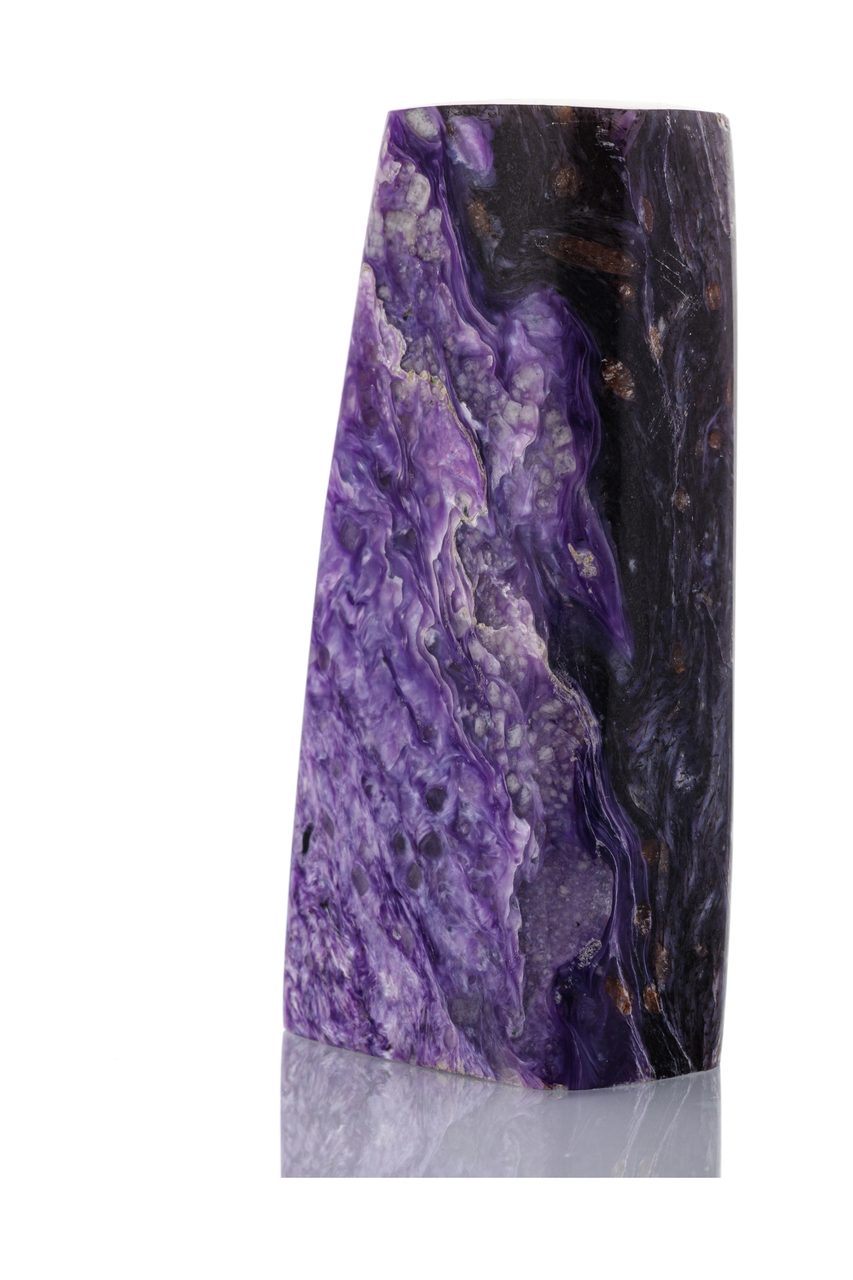
Every piece of charoite comes from one place. The swirling purple stone is dug from the Murun massif in Siberia, a remote body of alkaline rock between the Chara and Olekma rivers in the Sakha Republic, and the International Gem Society knows of no other source. What the shops sell is a rock made mostly of the mineral charoite, threaded with orange, black and grey-white crystals of other minerals.
The discovery was slow. Russian accounts credit the geologist Vladimir Ditmar, who mapped the lilac rock as a kind of schist. The International Gem Society dates the first finds to the 1940s, while David Carter's history of the find on Mindat places Ditmar's survey in 1956 to 1959. In 1960 the geologist Yuri Rogov returned to the area, and his wife, the mineralogist Vera Rogova, began the work that showed the rock held a new mineral.
Rogova named it after the Chara River. Carter adds that she liked the echo of the Russian word chary, enchantment, and that her first proposal, charaite, became charoite at the request of the International Mineralogical Association, to keep it apart from a mineral called cheralite. The IMA approved the name on 22 June 1977, and Rogova, Rogov, Drits and Kuznetsova published the full description in 1978. A GIA lab note gives 1976 as the year it was first described. Polished pieces had already been sold from 1973 under the name of a neighbouring mineral, canasite.
In crystal shops charoite is the stone of transformation, given for change and for letting fear go.
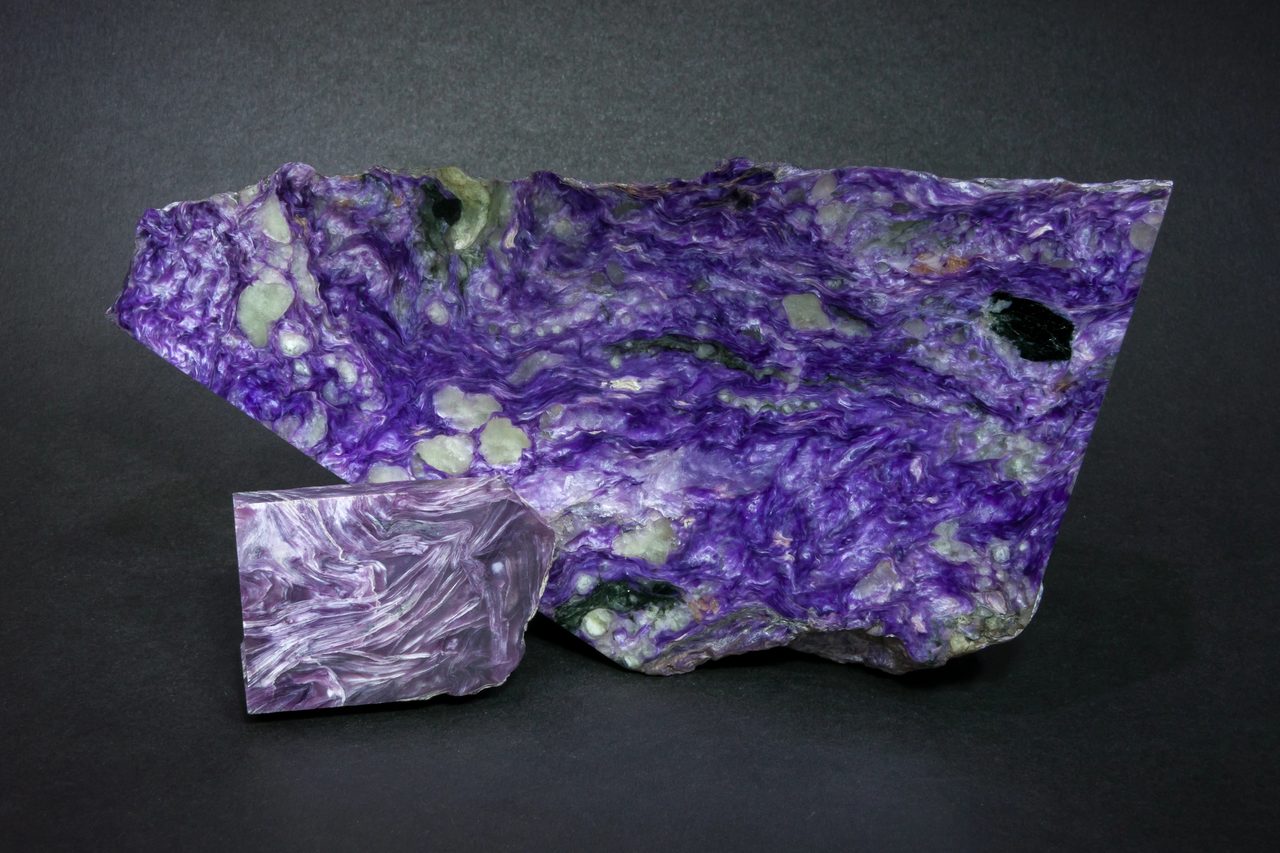
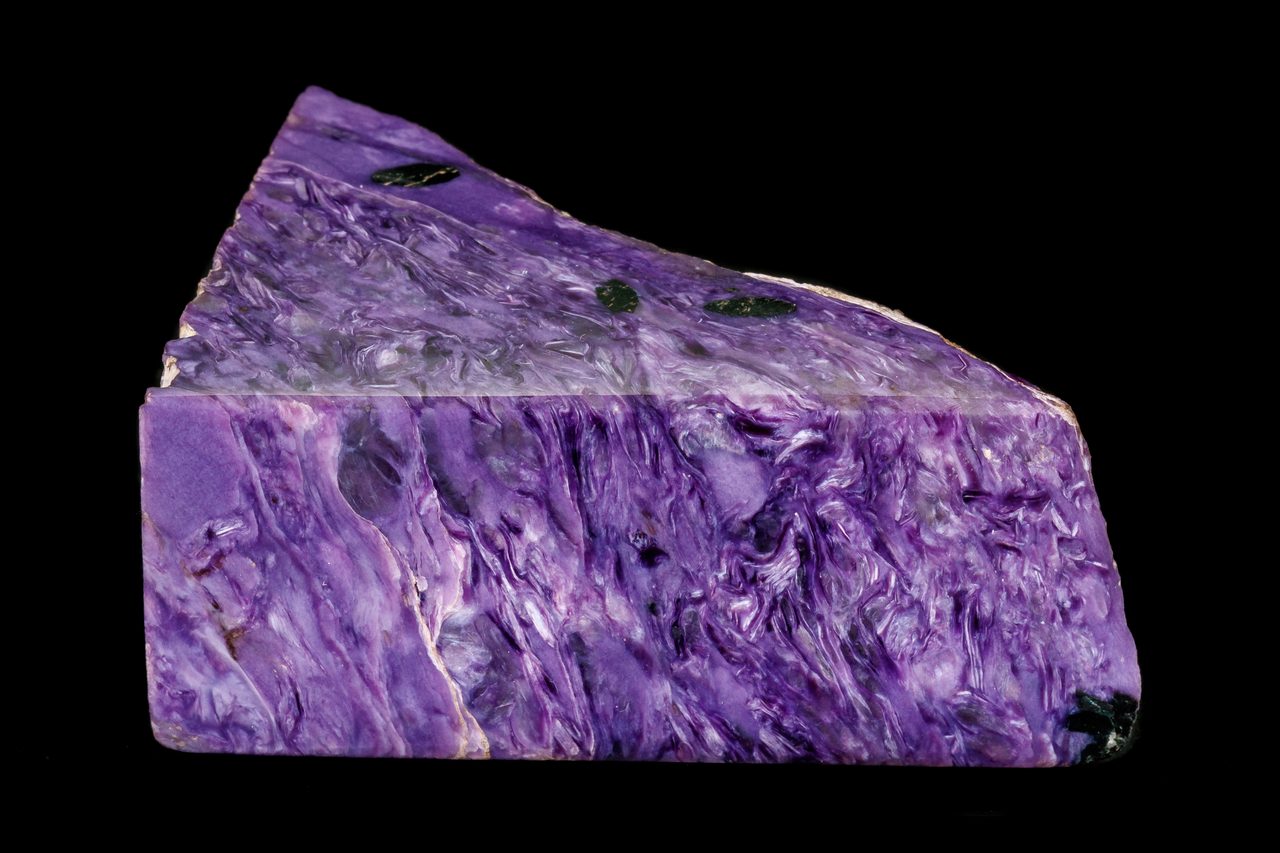
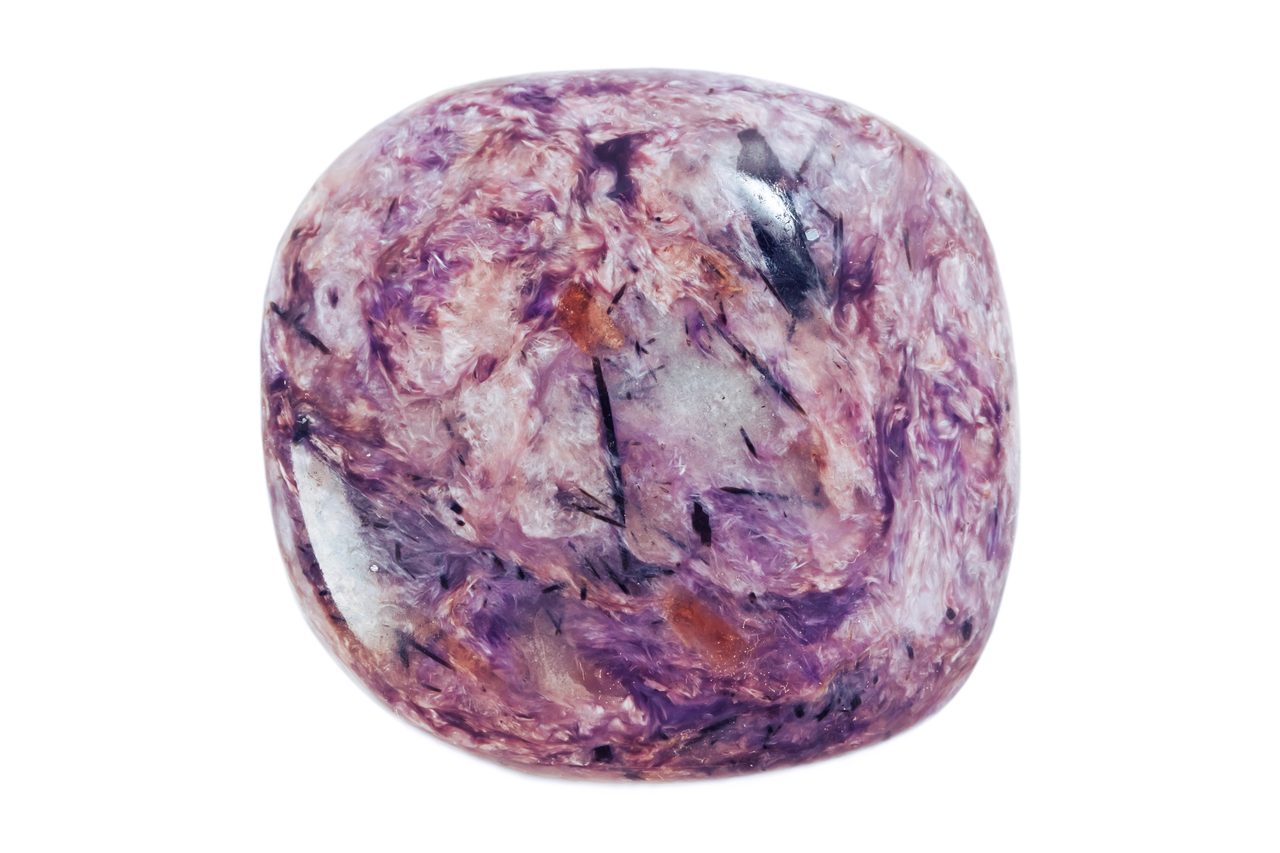
TABLE OF CONTENTS
Properties & Qualities
Physical Properties
Gemmologists treat charoite as a rock. The International Gem Society describes it as almost pure charoite, with orange prisms of tinaksite, pale greenish grey microcline and greenish black aegirine-augite scattered through it, and it notes that large blocks yield carvings a foot or more across. In 2001 the GIA laboratory examined a 292.14 carat cabochon holding an X-shaped spray of tinaksite 79 millimetres long, identified by Raman spectroscopy, with aegirine and feldspar or quartz beside it. The cutter had found the slab in a bin of scraps at that year's Tucson show.
The mineral itself is fibrous. Rozhdestvenskaya and colleagues, writing in Mineralogical Magazine in 2010, found fibres about 200 nanometres across, often separated by amorphous material and far too small for the usual single-crystal methods. They solved the structure by electron diffraction instead. It is built from three different silicate chains, some of them closed into tubes, with potassium, barium, strontium and water held inside the tubes and channels. The same paper describes several stacking variants, called polytypes, grown together in the fibres. The International Gem Society puts the swirling pattern and the silky, sometimes chatoyant glow down to these interlocking fibres.
The cause of the purple is still discussed. The 2010 paper cites earlier Russian work tying the shade, from light lilac to dark violet, to trivalent manganese, with iron and titanium also playing a part. Garcia-Guinea and colleagues, in the Journal of Luminescence in 2008, linked the lilac to colour centres of divalent manganese and trivalent iron, the same ions behind its strong luminescence.
The Handbook of Mineralogy lists good cleavage in three directions and refractive indices of 1.550, 1.553 and 1.559, and notes a pleochroism from rose to colourless in thick fragments. The International Gem Society rates the rock 5 to 6 on the Mohs scale, calls it tough with a splintery fracture, and lists it as heat sensitive. Garcia-Guinea's team found that heating changes the structure for good as it loses hydroxyl.
How the rock formed is disputed. The Handbook places charoite in potassium feldspar rocks altered by fluids where nepheline and aegirine syenites met limestone. Vladykin and colleagues argued in Geochemistry International in 2018 that the charoite rocks crystallised from a melt instead, beginning above 800 °C and ending between 600 and 450 °C. Wang and co-authors, in International Geology Review in 2014, traced the charoite rocks to fluids from the Malyy Murun magma reacting with the surrounding rock. The age is clearer. Ivanov and colleagues dated minerals that grew with charoite to 135.9 million years ago, in the Early Cretaceous. Ekaterina Reguir's 2001 thesis counts about 25 charoite rock localities along the southern edge of the Malyy Murun intrusion.
Metaphysical properties
Charoite is sold as the stone of transformation. Practitioners give it to people in the middle of a change they did not wholly choose, a move, a child leaving home, a job that has ended, and say it helps fear loosen while the change runs its course. Its purple places it at the crown chakra on top of the head and at the third eye between the brows. Some practitioners add the heart, so that insight and kindness work together.
A second name, the stone of service, gives it to people who look after others.
None of this is old. The International Gem Society says charoite reached Western buyers in the 1970s, and its meanings come from crystal books written afterwards. One of the earliest entries that later writers cite is in Melody's Love Is in the Earth, a crystal reference first published in the early 1990s; we know that entry only from those secondary quotations. A folk tale on some shop pages, about a Siberian girl turned into purple stone, gives no source. Our article on where crystal meanings come from traces how readings like these take shape.
Meaning & Symbolism
Physical meaning
On the Handbook of Mineralogy's account, charoite formed where hot alkaline rock pushed into limestone and the two reacted, so the stone exists because two unlike things met and changed each other. Practitioners trace its name as the stone of transformation to that meeting.
Its swirls are made of fibres about 200 nanometres across, bundled and bent together, each far too fine for the eye to pick out. Practice reads them as a life built from many small threads that only show their pattern together. Tilt a polished piece and a silky sheen slides across the purple, which practitioners call the moment a familiar situation shows a new side.
Orange tinaksite and black aegirine sit inside the purple without spoiling it, and practice sees in them the hard parts of a change, held within something whole.
Every piece comes from one remote massif in Siberia, and owners link that with the paths a person has to walk for themselves.
Spiritual meaning
Thresholds, the doorways between one stage of life and the next, are where charoite's spiritual reading sits. Practitioners keep it for the in-between time, after an old role has ended and before the new one feels like home, and say it helps a person stand in that gap without rushing to close it.
Geologists passed the lilac rock for years and mapped it as schist, and the full description came long after the first finds. People who know the story give charoite to anyone whose gifts are slow to be recognised, including by themselves.
Its early name, the International Gem Society notes, was simply lilac stone, and some practitioners read meaning into the colour itself. Lilac sits between the blue of calm and the red of feeling, and the stone is used to bring the two together.
Practice also gives charoite a place in service. It is offered to people whose work is for others, nurses and volunteers among them, with the hope that the work keeps coming from love and does not harden into duty.
Healing Benefits
Physical healing
Charoite is not a treatment, and no study has found that it affects health. The practices below belong to crystal tradition and sit beside medical care, never in its place.
Practitioners use charoite at bedtime for restless nights, resting a tumble on the pillow above the head while the breath slows. They lay it on the forehead during a short lie-down when the eyes are tired from screens, and say it lets the body settle after a long, tense day.
Sleep that stays poor for weeks is worth taking to a doctor.
Charoite is not a substitute for medical care. If something in your body worries you, see a doctor.
Emotional healing
Fear of change is the first thing charoite is given for. A person facing a move or the end of a relationship holds it while saying quietly what they are afraid of losing, and practitioners find that naming the fear takes some of its weight away.
It is used for overthinking, too. Someone who replays a conversation late into the evening keeps a tumble in the hand, counts ten slow breaths, and then puts the stone down, and putting it down becomes the signal to stop.
Practice offers charoite for resentment as well, the kind that builds in people who do a great deal for others and feel taken for granted. The stone is meant to help them notice the feeling early and ask for what they need before it turns sour.
On calmer days it is simply a soothing thing to hold, cool and smooth, with a sheen that moves as it turns. Our guide to crystals for letting go covers the wider practice.
Spiritual healing
In spiritual healing, charoite is used for a threshold meditation. The practitioner sits facing an open doorway with a piece of charoite in the lap and spends a few minutes with what lies behind them. Then they turn to face the room ahead, spend a few minutes with what comes next, and carry the stone through the doorway at the end.
A second practice works with the swirls. A polished slice is held up to the light, and the eye follows one line of purple through the pattern wherever it bends, until the mind goes quiet. Practitioners use it for prayer or contemplation when words feel too busy. Newcomers can start with our piece on how to meditate with crystals.
Some keep a small charoite bowl on a home altar and drop in a folded note each time they let something go, then empty the bowl at the turn of each season.
Use & Care
How to use
- Above the crown: Lie down with a tumble resting on the pillow just above your head, close to the crown.
- A bezel for rings: At 5 to 6 on the Mohs scale, charoite needs a protective setting in a ring, the International Gem Society advises, so choose one that wraps the edge.
- On a leather cord: A polished pendant on a simple cord sits at the base of the throat.
- A carved dish: Charoite is carved into bowls and boxes, and a small dish on the dresser can hold the rings you take off at night.
- On the nightstand: Keep a piece beside the bed for dream work. Our list of crystals for under the pillow covers the practical side of sleeping near stones.
- In the moving box: Pack a tumble in the box you will open first in a new home.
- On the commute: Hold it in a coat pocket on a crowded train and turn it over when the carriage feels close.
- A charoite mala: Count breaths on a string of charoite beads, one bead for each slow exhale.
- By the front door: Set a bowl by the door and touch the stone on the way in, as a line between work and home.
- First day somewhere new: Carry a piece on the first day of a new job, course or school.
- As a farewell present: Give one to a colleague who is leaving or a friend who is moving abroad.
How to cleanse
- Lukewarm suds: A soft brush, mild detergent and warm water are what the International Gem Society recommends.
- Not in the jewellery cleaner: Steam and ultrasonic cleaning are out, the same source warns, because charoite is heat sensitive and has cleavage.
- A quick rinse is fine: Charoite can take a short wash, unlike the stones in our list of crystals that should stay dry. Rinse and dry it straight away.
- Soft cloth to finish: Pat it dry and buff lightly to bring back the silky sheen.
- Cool places only: Store it away from radiators, stoves and hot car dashboards.
- Juniper smoke: Hold it in the smoke of a smouldering juniper sprig for a few slow breaths.
- Tuning fork: Strike a tuning fork and hold it near the stone until the note fades.
- Dried lavender: Nestle it overnight in a bowl of dried lavender flowers.
- Violet light: Hold it and picture a soft violet light washing through it.
- Dark moon night: Set it on a sill the night before the new moon.
How to charge
- Shade, not sun: Charoite is listed as heat sensitive by the International Gem Society, so a bright spot out of direct sun is the gentle choice. We found no source that reports charoite fading in light.
- Moonrise: Set it out as the moon comes up and bring it in the next morning.
- Twilight: Give it the half hour between sunset and dark, the in-between time that suits a stone of transition.
- Purple neighbours: Give it a night in a dish with other violet stones.
- A spoken change: Say aloud one thing you are ready to leave behind.
- Wind chime: Hang it in a pouch near a chime that moves in the breeze.
- Centre of a circle: Surround it with a ring of small quartz points for a night.
- Slow exhale: Breathe out over it three times, slowly.
- On a map: Spread out a map of the place you are heading to next and set the stone on it.
- Lilac in bloom: In spring, set it beside a vase of lilac, a nod to the stone's early name.
Combining with other stones
- Aegirine: The greenish black needles inside charoite rock, and a partner for staying protected while changing. The library has a page on aegirine.
- Sugilite: Another purple silicate, which the Handbook of Mineralogy also records from aegirine-bearing syenite, used with charoite at the crown. See Sugilite.
- Tinaksite: The orange flecks in many pieces, kept beside charoite for warmth inside a cool stone.
- Howlite: White howlite with grey veins, kept with charoite by the bed for quieter nights.
- Obsidian: Black volcanic obsidian is paired with charoite for facing fears directly.
- Sodalite: A partner for calm, orderly thinking during a time of change; deep blue sodalite brings a steadier note.
- Iolite: Violet-blue iolite, used with charoite for seeing the way ahead.
- Celestine: Pale blue celestine shares charoite's place on the nightstand.
- Dumortierite: A dense blue stone for patience, set beside charoite when change is slow. Read about dumortierite.
- Danburite: Clear danburite joins charoite at the crown in meditation.
Identification
Can be mistaken for
- Sugilite: A purple silicate from Japan and South Africa. Its hardness in the Handbook of Mineralogy is 5.5 to 6.5 and its density 2.74 to 2.79, and the International Gem Society gives it a refractive index of 1.590 to 1.610, above charoite's 1.550 to 1.559. See Sugilite.
- Stichtite: Lilac to rose-pink and waxy. The Handbook of Mineralogy puts it far below charoite in hardness, at 1.5 to 2, and lighter at 2.16, and describes it as an alteration product of chromite in serpentinite, so it turns up in serpentine rock.
- Purpurite: A reddish purple phosphate with a satiny lustre, often coated dark brown, that the Handbook rates at 4 to 4.5 and gives a density of 3.2 to 3.4.
- Lavender chalcedony: Pale purple with an even, waxy glow and no fibres. Chalcedony is quartz, hardness 7 in the Handbook of Mineralogy, and our article on the Mohs hardness scale explains what that number means.
- "Royal Russianite": GIA examined two manufactured charoite imitations made with a large share of plastic, the International Gem Society reports, and one was sold under this name.
- Purple-dyed beryl: Massive beryl with intergrown quartz, dyed purple, is another stand-in on the International Gem Society's list.
- Canasite: The name the first polished charoite was sold under in 1973. True canasite grows beside charoite at Murun, but the Handbook describes it as greenish yellow to greyish green.
- "Chinese charoite": A name some sellers give to banded purple fluorite. The lapidary writer Dale Armstrong lists misrepresented fluorite among charoite's few imitations, and fluorite's figures in the Handbook are hardness 4 and density 3.18. Our comparison of purple fluorite and amethyst shows the stone.
How to spot a fake
- Follow the fibres: Under a loupe, natural charoite shows bundles of fine fibres bending through the stone, and its sheen slides as the piece is tilted.
- Orange, black and grey-white: Tinaksite, aegirine and microcline are the companions the International Gem Society names, and their flecks fit rock from Murun.
- One massif, one country: Murun is the only source the International Gem Society knows, so a label naming another country deserves a polite question.
- Density alone won't decide: The two imitations GIA examined had specific gravity and refractive index readings inside charoite's range, and the plastic was found by a further laboratory test.
- No treatment expected: Charoite has no known enhancements in the International Gem Society's account, so a piece described as dyed or stabilised needs explaining.
- A fair price: Even high-quality charoite costs a few dollars a carat at most, in the International Gem Society's words, so a high price for its rarity pays for the story more than the stone.
- Raman for doubtful pieces: GIA identified the tinaksite in its 2001 cabochon by Raman spectroscopy, a method that leaves the stone unharmed.
- A named region: Sellers of genuine material can name Murun, Yakutia or the Sakha Republic.
- When buying online: Ask for daylight photos of the front and the back. Our guide to buying crystals online safely lists further checks.
Sources: Handbook of Mineralogy, Charoite; International Gem Society, Charoite value, price and jewelry information; Carter, D., Charoite, a chance discovery on the Murunskii Massif, Mindat (updated 2023); GIA (2001), Gem Trade Lab Notes: An interesting charoite cabochon, Gems & Gemology 37 (4), 318-325; Rogova, V.P., Rogov, Yu.G., Drits, V.A. and Kuznetsova, N.N. (1978), Charoite, a new mineral and a new jewelry stone, Zapiski Vsesoyuznogo Mineralogicheskogo Obshchestva 107, 94-100; Rozhdestvenskaya, I. et al. (2010), The structure of charoite, solved by conventional and automated electron diffraction, Mineralogical Magazine 74 (1), 159-177; Garcia-Guinea, J. et al. (2008), On the spectra luminescence properties of charoite silicate, Journal of Luminescence 128 (3), 403-412; Vladykin, N.V., Borovikov, A.A., Dokuchits, E.Yu. and Thomas, V.G. (2018), Genesis of charoite rocks in the Murun massif, Aldan Shield, Russia, Geochemistry International 56 (12), 1135-1147; Wang, Y., He, H., Ivanov, A.V., Zhu, R. and Lo, C. (2014), Age and origin of charoitite, Malyy Murun massif, Siberia, Russia, International Geology Review 56 (8), 1007-1019; Ivanov, A.V. et al. (2018), The first precise data on the age of charoite mineralization, Doklady Earth Sciences 478 (2), 179-182; Reguir, E. (2001), Aspects of the mineralogy of the Murun alkaline complex, Yakutia, Russia, thesis, Lakehead University; Melody (early 1990s), Love Is in the Earth, Earth-Love Publishing House (cited from secondary quotations); Armstrong, D., Gem profile: charoite, WireJewelry.com; International Gem Society, Sugilite value, price and jewelry information; Handbook of Mineralogy pages for sugilite, stichtite, purpurite, canasite, quartz and fluorite.