
Sugilite
Silicate (cyclosilicate of the milarite group, built on double rings of silicon and oxygen)
Bluish purple, purple and reddish purple in the South African gem material, more rarely pink; light brownish yellow at the type locality in Japan; often flecked with black braunite
Vitreous, resinous on a broken surface
5.5 - 6.5
2.74 - 2.80
Hexagonal; prismatic crystals are rare, and the gem material is a mass of tiny grains
South Africa (Wessels and N'Chwaning mines, Kalahari manganese field, Northern Cape), Japan (Iwagi Islet, Ehime Prefecture, the type locality), with small finds in Canada, Italy, India and Australia
Rare
KNa₂(Fe³⁺,Mn³⁺,Al)₂Li₃Si₁₂O₃₀ (potassium sodium lithium silicate with iron, manganese and aluminium)
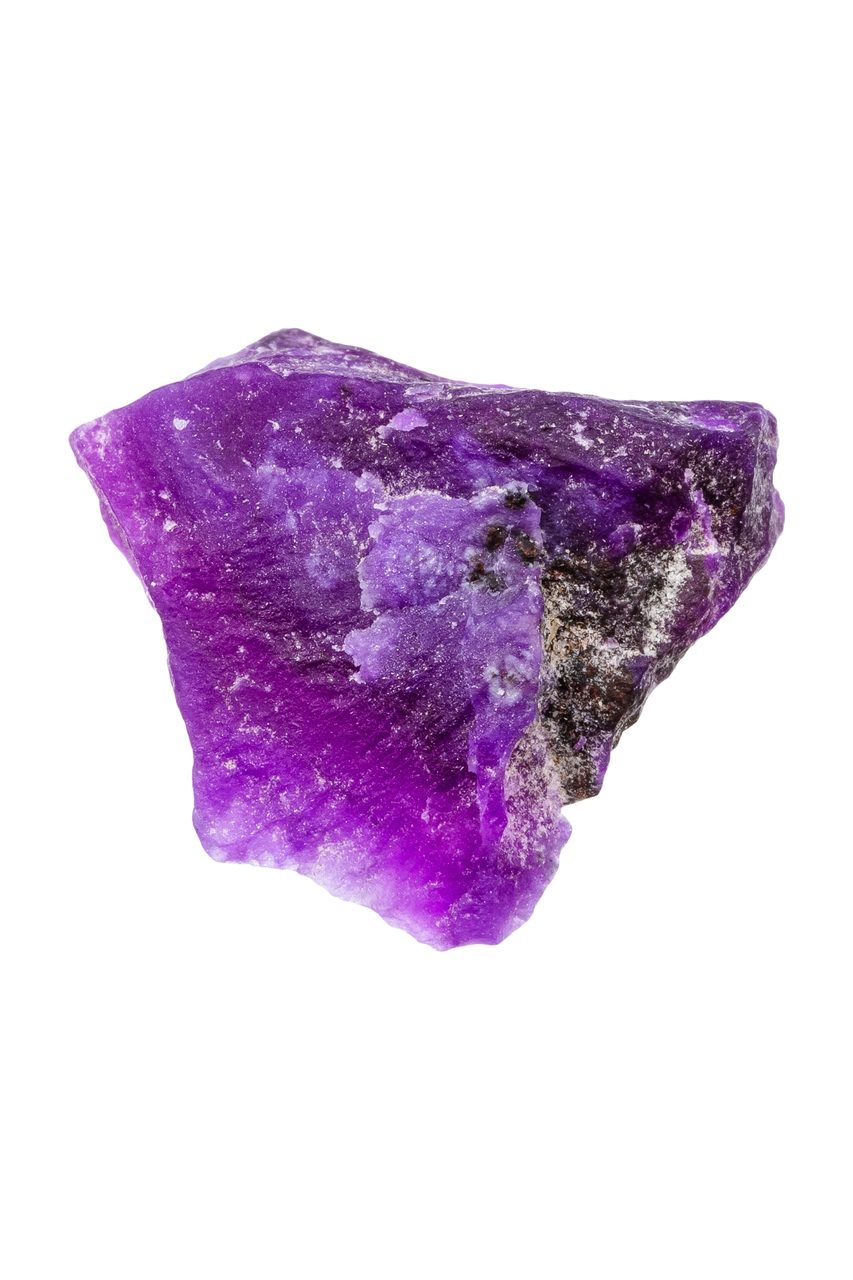
Sugilite was found twice, and the two finds look nothing alike. The first came from Iwagi, a small island in Ehime Prefecture in southwest Japan, where the petrologist Ken-ichi Sugi and his colleague M. Kutsuna noticed it in 1944 in a pale syenite. The grains there were light brownish yellow and far too small to cut. Sugi died in 1948, and the mineral was described and named in his honour only in 1976, when Nobuhide Murakami and three co-authors published it in the Mineralogical Journal.
The second find made it a gem. At the Wessels manganese mine in South Africa's Kalahari manganese field, miners ran into a seam of vivid purple stone. GIA's 1987 study of the material dates that discovery to 1973 and calls it an accidental encounter during normal mining, while the International Gem Society describes a thin seam in a drill core in 1975 and a much larger deposit found deep underground in 1979.
The purple stone began reaching the gem market in 1979, at first under the name sogdianite. In 1980 Dunn, Brummer and Belsky showed that it was sugilite rich in manganese. Dealers sold it as Royal Lavulite and as Royal Azel, a name taken from the nearby town of Hotazel.
Its colour has made it popular in Asia, the International Gem Society notes. In crystal shops sugilite is a love stone, given to sensitive people who find the world harsh.
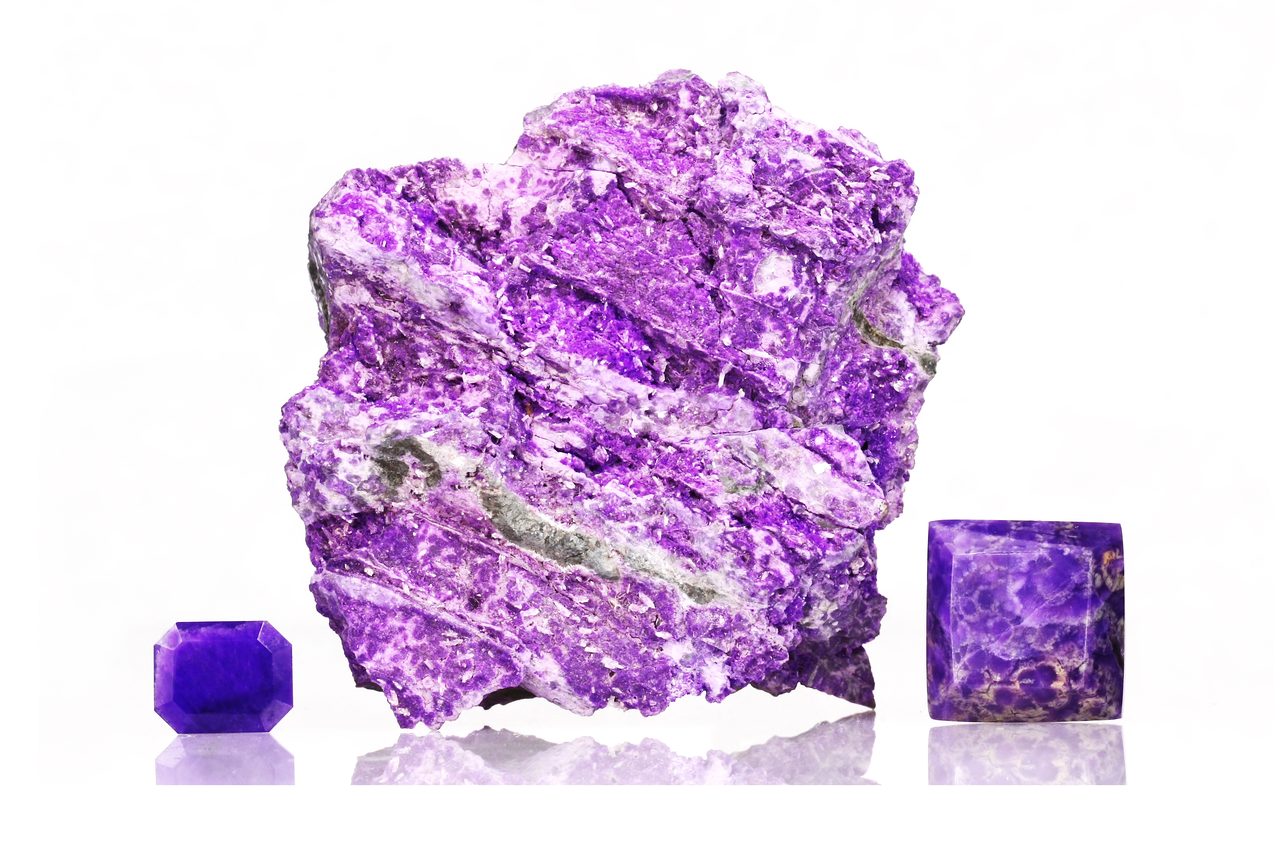
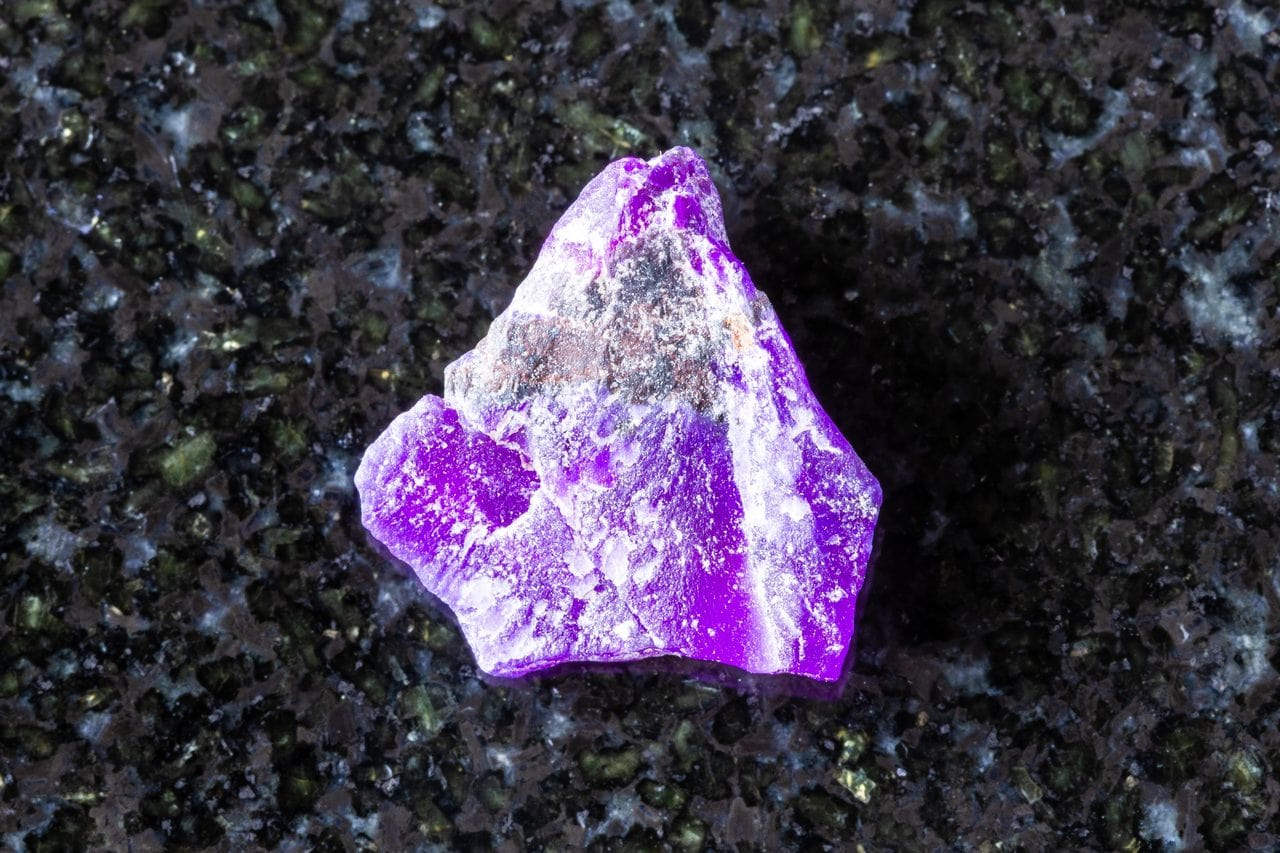
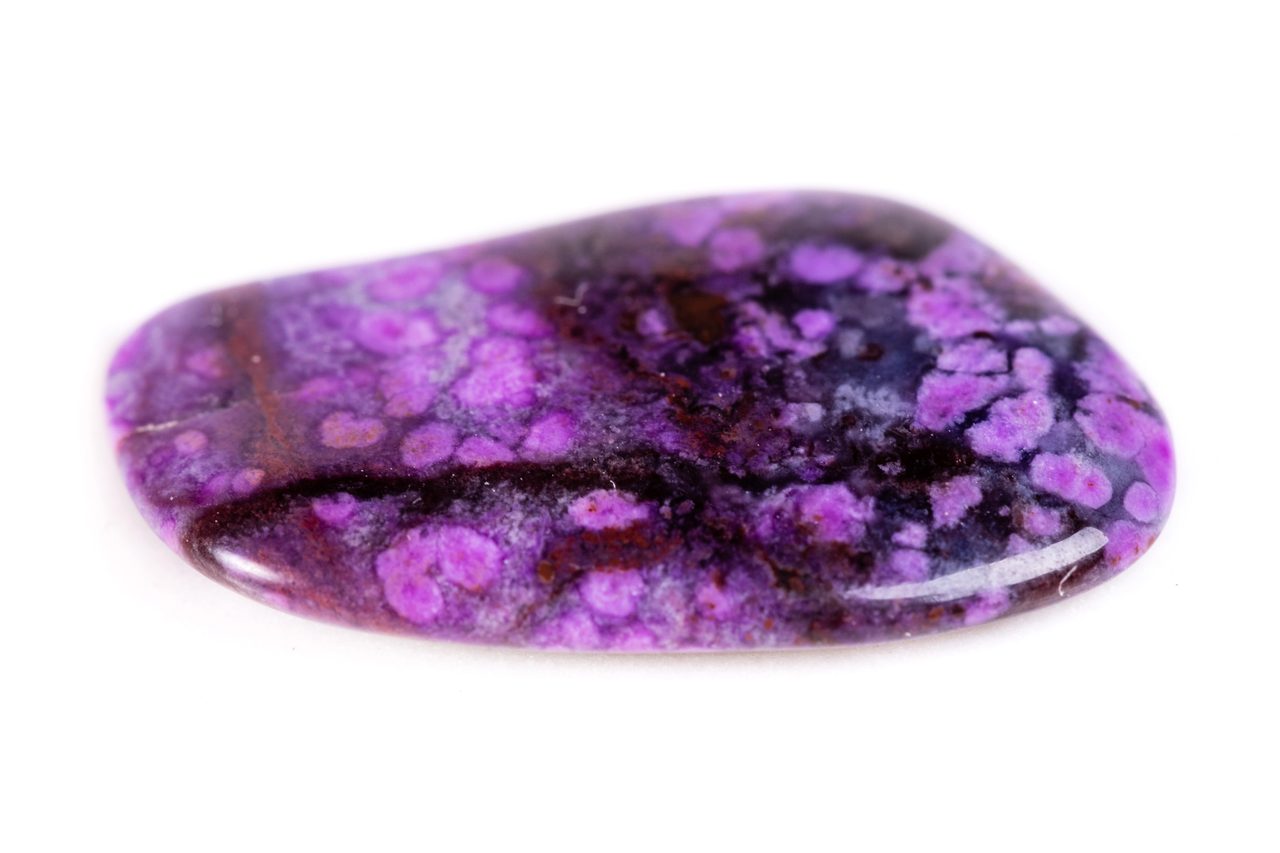
TABLE OF CONTENTS
Properties & Qualities
Physical Properties
Even the smoothest-looking sugilite breaks up into grains under the microscope. Shigley, Koivula and Fryer, writing in Gems & Gemology in 1987, found every sample they examined to be polycrystalline, a mosaic of interlocking grains about a tenth of a millimetre across, each showing its own interference colour in polarised light. They saw tiny black inclusions throughout and, in some pieces, reddish brown veinlets up to 2 millimetres wide. They also separated two materials sold under the one name. The first is manganese-bearing sugilite with minor impurity minerals. The second is chalcedony mixed with sugilite and coloured by it, lighter and less saturated, which they say should be described as a rock made of both.
At Wessels the sugilite lies in layers and seams within skarn zones of the layered manganese ore, up to 15 centimetres thick and up to 15 metres long. Black braunite, aegirine (listed as acmite), andradite, wollastonite, pectolite, vesuvianite, quartz and barite grow with it. GIA estimated 12 to 15 tons of sugilite of varying quality at the mine, while the 1979 deposit comes to 10 to 20 tons in the International Gem Society's estimate. Gem-A reported in 2019 that the known reserves at Wessels are exhausted. In Japan the Handbook places sugilite in an aegirine-bearing syenite stock inside biotite granite, where Murakami's team found it made up 3 to 8 percent of the rock.
Manganese oxide accounts for about 1 to 3 percent by weight of the purple material, GIA found. In 1994 Emmanuel Fritsch and James Shigley, in Mineralogical Magazine, attributed both the purple and the rarer pink to trivalent manganese, with the pink richer in aluminium and poorer in iron, and judged that iron adds little to the colour. The 1987 paper had credited manganese and iron together. Pink, aluminium-rich material from the Cerchiara mine in Liguria, Italy, was long counted as a form of sugilite, and in 2020 Nagashima and colleagues described it as a species of its own, aluminosugilite.
The Handbook gives refractive indices from 1.590 to 1.611 and weak pleochroism. GIA read a spot index near 1.607 on the gem material, found it inert under long-wave and short-wave ultraviolet light, and recorded a strong absorption band at about 419 nanometres that deepens with the colour. Toughness is good to excellent and cleavage poor. GIA found the colour stable after heating to 100 °C and after several hours of direct sunlight, and knew of no treatment used on sugilite. Writing later, the International Gem Society lists heating to lighten very dark material as a rare enhancement. The translucent kind, called gel sugilite, makes up about 0.1 percent of the deposit by the same source's estimate.
Metaphysical properties
In crystal practice sugilite is a love stone, and the love meant is a wide, spiritual kind. Practitioners give it to people who feel too much in a loud world, the sensitive and the easily overwhelmed, and say it gives them a quiet protection so they can stay kind without being worn down. Crystal writers assign it to the crown chakra and the third eye because of its purple, and some say it brings the whole chakra line into alignment. Our guide to crystals for empaths covers that wider practice.
These readings are younger than the gem itself. The mineral was unknown before 1944 and had no gem form until the South African find, so claims of ancient or Egyptian use have nothing behind them. The healing readings arrived with the crystal books of the 1980s. Later writers credit Katrina Raphaell's Crystal Trilogy, which began with Crystal Enlightenment in 1985, with first setting out sugilite as a love stone. The International Gem Society suggests that one trade name, Cybelene, may allude to the myth of Cybele, Attis and the violet. The name is modern, and no source ties the stone itself to the myth.
Meaning & Symbolism
Physical meaning
Sugilite grew where hot fluids worked through layers of manganese ore and changed what they touched, so practitioners read it as a stone that takes something dark and heavy and turns part of it purple. The gem material is a crowd of grains, each about a tenth of a millimetre, locked together so tightly that the stone feels whole and tough in the hand. Practice sees a community in that, many small lives holding each other up.
Black braunite often runs through the purple. Owners take the dark flecks as the hard parts of life, still there but held inside the purple.
The first sugilite, on a Japanese island, was pale and plain, and the vivid purple turned up decades later on another continent. Those who know the story pass it to anyone who feels overlooked, as a sign that the same nature can look ordinary in one place and remarkable in another.
Its colour holds in light and warmth, GIA found, and practice reads steadiness into that.
Spiritual meaning
Spiritually, sugilite belongs to the purple ray, a term crystal writers use for the colour of devotion and higher awareness. Practitioners give it to people who sense they are here for a purpose they cannot yet name, and use it while asking what that purpose might be.
It is also a stone for the feeling of not fitting in. Sensitive people who feel out of step with those around them carry it as a reminder that their way of feeling has a place, and some say it helps them find others who feel the same.
The love in its spiritual reading reaches outward. Practice offers it to people learning to forgive, and to anyone trying to treat themselves with the patience they give others. Our article on the best crystal for love sets this kind of love beside the romantic stones.
Gel sugilite, the rare translucent kind, glows a deep grape colour when held to light. Practitioners keep a piece for prayer and use its glow as a focus in the evening, when the house is quiet.
Healing Benefits
Physical healing
Sugilite heals nothing in the medical sense, and no trial has tested the uses that follow. They come from crystal writers and belong next to proper care.
Practitioners rest a cabochon against the temples when a long day leaves the head heavy and tight, breathing slowly. Some hold a tumble at the back of the neck while stretching the shoulders, and others keep one in the hand during a warm bath after physical work. They say it helps the body let go of the day's tension.
A headache that keeps returning deserves a visit to your GP.
Sugilite is not a substitute for medical care. If something in your body worries you, see a doctor.
Emotional healing
Practitioners reach for sugilite first when a person is overwhelmed. After a crowded, noisy day that person sits with a piece in both hands and keeps the first ten minutes of the evening quiet, and the stone, practitioners say, helps them set down feelings that belonged to other people.
Grief is another use. A person missing someone they have lost holds sugilite while saying the name aloud, and practice presents the stone as company for a sorrow that does not need fixing. Our guide to crystals for grief gathers other stones used this way.
Practitioners also give it for hostility, the sharp feelings that rise in an argument, and suggest holding it before replying to a message that stung. Forgiveness belongs here too, offered to others and to oneself.
For anxious moments, a sugilite bead in a pocket gives the fingers something smooth to turn during a hard conversation.
Spiritual healing
A violet light meditation is the main spiritual use. The practitioner lies down with sugilite just above the head, pictures a soft violet light gathering there, and lets it move slowly down through the body until it reaches the feet. Our list of the seven chakra stones shows where the crown sits in the wider system.
A second practice uses gel sugilite. The piece is held up to a lamp, and the practitioner watches its glow while repeating one word of intention, such as patience or kindness, until the mind settles.
Some write the name of a person they find hard to love on a slip of paper, set a piece of sugilite on it, and sit with the stone for a few minutes each evening for a week, asking only for a softer heart.
Others bring sugilite to a group meditation and pass it round the circle at the close, so each person holds it once before going home.
Use & Care
How to use
- Cabochon in a ring: With a Mohs hardness of 5.5 to 6.5 sugilite wears well, though the International Gem Society still advises a protective setting for rings; the scale itself is covered in our Mohs hardness explainer.
- Bead bracelet: A strand on the wrist keeps it close through a busy working day.
- Beside the bath: Set a tumble on the edge of the tub during a slow evening soak.
- At the top of the head: Lay a piece just above your head during a short lie-down.
- Before a crowded event: Slip one into a bag before a concert, a wedding or a party.
- Desk companion: Keep a polished piece by the keyboard on long screen days.
- A carved figure: Sugilite is often carved into decorative objects, the International Gem Society says, and a small carving makes a quiet shelf piece.
- Before a hard letter: Spend a minute holding it before writing to someone you have fallen out with.
- A gift for a carer: A friend who looks after a parent or a sick child might welcome one.
- Heart pendant: Choose a chain long enough for the stone to rest over the breastbone.
- With keepsakes: Keep a piece with the photos or letters of someone you miss.
How to cleanse
- Warm, soapy water: Warm water with a little mild detergent and a soft brush is the International Gem Society's advice.
- No special care needed: The International Gem Society adds that sugilite can go through mechanical cleaning systems, though beaded strands are better kept out of them for the sake of the thread.
- Dry it straight away: Pat it dry with a soft cloth and buff lightly.
- Singing bowl: Ring a bowl beside it, a method our guide to cleansing with words and sound explains.
- Rosemary smoke: Pass it through the smoke of a dried rosemary sprig.
- Bowl of dry rice: Leave it buried in dry brown rice until morning.
- A whispered blessing: Hold it in cupped hands and say a short blessing.
- Rainwater rinse: Rainwater collected in a clean bowl makes a gentle rinse.
- An open window: Leave it on a sill with the window open for an afternoon.
- Waxing moon: Set it outside on a night when the moon is growing.
How to charge
- Sunlight is fine: GIA found sugilite's colour unchanged after hours in direct sun, so a bright sill does it no harm. Our piece on charging through a window covers whether the glass matters.
- Full moon: Leave it out under a full moon and bring it in at dawn.
- Amethyst bed: Rest it on an amethyst cluster overnight.
- Purple candle: Sit with it by the light of a purple candle for ten minutes.
- Words of kindness: Tell the stone, out loud, what you love about someone close to you.
- Garden soil: A night in a pot of garden soil works too; rinse it the next morning.
- Favourite music: Play a song you love with the stone beside the speaker.
- Held at the heart: Press it to the centre of your chest for a minute.
- Violets in bloom: Set it beside a pot of violets, a nod to the Cybelene name.
- Selenite plate: A slab of selenite makes a good overnight resting place.
Combining with other stones
- Charoite (Siberian purple): The other great purple silicate, from Russia's Murun massif, which practice pairs with sugilite at the crown for times of change. See Charoite.
- Amethyst (purple quartz): Purple amethyst joins sugilite in meditation for a calmer, quieter mind, and our list of stones that go well with amethyst adds others.
- Lepidolite (lilac mica): Lilac lepidolite sits with sugilite on the nightstand for settled evenings.
- Kunzite: Pale pink kunzite is the partner for a gentle, open heart.
- Rose quartz (for self-kindness): Practice puts soft pink rose quartz beside sugilite when working on self-kindness.
- Black tourmaline (grounding base): Grounding black tourmaline adds a steady base to sugilite's protection, and our guide to wearing several crystals at once covers carrying the two together.
- Andradite: A garnet that GIA lists among the minerals growing with sugilite at Wessels; andradite brings warmth and courage to the pair.
- Vesuvianite: Another Wessels companion in GIA's list, and green vesuvianite is used with sugilite for patience.
- Malachite (green inlay partner): Jewellers set sugilite beside green malachite in inlay work, and practice pairs the two for heart and crown together.
Identification
Can be mistaken for
- Charoite: Purple and swirling, from Siberia. GIA separates it by its refractive index of about 1.55, well below sugilite's 1.607, and by its interlocking fibrous texture. See Charoite.
- Lavender jadeite: Natural or dyed purple jadeite gives a spot reading of about 1.66, GIA notes; the library's jade page covers the stone.
- Dumortierite (violet-blue): Violet to blue dumortierite reads 1.678 to 1.689 on the refractometer in GIA's comparison, far above sugilite.
- Amethyst and chalcedony: Both are quartz, and GIA puts their indices far below 1.607. Sugilite mixed with chalcedony is sold as well, and it can show a second reading near 1.544 beside the sugilite one.
- Sogdianite: A rarer purple mineral that can look the same. It holds titanium and zirconium, which sugilite lacks, so the International Gem Society says only chemical analysis tells them apart; the first Wessels material was sold under this name.
- Purpurite (the phosphate): This phosphate is reddish purple and denser than sugilite, the International Gem Society notes; the Handbook of Mineralogy gives 3.2 to 3.4, against sugilite's 2.74 to 2.80.
- Dyed serpentine: In 2019 GIA's Carlsbad laboratory examined reddish purple beads with a fibrous structure that resembled sugilite, and infrared spectroscopy and chemical analysis identified serpentine. Chen and colleagues described a similar imitation in 2023, dyed Lantian jade made of serpentine with calcite.
- Dyed marble and quartzite: Gems & Gemology reported dyed quartzite in 1998 and dyed marble pendants and bangles from the Chinese market in 2014, and the International Gem Society adds dyed magnesite and dyed, heated beryl.
How to spot a fake
- Grains, not fibres: Under a loupe, GIA found genuine sugilite made of tiny interlocking grains, while the 2019 serpentine imitation showed fibres.
- "Synthetic" means imitation: Stones sold online as "synthetic sugilite" are probably imitations that were never grown in a laboratory, the International Gem Society warns.
- Untreated is normal: GIA found no dye in any of its samples, so a piece described as enhanced deserves a question.
- Dark flecks fit: Black braunite and other manganese minerals belong in rock from the Kalahari manganese field.
- Ask where it was mined: In 1987 GIA knew of commercial gem quantities from Wessels alone, so ask the seller to name South Africa or explain another source.
- A UV torch: Gem sugilite stayed dark under long-wave and short-wave ultraviolet in GIA's tests, and a weak orange glow under short wave pointed to chalcedony mixed in.
- Size and price: Stones over ten carats are common and carry no extra value per carat, the International Gem Society says, and colour decides the grade, with the deepest purple at the top.
- A lab for costly pieces: GIA needed infrared spectroscopy and laser chemical analysis to identify the 2019 serpentine beads, so an expensive piece is worth sending to a gem laboratory.
- See it in daylight: Colour is the main test of quality, and our comparison of buying in person and online lists what to check when you cannot hold the stone first.
Sources: Handbook of Mineralogy, Sugilite; International Gem Society, Sugilite value, price and jewelry information; Shigley, J.E., Koivula, J.I. and Fryer, C.W. (1987), The occurrence and gemological properties of Wessels mine sugilite, Gems & Gemology 23 (2), 78-89; Murakami, N., Kato, T., Miúra, Y. and Hirowatari, F. (1976), Sugilite, a new silicate mineral from Iwagi Islet, Southwest Japan, Mineralogical Journal 8 (2), 110-121; Dunn, P.J., Brummer, J.J. and Belsky, H. (1980), Sugilite, a second occurrence: Wessels mine, Kalahari manganese field, Republic of South Africa, Canadian Mineralogist 18, 37-39; Fritsch, E. and Shigley, J.E. (1994), Causes of the purple and pink colours of manganoan sugilites from the Wessels mine, South Africa, Mineralogical Magazine 58, 681-685; Nagashima, M. et al. (2020), Aluminosugilite, KNa2Al2Li3Si12O30, an Al analogue of sugilite, from the Cerchiara mine, Liguria, Italy, European Journal of Mineralogy 32, 57-66; Hibou, J., Understanding sugilite, Gem-A (2019); Rizzo, J. (2019), Dyed serpentine imitating sugilite, Gems & Gemology 55 (2); Yin, K. and Du, S. (2014), Dyed marble as a purple sugilite imitation, Gems & Gemology 50 (4); Gems & Gemology Lab Notes, Summer 1998: Quartzite dyed to imitate sugilite; Chen, Y. et al. (2023), Gemmological characteristic of sugilite imitation, Journal of Gems & Gemmology 25 (3), 68-73; Geology.com, Sugilite; Raphaell, K. (1985), Crystal Enlightenment, Aurora Press (cited from later summaries); Handbook of Mineralogy page for purpurite.