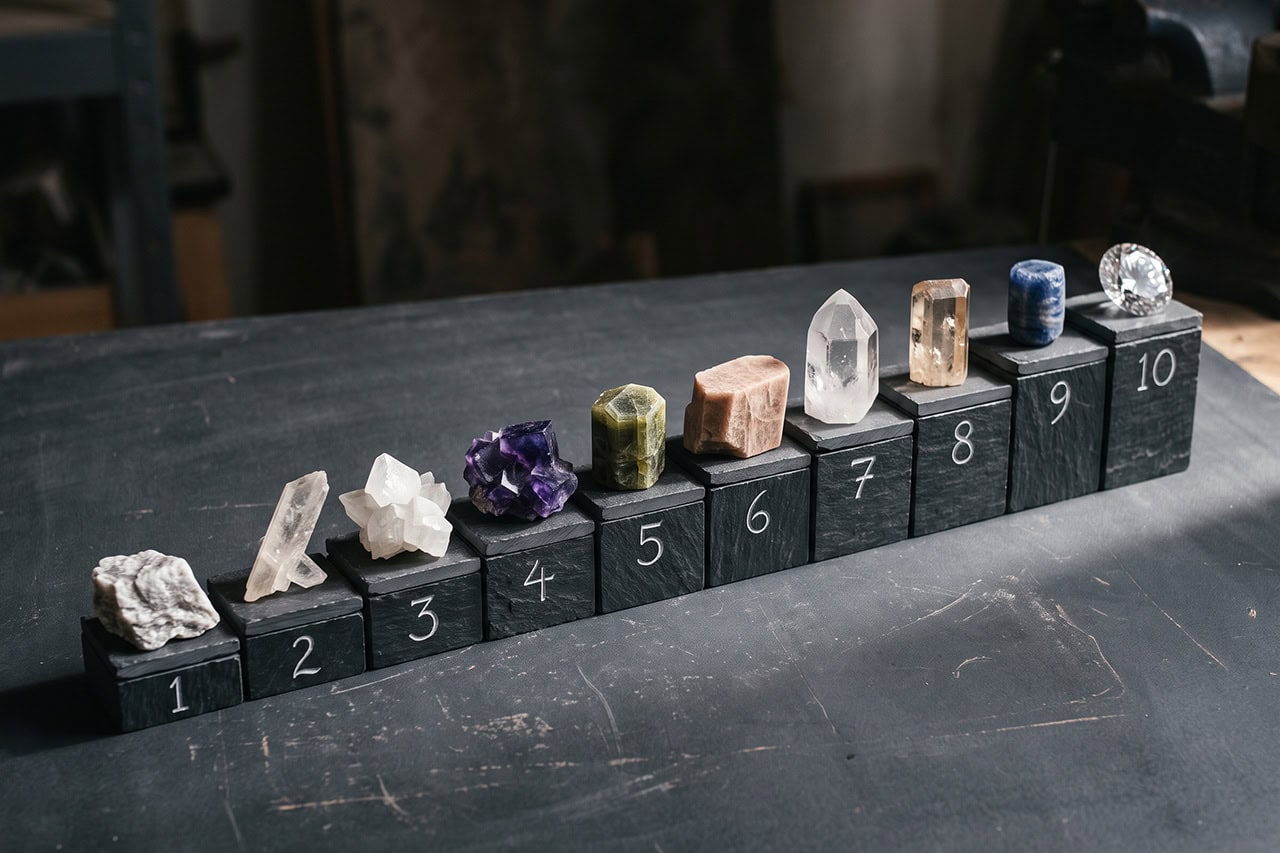
The Mohs scale ranks minerals from 1 to 10 by scratch resistance, talc at 1 and diamond at 10. Each one marks everything below it. You place a mineral on it by comparing it against objects of known hardness, scratching one with the other.
Kyanite has an older name, and the older name is a warning. It was once commonly called disthene, which means two strengths, and the Handbook of Mineralogy still gives its hardness as two figures. Hobart King, writing for Geology.com, puts the pair into ordinary terms: about 4.5 to 5 tested along the length of a crystal, and 6.5 to 7 tested across the short dimension of one.
The two sources do not even agree on the figures. The Handbook prints 5.5 and 7 against King’s 4.5 to 5 and 6.5 to 7. What they agree on is that there are two, and that a scratch running down a kyanite blade is answering a different question from a scratch running across it.
The scale is a test before it is a number.
How the scratch test is run
The Mineralogical Society of America sets the procedure out in its mineral identification key. You scratch the surface of a crystal or a cleavage face with something of known hardness, and then, in the society’s own words, you do it “vice versa, scratching the item of known hardness with a sharp point, edge, or grain of the mineral being tested”. Whenever possible, it says, the test should be run both ways. The society’s own one-line description of the method is looser. Relative hardness is used in identification by comparing the hardness of the mineral to that of items with known hardness.
A second step is where the test usually goes wrong. A softer material dragged across a harder one leaves a trail of its own powder behind, and that trail looks exactly like a scratch. You rub the mark with a finger. If it wipes away it was never a scratch, and the society gives the rule for that case directly: if the item leaves a streak on the sample, the item is softer than the sample. Your knife was shedding steel onto the stone, and the stone is the harder of the two. The rule flips when the test runs the other way. A mineral that leaves a powder streak on the thing being scratched is probably the softer one. With some samples, the society adds, it may take several tries before anyone can safely conclude a sample’s hardness.
The known-hardness objects are ordinary and their values are approximate. The society gives a fingernail at two and a half, a copper penny at three, a pocket knife at five and above, window glass at five and a half, and a steel file at six and a half. Nothing in that set produces a figure on its own. What it produces is a bracket. The knife marks the stone and the penny does not, so the stone sits somewhere between three and a little above five, and adding more objects narrows the interval. Push the method at something soft and the bracket closes from the other side. If a fingernail marks it you are already under two and a half, and there is not much room left down there.
Both directions of the test are specified in terms of a surface: a crystal face or a cleavage face on the sample, and a sharp point, edge or grain of the mineral being tested for the reverse.
A crystal with a grain in it
Kyanite is triclinic, and it is built along one axis. The Handbook records the crystals as bladed and tabular, elongated, reaching half a metre, and typically bent or twisted. Cleavage is perfect on the flat face of the blade and good on the next face round, with parting on a third plane besides, so the crystal arrives with its preferred surfaces already chosen. Fracture is splintery, a mineralogist’s word for a break that comes away in slivers. Every one of those fields describes the same thing from a different angle. The crystal has a grain, the way a plank does, and disthene was a good name for it.
Kyanite is the extreme case and not the only one. The Handbook gives quartz, the mineral that defines 7, a hardness field reading “variable by direction and form”. The fixed point of the upper middle of the scale is not a fixed quantity.
Form does as much work as direction. A gypsum desert rose bought years ago out of a friend’s collection, a rosette of intergrown blades about the width of a dinner plate, takes a fingernail mark with no effort at all. The test was fair because of the surface it ran on. Each blade in the rosette grew to that shape and was never worked afterwards, and this one carries enough of them that a mark on one costs nothing.
What Mohs was building
Friedrich Mohs was born in 1773. Archduke Johann of Habsburg founded the Johanneum in Graz in 1811 and invited Mohs to curate its mineral collection, and it is out of those Graz years that the scale comes. The scale was never meant to stand on its own. It was one character inside a whole system of classification, and the argument for that system was already in print: by 1804 Mohs had published a three-part work whose title announced a mineral system founded on external characteristics alone. His Versuch einer Elementar-Methode zur naturhistorischen Bestimmung und Erkennung der Fossilien followed in 1812, and the hardness scale belongs to the classification that book introduced.
Mohs and Abraham Werner were both working from Linnaeus’s method of botanical classification, which sorted by external characters. What Mohs held against Werner was that his approach leaned too heavily on the internal characteristics of minerals, and that is Mohs’s charge and not a neutral description of the man he was arguing with. In 1817 he succeeded Werner in the Freiberg chair, and Vienna followed in 1826. The Science History Institute records the scale as having been used widely well into the twentieth century.
Hardness is one of three
GIA’s definition of durability separates three things. Durability is a gemstone’s ability to resist scratching, which is hardness, breaking, which is toughness, and effects caused by heat, light or chemicals, which is stability. Three separate properties, and the scale measures one of them. The practical consequences of that are worked through in how to use raw crystals.
Then there is the cost of the test itself. It marks the specimen, and the two-way version marks it twice, once on the stone and once on your knife. Run on a surface that was cut and polished after the mineral finished growing, the test is destructive and what it reads is the lapidary’s work. Looking the species up costs nothing. There is still a case for running it on a specimen that grew a face of its own, and where a range is an acceptable answer.
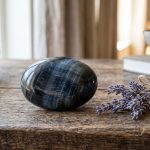
Individual species have their own entries in the Crystalance Mineral Library. A scratch test at home asks for a crystal face, and a polished stone does not have one to give.
Sources
- Handbook of Mineralogy, kyanite, for the hardness field carrying two figures, 5.5 and 7, each tied to a crystallographic direction, for the triclinic system, for crystals bladed and tabular and elongated to 0.5 m and typically bent or twisted, for perfect cleavage on {100} and good cleavage on {010}, and for splintery fracture.
- King, H.M., Kyanite, Geology.com, for a Mohs hardness of about 4.5 to 5 tested parallel to the length of a crystal and 6.5 to 7 tested across the short dimension, and for the mineral once being commonly called disthene, which means two strengths.
- Handbook of Mineralogy, quartz, for the hardness field reading “Hardness = 7, variable by direction and form”.
- Mineralogical Society of America, Collector’s Corner, mineral identification key, hardness, for testing by scratching the surface of a crystal or cleavage face with an item of known hardness “and vice versa, scratching the item of known hardness with a sharp point, edge, or grain of the mineral being tested”, for the instruction that the test should be done both ways whenever possible, for rubbing the mark with a finger to tell a scratch from a powder streak that rubs off, for “if a mineral produces a powder streak on the item being scratched then it is probably softer than that item” and for the converse, “if the item leaves a streak on the sample it is softer than the sample”, for “with some samples, it may take several tries before one can safely conclude the sample’s hardness”, and for the approximate values of a fingernail at 2.5, a copper penny at 3, a pocket knife at 5 and above, window glass at 5.5 and a steel file at 6.5. The link is http only.
- Science History Institute, Friedrich Mohs, for his birth in 1773, for the three-part work published by 1804 whose title announced a mineral system based entirely on external characteristics, for Archduke Johann founding the Johanneum in Graz in 1811 and inviting Mohs to curate the mineral collection, for the 1812 Versuch einer Elementar-Methode zur naturhistorischen Bestimmung und Erkennung der Fossilien introducing the classification the scale belongs to, for both Mohs and Werner being inspired by Linnaeus’s method of botanical classification based on external characteristics, for Mohs thinking Werner’s approach overly dependent on the internal characteristics of minerals, and for the scale being used widely well into the 20th century.
- Ashworth, W.B. (2016), Friedrich Mohs, Scientist of the Day, Linda Hall Library, for the hardness scale being worked out while Mohs was at Graz, for his succession to Abraham Werner’s chair at Freiberg in 1817, and for the move to Vienna in 1826. This source dates Mohs’s arrival at the Joanneum to 1812 where the Science History Institute dates the museum’s founding and his invitation to 1811.
- Martin, D.D. (1987), “Gemstone Durability: Design to Display”, Gems & Gemology Summer 1987, 63-77, for durability as the gemstone’s ability to resist scratching (hardness), breaking (toughness), and effects caused by heat, light, or chemicals (stability).