Moonstone
Tectosilicate (feldspar group)
Colorless, white, grey, peach, yellow to brown, green, grey to near black; sheen blue, white or silvery
Vitreous to pearly
6 - 6.5
2.56 - 2.59 (orthoclase moonstone)
Monoclinic (orthoclase moonstone); rainbow moonstone, a labradorite, is triclinic
Sri Lanka, India, Myanmar, Madagascar, Tanzania
Common; colorless stones with a strong blue sheen are scarce, and more so in larger sizes
KAlSi₃O₈ (orthoclase) intergrown with NaAlSi₃O₈ (albite)
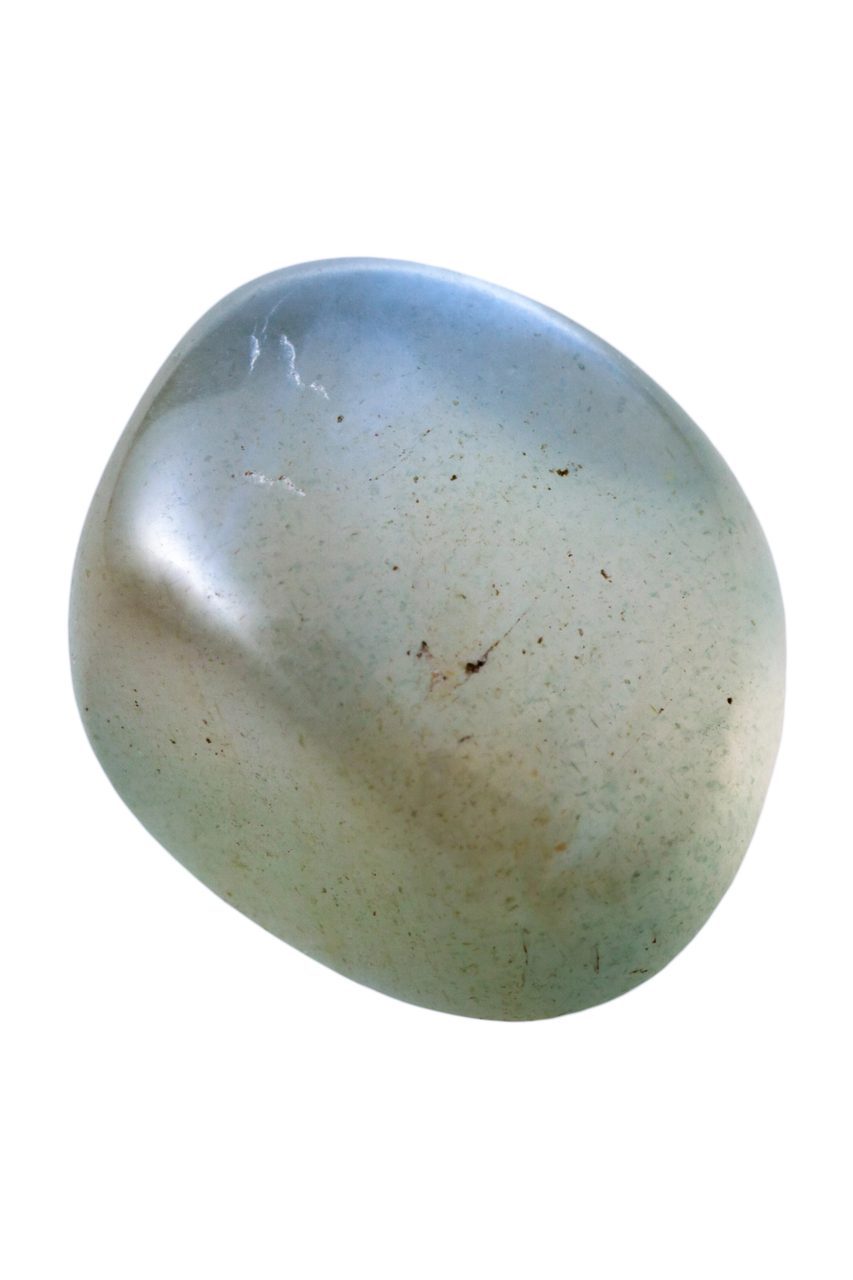
Moonstone is the name of an effect. Tilt a good one under a lamp and a pale light rises inside it, drifts across the dome as the stone turns, and slides away again. Gemmologists call that light adularescence. The stone carrying the name is almost always a feldspar, usually one particular kind, but the word describes the glow.
The Gemological Institute of America describes classic moonstone as a variety of orthoclase in which a second feldspar, albite, separated out into thin stacked layers as the crystal cooled. Light falling between those layers scatters, and the scattered light is the glow. GIA also says that, for a stone to be called moonstone, its actual mineral identity matters less than the beauty of its sheen. Other feldspars can produce the effect, and the trade has sold several of them under the name.
Its old name was adularia, after Mount Adular, the former name of the St Gotthard area of Switzerland and one of the first sources of fine moonstone. That word now names a low-temperature potassium feldspar from Alpine veins, which has its own page in the library under Adularia. At the counter, people say moonstone.
Moonstone is mined today in Sri Lanka, India, Myanmar, Madagascar and Tanzania, among other places. When American retail jewellers adopted their birthstone list in 1912, they printed moonstone beside pearl as June's second stone, and it has kept that place. Florida made it the state gem in 1970 to mark the Moon landings launched from the state, though moonstone does not occur naturally in Florida. Crystal practice ties it to the Moon and its cycles more closely than any other stone, an association that comes from the same drifting light as the name.
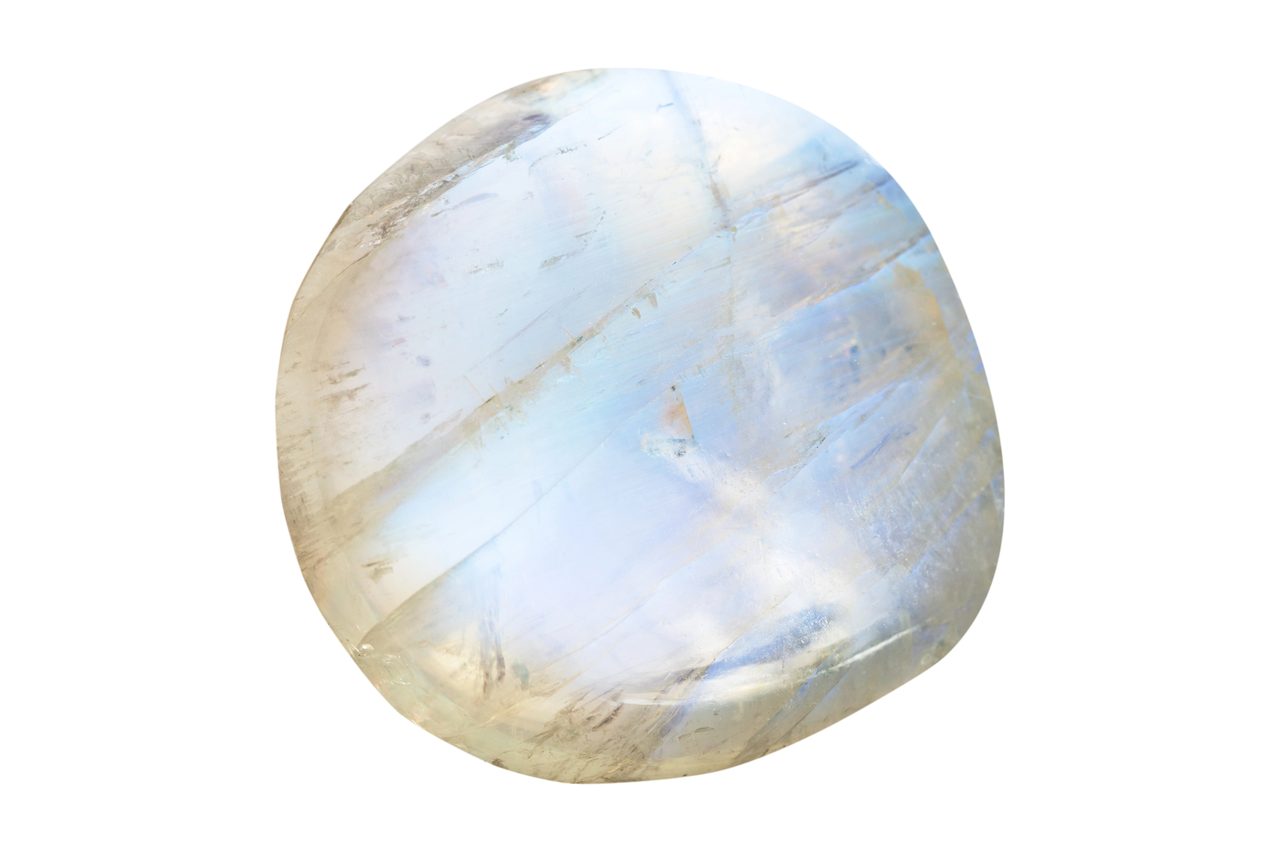
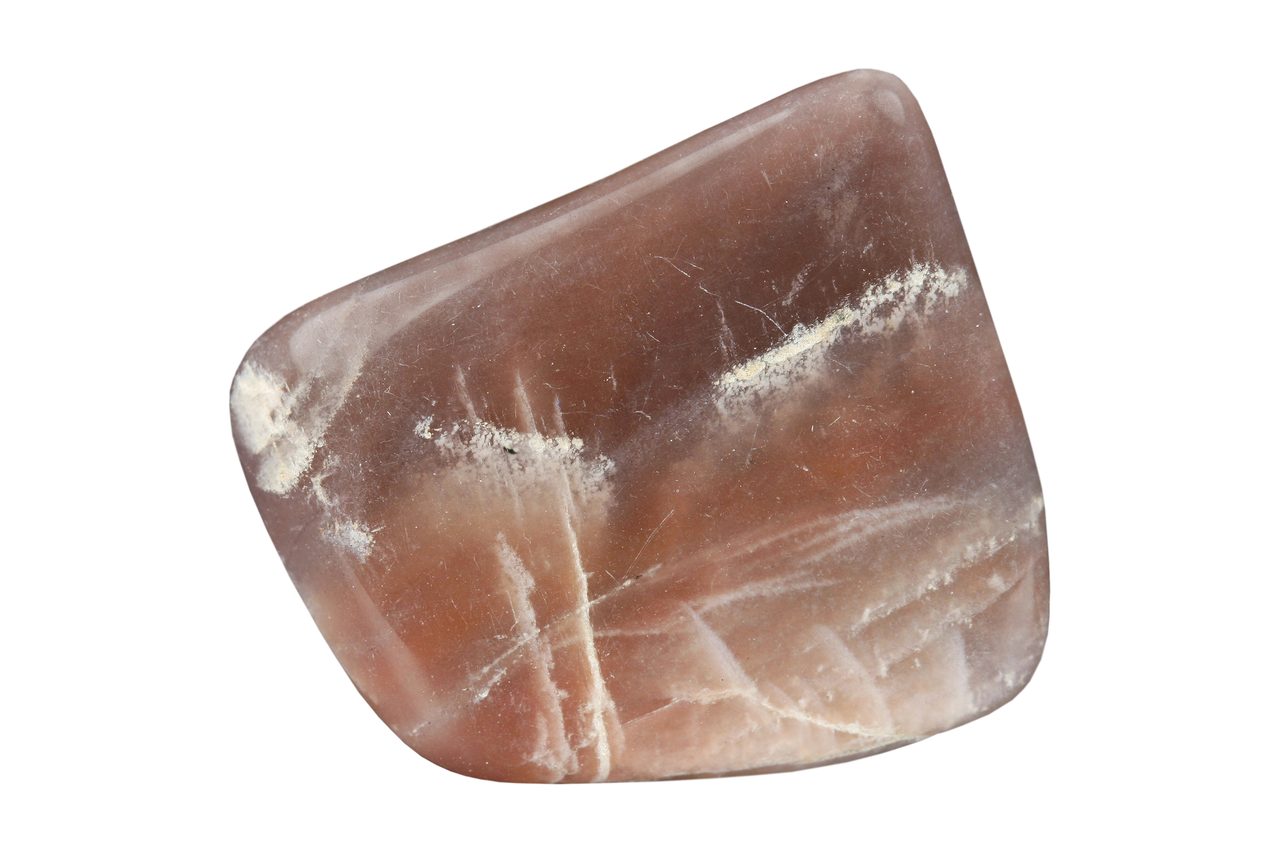
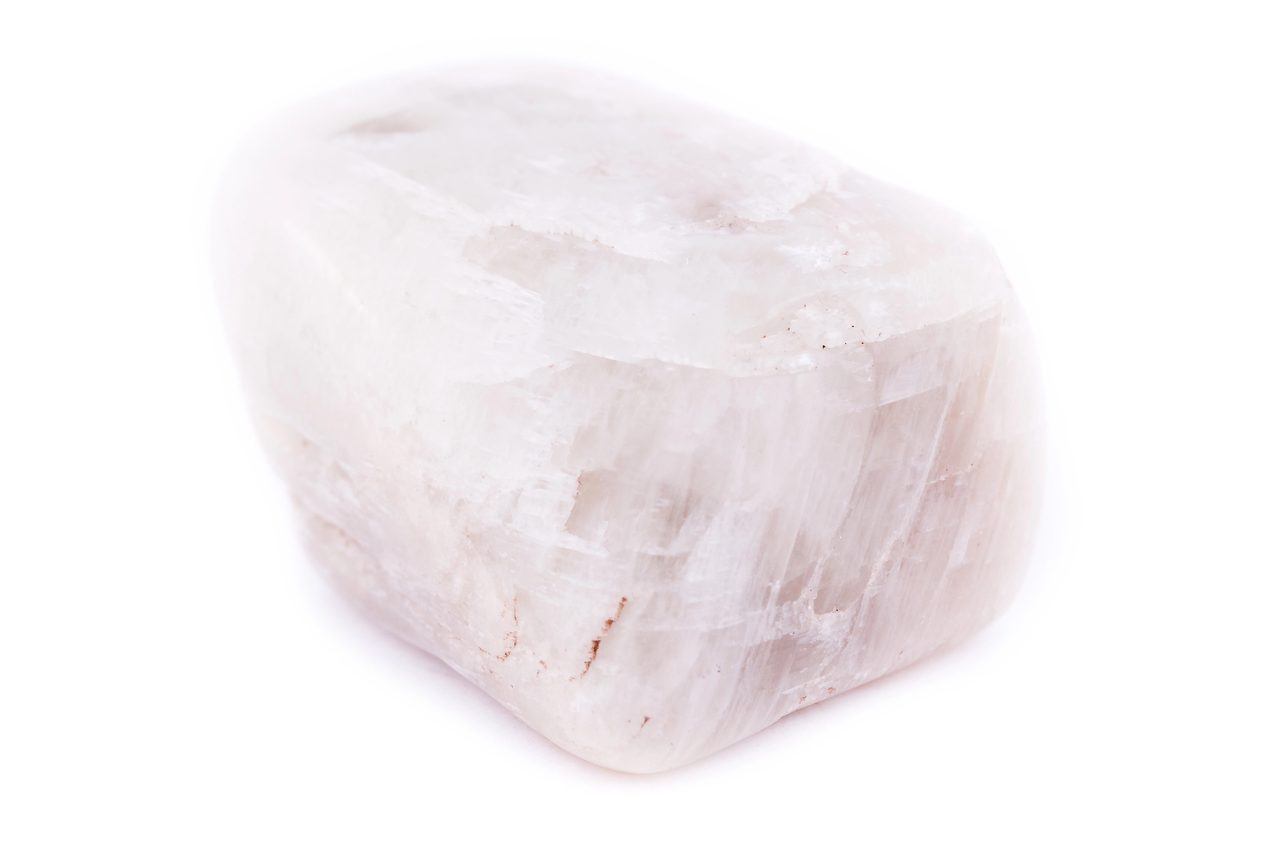
TABLE OF CONTENTS
Properties & Qualities
Physical Properties
What makes the glow. Classic moonstone begins as a single feldspar crystal of mixed potassium and sodium composition. As it cools slowly, the two halves stop fitting together and separate into alternating layers, potassium-rich orthoclase and sodium-rich albite, stacked like the pages of a closed book. GIA notes that these layers are close to the size of a wavelength of light. Thin layers scatter blue light most strongly, which is why the finest stones show a blue sheen, while thicker layers give a whiter, silvery glow. Mineralogists call this kind of intergrowth cryptoperthite.
One name, several minerals. Because the name follows the effect, it has been attached to more than one feldspar. GIA lists sanidine moonstone alongside orthoclase. A long 2025 review in Gems & Gemology takes the strict line and reserves the word for cryptoperthite alone, noting that it has been applied haphazardly to any pale feldspar with a soft sheen, peristerite and transparent labradorite among them. The Smithsonian's mineral sciences catalogue files moonstone as a variety under a feldspar species, so a record reads orthoclase (var. moonstone).
Rainbow moonstone is a labradorite. The white stone with blue, pink and gold colours playing across it, sold in quantity as rainbow moonstone, is labradorite, a plagioclase feldspar, not orthoclase. GIA describes it as labradorite with a light body colour and multicoloured adularescence. It is triclinic rather than monoclinic, slightly denser, and has a higher refractive index, so a gem lab separates the two easily. It is a fine stone in its own right, just a different mineral, and our comparison of moonstone and labradorite goes through the two optical effects side by side.
The colours. The body colour runs from colorless and white through grey, peach, yellow and brown to green and near black. GIA names peach as a popular colour, and records that miners in southern India found a bright green moonstone in 1997. The most valued stones are nearly colorless and close to transparent, with a vivid blue sheen centred on the top of the cabochon and visible from a wide range of angles. Black moonstone, popular in crystal practice, is a separate question, and not every dark stone sold under that name shows a true moonstone sheen.
Cut and inclusions. Moonstone is usually cut as a cabochon, and the dome has to be high enough and oriented correctly to bring the sheen to the centre. A flat stone shows it poorly. Faceted moonstone is increasingly common, along with tapered sugarloaf shapes, rose cuts and carved faces, including the man in the moon. The characteristic inclusions are small tension cracks that gemmologists call centipedes, from their resemblance to a many-legged creature. Some moonstones show a cat's-eye line, and a few show a four-rayed star.
Hardness and durability. Moonstone sits at 6 to 6.5 on the Mohs scale, softer than the quartz it often shares a tray with. GIA rates its toughness as poor. Like all feldspars it cleaves easily in two directions, so a sharp knock can split it along a flat plane rather than simply chip it. It can crack when exposed to high heat, and GIA advises against ultrasonic and steam cleaners. Warm soapy water and a soft brush are enough.
Optical data. The refractive index of orthoclase moonstone is about 1.518 to 1.526, and its specific gravity is about 2.56 to 2.59. Those two figures are what a gemmologist uses to separate it from labradorite, from glass, and from the reheated synthetic spinel that has been used to imitate it, which is markedly denser.
Metaphysical properties
In crystal practice moonstone is the stone of the Moon, and nearly everything practitioners say about it grows from that link: intuition, receptivity, emotional tides, cycles and new beginnings. Some of the lunar story is old. GIA records a Hindu belief that moonstone is made of solidified moonbeams, and another that holding one in the mouth at the full moon could show the future. The detailed list of meanings in use today, from intuition to emotional balance, comes from modern crystal practice and its books.
Practice assigns it to the crown, third eye and sacral chakras, and gives it intuition as its main work, trusting a feeling before you can explain it. It is widely called a feminine stone and linked with lunar goddesses. That reading follows from the Moon association.
Much of the practice runs on a lunar calendar. Today moonstone is commonly cleansed and recharged on the full or new moon. Keeping to that schedule is optional.
The varieties get different shades of the same meaning. White and blue-sheen moonstone carries the classic reading, peach is treated as warmer and more nurturing, and black moonstone goes with the new moon, with rest, and with turning inward.
Meaning & Symbolism
Physical meaning
The glow is real, but you only see it when light arrives from the right direction and meets the stone at the right angle. In a closed drawer, or under flat overhead light, even a fine moonstone looks like a pale pebble. Practitioners read this as a reminder that the body has its own conditions for doing well, and that rest and timing count for as much as effort.
A single crystal, cooled slowly enough, separates into two materials that stay locked together, and the light comes from the boundaries between them. Moonstone is commonly given to people in the middle of a slow change, where something is separating out without breaking apart.
A soft stone also needs looking after: a pouch of its own, away from keys, and a setting where it will not take knocks. That care can become part of the practice, a small daily habit of attention.
Spiritual meaning
Spiritually, moonstone is a stone of reflected light. The Moon has none of its own, and the glow in moonstone is light given back from inside the stone, not a colour in it. Practitioners use that image for intuition, the kind of insight that seems to arrive from nowhere and turns out to have been there already. The same picture makes it a stone of receptivity in practice, used for listening before speaking and for letting an impression settle before acting on it.
From the Moon's phases comes the idea that growth has seasons, that emptiness and fullness both belong to the cycle, and that a quiet phase is not a failure. This is why moonstone is a common choice for beginnings and transitions, a new routine among them.
Dreams and the inner life are the last part of the reading. People keep moonstone by the bed or under the pillow and use it in dream journaling and reflective meditation, where its job is to hold attention on what is already there.
Healing Benefits
Physical healing
Moonstone in crystal healing is a matter of practice and tradition, not medicine, and nothing about the stone's mineralogy acts on the body.
In practice moonstone is linked with sleep, rest and the body's cycles, and is commonly placed on a nightstand or under a pillow. Through the lunar reading it is also given as a keepsake around pregnancy and new motherhood, a symbolic gift rather than a treatment. Moonstone is not a substitute for medical care. If something in your body worries you, see a doctor.
Emotional healing
Practitioners describe moonstone as calming, a stone for difficult feelings that need to be felt more than fixed, and for the ups and downs that come with sleep, season and stress.
It is commonly recommended for people who feel overwhelmed by other people's moods, as a reminder to notice which feelings are their own. It is also given to people returning to their intuition after a period of overriding it, as a small, touchable reminder to listen. Practitioners suggest it, too, for changes at home that stir up feeling faster than it can be put into words, such as a new baby, a child moving out or a partner's long absence.
One caution circulates with moonstone, that it should be put away in emotionally difficult stretches because it amplifies whatever is already there. It is a modern rule of thumb, and it asks people to distrust a comfort they chose. Whether to keep the stone close is a decision for the day.
Spiritual healing
In spiritual healing, moonstone is used to restore trust in inner guidance, especially where that guidance has been ignored for a long time. Practitioners place it on the third eye or crown during meditation, or hold it during quiet reflection at the new or full moon.
It is also tied to what practice calls the divine feminine, the receptive, intuitive and cyclical qualities that practitioners say each person carries. In rituals for a new year, a move or the end of a relationship, moonstone is there to mark the change.
One practice runs across a whole lunar month. At the new moon, write a short intention on a slip of paper and set the moonstone on top of it. Each evening after that, hold the stone for a minute and read the words again. When the full moon comes, look back at what has shifted, and keep the slip until the next new moon before letting it go.
Use & Care
How to use
- Window ritual: Take the stone out once a day and turn it slowly under a window or a single lamp until the sheen appears. It takes a few seconds and shows the stone at its best.
- Pendant: Wear it at chest height, where a soft stone meets very few knocks. Practice treats a pendant as keeping the stone's associations close through the day.
- Pocket stone: Carry a tumbled piece in a small soft pouch of its own, away from keys and harder stones. Our guide to carrying moonstone goes into the formats in detail.
- Bedside stone: Keep a piece on the nightstand or under the pillow for the practice's associations with rest and dreams.
- Dream journal: Keep a moonstone with a dream journal and hold it for a moment before writing each morning.
- Moon-phase practice: Use it to mark the new or full moon with a short intention or reflection, a common rhythm in moonstone practice.
- Meditation: Hold it, or rest it on the forehead or the lower belly, during quiet meditation focused on intuition or emotional balance.
- Ring: Choose a bezel setting over prongs, and keep moonstone rings for days when your hands are not doing much work.
- Peach moonstone: Set it in a bedroom, where practice gives this colour its nurturing role.
- Black moonstone in the evening: Keep a dark piece where you wind down, in line with its new-moon reading of rest.
- Beside the bath: Rest a piece on the dry edge of the bath during an evening soak, out of the water.
How to cleanse
- Moonlight: The classic method for this stone. Leave it on a windowsill or outdoors overnight under the full or new moon.
- Smoke: Pass it through the smoke of incense, sage or palo santo.
- Sound: Use a singing bowl, bell or tuning fork nearby.
- Brief water rinse: A quick rinse under cool water is fine for polished moonstone. Dry it straight away, and skip long soaks for stones with visible cracks or centipede inclusions.
- Breath and intention: Hold it, breathe slowly, and set the intention that whatever it has gathered is released.
- Waning moon: Some practitioners cleanse in the days after the full moon, the phase lunar practice links with release.
- Selenite plate: Lay it on a selenite slab for a few hours, a dry method that suits a soft, easily knocked stone.
- Soapy wash for jewellery: Warm soapy water and a soft brush lift skin oils from a ring or pendant. Pat it dry afterwards.
- Avoid heat: Skip hot water and the ultrasonic or steam cleaners GIA warns against, since moonstone can crack under high heat.
How to charge
- Full moon: Leave it under the full moon overnight, the traditional charge for this stone.
- New moon: Practitioners working with intentions and new beginnings, and especially with black moonstone, prefer the new moon.
- Lunar cycle: Leave it on a windowsill from one new moon to the next for a slow, complete charge.
- Waxing moon: For an intention that should grow, set it out on the nights as the moon fills.
- Cloudy full moon: Practitioners say the full moon still counts behind cloud, so put the stone out anyway.
- After meditation: Keep holding it for a minute once a sitting ends, which some treat as passing that settled attention into the stone.
- Intention: Hold it in both hands and state clearly what you want it to support.
- Clear quartz: Rest it beside a clear quartz point or cluster overnight, which practice treats as amplifying.
- Sunlight: Short morning sun is harmless to the stone, but practice rarely charges moonstone this way, preferring moonlight.
Combining with other stones
- Labradorite: A fellow feldspar with a related glow, and the classic pairing for intuition and protection.
- Rose quartz: Adds warmth and comfort, and suits peach moonstone especially well.
- Amethyst: A steadier partner for meditation and inner work.
- Selenite: A light, clear pairing for a meditation space or a bedside, though too soft to carry with moonstone.
- Aquamarine: Another water-associated stone, paired for calm and honest expression.
- Pearl: Moonstone's companion in the June birthstone line and in lunar symbolism.
- Lepidolite: A bedside partner, paired with moonstone in practice for calm and sleep.
- Smoky quartz: A grounding partner, commonly paired with black moonstone.
- Carnelian and red jasper: Commonly kept apart. Practice treats them as forward-driving stones that pull against moonstone's quiet character, though a deliberate contrast is a valid choice.
Our article on what goes well with moonstone explains how the variety you own changes the pairing.
Identification
Can be mistaken for
- Labradorite: Darker, mostly opaque, and flashes several separate colours as it turns, where moonstone gives a single soft glow. White rainbow moonstone is itself a labradorite.
- Adularia: The Alpine orthoclase that gave moonstone its old name. Some adularia shows the sheen, so the two names overlap. See Adularia.
- Opalite: Man-made opalescent glass, commonly sold beside moonstone. It glows bluish in daylight and honey-coloured with light behind it, but the glow sits evenly through the whole piece rather than floating as a moving sheen. Our opal and opalite comparison covers the glass in detail.
- White chalcedony: Translucent and milky, sometimes with a faint bluish tint, but with no moving sheen. See Chalcedony.
- Milky quartz: Cut as a cabochon it can glow softly, but it is harder and lacks the feldspar's directional sheen.
- Synthetic spinel: Reheated synthetic spinel has been used as an imitation. It is milkier, has no mobile sheen, and is much heavier for its size.
- Selenite and satin spar: Satin spar gypsum shows a silky sheen, but it is very soft and fibrous. See Selenite.
- Peristerite and other pale feldspars: Sold as moonstone under the loose definition, and genuine feldspars, but not the classic orthoclase material.
How to spot a fake
- Tilt it under one light: Real moonstone's sheen moves. It appears at one angle, slides across the stone, and fades as you turn it. A glow that stays the same from any angle points to glass or plastic.
- Use a loupe: Look for the small centipede cracks and natural inclusions of real moonstone. Round gas bubbles point to glass.
- Check behind the light: Opalite turns warm honey or amber when light shines through it from behind. Real moonstone does not change colour this way.
- Feel the weight: Moonstone is about 2.6 times as heavy as the same volume of water. Synthetic spinel is distinctly heavier for its size. Weight will not separate moonstone from glass, which can weigh about the same.
- Look at the edge for a join: GIA has documented an assembled imitation of rainbow moonstone, made from more than one piece joined together. Check the side of the stone for a straight line where two pieces meet.
- Ask what it is: A good seller can tell you whether a stone is orthoclase moonstone or rainbow moonstone (labradorite). Both are real and natural, but they are different minerals at different prices.
- Ask about treatment: GIA's research pages include a study of fracture-filled moonstone. On an expensive stone it is worth asking, and a lab can detect filling.
- Treat a perfect stone at a low price with suspicion: Completely clear moonstone with a strong blue sheen is scarce. A large, flawless, glowing stone at a bargain price is more likely glass. Our guide to what "natural" means when buying crystals covers the wording sellers use.
Sources: GIA, Moonstone Description; GIA, Moonstone Quality Factors; GIA, Moonstone History and Lore; GIA, June Birthstones; Jin, Renfro, Palke and Shigley, "Structures Behind the Spectacle", Gems & Gemology 61:2, 2025; Smithsonian NMNH, Department of Mineral Sciences collection search; The Jewelers' Circular, 14 August 1912; Florida Statutes 15.034, State gem; Gemdat, Spinel (synthetic spinel as a moonstone imitation).